July 26 Daily Issue — Recoverable Automation, Agent Identity, and MCP Policy Boundaries
A July 26 operating briefing on recovery contracts for AI automation, accountable agent identity, and policy boundaries for MCP tools.
DAILY NEWSLETTER · 2026-07-26 · ROLLBACK · AGENT IDENTITY · MCP POLICY
July 26 Daily Issue — Recoverable Automation, Agent Identity, and MCP Policy Boundaries
Once an AI agent changes files, calls APIs, and moves through business systems, the operating question shifts from what it can do to who can account for, stop, and recover its actions. This briefing connects three practical controls: a recovery contract for automation changes, an identity ledger that gives agent access a verifiable end, and an MCP policy boundary that decides tool actions before they run.
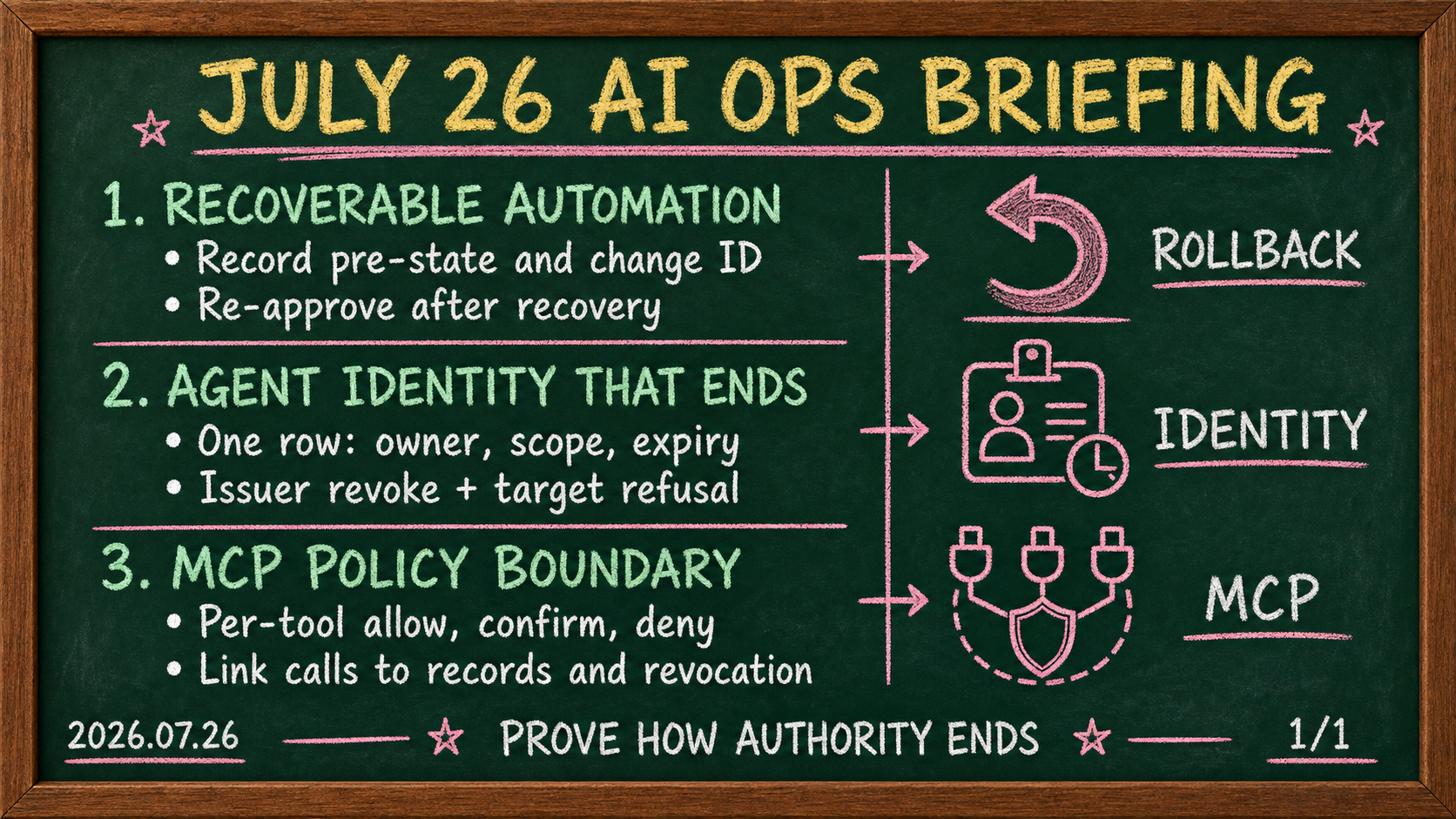
Three points for today
The three topics are one operational gap viewed from different sides. Automation needs a pre-change state and a recovery owner. An agent needs an actual authenticated subject and a revocation path. An MCP tool needs a per-action policy decision and an auditable result. More enabled features do not make a system safer; linked records across those controls do.
- Rollback only works when the pre-state and re-enable approval are part of the change.
- Agent identity is an operational ledger of scope, owner, and revocation evidence—not a display name.
- An MCP connection is delegated authority, so policy must decide whether each action is allowed, confirmed, or denied.
1. Automation is not complete until its change can be recovered
An automation that changes records or starts a deployment is operationally incomplete if it leaves only a “completed” message. CIO’s discussion of AI workload resilience argues that immutable backups, automated lineage tracking, and clean rollback need to work together for recovery to be fast, accurate, and trustworthy. In this context, rollback is not an undo button. It is an evidence trail that can show the pre-change state, the automation and scope that changed it, the recovery performed, and the verification that followed.
 Source · CIOBuilding resilience for AI workloads in the cloudSets out why immutable backups, lineage tracking, and clean rollback belong together in AI workload recovery.
A small team does not need a large ITSM implementation for every change. It does need a compact contract: change_id, owner, target resource, permitted blast radius, pre-state reference, approver, and stop condition before execution; actual changes, recovery procedure, and verification location after it. The same shape covers a bulk CRM update, a document reorganization, a webhook-driven state change, or a ticket created by an MCP tool. Deletion, payment, or external transfer should not rely on later recovery alone; separate such hard-to-reverse actions behind an explicit human confirmation.
The step often missing from a recovery contract is re-enablement. Restoring data and immediately reopening the same automation can repeat the incident before its cause and policy version have been reviewed. Keep proof of recovery and the person who authorizes another run. CIO’s examination of an agent data-deletion incident similarly turns attention from whether a rollback exists to the guardrails and undo strategy required before autonomous systems receive write access.
 Source · CIOYour AI agent deletes critical data: Who is responsible?Raises the need for guardrails and an undo strategy before autonomous agents receive broad write authority.
Run one low-risk drill this week: make a controlled change, stop the automation, recover the pre-state, and require approval before re-enabling. The success condition is not an agent saying it recovered. It is a target system showing the original state, a linked change ID and operator record, and a verified recovery result. This is a practical third option between blindly trusting an agent and disabling automation altogether.
2. Agent identity is a ledger for access that ends
Korea’s launch of the Agentic AI Alliance is a public signal that agentic AI is moving into the language of institutions and industry. The useful operational translation is not an abstract “AI ID card” product. A real business environment has agents, service accounts, OAuth grants, MCP credentials, and browser extensions touching the same data and tools. A name alone does not create accountability if nobody can identify the actual subject or stop it at the end of an incident or task.
 Source · Korea Policy Briefing능동적으로 행동하는 인공지능 시대, '능동형 인공지능 협력체 (에이전틱 AI 얼라이언스)' 출범Provides official Korean policy context for the emerging agentic-AI ecosystem.
Use one row per access path: subject_id, owner, purpose, resource and action scope, credential_ref, runtime, expiry or next review date, revoke_path, and revoke_evidence. The subject ID is the actual principal recognized by an identity provider, cloud, or API—not the friendly bot name. Keep a secret-manager reference rather than a token in the ledger. When service accounts and a person’s OAuth grant are mixed together, recording owner and purpose exposes risky shared identities immediately.
The report that Korea’s Digital Certification Association is beginning work on international standards for AI agent identity management reflects the growing focus on reliability and accountability for non-human actors. Teams do not need to wait for a standard to test one revocation path. Use a low-risk test subject, establish that an allowed request works, cancel or rotate the applicable consent, token, role, or key at the issuer, then verify that the target resource rejects the old request. An issuer console’s green state and a target-side denial are separate evidence.
 Source · The Asia Business DailyKorea Digital Certification Association Begins Development of International Standards for AI Agent Identity ManagementReports identity-management standardization work focused on trust and accountability for non-human AI agents.
Revocation evidence should carry more than a ticket ID: operator, time, issuer-side confirmation, target-side denial, remaining exception, and next review. It is not audit decoration. It lets the next operator quickly decide whether an access path still exists. An automation without an identifiable subject is hard to stop; an identity without a revocation path is operational debt to resolve before connecting it to another system.
3. MCP policy as code translates a connection into allow, confirm, or deny
Adding an MCP server does more than make new information available to a model. It adds a delegated-authorization route through which a client can request a restricted server on behalf of a resource owner. The MCP Authorization specification defines this flow for HTTP-based transports. A connection test is therefore insufficient: an operator needs to separate which client is reaching which server, with which token and scope, for which resource.
 Source · Model Context ProtocolAuthorizationDefines an authorization flow for MCP clients accessing restricted MCP servers in HTTP-based transports.
The smallest useful policy unit is an action decision, not the number of policy rules. Split read, write, execute, external transfer, deletion, and payment. Assign every action one of allow, confirm, or deny. Calendar availability lookup might be allowed; sending an invitation might require confirmation; changing a payment method might be denied. Record the calling subject, tool and version, input reference, destination, policy version, approver, result, and related change ID. Then an allowed action remains explainable after the fact.
NIST describes the AI Risk Management Framework as voluntary guidance to improve incorporation of trustworthiness considerations into the design, development, use, and evaluation of AI products, services, and systems. Applied to MCP, this means a policy file is not the finish line. When a server is added or scope broadens, identify the new risk, measure whether policy decisions match real calls, and manage exceptions. NIST does not prescribe MCP settings, but it supplies a useful frame for treating tool connections as AI-system risks that require ongoing management.
 Source · NISTAI Risk Management FrameworkProvides a voluntary framework for incorporating trustworthiness throughout AI-system design, use, and evaluation.
For a newly connected server, write five lines first: allowed tools, denied tools, irreversible actions requiring confirmation, permitted external destinations, and a stop-and-revoke path. Then try a call expected to be blocked in an isolated environment. The result that matters is not a model explanation; it is a server refusal and a record of the subject and policy decision. That makes MCP a manageable authority boundary rather than a convenient plug-in.
Operator memo
Identifiers connect today’s three topics. Give every automation change a change_id, every agent and credential a subject_id, and every MCP call a tool, policy, and approval record. Once those records join, an operator can answer one question: which agent used which authority to change what, and how was it stopped, revoked, or recovered? Without that join, many logs still leave responders moving between disconnected consoles.
Start narrowly: attach a pre-state and recovery drill to one low-risk automation, fill the actual identity row for that automation, and assign allow/confirm/deny to one connected MCP tool. Test recovery plus re-approval, revocation plus target refusal, and a denied tool action. Running those three small tests before adding more connections is usually faster than cleaning up broad defaults later.
Watch not only for announcements that make agents more autonomous, but for the way that autonomy reaches real business authority. Policy and standards discussions will continue, while the controls a team can make today are already clear: a recoverable-change contract, an identity ledger with a verifiable end, and an action-level MCP policy.
If you start with one action, choose the automation that runs most often. Put its pre-state, execution identity, tool authority, and recovery path into one record, then actually stop, revoke, and recover it. Trust in agent operations comes not from broad authority, but from demonstrating how narrow authority ends and returns safely.
Sources
- Building resilience for AI workloads in the cloud | CIO ↗
- Your AI agent deletes critical data: Who is responsible? | CIO ↗
- Launch of the Agentic AI Alliance | Korea Policy Briefing ↗
- Korea Digital Certification Association Begins Development of International Standards for AI Agent Identity Management | The Asia Business Daily ↗
- Authorization | Model Context Protocol ↗
- AI Risk Management Framework | NIST ↗
Related posts
Read →Related tools