Daily Briefing, August 23 — Payment Approval Boundaries, Shadow Delegation, and AgentCore Payments
Today’s briefing covers the approval boundary needed when AI agents make payments, the shadow delegation that can arise inside MCP tool calls, and the general availability of Amazon Bedrock AgentCore payments. The central task is not merely connecting a payment method to an agent, but redesigning whose authority can execute what and how far.
DAILY NEWSLETTER · 2026-08-23 · PAYMENT APPROVAL · MCP DELEGATION · AGENTCORE
Daily Briefing, August 23 — Payment Approval Boundaries, Shadow Delegation, and AgentCore Payments
When agents move beyond producing answers and begin calling paid APIs, paying for content, and invoking tools held by other agents, the question changes. Before asking whether an agent can pay, ask whose approval authorizes it, within which boundary, and whether that authority extends to the next call. Today connects payment approval boundaries, ways to expose shadow delegation in MCP connections, and the operating questions raised by the general availability of AgentCore payments.
Three things to carry into today
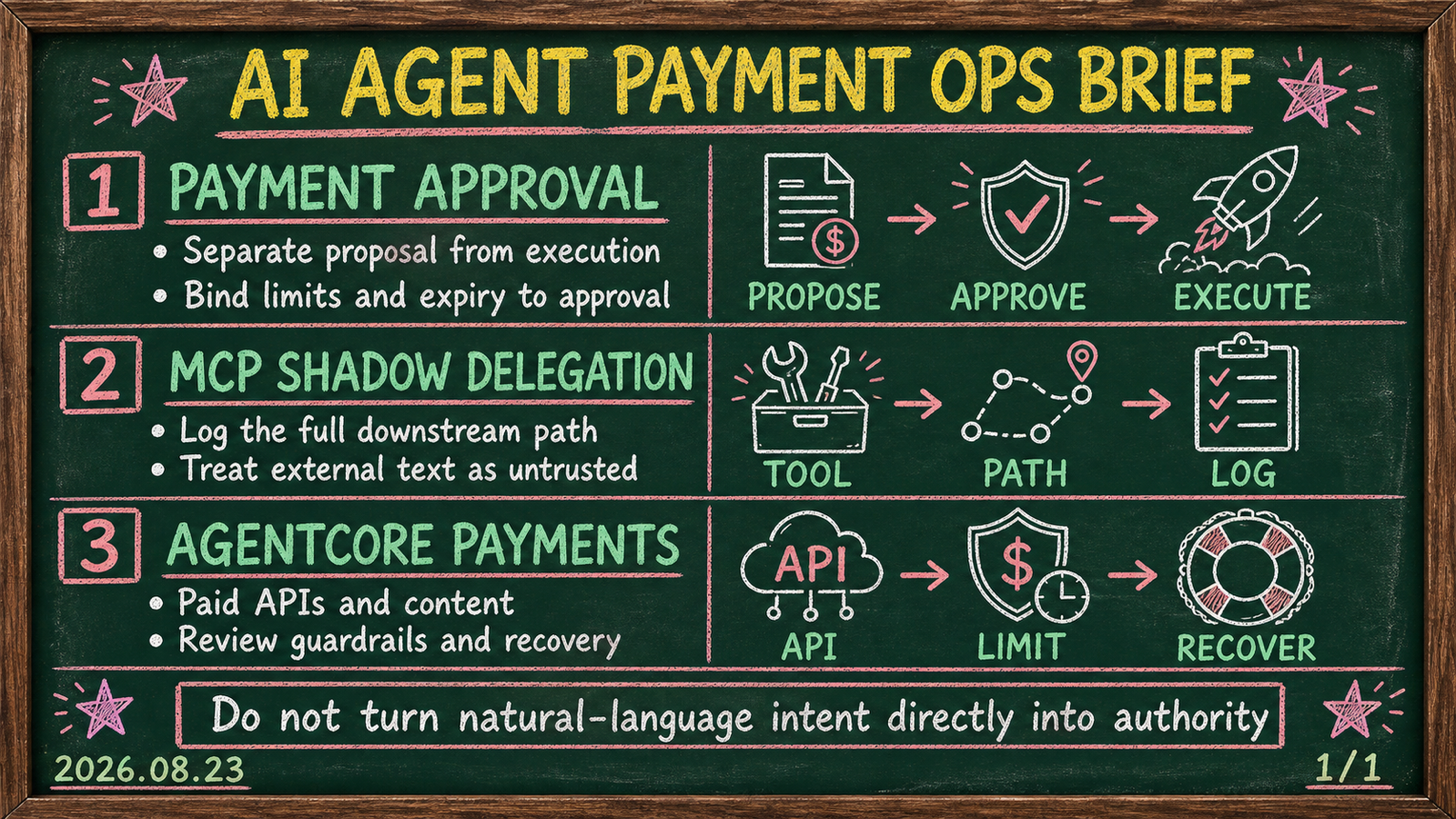
First, payment authority should not be one broad permission assigned to an agent. It should be a flow separated into proposal, approval, execution, and settlement records. Second, an MCP tool call can lead to calls by another service or agent, so looking only at the original request can miss the real authorization path. Third, the general availability of Amazon Bedrock AgentCore payments shows that agent payments are becoming a product-operations and policy-design issue, not merely a demo topic.
All three subjects converge on one operating principle. A user’s intent expressed in natural language is not execution authority by itself. The intent should be structured, the target and cost or result should be checked, an approver should be involved where required, and execution should then use a constrained credential. Skip that flow and a convenient tool connection can become broad delegation; broad delegation can become payments and changes that are difficult to explain later.
1. Payment approval boundaries — separate “can pay” from “may pay for this request”
The first boundary to draw in agent payments is between possessing a payment method and approving a specific expense. The fact that a service account or runtime can perform a payment does not mean a particular user request is suitable for automatic execution. Even when a user says, “Buy this data and finish the report,” the agent should turn the request into a proposal that separates the target, purpose, cost conditions, delivered result, and available limit. A proposal is not an execution record, and approval should not be a casual chat phrase. It should be a policy decision linked to the request that will execute.
AWS documentation says that AgentCore payments supports secure microtransaction payments for AI agents, including payments for paid APIs, MCP servers, and content, as well as stablecoins and x402. It also describes configurable guardrails for controlling spending. The practical point is not the payment feature alone but the control plane. If an agent can explore several paid tools, pricing conditions and actual invocation authority should not be left open as one combined permission. The boundary where policy applies needs to be explicit.
Source · AWSAgentCore payments is now generally available in Amazon Bedrock AgentCore - AWSAWS announced the general availability of AgentCore payments in Amazon Bedrock AgentCore. Source · AWSAmazon Bedrock AgentCore payments: Enable secure microtransaction payments for AI agents - Amazon Bedrock AgentCoreThe official documentation describes paid APIs, MCP-server and content payments, and configurable guardrails for spending control.“Confirm before payment” is not enough language for an approval boundary. The team must decide what appears in the approval view, whether an approved request can later change, how many minutes or hours it remains executable, and whether a retry is allowed under the same approval. At minimum, an approval object should connect the request purpose, provider or tool target, cost conditions, job identifier, requester, approver, and expiry condition. The execution credential should never be broader than that approval object.
The structure applies beyond direct money movement. Paid dataset lookups, content purchases, external analysis API calls, and bookings or order changes performed on behalf of a customer all leave a cost or state change outside the system. Automation should find options and prepare a structured proposal, then prepare execution only within the small range policy permits. It must not turn a user’s vague intent directly into persistent, reusable payment authority.
Operators should avoid seeing limits as a single number alone. A per-job limit, a permitted range for a tool, a budget for a user or team, an execution period, and blocking repeated calls without approval are separate controls. The needed combination depends on the work, but the team should be able to answer later which call failed and which policy permitted a call. Do not treat payment failures only as generic errors. Record whether the stop occurred in policy, approval, tool response, or retry handling.
2. MCP shadow delegation — treat calls following a tool call as part of the authority path
The MCP authorization specification addresses authorization flows among an MCP client, server, and authorization server. That means an MCP connection is not simply a plug-in installation; it is a distinct authorization relationship. The harder operating problem is that the first MCP call may not be the last. A tool can forward a request to another service, call a tool held by another agent, or start external work. Operators and users may see one initial tool name while the execution path that produced the result is longer.
The author of ‘When Agents Call Agents’ frames this as a problem in which ordinary agent tool calls can create shadow delegation. That is the author’s framing, not formal MCP-standard language. It is still useful operationally. If a primary agent calls a “research” tool and that tool can itself choose search, paid-data, or external-execution tools, the team must revisit what the original approval actually approved. A system that only returns a tool result and one that lets the tool independently select further actions cannot be treated as having the same authority.
 Source · Model Context ProtocolAuthorization - Model Context ProtocolThe official MCP specification covers authorization flows among clients, servers, and authorization servers.
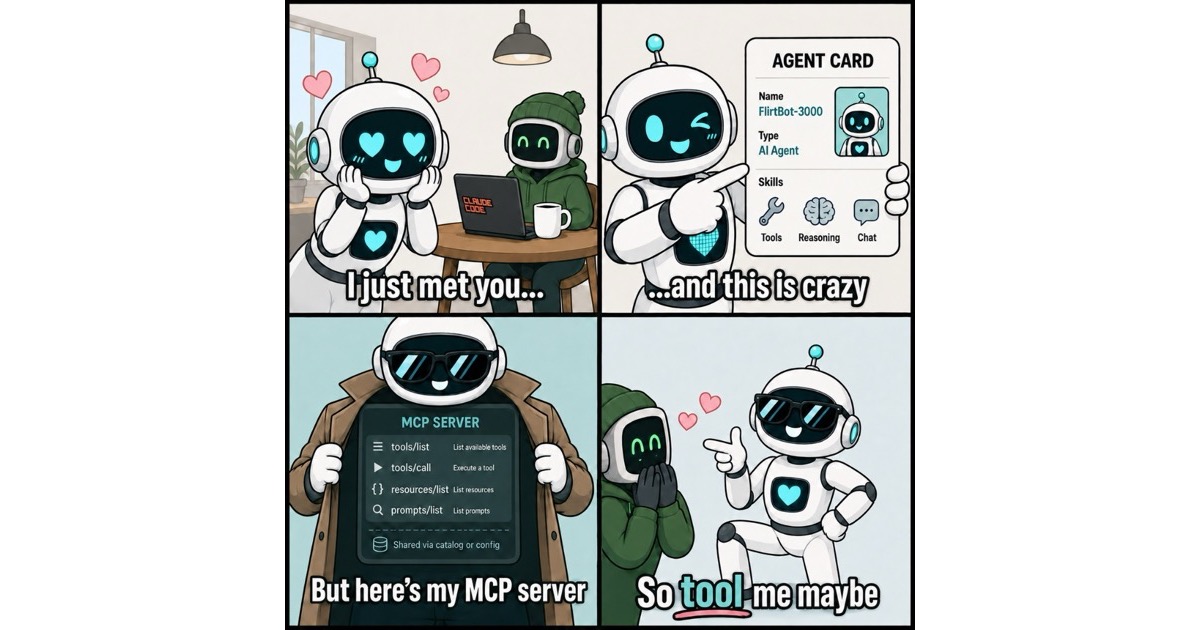 Source · NiyikizaWhen Agents Call AgentsThe author frames ordinary agent tool calls as a setting where shadow delegation can arise.
Tool inventories should therefore record delegation properties alongside names and descriptions. Can this tool initiate an external request? Can it call other tools? Can it use payment-capable credentials? Can it change state while producing a response? Can it select targets beyond the target approved by a person? A “yes” answer means the tool should not be handled like a simple read-only query. Show the execution plan first, stop again where additional action is needed, or execute with authority that does not permit downstream calls in the first place.
The issue also touches input risks such as prompt injection. A document or web page processed by an agent can contain language telling it to call another tool, and that language can influence model judgment. External content should therefore be treated as untrusted data, not as an execution instruction. For irreversible work such as payment, account modification, or data transfer, the system should proceed only from structured policy inputs and explicit approval, not from text the model happened to read.
An audit record also needs more than success or failure for a single call. Under one primary request identifier, the team should be able to connect which agent called which MCP server and which work that server started afterward. This does not mean copying every source text. Sensitive data and secrets should be minimized, while delegation relationships and outcomes remain reconstructable. An operator needs to see not only who paid, but which original request led through which path to a payment.
3. AgentCore Payments general availability — read a feature release as a payment-policy release
AWS announced on August 22 that AgentCore payments is generally available in Amazon Bedrock AgentCore. The Hacker News Algolia recent-search result also lists the same general-availability item on 2026-08-22. This fact alone is not a signal that every team should adopt it immediately. It is, however, a signal that agent flows transacting with paid services are being presented more clearly as product functionality. A team’s review now extends beyond whether a model can invoke a payment to how responsibility and recovery will operate before and after the payment.
The AWS Machine Learning Blog introduces AgentCore payments built with Coinbase and Stripe. Taken with the official documentation, the material presents payment not as an isolated capability but as a point where an agent meets external services, paid APIs, and content. As those connection points increase, operations teams need to review provider connections, payment methods, spending guardrails, approval experience, error handling, and observability together. Attaching a payment module first and adding policy later can become more costly as agents connect to real work.
Source · AWSAgentCore payments is now generally available in Amazon Bedrock AgentCore - AWSAWS’s announcement confirms the general availability of AgentCore payments. Source · AWSAgents that transact: Introducing Amazon Bedrock AgentCore payments, built with Coinbase and Stripe | Amazon Web ServicesThe AWS Machine Learning Blog introduces AgentCore payments built with Coinbase and Stripe.
The most practical way to assess a general-availability release is to select one small payment workflow and map its full lifecycle. Where is a user’s natural-language request structured? Where are the tools and providers the agent may select defined? At what point are cost conditions checked? What does an approver see? How are failed and duplicate executions distinguished? Which logs connect request, approval, execution, and outcome after the job ends? If these questions cannot be answered, the payment feature may be available while the operating boundary is not yet ready.
The release also raises a question of role division. Developers review tool contracts and constrained credentials. Product owners review approval experiences and user communication. Finance or operations teams review limits and exception handling. Security teams review authorization, secrets, and audit paths. No single role can make every judgment alone. In a system where an agent breaks work down and selects tools, the expected scope of work and the calls actually made need to remain comparable.
The safest starting point is not fully automatic payment but constrained proposal and constrained approval. Automate read-only discovery and cost estimation, while leaving the actual payment pending approval. Even after approval, let the system execute only the target and conditions attached to that approval object. If the team later considers automatic execution for recurring work, first confirm that sufficient records exist for failure, retry, cancellation, and authority withdrawal. Payment automation maturity is not measured by how quickly an agent can pay, but by how clearly unwanted payment can be blocked, explained, and reversed where possible.
Operator’s note
Reduce today’s three issues to one review question: not “Do we have a payment-capable tool?” but “Do we have an unapproved delegation path?” First list the tools the agent calls directly, then mark the services and agents those tools can call in turn. Next, label each path as read access, external transmission, state change, or cost creation. Finally, confirm where a person approves, where policy rejects, and which log binds the whole flow together.
Small teams do not need to begin with a massive payment-governance document. Choose one paid API call and separate four stages: request proposal, approval, execution token, and result record. Then check whether the same authority can call another provider, or whether a downstream agent can initiate additional work. Those two questions examine whether authority travels farther than expected, rather than merely whether the payment feature works.
An approval experience should expose uncertainty, not simply inconvenience the user. The approver needs to know the purpose, target, conditions, and expected result of a spend or change. If the approver is forced to guess missing information, the approval button becomes ceremonial. Separate low-risk ranges that policy may permit automatically from high-risk ranges that must reach a person, and record an expiry and reason for exception approvals.
Incident response belongs inside payment design as well. The team should be able to disable a specific provider, MCP server, service account, or approval policy independently. A global stop for every automation may be a last resort, but narrow revocation improves recovery during normal operations. Reproducing approval expiry, duplicate requests, downstream-call failure, and tool-permission withdrawal once in a test environment quickly exposes gaps in operating documentation.
The general availability of AgentCore payments and the expansion of MCP connections point toward agents leaving more consequences in the external world. Whether the consequence is a payment, a paid API call, or delegation to another agent, the operating starting point is the same: do not convert natural-language requests directly into authority. Design the execution path and approval path separately.
For today, choose one team tool that can create cost or change external state, then map every next call it can initiate. Add an approver, limit, expiry, and log to each path. That produces the first boundary that reduces payment-approval risk and shadow delegation at the same time.
Sources
- AgentCore payments is now generally available in Amazon Bedrock AgentCore - AWS ↗
- Agents that transact: Introducing Amazon Bedrock AgentCore payments, built with Coinbase and Stripe | Amazon Web Services ↗
- Amazon Bedrock AgentCore payments: Enable secure microtransaction payments for AI agents - Amazon Bedrock AgentCore ↗
- Authorization - Model Context Protocol ↗
- When Agents Call Agents ↗
- Hacker News Algolia recent search: AgentCore Payments ↗
Related posts
Read →Related tools