Three Boundaries for MCP Operations: Credentials, Tool Approval, and Agent Permissions
An operational briefing on MCP credential security, access control, audit records, tool-call approval, and the permissions that govern agent execution.
OPERATIONS BRIEF · 2026.09.28 · MCP
Three Boundaries for MCP Operations: Credentials, Tool Approval, and Agent Permissions
Running MCP in a business workflow means knowing whose credentials grant access, which calls are approved, and what actually changes. This briefing sets out three practical boundaries for reviewing existing connections as adoption continues.
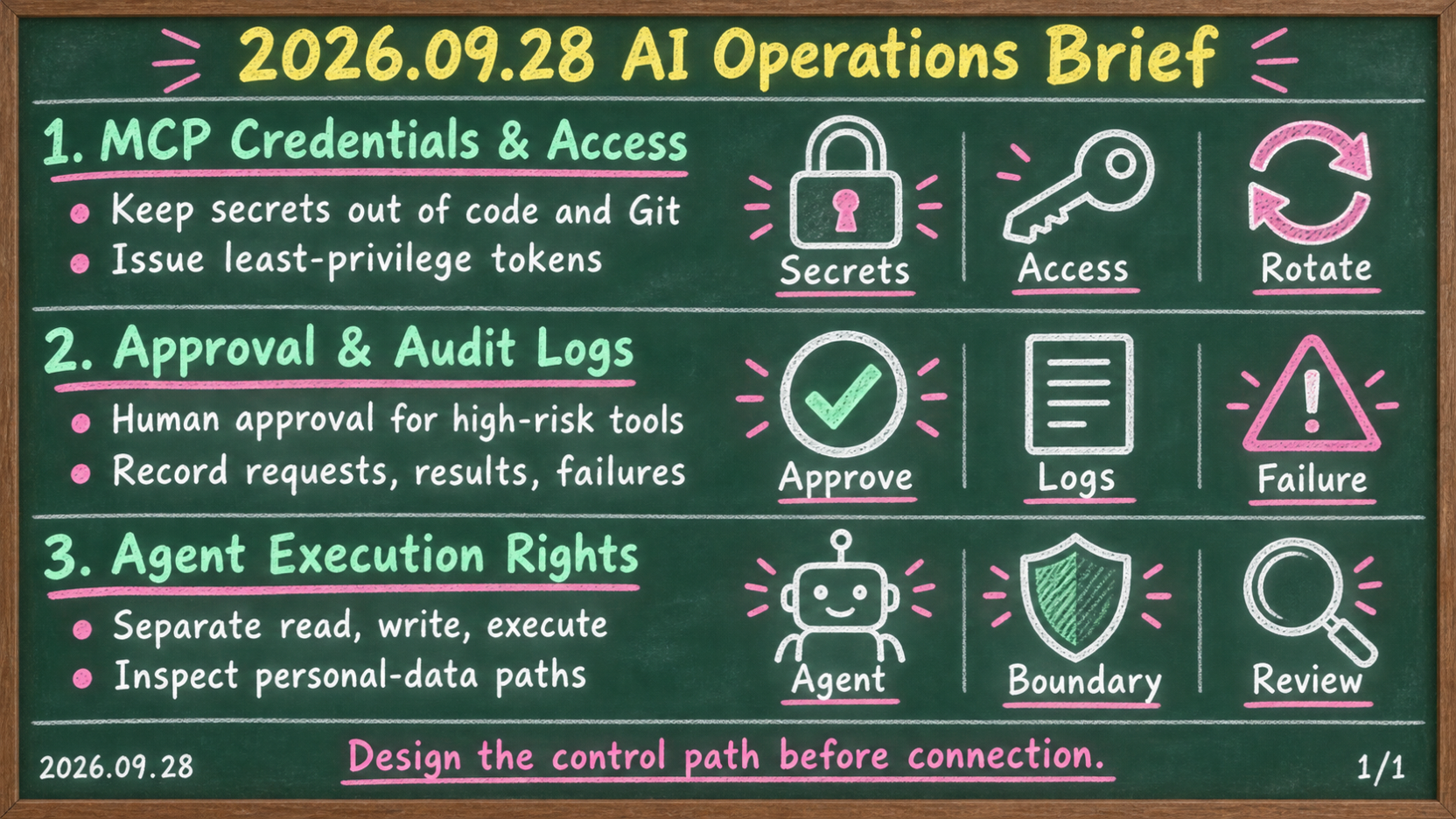
Three priorities for MCP operations
First, credential security and access control need a named owner and a defined scope for each connection. Second, audit records and tool-call approval need to follow a request through to its actual outcome. Third, agent permissions need to distinguish retrieval, changes, and external delivery. These are separate controls over credentials, evidence, and actions, but they meet inside the same workflow.
This is an operational briefing for teams working with MCP as adoption continues, not a report of a September 28 launch or security incident. It draws on the official introduction, a dated authorization specification, Microsoft Learn guidance, and the PlayMCP service page. The workflow examples and review procedures below are editorial recommendations, not claims about built-in product features or universal protocol requirements.
1. Credential security and access control: establish ownership and scope
The official MCP introduction describes connections between AI applications and external data and tools. For an operator, the first question is whose access a connection uses: an individual’s delegated access, a recurring team workflow, or a separate service account. Requests may start in the same interface while relying on very different authority.
 PRIMARY SOURCEWhat is the Model Context Protocol (MCP)? - Model Context ProtocolThe official introduction establishes what MCP connects. Use it as context for separating connectivity from permission to perform a business task.
The June 18, 2025 authorization specification covers HTTP transports; authorization itself is optional. Within that flow, servers must validate the intended token audience and must not pass received tokens through to downstream services. Access tokens must not appear in URL query strings. A successful connection alone therefore does not establish that token use is correctly scoped.
PRIMARY SOURCEAuthorization - Model Context ProtocolThis dated specification defines the scope of HTTP authorization and token-handling requirements. It provides the reference for reviewing access boundaries.
A practical review can start with a connection register. Record the business purpose, requesting identity, server address, credential owner, allowed operations, and operational contact. Store a reference to the secret rather than the secret itself. Prioritize entries whose environment is unclear or whose owner has left without a replacement.
Describe permissions in terms of actions, not just job titles. For a support lookup, define which customers may be queried and which fields may be returned. The recommended starting point is the data and operations needed to complete the task, rather than broad access followed by instructions to ask careful questions.
Treat development, test, and production as distinct entries. The same tool name can refer to different targets and owners, and a successful test call does not authorize production use. Where a shared account is unavoidable, document its permitted workflows and responsible people more narrowly. Shared credentials should not erase the identity that initiated a request.
Credential rotation needs both positive and negative checks: the replacement supports the intended workflow, and the old credential no longer grants access. Document where credentials are injected, who can pause the connection, and what users see during a failure. Record deployment of the replacement separately from retirement of the old access.
For suspected exposure, define a response that does not copy the secret into another report or chat. Identify it by reference name and discovery location, then assign responsibility for revocation, replacement, and impact review. Track residual copies separately from the task of disabling usable access. This is a proposed preparation exercise, not a reconstruction of an incident.
Test denied paths as well as successful ones: an out-of-scope target, expired credentials, and an account from another environment. Design blocked requests to stop rather than automatically retry under a more privileged identity. If the workflow genuinely needs broader access, record the reason and approver as a separate change.
The review should produce a decision record for each connection, not merely a screenshot of settings. Capture why it remains enabled, permissions removed, denial cases tested, and open issues with owners. Challenge the business need for unused connections, and record closures alongside new approvals so the next operator can explain the current state.
2. Audit records and tool-call approval: connect decisions to outcomes
Microsoft Learn describes an MCP server for retrieving public documentation and states that access requires no authentication. As an operational example, it helps distinguish public retrieval from changes to internal systems. Decide separately what information a lookup may send and what actions may follow from the retrieved material.
 PRIMARY SOURCEMicrosoft Learn MCP Server 개요Microsoft’s guidance describes public documentation access and its authentication requirements. It is a useful reference for defining a retrieval-only stage.
Token protection also matters when designing records: the authorization specification requires secure token storage. The audit fields and approval interface proposed here are not a common logging format prescribed by that specification. Operators still need evidence that explains who acted, under which authority, and where execution stopped, without recording secrets.
PRIMARY SOURCEAuthorization - Model Context ProtocolThe specification supplies the token-protection reference. Apply that boundary when deciding what audit records may contain.
A useful starting record includes a request identifier, initiator, connection and tool, target scope, applied policy, approval state, execution time, and outcome. Keep only the input summary needed for investigation and redact sensitive fields. This does not require retaining entire conversations or internal model reasoning; it requires evidence of observable requests, decisions, and results.
Bind approval to the action that will actually execute. For an external message, the recipient, content, and attachments presented for review should match the call. A changed recipient or expanded scope should trigger a new decision. Set an approval lifetime and permitted number of uses so an old confirmation does not authorize later, different work.
Use approval where it supports a meaningful decision. Public-document retrieval within an agreed scope can run automatically; disclosure of internal information or a state change can require a specific review. Show the target and expected effect, not just the tool name. Give users a workable route to reject or revise the proposed action.
Separate call success from business completion. If a tool accepts a job that still needs downstream processing, record it as accepted. Mark it complete only after verifying the intended target state. A missing response also need not prove failure; use an explicit unresolved state when the actual effect cannot yet be established.
Make retry behavior an explicit design decision. Link each call to its parent business request and check for an existing effect before repeating a change. If the tool cannot protect against duplicate execution, disabling automatic retries may be appropriate. Review failure handling in the same document as the successful workflow.
Assign ownership for log access and retention. Limit readers to the evidence they need, distinguish long-lived records from short-lived details, and verify scheduled deletion. Check redaction in error messages and diagnostic output as well as successful calls. The useful measure is whether the evidence supports investigation, not how much text is collected.
Keep rejection, expiry, policy denial, and tool failure distinct. Repeated rejections may reveal a missing legitimate workflow rather than justify removing review. Also find approvals with no recorded outcome and assign someone to resolve them. In review meetings, walk a representative request from initiation to final state instead of only counting events.
3. Agent execution permissions: define the boundary between reading and acting
PlayMCP’s official service page provides a reference point for the Korean MCP context. A service landing page does not, by itself, establish how a particular connection stores tokens, records events, or handles approvals. Adoption reviews need to examine the actual server and client behavior. This briefing makes no finding that PlayMCP has or lacks a particular security feature.
 PRIMARY SOURCEPlayMCP | 새로운 AI 경험의 시작The official service page is a reference for the Korean MCP context. Security and approval behavior for individual connections require separate verification.
Turning the connectivity described in the MCP introduction into workplace permissions requires separating actions. Retrieval, drafting, saving, and external delivery may all belong to one user request, yet need different boundaries. Permission to read a result should not automatically authorize sending it to a customer. Record connectivity and execution authority as separate decisions.
PRIMARY SOURCEWhat is the Model Context Protocol (MCP)? - Model Context ProtocolThe introduction explains MCP’s role in connecting data and tools. Operational policy must still define permission for each resulting action.
A permission table can begin with three routes: automatic execution, approval before execution, and disallowed. Bounded public retrieval is a candidate for automation. Customer messages and changes to business records need their own conditions. Keep tasks without an owner or recovery path disabled. These are team decisions about workflows, not fixed product classifications.
Inspect inputs, outputs, and destination systems when a tool description is too vague. If an apparently read-oriented tool also creates files or transmits content, review those effects. For a broad tool, consider restricting accepted parameters or splitting the workflow. The policy should match what actually changes, not merely the name users see.
Execution conditions can include the target account, document set, quantity, environment, and time window. Approval to edit one customer record should not also authorize a bulk update. Set limits according to the operator’s ability to verify and recover the result rather than applying an arbitrary number across every workflow.
Set a policy that retrieved documents and tool responses cannot grant new authority. If returned text asks for an additional transfer or access to another system, evaluate it against the original user request and policy. Reference content may inform a decision without expanding permission. Test this boundary with prepared material rather than real sensitive data.
Prepare stop controls alongside execution permissions. Distinguish disconnecting a server, disabling a particular write tool, and checking work already in progress. A stop action should not be reported as cancellation of effects that may already exist in an external system. Track applied changes for verification or recovery, with an owner for the remaining work.
Expand deployment on the strength of operational evidence. Begin with limited data in a test environment and check denial of out-of-scope requests, renewed approval after changes, unresolved outcomes, and post-stop verification. Promote workflows whose behavior can be explained. Revisit permission decisions when tool inputs or destinations change, even if the tool keeps its name.
Include withdrawal of access in the lifecycle. When a person changes teams or a task ends, review connections, scheduled work, and outstanding approvals together. Do not assume closing one account settles every downstream task. Identify what continues and what stops, and record the outcome so operators can state the current scope of automation.
Operator memo: trace one workflow all the way through
For the next review, choose one frequently used workflow. Map it from the initiating person to the final destination, adding the credential and approval decision at each step. Assign an owner and review date to every unexplained handoff. A concrete case makes gaps between the register and actual behavior easier to identify.
Keep three connected outputs: a register of owners and scope, approval criteria covering targets and changes, and execution evidence showing how the outcome was verified and what remains open. A small team can use three sections in one document. Larger teams should link their records through the same request identifier.
Define review completion as verified behavior, not finished paperwork. Exercise an allowed request and a request that should be blocked against the actual configuration, then retain sanitized evidence. Mark unresolved results as unverified and assign follow-up. Do not describe untested behavior as a built-in service feature; visible uncertainty gives the next review somewhere to start.
Make responsibility as explicit as the connection
As MCP becomes part of more workflows, operators need to explain more than connection status. They need to identify who owns access, what was approved, what actually happened, and where an agent must stop. Start by making one existing workflow fully accountable. Verified records from that exercise provide a concrete basis for deciding what the next connection may do.
Sources
Related posts
Read →Related tools