September 11 Daily Briefing — Payment approvals, MCP key isolation, and agent audit trails
As AI agents spend money, call tools, and act in business systems, payment approvals, secret isolation, and audit trails become one operating boundary.
DAILY NEWSLETTER · 2026-09-11 · PAYMENT APPROVALS · MCP SECURITY · AGENT AUDIT
September 11 Daily Briefing — Payment approvals, MCP key isolation, and agent audit trails
Once an agent can spend money, invoke tools, and change operational systems, the important question is no longer whether its intent sounds reasonable. It is whether the organisation can check the action before it happens and explain it after the fact. Today’s briefing joins payment limits, MCP authorisation, secret isolation, and audit records into one execution boundary.
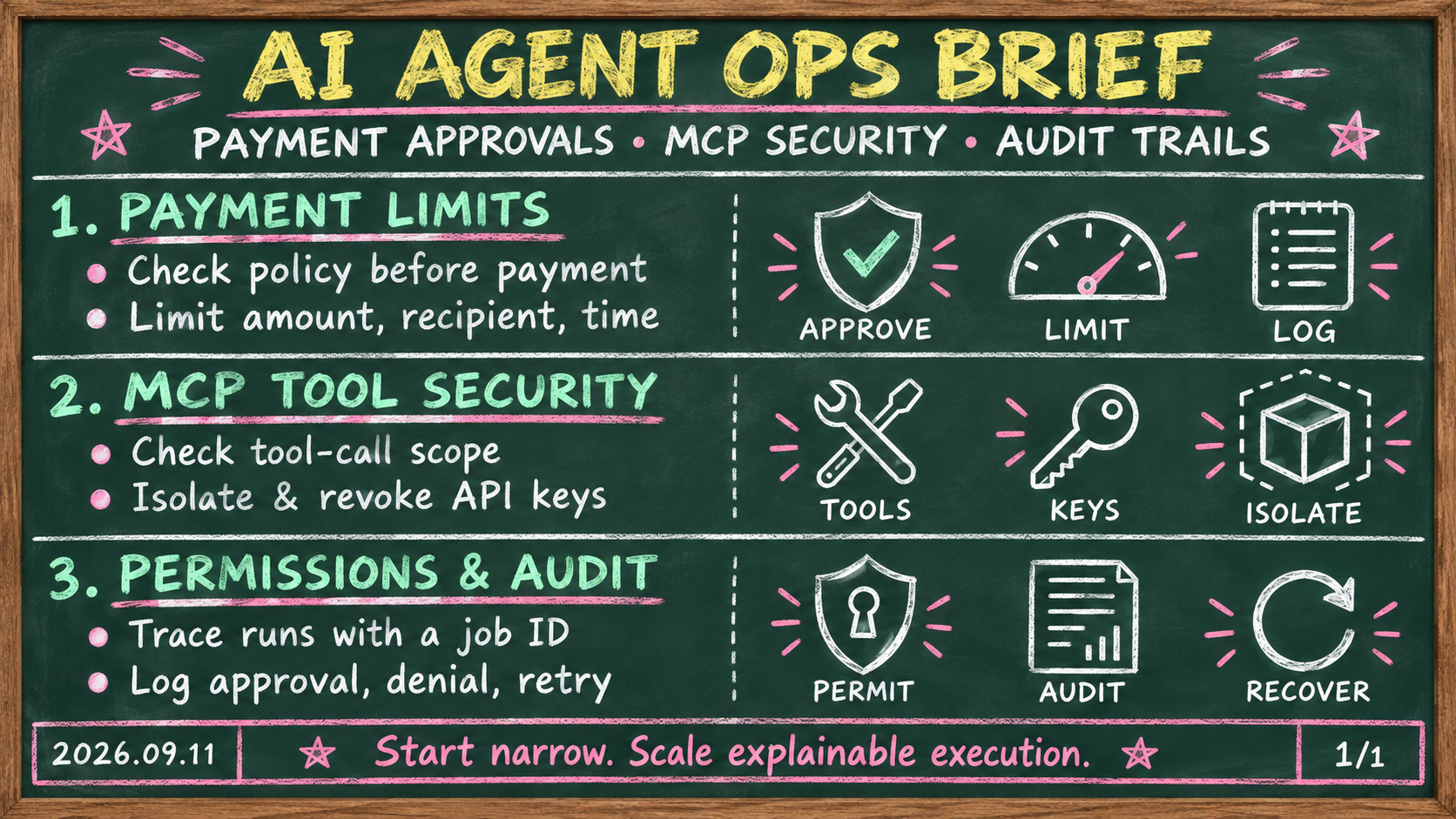
Today’s three points
First, an agent that can pay needs a pre-payment check and limits that match the action. Second, an MCP connection adds both tools and an authentication-and-secrets path, so tool approval and key isolation need to be designed together. Third, permission policy is not enough as prose: teams need an audit record that can account for an executed, denied, approved, or failed action.
- Constrain payment authority by purpose, amount, recipient, and time window—not by the wallet’s entire balance.
- Grant MCP tools only the access they need, and keep secrets separated from the model conversation and from unrelated tools.
- Record the order of actions and policy decisions, not merely the final answer shown to a user.
1. Agent payments — design the approval surface and spend limits together
The first distinction for a payment-capable agent is between being able to pay and being allowed to make this payment now. The first is about a credential or wallet capability. The second is about a job’s purpose, amount, recipient, currency, recurrence, and available budget. Combining both in one long-lived token or broad approval erases the difference between a routine small charge and an exceptional transaction. The boundaries and approval conditions should exist before the agent creates the payment request.
gatekeep402 describes itself as a deterministic, socket-layer pre-payment audit proxy for x402, intended to protect autonomous AI agents from wallet-draining prompt injections and ghost paywalls. That framing highlights an operational question: when a model reads external content and then proposes or enters a payment flow, is there an independent checkpoint before funds move? Treating instructions in content or a tool description as payment intent is unsafe. A safer flow rebuilds the target and terms as a structured request, then checks that request against policy.
Approval does not mean asking a person about every transaction in the same way. Classify payment types first: a small contracted service charge, a recurring cost to a known provider, a one-off payment to a new recipient, and a transaction with changing amount, currency, or recipient do not deserve identical treatment. Attach job-level limits, cumulative daily or period limits, recipient allowlists, approval expiry, retry limits, and cancellation or refund conditions as applicable. When a condition changes, do not reuse the old approval; create and evaluate a new request.
A useful approval surface leads with the effect, not a long model narrative. It should identify the actor, account or wallet, recipient, amount, reason, budget impact, and whether untrusted external input influenced the decision. A display name may help review, but it cannot substitute for verifying the real recipient identifier. The approval record should mean: this approver accepted this target, this amount, and these conditions—not merely that someone saw a request.
Keep the first automation boundary narrow. An agent can automate reading, quotation, and payment-draft work while actual transfer remains behind a separate gate. Test unattended execution only for pre-verified recipients, limited amounts, and repeatable work. Route new providers, new wallets, budget overruns, policy mismatches, and requests rooted in untrusted input to a waiting state. Denials and post-approval cancellations are useful operational evidence, not events to hide. Payment authority is a capability to reduce, expand, and revoke as observed use changes.
2. MCP security — tool-call approval and API-key isolation share an execution boundary
MCP provides a route from a client to external servers, tools, and information. Connecting a server therefore adds more than a feature list: it introduces its authentication method, credentials passed by the client, data reachable through tool calls, and potentially untrusted content returned by those calls. When a tool reaches an internal system or external API, an explicit transformation and check must sit between a natural-language request and the API authority that performs the action.
The Model Context Protocol Authorization specification addresses authorisation for MCP. Product behaviour must still be checked in the relevant client and server implementation, but the operating principle is clear: successful authentication does not make every tool permissible. Check the calling principal, intended tool, request scope, session or token lifetime, and delegated authority separately. A statement such as “this job may use this tool for this read-only scope” is easier to review and revoke than broad permission to connect to a server.
 Source · Model Context ProtocolAuthorization - Model Context ProtocolThe official specification covers MCP authorisation and provides a reference point for separating connection access from tool-level authority.
An API key is not a secret string to place in a model prompt or conversation transcript. Separate which process reads it, which tool uses it against which API, and how it expires, rotates, and is revoked in each environment. Where possible, avoid sharing a long-lived key across tools; give a tool only the scoped, short-lived credential or service identity it needs. Keep development credentials away from production data, and check that logs, error messages, tool outputs, and approval surfaces do not reveal secrets. Isolation limits the blast radius when an agent makes a mistake or is influenced by unsafe input.
Tool approval becomes ceremonial if it omits parameters. File lookup and file deletion, search and external publication, balance inquiry and fund transfer are all tool calls, but they have different reversibility. Even a read can create an egress path when it retrieves a broad set of sensitive records. Before invocation, expose the tool name, target resource, filters and scope, write effect, external recipient, and expected side effect to the policy layer and, where needed, a reviewer. After invocation, retain the actual parameters and response status so the team can compare the approved request with the executed one.
A scanner is a useful starting point, not a verdict of safe or unsafe. A tool such as agent-scan can be part of a deployment review for agents, MCP servers, and skills. The team still needs an inventory based on its real configuration: owner, deployment location, dependencies, exposed tools, requested authority, network destinations, and secret-injection path. When a server or skill is added, the inventory and approval rules should change with it; when it is removed, tokens, connections, and log access should be withdrawn too. Security review is a lifecycle activity, not a final install-time checkbox.
3. Permissions and audit trails — operations must be able to account for execution
An agent’s final prose cannot fully establish trust in an operation. Two runs can present the same answer while one only read an internal document and the other edited a file or sent a request to an outside system. When something goes wrong, the team needs the real sequence of actions rather than a plausible summary. Join the initiating user or service, applied policy version, tool calls and their scopes, human approvals, denials and cancellations, and final outcome under one job identifier.
boundflow/charter presents itself as a project for building and operating production-safe agents that run in an organisation’s own environment. That direction aligns with keeping the execution environment and operating responsibility under visible control. It does not, by itself, settle an organisation’s authority model or incident process. Each environment still needs explicit decisions about who can change policy, which work requires approval, what evidence is retained, and who may inspect it.
The minimum audit unit is an execution, not a model response. Under a request ID, retain the caller, agent and model identifiers, policy result, approval event, tool name and purpose, authorised data category, execution time, outcome code, and any retry or human intervention. Recording unlimited prompt text, secrets, or personal data creates another risk surface. Preserve the metadata and minimal evidence needed for reconstruction, protect sensitive fields through masking, hashing, and access control, and set retention and viewing rules explicitly.
Permission policies become more useful when they include execution context rather than only static roles. The same person using the same tool can require different conditions for test versus production data, read versus write, internal versus external targets, and an approved versus unapproved change window. A policy engine needs states beyond allow and deny: waiting for approval, safe draft creation, and constrained sandbox execution can preserve a useful workflow without opening the final action. When a policy changes, retain its reason, approver, effective time, and scope so past runs can be interpreted against the rules that applied at the time.
Incident response and quality improvement should use the same evidence. Do not scatter an unexpected tool call, a missing-permission error, a cancelled payment, a changed parameter after approval, and repeated failure across unrelated dashboards. Join them as an incident flow, review the cause, revoke authority when needed, and update preventative rules and evaluation cases. “The agent made a mistake” is not an actionable endpoint. The review must identify the input, tool description, authority combination, or policy gap that enabled the behaviour.
Operator memo
Before adding another agent feature this week, choose one real job and draw its execution boundary. Connect the user request, model, MCP server, internal API, payment mechanism, and external recipient. On every edge, write the data type, authority, secret location, approver, and log location. Put a policy decision and distinct approval point before irreversible actions such as payment and external transmission. A blank spot is not merely missing product functionality; it is a responsibility and control that has not yet been assigned.
Then test a small limits policy. Allow only low amounts, verified recipients, and short approval windows; route new recipients, cumulative-limit overruns, changed parameters, and payment requests shaped by untrusted input to human review. Make the approval surface show target, amount, budget impact, and the real tool invocation. If the executed values differ after approval, require approval again. The same pattern applies to file deletion, deployment, permission changes, and customer outreach.
Attach the credentials inventory to the same exercise. Identify which server uses which credential, for what scope, who owns its rotation and revocation, and whether errors and logs mask it. The convenience of broad shared development keys or long-lived keys can make initial setup seem fast, but it expands the impact when one tool misbehaves or reacts to unsafe input. Use least privilege, short lifetimes, environment separation, and revocability as defaults; record exceptions in a ticket and approval trail.
Finally, use the audit log as an operator would. Confirm that one job ID can retrieve the request, policy decision, approval, tool calls, payment or external-action result, and any cancellation, retry, or human intervention. The standard is reconstruction without retaining unnecessary sensitive information. That record is what lets a team decide whether to narrow authority, where approval waits are slow, and which failures belong in evaluation. Automation does not scale only through broad authority; it scales into more consequential work through repeatable execution that is reversible and explainable.
Today’s three subjects reduce to one question: before an agent affects the world, can the organisation check its target, scope, budget, and authority? Afterward, can it explain from one record why policy permitted or stopped that action?
Pre-payment audit, MCP authorisation and key isolation, and permission-aware audit trails are not separate security ornaments. They are parts of the same execution boundary. Start the next automation with a small real job, a clear approval, a bounded limit, and evidence that survives the run.
Sources
- GitHub - al1-nasir/gatekeep402: Protect autonomous AI agents from wallet-draining prompt injections and ghost paywalls. Deterministic socket-layer pre-payment audit proxy for x402. · GitHub ↗
- GitHub - Quidli/connect-mcp: MCP server for agent identity & reputation: Resolve social handles to wallet addresses, score onchain reputation, and send USDC from any MCP client. Read-only mirror — PRs here are overwritten on release; please open an issue instead. · GitHub ↗
- Authorization - Model Context Protocol ↗
- GitHub - snyk/agent-scan: Security scanner for AI agents, MCP servers and agent skills. · GitHub ↗
- GitHub - boundflow/charter: Build and operate production-safe agents that run in your own environment. · GitHub ↗
- Security - Claude Code Docs ↗
Related posts
Read →Related tools