Permissions, Records, and Exit Paths: Today’s AI Operations Briefing
An operational briefing on agent controls, practical preparation for Korea’s AI Basic Act, and exit readiness for sovereign AI deployments.
DAILY BRIEF · 2026.09.17 · AI OPERATIONS
Agent control · AI Basic Act · Sovereign AI · Exit readiness
Permissions, Records, and Exit Paths: Today’s AI Operations Briefing
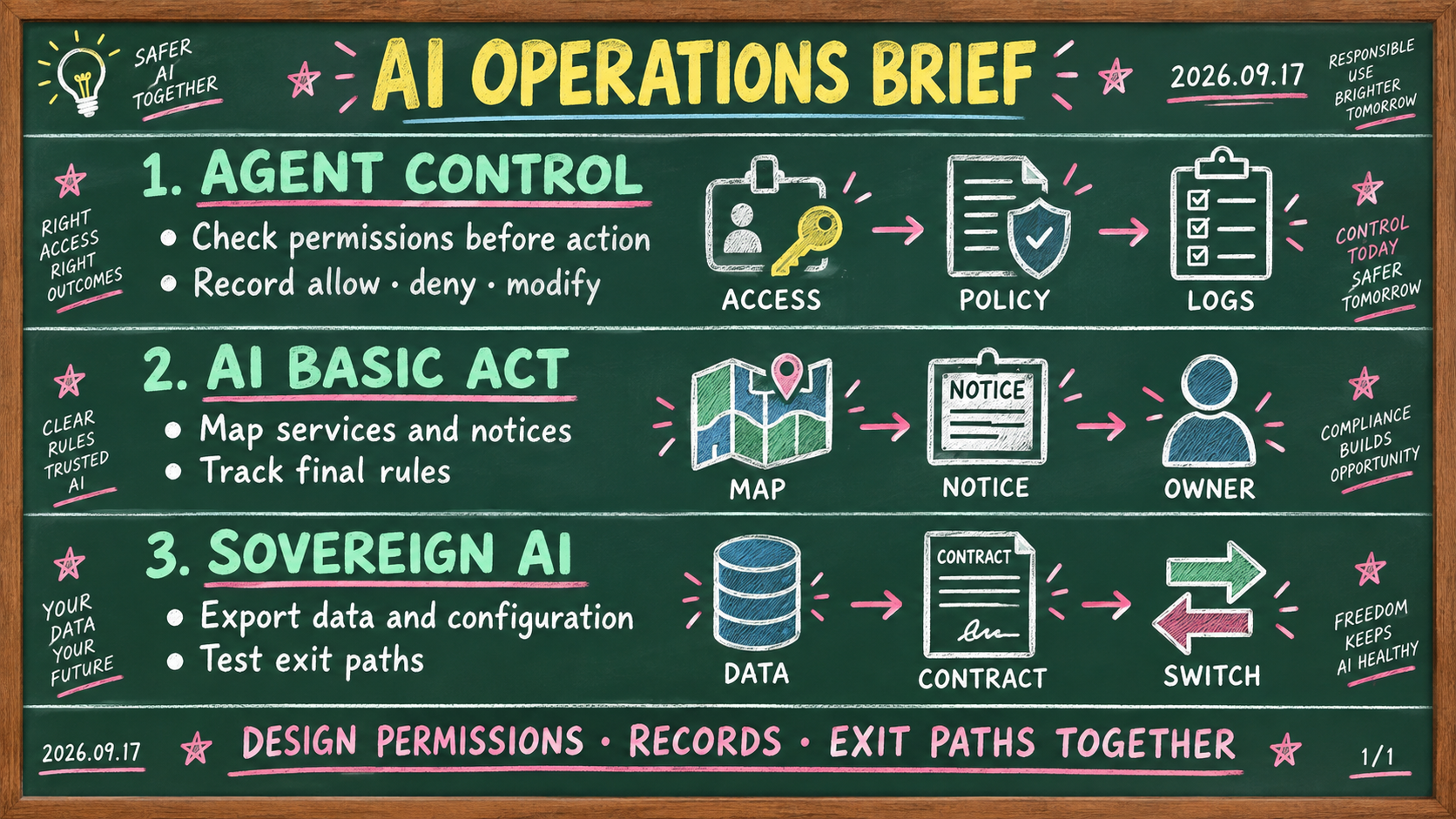
Operating AI well is becoming less about adding another model and more about setting three practical routes: the route that authorizes an action, the route that preserves its record, and the route out when conditions change. Agent controls, practical preparation for Korea’s AI Basic Act, and sovereign AI discussions all return to the same operational question: are the boundaries an organization claims to control present in the real workflow?
Orientation
- Agent control begins with a path to permit, alter, or stop execution before it reaches a real system.
- Preparation for the AI Basic Act means separating enacted law from draft detail while keeping service facts and user communications current.
- Sovereign AI is not a slogan for one deployment model; it is the ability to move data, configuration, and operating knowledge when needed.
1. Behavioral control for agents: Decide before a tool acts
An agent’s risk profile cannot be read only from the text it returns. Consequences arise when a chosen tool reads a repository, retrieves customer information, updates a ticket, changes an account, or transmits something beyond the organization. The useful unit of review is therefore an execution request, not simply a prompt or a bot name. For each request, teams should be able to connect the initiating identity, business purpose, data involved, selected tool, allowed scope, and expected behavior on failure. A single broad shared credential across many tasks obscures all of those links.
OWASP announced its Agent Control Standard, or ACS, in September 2026. That announcement signals a growing need for agent-control practices; it does not establish universal adoption or mean every product implements the standard in the same way. The public ACS reference describes concepts of inspectability and traceability, with a policy decision before execution that can allow, deny, or modify an action. It still has material hardening gaps in its public form. Teams should not characterize it as a hardened or fail-closed deployment pattern. Instead, use it to frame design review, then test the authentication, error handling, and bypass possibilities of the actual integrations in use.
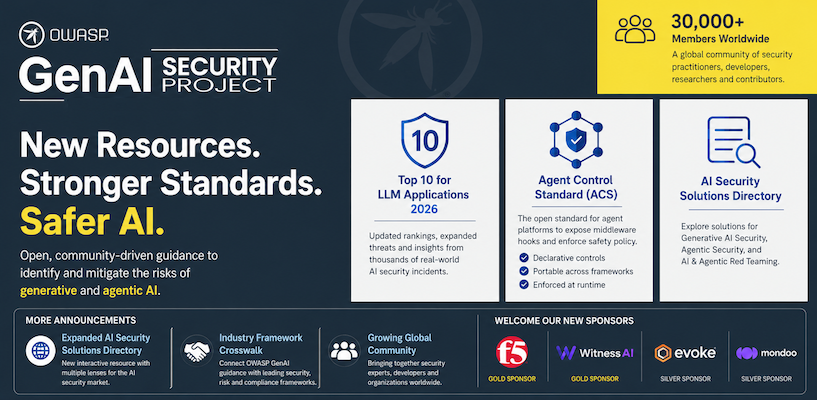 Source · OWASPOWASP GenAI Security Project Unveils 2026 Top 10 for LLM Applications, New Agent Control Standard and Sponsors as Community Tops 30,000 MembersOWASP’s September 2026 announcement of ACS.
In practice, place a modest decision point in front of each tool call. Distinguish a read from a write, a reversible action from an irreversible one, and an internal lookup from an external transfer. Limited automatic execution may be suitable for a low-impact internal query, while customer-data changes or outbound messages can require a human approval step or a separately controlled service identity. “Modify” need not mean editing text: it can mean reducing parameters to an approved range, removing a risky target set, or routing a request to a review queue. The essential point is that the decision does not rely solely on the model’s own explanation of what it intends to do.
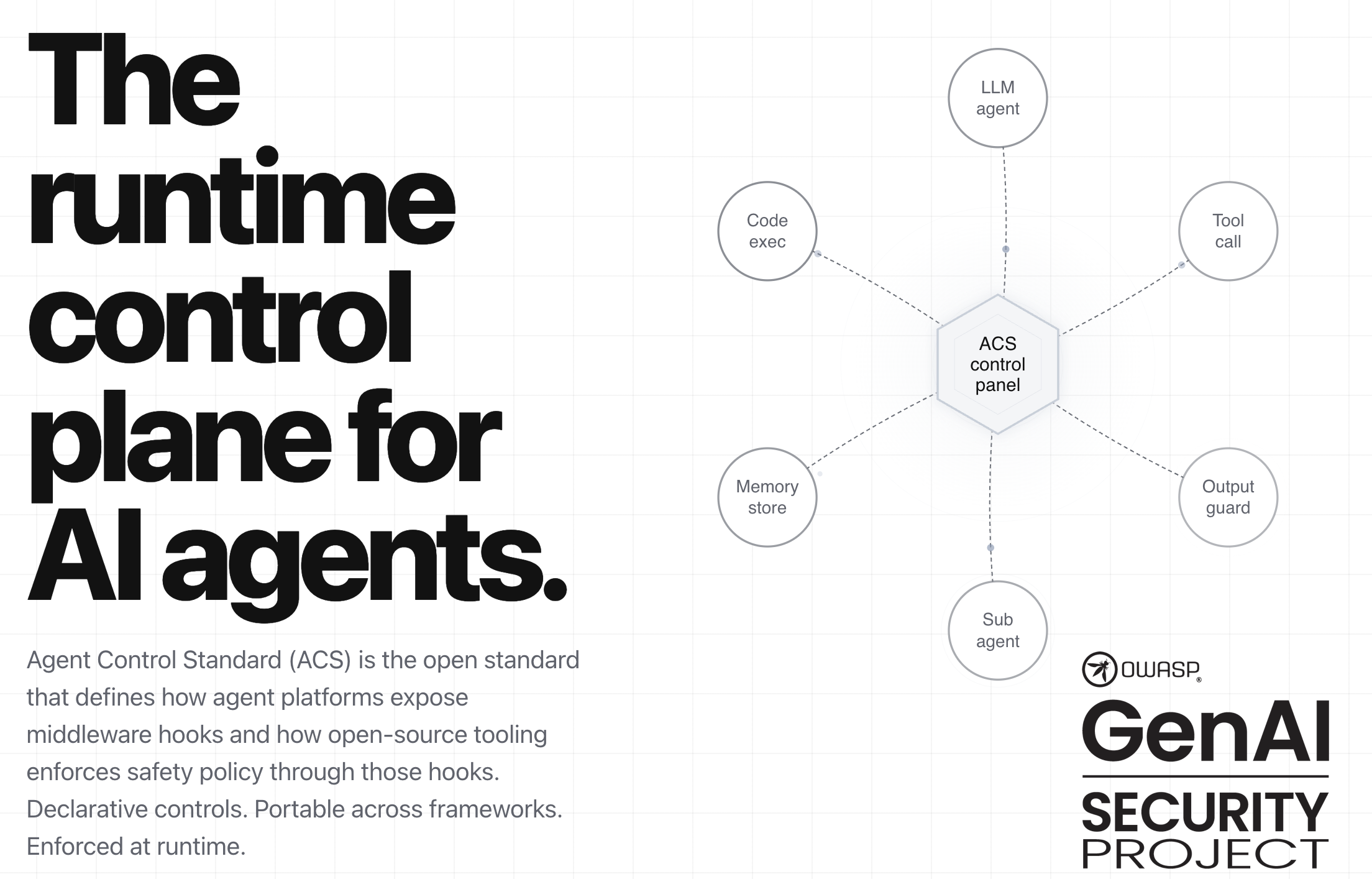 Source · OWASPAgent Control Standard (ACS)A public reference for inspectability, traceability, and allow, deny, or modify decisions before execution.
A record is part of the control, not decoration for an incident report. Link a request ID, calling identity, stated purpose, tool selection, policy decision, approver, timestamp, and outcome in one trace. This does not mean putting raw sensitive material or secrets into logs. Use safe references, masking rules, retention periods, and separate access controls for the records themselves. Denied and modified requests deserve the same attention as successful ones. They reveal whether a policy is blocking ordinary work unnecessarily or allowing risky requests through too easily.
Anthropic’s research on agentic misalignment considers conditions under which models could act like insider threats in controlled hypothetical environments. Anthropic says it has no evidence of such behavior in real deployments. It should not be treated as incident statistics, but it does make the case for testing environments with broad permissions and weak observation. Before release, reproduce attempts to reach an unapproved recipient, select a tool outside scope, use expired credentials, or continue after a stop signal. A demonstration that only follows the happy path offers less operational evidence than a test that shows how rejection and recovery are recorded.
The minimum deliverable is straightforward: a tool inventory, a permission table, an execution-time policy, a traceable record, and a stop-and-recovery procedure. Revisit all five when a prompt, data source, or connection changes. That turns security review from a final gate into a routine part of change management.
2. Korea’s AI Basic Act: Separate confirmed requirements from preparation
Teams operating AI services in Korea need more than the name of a statute to organize their work. The Ministry of Science and ICT’s English notice describes the AI Basic Act as scheduled to take effect on January 22, 2026, while discussing a legislative notice for an enforcement decree. Details described there should therefore be read as draft rules at that point, not as an unqualified final checklist. Start by distinguishing the statute, final subordinate rules, the facts of a particular service, and the contractual roles of its participants.
A practical first step is to inventory services that provide or operate AI capabilities, rather than merely listing places where staff use AI. Include customer-facing features, internal assistants, automations that call an external model, and functions run by an overseas affiliate that reach Korean users. For each entry, record the providing entity, user group, input data, where generated recommendations or decisions are used, human-review points, deployment regions, and the contractual provider and operator. This is not an immediate legal conclusion. It is a shared factual basis for product, legal, security, and operations teams.
Source · Ministry of Science and ICTMSIT Announces Legislative Notice for the Enforcement Decree of the AI Basic Act to Foster the AI Industry and Build a Foundation for Safety and TrustGovernment notice addressing a proposed enforcement decree and the Act’s scheduled effective date.Next, inspect what users are told at the point where they act. The fact that AI is involved, the nature of generated output, a path for human review or questions, and material limitations may otherwise be scattered across product screens and operating procedures. A single generic notice is less useful than information placed where a user must decide whether to rely on a result. Distinguish a recommendation that assists a person from a workflow that automatically opens the next step, and distinguish an internal result from one sent outside. Transparency is operational information that helps someone understand what happens next, not a promotional label.
 Commentary · CooleySouth Korea’s AI Basic Act: Overview and Key Takeaways // Cooley // Global Law FirmA legal explainer on scope, transparency, and potential implications for overseas operators; not controlling text.
Services run across borders require the same factual discipline. Cooley’s explainer identifies questions around scope, transparency, and overseas operators, but it is commentary rather than the controlling legal text or an administrative ruling. The productive question is not “does our service certainly fall in scope?” but how the service connects to Korea, who controls the feature, and who handles user responses and incidents. Put supplier terms, reseller arrangements, data-processing roles, and customer-support paths beside the service inventory so that responsibility gaps can be found.
Add change management to the checklist. When a team swaps models, extends automation, or replaces human review with automatic handling, revisit the service record, user communications, and internal approval route. Do not treat a draft provision as settled simply because it is easy to quote; retain the date and version of the source used. Reporting and commentary such as Tech Policy Press can give useful market context, but they are not final legal authority. Keeping commentary and binding requirements in separate fields prevents a policy narrative from silently becoming an operational obligation.
3. Sovereign AI and exit readiness: Design for movement, not just placement
Sovereign AI does not mean only on-premises infrastructure. It also concerns the jurisdiction and contract terms governing data, who can approve access, and whether models, retrieval indexes, prompts, evaluation material, logs, and operating knowledge can be extracted in usable form. A decision to use a particular country or cloud may be appropriate, but operational sovereignty is better understood as the ability to keep the system explainable when the provider, owner, region, or commercial conditions change.
Cloudera and Mistral announced a strategic partnership on September 10, 2026, aimed at bringing specialized sovereign intelligence to enterprise data. The announcement does not mean that every planned integration is already deployed for all customers; the companies describe integrations rolling out over time. Procurement and architecture reviews should therefore separate the direction announced from functions available today. Ask which components are currently delivered, where data is processed, who provides notice when the model or platform changes, and what export assistance covers.
 Announcement · ClouderaCloudera and Mistral Partner to Bring Specialized, Sovereign Intelligence to Enterprise DataA strategic partnership announced on September 10, 2026, with integrations expected to roll out over time.
Exit readiness has a contractual and a technical side. List datasets, embeddings and indexes, system prompts, tool definitions, access policies, evaluation cases, audit records, and operating documents. For each, name the owner, available export format, contractual support, and what would need rebuilding in an alternative environment. Can the search index and approval rules survive a model-provider switch? Which tools depend on a provider-specific calling pattern? How quickly can keys and service accounts be replaced? This is not a hostile plan that assumes a contract will end. It is recovery design for an outage, price change, regional requirement, or shift in business strategy.
Source · EUR-LexRegulation - EU - 2023/2854 - EN - Data Act - EUR-LexArticle 25 addresses switching-contract requirements for qualifying data-processing services and can include a move to on-premises infrastructure.Article 25 of the EU Data Act addresses switching-contract requirements for qualifying data-processing services, and a move to on-premises infrastructure can be within that framework. It does not follow that every AI SaaS product is covered. Whether a service falls within the relevant category and which contract obligations apply need their own review. Even organizations outside the Act’s direct scope can use the same prompts in supplier discussions: transition period, export support, functional differences, return or deletion of data, and assistance after termination.
NIST’s Generative AI Profile can help teams identify assets and context while considering risk-management actions through a system lifecycle. The safe-decommissioning steps suggested here are not a single NIST-mandated procedure. An exit plan can specify confirmation of data and secret return or deletion, withdrawal of access, shutdown of integrations, retention of required audit records, communications to customers and internal owners, and verification in the replacement environment. An exit route written in advance makes sovereignty a practical recovery capability rather than a label.
Operator memo
A useful hour today can produce three short tables. The first lists every operating agent with its tools, permissions, approver, and stopping method. The second lists every AI-enabled service with its providing entity, users, deployment region, notice location, and owner for questions or objections. The third lists data and configuration assets, export formats, contractual support, and the difficulty of rebuilding them elsewhere. Empty fields are not proof of failure; they are an ordered queue for investigation.
Prioritize by impact and reversibility, not by the novelty of a feature. External delivery, bulk changes, customer decisions, and financial or personnel information deserve narrow permissions, approval points, and detailed records first. The same principle helps with regulatory preparation: instead of freezing a product on an unconfirmed decree detail, name someone to track authoritative updates and set a cadence to refresh service facts. For provider transition, begin with a small test that recreates a representative data set and workflow elsewhere rather than trying to migrate everything at once.
Bring product, legal or policy, security, platform operations, and the business owner into the review. One group knows the model settings, another knows the contract, and another sees the exceptions in day-to-day work. Together they can test whether a permission table reflects reality, whether a notice appears where users need it, and whether an exit plan is more than a promise in a document. The meeting can end with a concise assigned list: permissions to remove, authorities to confirm, recovery paths to test, and named owners.
A shared test for controllable AI operations
Agent control, AI Basic Act preparation, and sovereign AI may belong to different teams, but they ask the operator to answer the same questions. Who authorized this action? Can its result and basis be reconstructed later? Can the service be stopped or moved safely when conditions change? Set permissions before execution, preserve records with execution, and design exit paths at the start of contracts and architecture. When those routes are clear, teams can read announcements, drafts, and new partnerships without overstatement and choose a next step that fits the work they actually operate.
Sources
Related posts
Read →Related tools