MCP’s Next Boundary: Managing Secrets, Patent Data, and Execution Records Together
A daily briefing on MCP credential remediation, patent and internal-data connections, and execution permissions with agent audit trails.
DAILY BRIEF · 2026.09.26 · MCP OPERATIONS
MCP credentials · Git history · Patent data · Execution permissions · Audit logs
Once MCP connects to working systems, the question changes from what a model can answer to which identity can read which data, what it may execute, and whether that path can be reconstructed later. The immediate operational task is to close the route by which credentials persist in Git history, connect internal and patent data only within defined boundaries, and preserve agent execution and approval in one trace.
MCP’s Next Boundary: Managing Secrets, Patent Data, and Execution Records Together
Today’s orientation
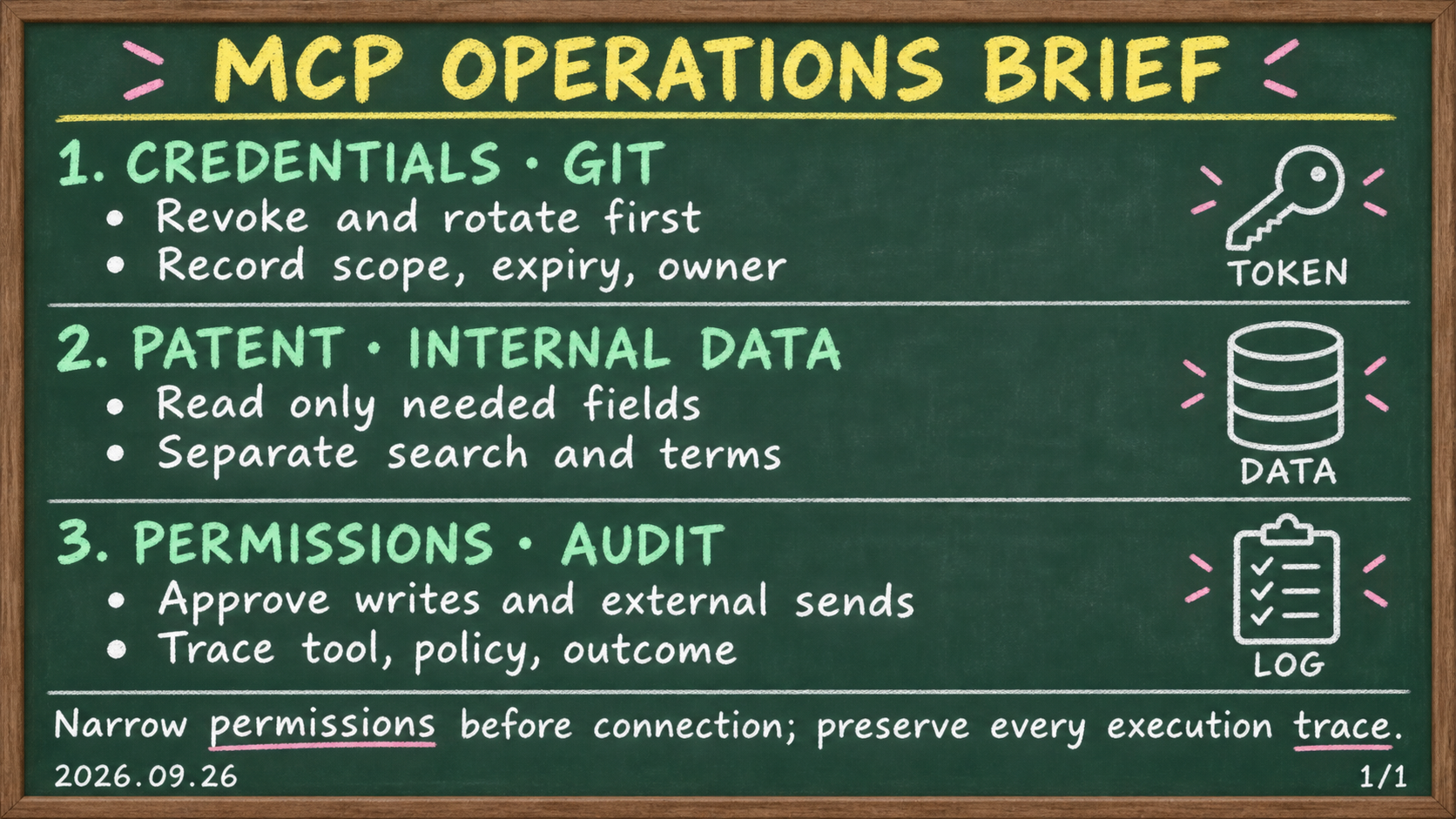
- Deleting a credential from a file is not the same as revoking and rotating it. Git-history response and credential rotation need to happen together.
- MCP can provide a natural-language path to internal and patent data, but query scope, calling identity, and returned fields need their own controls.
- As agents move from reading to writing, permissions, approvals, tool calls, policy decisions, and outcomes should become one auditable trace.
1. Credential security: Removing a file does not remove a secret from Git history
When an MCP server connects to SaaS services, repositories, databases, or internal APIs, credentials are more than configuration values. The authority carried by a token determines the data an agent can reach and the actions it can take. Teams should therefore ask not only whether a secret exists in the current file, but where it may persist across repositories, branches, build artifacts, CI logs, caches, tickets, and documentation.
GitHub Docs distinguishes between revoking or rotating a leaked secret and removing sensitive data from repository history. Removing a value in a later commit does not automatically remove it from earlier commits. A token that may have been exposed should be disabled or replaced regardless of whether history cleanup succeeds. For teams that use Git-centered collaboration alongside several SaaS systems, repository cleanup should not be treated as a substitute for credential rotation.
 Source · GitHub Docs
Remediating a leaked secret in your repository - GitHub Docs
Official guidance that separates secret revocation or rotation from repository-history cleanup. OG image: https://docs.github.com/assets/cb-345/images/social-cards/code-security.png
Source · GitHub Docs
Remediating a leaked secret in your repository - GitHub Docs
Official guidance that separates secret revocation or rotation from repository-history cleanup. OG image: https://docs.github.com/assets/cb-345/images/social-cards/code-security.png
A workable response sequence has distinct owners. First, disable or rotate the key, token, password, or certificate. Second, identify the accounts and systems reachable with it. Third, widen the investigation beyond the primary branch to history, forks, deployment outputs, CI logs, caches, and examples. Fourth, issue replacement credentials with narrower scopes, shorter lifetimes, and purpose-specific separation where possible. Finally, retain a record of who changed the credential, when the change occurred, and what follow-up verification found.
The MCP authorization specification addresses OAuth-based authorization and access to protected resources. It does not require one secret-management product or one deployment model. It does, however, show why “the client connects to the server” is too simple a description for an operational design: authorization servers, resource servers, token audiences, and scopes matter separately. A broadly shared internal service account used across multiple MCP servers enlarges both the impact of a leak and the scope of an investigation.
 Specification · Model Context Protocol
Authorization - Model Context Protocol
The MCP specification for OAuth-based authorization and protected-resource access. OG image: https://raw.githubusercontent.com/modelcontextprotocol/docs/2eb6171ddbfeefde349dc3b8d5e2b87414c26250/images/og-image.png
Specification · Model Context Protocol
Authorization - Model Context Protocol
The MCP specification for OAuth-based authorization and protected-resource access. OG image: https://raw.githubusercontent.com/modelcontextprotocol/docs/2eb6171ddbfeefde349dc3b8d5e2b87414c26250/images/og-image.png
A credential inventory can include the credential name, owning team, connected system, scope, issue date, expiry or rotation rule, storage location, and emergency revocation process. Purpose-revealing names such as “patent-search-readonly-dev” make investigation and replacement easier than a broad label such as “development.” Code should contain references to approved secret stores or injection paths rather than live secret values.
2. Internal and patent-data connections: Design the natural-language path and the data boundary together
MCP provides a protocol for connecting models with external tools and data sources. That can bring internal document search, customer-history lookup, research-material discovery, and prior-art work into one conversation flow. Connection capability is not, however, blanket permission to reach all data. Patent and intellectual-property work can mix public records, contract-based content, paid analysis, and customer-specific project material, so source and usage boundaries need to be explicit.
WIPS’s homepage lists a September 22, 2026 media item referring to a direct ChatGPT connection to a patent database and the public release of WIPS MCP. This is a public signal from a Korean intellectual-property company that places patent-data access in an MCP context. A media-item title alone does not establish the complete feature set, territory availability, tenant permissions, data accuracy, or commercial-use terms. A deployment decision should separately confirm product documentation, contract terms, and tenant-specific settings.
 Source · WIPS
WIPS
The homepage’s September 22, 2026 media list refers to WIPS MCP and a direct patent-database connection. OG image: https://www.wipscorp.com/images/common/og-img.png
Source · WIPS
WIPS
The homepage’s September 22, 2026 media list refers to WIPS MCP and a direct patent-database connection. OG image: https://www.wipscorp.com/images/common/og-img.png
KIPRIS Plus presents an intellectual-property information utilization service with Open API, bulk-data, domestic-IP-data, and overseas-IP-data paths. This shows that IP data can be available through APIs and data-utilization services as well as a search screen. It does not establish that every API call is available to every user, or which authentication, application, usage, and return-field conditions govern a particular integration. Those details should be checked through the service’s own process and terms.
Source · KIPRIS Plus 지식재산정보 활용 서비스 An intellectual-property information utilization service presenting Open API, bulk-data, domestic-IP-data, and overseas-IP-data options. OG image: noneThe useful design question is not simply what an agent should be able to find, but which questions this connection should be allowed to answer. An R&D team may need application numbers, publication numbers, classifications, citations, and legal-status information. It may not need customer project notes, internal analyst opinions, or undisclosed strategy material in the same tool response. For each source, separate read-only status, allowed fields, query filters, download capability, and redistribution constraints. That reduces the chance that natural-language querying becomes an unintended route around normal access boundaries.
The same principle applies to internal financial, contract, personnel, and customer systems. Instead of copying broad document permissions into an MCP tool, define a smaller data set for the workflow. A patent-research agent that needs access to an entire contract repository may have a tool definition that is too broad. A tool can return a document identifier and approved request path rather than raw document content, leaving the original access-control system to decide whether the full material can be opened.
3. Execution permissions and audit logs: Treat the conversational agent as an execution system
An agent’s practical risk appears in tool calls rather than in prose alone. Document search may be a relatively low-impact read operation, while changing tickets, sending email, modifying customer accounts, deleting files, or initiating purchase requests changes system state or external relationships. Tools should not be managed only as connected or disconnected. Read, write, external transfer, bulk change, and irreversible actions require different authority and approval routes.
The MCP tools specification says users should have an opportunity to review server calls and should remain able to deny tool invocations. It recommends that applications make exposed tools clear, visibly indicate tool invocation, present confirmation prompts, and log tool usage for audit purposes. This is not a rule requiring one identical approval screen for every call. It is a design signal not to make an opaque, unstoppable execution path the default.
Specification · Model Context Protocol
Tools - Model Context Protocol
MCP guidance on human review, the ability to deny calls, visible tool use, and audit logging. OG image: https://raw.githubusercontent.com/modelcontextprotocol/docs/2eb6171ddbfeefde349dc3b8d5e2b87414c26250/images/og-image.png
A permission table is closer to an execution contract than a list of role names. For every tool, identify the calling principal, permitted target system, read or write scope, allowed parameter range, time and volume limit, additional approval condition, and stop method. “CRM access” is less actionable than “support-ticket lookup allowed; customer-tier changes require an approval queue; export prohibited.” Service identities should be separated by purpose and unnecessary connections should be removed rather than retained for convenience.
WorkOS argues that agent audit logs need to address questions beyond ordinary application logging: who initiated an action, what authority was used, whether it was within the expected scope of a session, and whether a human approved it. The article is technical commentary rather than a regulatory compliance standard. Still, its distinction is operationally useful: an agent using delegated authority across several tools may not be sufficiently explained by HTTP status codes and error messages alone.
 Commentary · WorkOS
Why AI agent audit logs are different from application logs — WorkOS
A technical discussion of initiation, authorization, session scope, and human approval in agent audit trails. OG image: https://images.workoscdn.com/images/8ba7a56c-994b-4436-ab5b-45e423219a38.png?auto=format&fit=clip&q=80
Commentary · WorkOS
Why AI agent audit logs are different from application logs — WorkOS
A technical discussion of initiation, authorization, session scope, and human approval in agent audit trails. OG image: https://images.workoscdn.com/images/8ba7a56c-994b-4436-ab5b-45e423219a38.png?auto=format&fit=clip&q=80
The minimum unit of audit should be an execution trace, not merely a final answer. Link a request ID, user or service identity, agent and model configuration version, selected tool, masked parameter summary, applicable policy, approval, denial or modification result, execution time, result status, and relationship to later actions. This does not mean retaining every prompt and raw result indefinitely. Unbounded logging can create another sensitive-data store, so evidence requirements should be separated from unnecessary source content, with access, retention, and deletion controls for the logs themselves.
Approval can follow the risk of the action. A search over internal public documents may receive limited automatic execution. Customer-record changes can require owner approval. Outbound email can require confirmation of recipients, attachments, and final body. Mass deletion, payment, or account-permission changes can require separated approval. The reviewer should be able to see the target system, concrete change, impact range, and reversibility—not just a model-generated explanation. A route that can stop before execution turns logs from post-incident explanation into part of the control itself.
Operator memo: Create three tables before adding another connection
The first table is a credential inventory: owner, target system, scope, expiry, storage location, and revocation method for every token. The second is a data-connection inventory: source, return fields, usage terms, external-transfer path, and human-review point for every MCP tool. The third is an execution-trace inventory: read or write status, approver, policy outcome, log-retention rule, and stop-and-recovery route for every action.
The blank fields in those tables are not proof of failure; they are the next investigation queue. Cleaning a secret from Git history, searching patent data through natural language, and automating work with an agent look like separate projects. In practice, each depends on the same operating boundaries: identity and authority, data scope, and a reconstructable execution record. Narrow credentials before connection, expose only necessary data, and begin execution with an approval and logging path.
Sources
Related posts
Read →Related tools