Designing Accountability for Connection: MCP Secrets, Patent Data, and Agent Execution
A daily briefing on MCP secret remediation, internal and patent-data connections, and execution permissions with AI-agent audit trails.
DAILY BRIEF · 2026.09.27 · CONNECTED OPERATIONS
Designing Accountability for Connection: MCP Secrets, Patent Data, and Agent Execution
Today’s briefing is not about making more connections. It is about deciding which identity may read or change what in a connected system, and how that path will be explained. Secret remediation, intellectual-property data boundaries, and approval and recording for executing agents are easy to leave with gaps when managed separately.
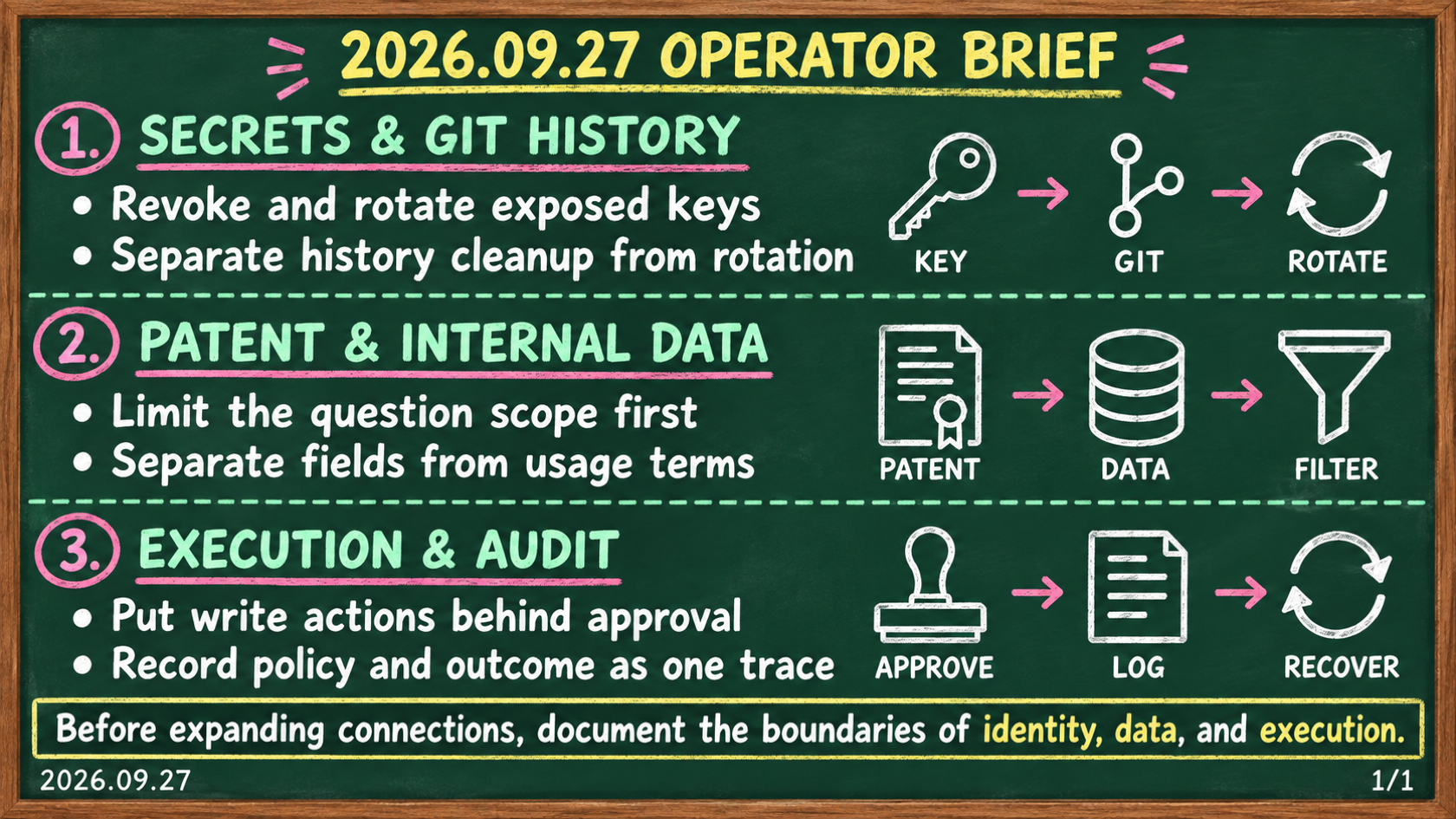
Today’s orientation
This issue reads three scenes as one operational line. The first is responding when a secret enters a repository. The second is the moment patent and internal information are connected to natural-language tools. The third is the moment an agent goes beyond answering and calls real tools. The same questions recur in all three: who is the calling principal, where is the permitted boundary, and can the activity be stopped and reviewed afterward?
This article is not a deployment procedure for a particular product or legal advice. It uses the operating subjects indicated by the supplied official documents and service pages to suggest a record and approval structure that a small team can agree on first. Convenience in connection matters, but it does not fill in blanks in accountability.
1. Secret remediation starts by organizing authority as well as the repository
When an MCP server reaches repositories, databases, work SaaS, or internal APIs, a credential is more than a configuration string. The scope attached to a token or key governs the behavioral scope of the connection. It is therefore not enough to check whether the value is visible in a current settings file. Whether the value was used by someone in an environment, which systems it could reach, and whether the old value still works after replacement are separate questions.
GitHub Docs’ Remediating a leaked secret in your repository, as its title indicates, addresses responding to a secret exposed in a repository. Operators should avoid reducing that to “remove the string.” When a potentially exposed value is found, they should first decide whether to issue a new value, invalidate the old one, and identify which reachable targets are affected. History cleanup may be an important follow-up, but it should not become a reason to leave usable authority in place.
 Source · GitHub DocsRemediating a leaked secret in your repositoryOfficial GitHub documentation on responding to a secret leaked in a repository.
In practice, it is useful to create one incident table. Put an identifying name for the secret in the first column, then its owner and connected target. Record the permitted read or write actions, discovery location, invalidation status, deployment state of the replacement, and follow-up owner. It is important not to copy the live value into the table. The purpose is not to reproduce the secret, but to close authority without omissions and verify the new connection.
A habit of placing one shared account in multiple development environments and tools needlessly enlarges the investigation. Separating development, test, and production purposes; separating read-only and change-making work; and choosing recognizable names for connections reduce confusion at replacement time. Expiry and rotation should not depend only on someone’s memory. Recording an owner and stop procedure when a connection is first created also makes it possible to later assess the basis for retaining it.
The Model Context Protocol Authorization specification addresses MCP authorization, as its title indicates. The useful operational point is to avoid treating a connection as one simple line. Client, server, protected resource, and authorization context are difficult to collapse into the same name in real operations. Instead of merely stating that “MCP is connected,” a team should be able to state which principal is permitted to access which resource with which scope.
 Specification · Model Context ProtocolAuthorization - Model Context ProtocolThe official specification covering MCP authorization.
Use two completion criteria for a response. One confirms that the old credential can no longer reach systems where it is not needed. The other confirms that the repository and related artifacts have been investigated and handled for sensitive traces. When the criteria are merged into one sentence, neither is clear. When each has an owner, completion time, and verification method, the result becomes an operational record that can be reused at the next rotation or incident.
Review does not end with one check that the new key works. Confirm that it is used only by the intended tool, that no automation still refers to the old key, and that failed calls remain visible rather than hidden. Record the sequence for reflecting the new value in production as well. Changing every connection at once makes failure causes hard to isolate; keeping both paths for too long leaves the old authority open. A transition time and rollback owner for each connection allow security response and service stability to be handled together.
Do not leave all investigation to the person who found the secret. A service owner can judge impact, a platform owner can check injection paths and deployment state, and a security owner can coordinate invalidation and evidence-retention criteria. Even a small team can separate these roles by name. What matters is not a job title but that no gap remains over who disables old authority, verifies the new path, and records the result.
2. Internal and patent-data connections require question boundaries before search capability
Finding information in natural language may reduce search syntax, but it does not automatically determine access authority. When patent research, research-material discovery, contract review, and customer-history lookup enter one tool list, the experience may become easier while data types become more mixed. Before connecting, decide not only what can be found, but what the connection must not return.
WIPS’s official site is an entry point for the intellectual-property-related service WIPS. This source alone does not establish the detail of a particular MCP feature, the data scope, or terms of use. For a team considering a patent-data connection, it is still a starting point for separating the provider, the actual contract or application process, and the range of data the organization will permit. A public page and a particular tenant’s authority are not the same fact.
 Source · WIPSWIPSThe official page for the intellectual-property-related service WIPS.
Keep a tool’s inputs and outputs as narrow as possible around a unit of work. For example, publication numbers or classification information needed for prior-art review may not need to arrive in the same response as internal analysis notes or customer-specific strategy documents. A design can return only a document identifier, a summary, and a route to the existing authorization system rather than the full original document. This does not create friction for its own sake; it preserves the reason for opening the original and the access decision in the original system.
The KIPRIS Plus page is titled “Intellectual Property Information Utilization Service.” The name is a reminder that intellectual-property information is data whose utilization paths and conditions need review, not simply material to view. A team should bring into the connection design which information will be used for which purpose, whether returned results may enter an external model context or another system, and how long those results remain. Rather than infer permission from a title or search result, verify the relevant service process.
Source · KIPRIS Plus지식재산정보 활용 서비스The official page for the Intellectual Property Information Utilization Service.Divide internal data the same way. If domains with different sensitivity—personnel, finance, contracts, and customer support—are bundled into one broad tool, a natural-language request can become a wider lookup route than expected. For each tool, list permitted question types, required search conditions, return fields, download availability, external-transfer availability, and owner. The list need not be a perfect taxonomy. Start by allowing only one narrow, read-only question, then widen scope after reviewing actual use and errors.
Also separate data returned from the action that follows it. A person reviewing a search result and a system using that result to create a ticket or send an external message have different risk levels. A data-connection table should include the source and fields as well as the next tool, human review point, and status shown on failure. Do not silently reuse an old result when a lookup fails, and do not treat an answer whose source cannot be confirmed as an established fact.
When testing a connection, do not prepare only normal queries. Try a document name without permission, an overly broad period, an ambiguous company name, and a question in which multiple data sources conflict. Check what the tool does not return, what limitation it shows the user, and what record the operator sees. This test is less about grading a model answer than verifying that the connection boundary works as intended. When a result is uncertain, provide a route back to human review in the original system rather than widening the tool to seek more data.
Data minimization does not mean giving up necessary work. Agreeing first on the minimum fields and query conditions for the work makes it easier to compare the reason and impact when a field or system is added later. Especially when several teams use the same tool, separating read-only tools by workflow can support traceability and maintenance better than collecting every permission in one common tool.
3. Execution permissions and audit trails begin outside an agent’s answer
In a conversational interface, prose can look like the result. In an executing agent, tool calls create the real result. Document search may be an act of reading information, while changing a ticket, sending email, altering an account, or deleting a file changes system state or an external relationship. A one-line policy that “agents are allowed” is therefore insufficient. Each tool needs to be distinguished by whether it reads or writes, whether it can be reversed, how much it can change, and whose confirmation it needs.
The Model Context Protocol Tools specification, as its title says, concerns server tools. Making tools visible to users and considering a flow in which a call can be reviewed or denied is a starting point for execution-permission design. This does not mean placing the same confirmation screen on every activity. It can be read as a signal to give low-impact reading and external transfer or change-making work different automatic-execution routes and appropriate stopping points.
Specification · Model Context ProtocolTools - Model Context ProtocolThe official specification covering MCP server tools.
A permission table should contain material closer to an execution contract than role names. Examples include calling principal, target system, permitted parameter range, time or volume limit, approver, stop method, and recovery owner. “CRM access” is less useful for testing and review than “support-ticket lookup allowed; customer-tier changes require approval; export is not allowed.” Start with little automatic execution, and widen only actions whose reversal procedure has been tested in practice.
WorkOS’s Why AI agent audit logs are different from application logs directly raises the difference between agent audit logs and ordinary application logs in its title. The distinction asks an operator whether final success and failure codes are sufficient. Explaining agent activity may require the initiating principal, authority used, selected tool, human approval or denial, outcome, and relation to subsequent activity. An audit trail should not be a device for retaining every model thought; it should be a record that reconstructs the path of accountable execution.
 Commentary · WorkOSWhy AI agent audit logs are different from application logsCommentary on the distinction between AI-agent audit logs and application logs.
A minimum execution trace can connect a request identifier, initiating principal, agent configuration, selected tool, parameter summary excluding sensitive values, applicable policy, approval or denial result, execution time, and outcome status. This is not a request to retain every original text forever. The log can itself become a sensitive data store, so decide what to mask, who can read it, and when it will be deleted. Separating required evidence from unnecessary duplication improves the quality of audit.
Approval is a route based on risk, not a single button. A limited document search can run automatically under set conditions. External delivery can require checking recipients and final content. High-impact actions such as bulk changes, costs, or account-permission adjustments can require separate approval and a recovery plan. An approver should be able to inspect the real target, scope of change, and reversibility, not only a model-written explanation. A structure that can stop before execution prevents the record from becoming mere post-incident explanation.
Permission change is not a one-time deployment decision. When people move, work ends, or a tool’s parameters or target system changes, revisit the existing table. A periodic review can identify connections unused for a long time, actions without an approver, and write authority whose recovery method has not been tested. The objective is not to halt every automation, but to prevent automation without a real accountable owner from quietly increasing.
Failures and denials are part of the record as well. Whether a call was blocked by policy, failed for lack of authority, or was modified in human review leads to different next designs. If a denied request repeats, inspect whether a necessary work route is missing rather than simply blaming users for bypass behavior. Conversely, preventing an error from automatically trying broader authority turns failure into a safe stopping point.
This structure is not a procedure only for large organizations. Even a tool operated by one person can have a short record of the credential name, data source, whether execution is possible, and the person to check with. When the same connection is revisited next week, its state may already be difficult to explain without those four lines. As small records accumulate, the existing approval line and data boundary can be reused when another tool is added.
Update this document with the connection inventory. A decision to remove a tool or reduce authority is as worth recording as a decision to create a connection. Recording that an unused connection was closed reduces operating burden and makes the next review set clearer.
A record is not a perfect document; it is a reference point for the next action. When a gap is found, turn that item into an owner and date for the next review.
Operator memo: Write down three questions before the next connection
First, record who owns this connection’s credential and when it can be invalidated. Second, record which questions this tool answers and which data it must not return. Third, record who can stop and approve a system-changing action, and what will remain afterward. If a team cannot answer the three questions, it should narrow scope rather than rush the connection.
Secret-leak response, use of patent data, and agent authority can look like different teams’ work. All three are the same operational problem of making identity, data boundaries, and execution accountability clear. Start with narrow authority and read-only connections, review real use, retain approval and traces, and only then widen to the next stage.
Sources
Related posts
Read →Related tools