September 6 Daily Brief — Bringing Agent Permissions, Coding Harnesses, and Workflow Bots into a Controlled Flow
A practical operating view of AI-agent execution authority, approvals and audit records, coding-agent harness controls for tests, secrets and rollback, and data classification and value measurement for enterprise workflow bots.
DAILY NEWSLETTER · 2026-09-06 · AGENT PERMISSIONS · CODING HARNESS · WORKFLOW BOTS
September 6 Daily Brief — Bringing Agent Permissions, Coding Harnesses, and Workflow Bots into a Controlled Flow
Today’s signals show what an organization must operate when it gives work to agents. In agent security, access rights alone are not enough: the context of a request and the intent behind an action must also be assessed. In coding agents, the harness surrounding the model, instructions, and tools becomes the work environment that reduces recurring errors. In enterprise platforms, generative AI and role-specific workflow bots are entering search, document drafting, translation, and planning support, making the treatment of automation inputs and outputs an operating concern for line-of-business users.
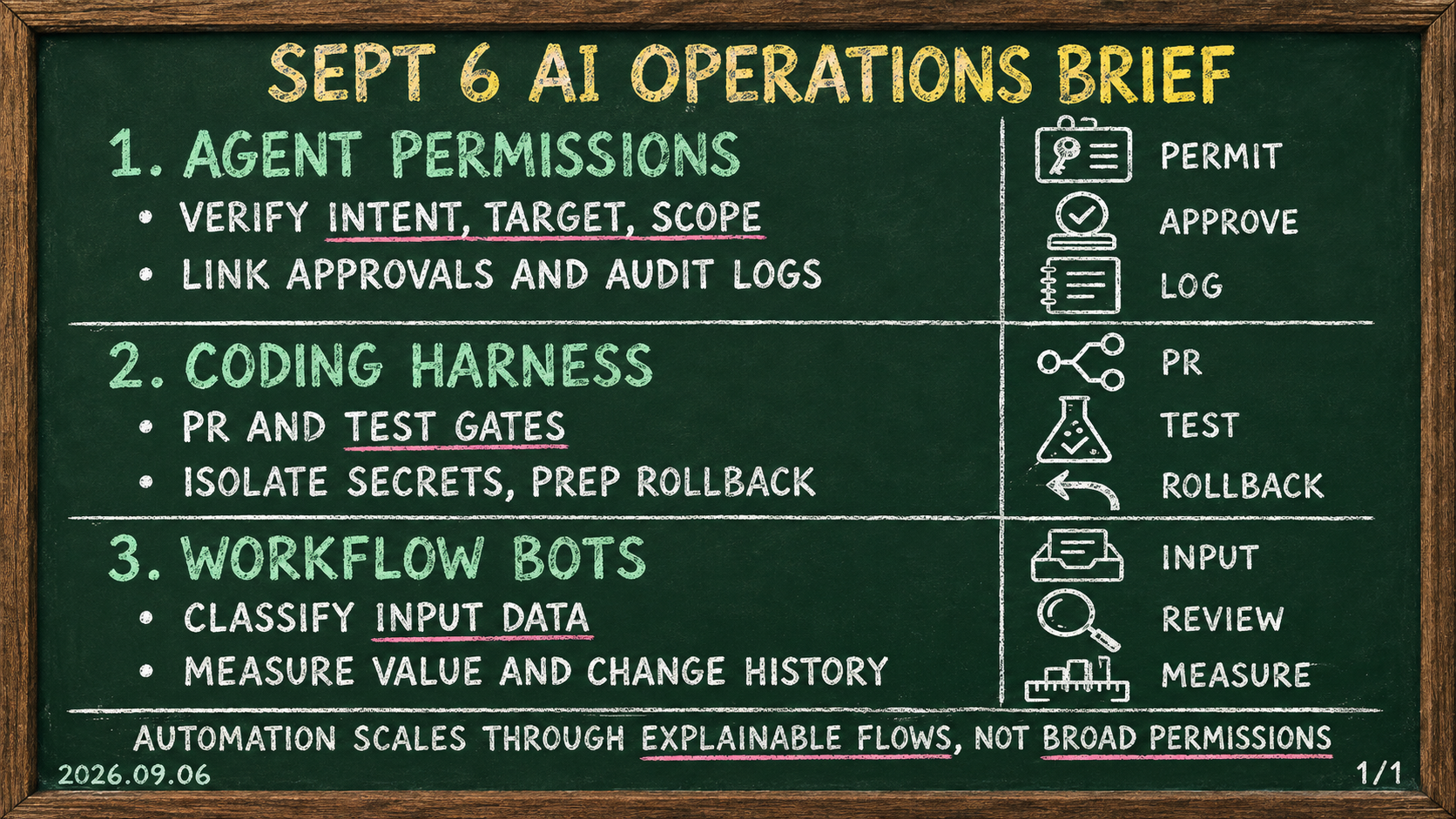
Today’s operating points
The three topics can appear to belong to different products and departments, yet they lead to the same questions. Who requested work from the agent, and for what purpose? Which data and tools may the agent use? Who verifies what before execution? What changed after execution, and how far can the team roll back if something goes wrong? Automation becomes a reusable work path rather than a feature demonstration only when these questions can be answered. In adoption discussions across Korean enterprises and public organizations as well, execution authority, approval, and audit records need to be designed as one request flow instead of separate documents.
- Separate the access rights granted to an agent from the execution authority allowed for a specific request.
- Apply coding-agent output only after it passes PR, testing, secret-management, and rollback controls.
- Manage workflow bots with data classification, approval points, the value of results, and a history of changes.
1. Agent security must address execution intent and approval records, not only a list of permissions
An ITDaily interview raises the issue that AI agents may access data and act outside their original purpose, and introduces the view that context and intent must be assessed alongside access authority. This makes agent security more than an extension of ordinary account-permission management. Even with the same right to read a document repository, a lookup for an internal summary and collection of contact details for an external send have different purposes and downstream effects. Even with the same messaging tool, creating a draft, posting to a designated internal channel, and sending to a customer or external partner cannot be treated as the same execution. A permission table should be operating data that includes target resources, allowed actions, request purpose, whether external transmission is involved, approval conditions, and expiry conditions—not merely a service-name list.
 Source · ITDaily[인터뷰] “AI 에이전트 보안, 핵심은 ‘의도’를 읽어내는 것”The interview with Proofpoint SAK VP JP Yu frames agent security as an issue of assessing the context and intent of behavior outside the original purpose, alongside access authority.
In practice, a policy layer must separate “the agent can do this” from “the agent may do this now.” A model may propose a tool call, but the tool service should separately decide whether to allow it using the requester identity, agent identity, work purpose, target scope, action type, and approval status. Read-only search and limited internal drafting can be automated within a narrow scope. Data deletion, permission changes, external messages, and actions connected to contracts or payments are better routed to a queue where a person checks the target and expected change before execution. The approver is not merely a reader of the final text. This operator needs the input source, intended tool, changed target, impact scope, and cancellation or recovery method. If approval becomes a formal button press, review responsibility remains while the information needed to exercise judgment disappears.
Audit records are not an accessory for post-incident reporting. When one execution identifier connects the requester, work purpose, agent, tools used, policy decision, approval status, target resource, result, and stop or recovery action, an operator can follow the execution path instead of inspecting only the final answer. Records should not indiscriminately retain secrets or sensitive originals, but they should preserve why a policy allowed or denied an action at a recoverable level of detail. Reporting that CrowdWorks was selected for a Ministry of Science and ICT and NIA project supporting an AI-agent safety and reliability verification system shows that the infrastructure for verifying agent safety and reliability is also being treated as a domestic issue. Before expanding permissions, organizations need to verify how allow, deny, expiry, revocation, and stop states are recorded in the actual flow.
 Source · AI Times크라우드웍스, 데이터 구축 노하우로The report states that CrowdWorks was selected for a Ministry of Science and ICT and NIA project supporting an AI-agent safety and reliability verification system.
The smallest unit to inspect is one automation already in operation. Classify the data it accesses, list its callable tools, and identify the targets each tool can change. Then separate automatically executable steps from those requiring approval, and verify whether token revocation, blocking a specific connector, stopping a queue, or cancelling a change is possible when an anomaly is found during execution. With this sequence in place, security is not a device for lowering agent autonomy without exception. It is a device for controlling the speed and scope of high-impact actions while automating low-risk repetitive work on clearer evidence.
2. A coding agent’s quality is determined not only by its model, but by PR, testing, secret, and rollback boundaries in its harness
Digital Today introduces harness engineering as an answer to recurring AI coding-agent errors: the continuing work of designing and improving the environment around the model, instructions, and tools. This view does not treat a coding agent as a chat window that merely generates code. Which repository and branch the agent can access, which commands it may run, how it interprets test results, and which state it returns to after failure all affect output quality. When Korean development teams connect agents to real delivery flows, the core need is likewise not a single strong output but a repeatable validation path. A change generated by a model should be treated as a reviewable proposal, not as an immediate fact in the production environment.
 Source · Digital TodayAI 코딩 에이전트 반복 오류 줄이는 해법,Harness engineering is presented as the continuing design and improvement of the work environment around a model, its instructions, and tools to reduce repeated errors.
A clear work contract is the starting point for a harness. The request should state the scope to change, areas that must not be changed, tests that must pass, available tools, artifact format, human reviewer, and stop conditions. Rather than giving broad authority to modify an entire repository, have the agent create changes in a task branch or limited directory and route the result through a PR with human and automated checks. A failed test, unexpected file change, major lock-file change, a privileged command, or external network access is not a signal to proceed automatically; it is a signal to stop and review. This structure does not obtain a promise that the agent will never be wrong. It creates a way to find a bad change before it spreads into a broader environment.
Secret management and rollback are not peripheral harness features but core constraints. An agent work environment should not receive long-lived credentials or production secrets by default. Where they are necessary, use limited credentials appropriate to the work purpose and scope, and check that secrets do not remain in logs or artifacts. Rollback also does not work as a statement that a team will revert if something goes wrong. The work contract and deployment record need to identify which changes can be reverted, where the prior version lives, who can halt deployment, and what recovery sequence applies if data changes are involved. This is why the rationale for a coding-agent change and its validation result should remain at the PR level.
 Source · GTT KoreaAI 코딩 에이전트 스마트폰 통합 관리...다중 모델 역할 분담·세션 제어·개발 보안 강화The article addresses role separation, session control, and development security for multiple coding agents, noting that putting intermediate work into one session can needlessly consume a primary agent’s context.
In a multi-agent environment, sessions are boundaries as well as roles. Even when research, code-change proposals, test analysis, and documentation are divided among agents, the team must know what input each task received and what result it passed onward. Continually accumulating intermediate artifacts in a primary agent’s long session can make context harder to manage and blur the difference between verified fact and tentative proposal. Teams are better served by passing role-specific artifacts as reviewable files, issues, PR descriptions, and test results. A harness is not packaging that makes a model seem smarter; it is a development operating system for splitting work, validating it, and isolating failure.
3. Enterprise workflow bots need operating design for input classification, approval, and value measurement before more generative-AI features
Financial News reports that Hankook & Company Group collaborated with GaonI to revamp its Arena platform, conducted a one-week beta test in an actual work environment, and is extending generative-AI support to planning and decision work. M Today reports that the same group is expanding generative AI to employee search, document drafting, and translation, and plans role-specific workflow bots that find and summarize recurring internal information. These cases point to generative AI moving from a separate experimental screen into the search and document flows of the work platform. At the same time, when line-of-business users create or use automation, what they may enter and how far they may use its output in work decisions can no longer be managed outside the product’s functions.
 Source · Financial News한국앤컴퍼니, 업무 전면에 생성형 AI 확대 적용…"기획·의사결정까지 지원"The report says Hankook & Company Group worked with GaonI to revamp Arena, conducted a one-week beta test in an actual work environment, and supports planning and decision work.
The first question for a workflow bot is not “what should be automated?” but “what may be entered?” Internal documents, employee information, customer information, contract materials, finance-related materials, and knowledge approved for public use cannot be collected, transmitted, and retained in the same way. Where line-of-business users can create bots, the product must expose the classification of input data and the range of permitted connections. A bot that finds and summarizes recurring information intended for internal sharing should have different access conditions, reviewers, and retention policies from a bot handling sensitive personnel or contract information. If input classification remains only a principle in a document, users will choose convenient connection paths and operators will later be left tracing which material passed through which bot.
Approval does not mean having people rewrite every result. It means placing decision points around high-impact results: summaries that affect decisions, externally sent documents, cross-department sharing, and proposals connected to policy or contracts. An approval view should show the categories of materials used by the bot, the generation purpose, the target of the result, and the next intended action. The required review differs depending on whether the result is a draft, an internal reference summary, or evidence for a real work decision. As the scope expands into planning and decision support, the source and freshness of the result, whether a person reviewed it, and the action that followed should remain at the request level. Fluent generative-AI output is not evidence that the result is an approved work decision.
 Source · M Today한국앤컴퍼니그룹, 사내 업무 플랫폼에 생성형 AI 확대…직무별 ‘업무봇’도 만든다 - 엠투데이The report covers generative-AI use for employee search, document drafting, and translation, along with role-specific bots that find and summarize recurring internal information.
Value measurement should not end with usage counts or generated volume. For each workflow bot, distinguish the work people previously performed, the waiting time or repetitive steps it aims to reduce, the judgment that must remain with a person, the impact of an error, and the outputs actually adopted. This record is not surveillance intended to reduce automation. It is evidence of where input boundaries and approval design contributed value. A bot useful for searching and summarizing recurring information does not therefore deserve access to more sensitive data or external execution rights. Each bot is easier to expand when operated as a small work contract with a defined purpose, input classification, tool authority, review point, use of results, and history of stops and changes.
Operator’s note for the week
Today’s three flows can be put into a single review sheet. On the left, place the requester and work purpose, input-data classification, and whether untrusted external input is present. In the middle, place the tools available to the agent or workflow bot, the branch and tests for coding work, the approval queue, and stop conditions. On the right, place the execution result, actual changed target, reviewer, rollback or revocation state, and whether the result was adopted for work. This sheet is neither a security-team artifact nor a development-team artifact alone. It is a common record through which line-of-business owners, developers, and security and operations staff examine the same request from different perspectives.
The rollout sequence is easier to manage when it expands from low-impact reading and summarization, to limited internal drafts, to reviewed changes, and then to external execution. At every stage, check whether calls without authority are denied, whether work stops when testing or approval conditions are absent, whether secrets remain out of artifacts and records, and whether work already underway can be halted or reversed. Workflow bots require checks on input classification and the destination of their results; coding agents require boundaries around changes and tests; security operations require a check on the intent of requests and execution. When those reviews connect, automation expands on more explainable authority rather than simply broader authority.
The conclusion is clear. AI agents, coding agents, and role-specific workflow bots do not operate on model performance alone. Teams must verify the purpose of execution and scope of data, apply approval and validation to high-impact actions, and retain results and recovery status in the same record.
Permission control is not the final gate that blocks automation. It is the evidence system that safely opens the next scope. Organizations that connect harnesses, approval, audit records, data classification, and value measurement into one work contract can repeat generative-AI automation more reliably.
Sources
Related posts
Read →Related tools