September 4 Daily Briefing — MCP permissions, agent guardrails, and local AI on the Mac
MCP permissions, guardrails for team-operated AI agents, and Apple Silicon local inference are one operational-boundary problem. Start by mapping connections and data paths.
DAILY NEWSLETTER · 2026-09-04 · MCP PERMISSIONS · AGENT GUARDRAILS · APPLE SILICON
September 4 Daily Briefing — MCP permissions, agent guardrails, and local AI on the Mac
These three signals look like separate product conversations, but they pose the same operator question: can a team explain what it connected, who approved an action, and where its data travelled? Today’s briefing treats MCP evolution, team-agent guardrails, and Apple Silicon inference as a problem of controllable boundaries rather than maximal automation.
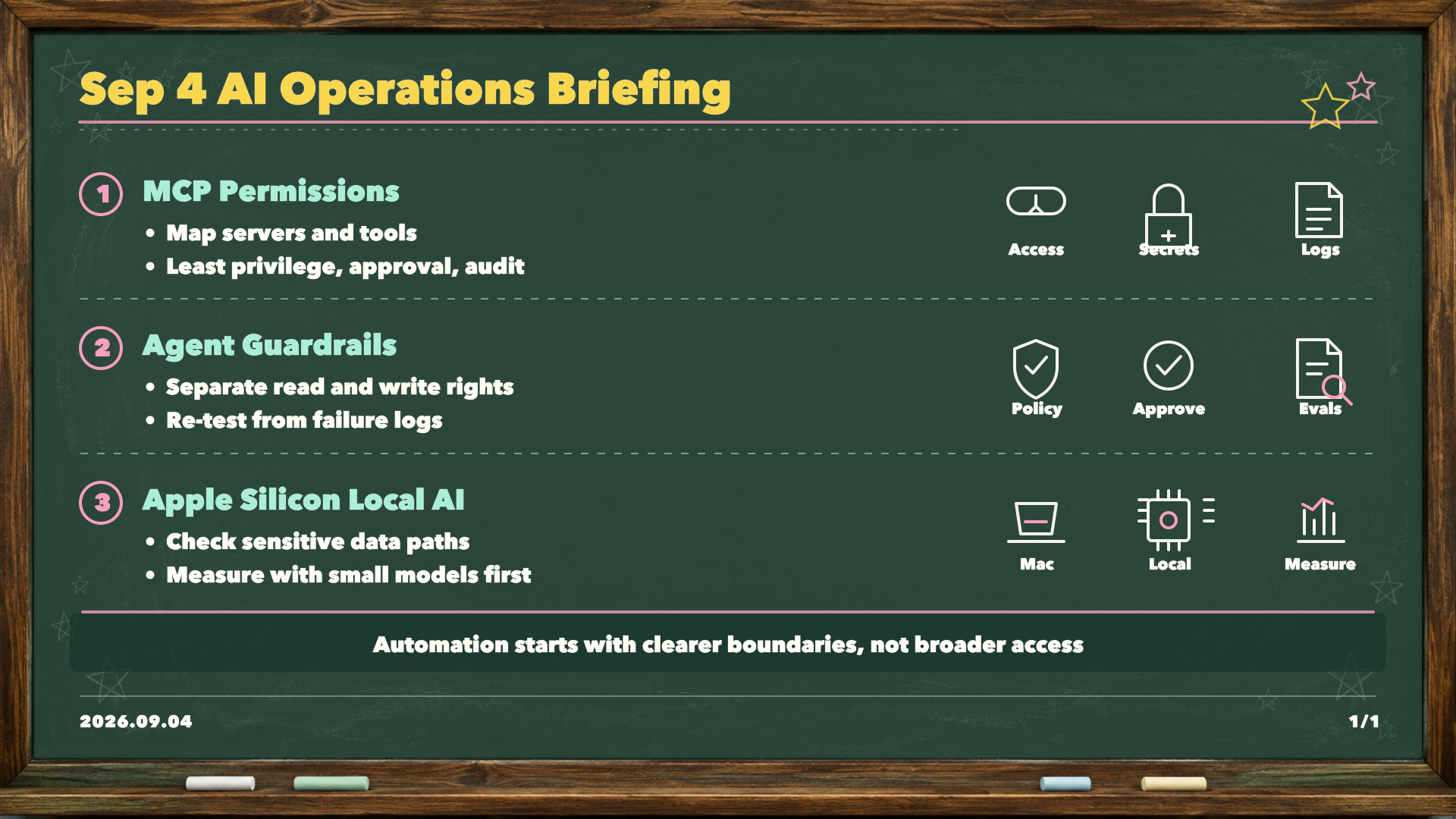
Today’s three points
First, connecting an MCP server adds an authority boundary, not merely another tool. Second, an agent becomes useful in a team through clear separation of reading, writing, and external actions—and through failure records—not through an unchecked long-running loop. Third, local inference on Apple Silicon is an option to measure data paths and model behavior directly; it is not an automatic privacy guarantee. All three require a trace that can replay a real piece of work end to end.
1. MCP security — map permissions before connecting a server
The official Model Context Protocol roadmap describes the priority areas and proposal-review path for a future specification release. It is not a certification list saying that any particular server is safe to trust. As MCP expands the layer between clients, servers, tools, and resources, teams should treat a connection as a new access path. Every tool can differ in the data it reads, the records it can change, its network reach, and the secrets it receives.
 Source · Model Context ProtocolRoadmap - Model Context ProtocolThe official roadmap explains priority areas and the proposal-review path for the next specification release.
 Source · Model Context Protocol BlogThe New MCP RoadmapThe MCP project shares the public direction of its roadmap through this announcement.
Build a short inventory before deployment: server name and location, exposed tools and resources, callers, authentication, secrets, data scope, write capability, and external egress. Then default-deny at the tool level. Search and retrieval, file edits, account changes, payments, deployments, and outbound messages should not share one permission tier. Inject credentials only at run time and only with the required scope; separate development, staging, and production credentials. An approval should show the target, parameters, recipient, and data scope—not just a vague “continue?” button.
Security testing must go beyond reproducing a friendly demo. Mcploitable presents a deliberately vulnerable MCP server for agent-security training, mapped to the OWASP Top 10 for Agentic Applications. A training environment like this lets a team examine tool descriptions, untrusted input, excess authority, and unexpected tool combinations without touching a business server. It does not prove that a company’s own connector is vulnerable; real testing still has to use its actual client, model, policy, and permissions.
2. Agent guardrails for teams — limit execution instead of relying on the model
An agent may search, read documents, execute code, open tickets, and send messages behind a single answer surface. Managing that requires more than prompt quality. For each job, retain the inputs, tool calls and parameters, and the policy decision—allow, deny, or wait for approval—as one connected record. Teams operating across distinct roles, data locations, and responsibilities should not copy a personal-experiment permission set into shared production work.
 Source · AnthropicBuilding Effective AI AgentsAnthropic outlines capability, safety, and technical considerations for reliable AI agents.
Start by splitting permission by action. Open read-only search and internal summarisation on a narrow data scope; keep writes in a sandbox or draft state. Put separate approval and revalidation around irreversible actions such as external transmission, customer-data access, account changes, and deployment. If a target or parameter changes after approval, do not reuse the approval. Reviewers need the actual recipient, before-and-after values, attached data, and planned tool—not only a natural-language summary.
Failure logs are inputs to the next execution, not a blame archive. Join incomplete jobs, blocked calls, retries, tool errors, and human cancellations under the same job ID, then turn recurring failures into evaluation cases. Test not only whether the answer was correct, but whether a prohibited tool stayed unused, whether outbound transmission was attempted before approval, and whether the agent stopped safely after an error. NIST’s AI RMF provides a framework for managing AI risk in organisational context; use it as a repeatable loop whenever the model, connector, or policy changes.
 Source · NISTAI Risk Management FrameworkNIST provides a framework for managing AI risk within an organisation’s operational context.
3. Apple Silicon local AI — verify the data path, not the word “local”
Local inference on Apple Silicon can be a practical option for teams validating smaller models and focused workflows on a Mac. MLX is published as an array framework for Apple silicon, while Core ML is Apple’s documentation path for integrating machine-learning models into apps. Neither source says that one open model fits every business task. They do establish separate layers—hardware, framework, and app integration—that a team can measure for latency, memory, quality, and operating burden against its own data.
A privacy decision cannot end with a claim about the chip running the model. Check how text and attachments enter the app; where embeddings and logs are stored; whether update checks, analytics, remote inference, plugins, or cloud backups create network requests; and how error reporting or screen sharing works. A “local” label is only a clue. Test the core task with the network blocked, inspect firewall or proxy logs, and verify which user permission owns outputs and caches.
Keep the first rollout small. Choose one low-sensitivity task with an easily reviewed answer—summarisation, classification, or draft assistance—and run the same inputs through the local and existing cloud paths. Record quality, latency, memory, failure rate, and operator review time. Then document egress rules, retention, model-file provenance and update ownership, and response to a lost device or changed account. This avoids both forcing weak local quality onto a task and calling every execution “local” merely because the data is sensitive.
 Source · Apple DeveloperCore ML | Apple Developer DocumentationApple’s Core ML documentation describes a development path for integrating models into an app.
Operator note
This week, map one actual agent job before connecting another tool. Draw the route from user input to model, MCP server, internal system, and external destination; attach the data type, permission, approver, and log location to every edge. A blank space is not just missing product capability—it is an operating responsibility with no owner yet.
Next, run a least-privilege experiment. Begin read-only, add narrow write authority only after measured value, make the approval surface show the intended effect, and feed denied, failed, and cancelled runs back into evaluation. Use the same discipline for local Mac inference: measure data paths, model files, logs, and remote connections. Control is not the opposite of automation; it is the condition for moving automation into more consequential work.
Today’s signal converges on one point. MCP, agents, and local AI each widen the connection surface, but operations start with clear boundaries rather than broad authority. Teams that inventory servers and tools, approve actions at the right level, and retain data-path and failure evidence can test the next capability more safely.
Before the next deployment, ask one question: when something goes wrong, can the team explain in one job record who did what through which tool, where the data went, and why the action was allowed? When that answer exists, automation becomes an operable system rather than a convenience feature.
Sources
Related posts
Read →Related tools