Daily Issue, August 24 — Policies That Verify Actions and Automation Boundaries
Today’s briefing examines authorization and security guardrails for AI agents, AWS’s Dogwood perspective on verifying sequences of actions, and the boundaries Korean teams can apply to work automation. The core question is less about what a model can answer than about which actions it may take, under which conditions, and in which order.
DAILY NEWSLETTER · 2026-08-24 · AGENT SECURITY · DOGWOOD · WORK AUTOMATION
Daily Issue, August 24 — Policies That Verify Actions and Automation Boundaries
The hardest question in connecting AI agents to work is not whether the model is smart enough. It is who authorizes the agent’s tools, what it may do after an allowed action, and whether the team can explain and revoke those boundaries in real operations. Today brings together agent authorization and security guardrails, AWS’s Dogwood perspective on verifying sequences of tool calls, and the boundaries Korean teams can use for work automation.
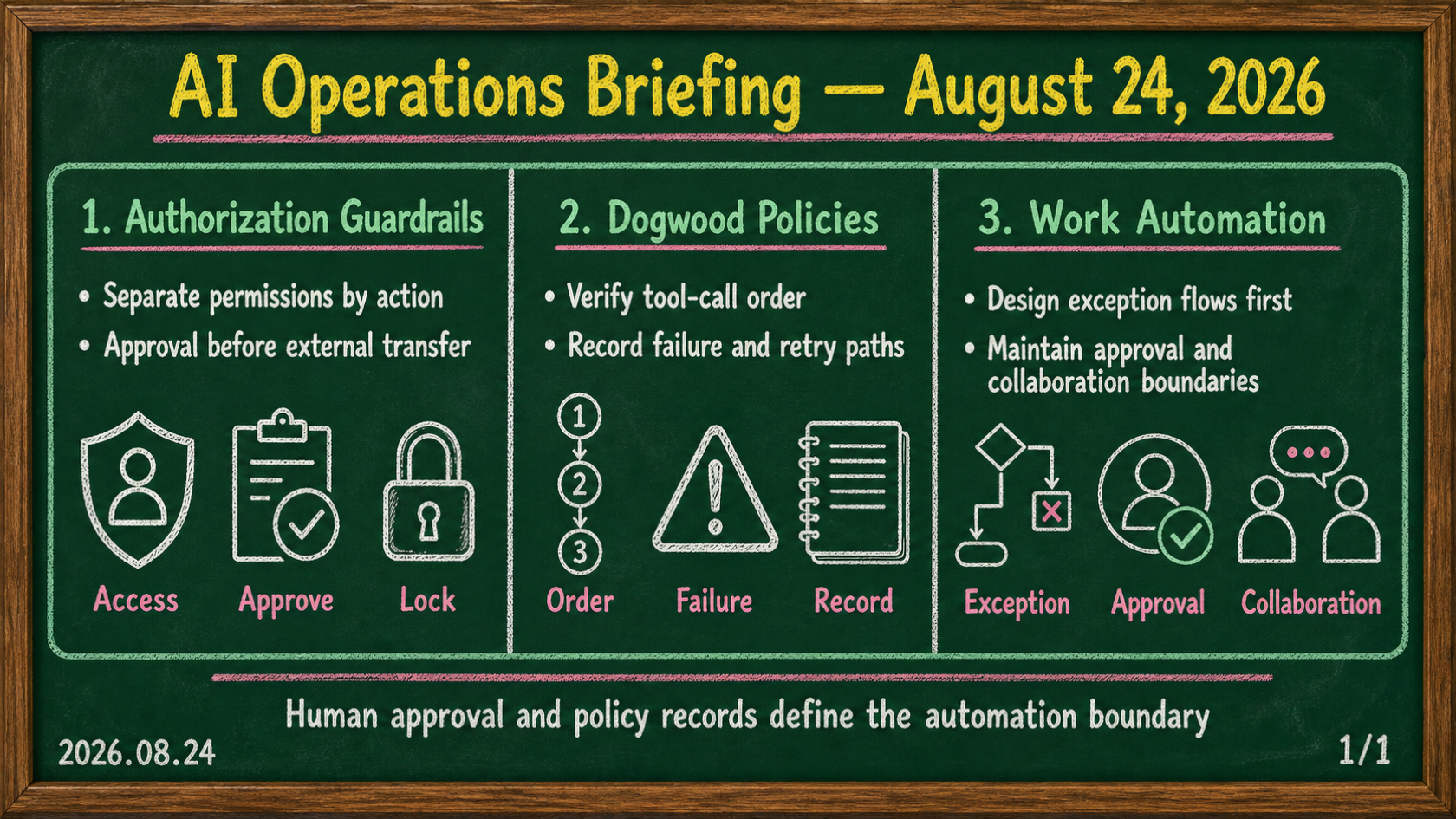
Today’s orientation — design the action path before judging the agent’s answer
Agent-adoption conversations often begin with the hours a team might save. Sorting email, finding material, drafting documents, entering data into systems, and initiating follow-up work are compelling prospects. But once those flows connect to real tools, the unit of automation is no longer a sentence; it is an action. Search, file reading, customer-data lookup, external transmission, record modification, ticket creation, and message delivery carry different risks and responsibilities. A sequence that feels natural in one chat window does not automatically deserve one shared permission.
Teams should therefore create an action map before evaluating an agent’s capabilities. How is a user request turned into structured work? Which tools can that work call? Does each tool only read, transmit information outside the organization, or change state? Does a later action depend on an earlier result? Where should work stop, seek approval, or be reviewed again? Those questions turn an abstract discussion—“Can we use an agent?”—into an operational one: “Can we automate this work within this boundary?”
Today’s three subjects sit at different layers but lead to one conclusion. First, authority should be divided by action and target rather than granted broadly to an agent as a single actor. Second, tool calls should be reviewed not only for individual success but also for their order and conditions. Third, work automation for Korean teams should begin with flows that reveal exceptions and preserve responsibility, not with a plan to remove people. Automation quality appears in how quickly unexpected actions can be blocked and explained, not in how much work is handed over at once.
1. AI agent authorization and security guardrails — attach authority to action context, not just a role
A common mistake in agent authorization is copying a person’s job-level access into one broad service account. The fact that an employee may access a customer-management system is different from allowing an agent acting for that employee to read, modify, and transmit every customer record to external services. A person normally uses work context, organizational rules, peer review, interface warnings, and situational judgment together. An agent acts through the tools, credentials, inputs, and policies provided to it. Ignore that difference and automation created for convenience can acquire a much wider execution path than expected.
Guardrails are more than one feature that blocks “dangerous requests.” In practice, requester verification, target restriction, per-tool scope, data classification, execution time, approval requirements, retry conditions, and record retention need to work together. A report-drafting workflow, for example, can automate internal-document search and summarization while leaving external delivery as a separate step. A customer-record workflow can separate proposing a new value from actually saving it. These distinctions are not intended to slow work; they apply different controls where the risk changes.
It is especially important not to read a natural-language request as execution authority by itself. “Send the latest material to the client” may leave recipients, document scope, freshness criteria, attachments, timing, and editing authority unspecified. An agent may infer those blanks, but whether the organization accepts that inference as automatic execution is a separate policy question. A safer flow turns language into an executable proposal, confirms its target and outcome, and then performs only limited actions with the needed authority.
Source · TechTargetAI agent security must move beyond human-in-the-loop, experts sayA report on the view that AI-agent security cannot rely on human review alone. Source · AWSAuthoring Dogwood policies from natural language in Amazon Bedrock AgentCoreAWS introduces the subject of authoring Dogwood policies from natural language in Amazon Bedrock AgentCore.Adding a human reviewer does not automatically make a design safe. If approvers repeatedly see a context-free approval button, people become a delay mechanism rather than a meaningful control. Human involvement belongs at boundaries that require judgment: actions that create cost, irreversible changes, external transmission of sensitive data, access to new targets, and exceptional authority expansion. Conversely, routing every bounded, reversible, repetitive read operation through a person removes the value of automation and buries meaningful warnings in noise.
A useful guardrail does more than permit or deny. It shows why an agent stopped, which information was missing, which policy condition did not match, and what a user should confirm next. Policy should therefore be part of the product flow rather than a rule collection understood only by operators. Users need to see the scope before execution, approvers need to see grounds for judgment, and operators need to see policy outcomes and call paths. Since those roles need different information, the purpose and exposure of records must be designed together.
Authority revocation must be prepared from the beginning. If stopping one tool requires turning off an entire agent, the team faces an unnecessarily large choice between safety and business continuity. Tools, connection targets, service accounts, data categories, and policy rules should be independently suspendable where possible. This structure allows a team to start a new automation narrowly and reverse it narrowly when trouble appears. A system whose authority can be reduced and revoked clearly is better suited to operations than one that only makes granting access easy.
2. Dogwood and sequence verification — move from “what was called?” to “in what order was it called?”
AWS introduces Dogwood for runtime verification of AI agents, while related coverage describes it as a policy language for governing sequences of agent tool calls. The important perspective is that checking whether an individual tool call belongs to an allowlist may not be sufficient. An action can be acceptable on its own yet operationally unacceptable when combined with a preceding action or performed after a required stage has been skipped. In environments where agents assemble multi-step work, policy needs to examine both an action inventory and an action sequence.
Imagine a team automating a flow that searches internal material, organizes results, and posts them to an external collaboration tool. Even if every tool is individually allowed, the outcome changes depending on whether the task scope was established before search, whether a review stage occurred before posting, or whether a failed execution leads to a duplicate restart. This is not a claim about a specific product behavior. It is the kind of operating question that sequence-based policy is meant to surface. Policy asks not only, “May this tool be used?” but also, “May it be used now, after these conditions have been met?”
When reading the name Dogwood as a starting point for adoption review, teams should define the policy boundary before focusing on the language itself. Which tool calls will be recorded? What request identifier binds one unit of work together? How will a user request, an agent plan, a policy decision, and actual tool results be connected? How will failed and cancelled calls be represented? Without this foundation, even sequence verification is hard to explain operationally. A policy engine does not create context on its own; it can make meaningful decisions only inside the work boundaries a team has defined.
Source · AWSIntroducing Dogwood: runtime verification for AI agentsAWS introduces Dogwood as runtime verification for AI agents. Source · InfoQAWS Open-Sources Dogwood, Extending Cedar to Govern Sequences of Agent Tool CallsInfoQ reports on AWS open-sourcing Dogwood and the framing of governance for sequences of agent tool calls.Policies that handle action order are especially valuable in exception handling. Automation often creates its hardest problems on failure paths rather than normal ones. When an external system response is delayed, is retry allowed? If the first call succeeded but the next one failed, can a restart create a duplicate change? May a task that waited for approval execute later under the same conditions? If a user cancels, are any scheduled downstream actions still able to run? These are closer to execution-state management than to the quality of a model’s answer.
Rather than modeling every possible path perfectly from the start, a team should choose several genuinely risky transitions. Moving from read access to write access, from internal data to external transmission, from a user-confirmed action to an unattended repeat, and from a primary tool to downstream work are sensible early candidates. Defining allow conditions, denial conditions, approval conditions, expiry conditions, and record conditions at each transition turns policy from a complicated rulebook into executable operating rules.
A natural-language approach to policy writing belongs under the same discipline. Natural language can help produce a policy draft quickly or support conversation between operators and security teams. Yet ambiguity remains when a sentence becomes an executable rule. “Do not send sensitive information outside” and “Run important work only after approval” express clear intent while leaving targets and exceptions unclear. Teams should collect requirements in natural language, then resolve them into checkable conditions involving real tools, targets, states, and time.
Sequence verification is not only a mechanism for expanding surveillance. It makes automation’s promise clearer to users and operators alike. Users know where work pauses; developers know which tool contracts they must preserve; security teams know which bypass paths to test. Without this shared language, automation can easily become a black box that creates a new exception each time. Even brief documentation of permitted and prohibited flows helps a team add features while retaining responsibility boundaries.
3. AI work automation for Korean teams — define work boundaries and exception flows before pursuing efficiency
When Korean organizations discuss AI work automation, expectations often include reducing repetitive work, speeding up document processing, supporting customer response, drafting reports, and connecting collaboration tools. Related reporting on AI work automation reflects interest in this direction. But no single automation structure fits every team. Work regularity, data sensitivity, customer impact, approval culture, legacy-system connections, and owner responsibility all differ. The starting point is not “What should we give to AI?” but “Which judgments must people continue to own?”
The most practical unit is not handing over an entire job. It is separating repetitive, verifiable stages inside it. Extracting action items from meeting notes into a draft list, classifying inquiries by type, filling a defined form, or gathering candidate information from documents into a comparison table can begin in constrained scope. Confirming a customer commitment, changing contract terms, or making sensitive personnel, evaluation, or financial judgments has greater consequences and needs clearer review and approval paths. Tasks that appear in the same interface do not carry the same risk.
Work-automation boundaries cannot be set by a technical team alone. Business operators know where real exceptions occur; operations staff know the recovery order when work stops; security teams know the limits of data and authority; leaders set responsibility and performance standards. If these roles do not review the flow together, automation can process normal cases quickly while leaving exceptions as larger confusion. In an initial design, agreeing who can review, correct, and stop an automated result matters more than perfect integration.
Source · AWSSecuring AI agents with temporal policies in Amazon Bedrock AgentCoreAWS covers the subject of securing AI agents with temporal policies in Amazon Bedrock AgentCore. Related coverage · AI TimesAI 업무 자동화 관련 보도 — AI타임스A related report to consult when considering discussion of AI work automation in Korea.Korean teams should examine how automated results meet existing approval, collaboration, and customer-response flows. Who verifies an automated proposal? How is a person’s correction reflected in the next automation? Who takes over when the owner is unavailable? How should customers or colleagues be informed when an error occurs? Automation may temporarily speed work by bypassing existing procedures, but it can later make responsibility and change history difficult to reconstruct. Simplifying a workflow is not the same as removing control.
Small pilots need small, explicit measurement criteria. A team can track processing time for an inquiry-classification draft, the proportion of results modified by the owner, the number of jobs paused pending approval, or the number of incorrect deliveries blocked before they occurred. Looking only at output volume makes it easy to miss rework and hidden review costs created by automation. Automation earns operational trust not through a dramatic demonstration, but because mistakes are easy to discover, correct, and stop before the next execution.
Time conditions matter in work automation as well. Information created in the morning may not mean the same thing in the afternoon. Authority can be valid only during a specified period. Some work must not execute after a deadline. An approval may need confirmation again after a set interval. These questions connect to the issue signaled by AWS material on temporal policies. Automation must decide not simply whether it can act, but whether it may act now, in this state, under these conditions.
Finally, teams should distinguish a personal productivity tool from an organizational execution system. A tool that organizes a person’s notes or drafts text cannot be governed by the same standard as one that accesses customer data and changes external systems. The latter needs much stronger attention to authority, records, exception handling, and stop procedures. Making the distinction early supports two-speed operations: quick experiments for low-risk work and expansion only after appropriate controls exist for high-risk work.
Operator’s note
A useful action for today is to choose one team agent and list not merely “what it can do,” but “what consequences it can leave.” Write down external message delivery, data lookup, file creation, record modification, ticket creation, scheduled execution, and downstream tool calls. For each action, add a target, authority, approval, expiry, and logging field. This becomes both a security document and a product requirement. It also reveals where the user-facing flow diverges from the flow that operators must control.
Next, choose one workflow where order matters. Write whether a summary can be created only after information gathering, whether posting can happen only after review, and whether no downstream call may run after cancellation. Three to five rules are enough at first. The goal is not to anticipate every possibility, but to make action paths the team will never permit unmistakably clear.
Human review should be repositioned rather than eliminated. Use constrained automation for repetitive, reversible work, and place richer review at points involving cost, external transmission, sensitive information, customer commitments, or authority expansion. An approval view should show more than a confirmation phrase: it should show the target, expected result, change scope, expiry, and cancellation method. If a system hides information an approver needs for judgment, approval is unlikely to be a meaningful control.
The final check is revocation and recovery. If a specific tool is turned off, what happens to work already in progress? If authority is revoked, do scheduled jobs stop too? Who receives an alert on a policy violation? Can the full path from request to result be reconstructed from records? Behavior during failure, cancellation, retry, and authority withdrawal is a stronger measure of operating maturity than success rates on the normal path.
The next advantage for AI agents is not only connecting more tools. It is establishing who may take which action, which actions must follow which earlier conditions, and whether operators can explain and revoke those boundaries. The Dogwood-related announcements from AWS and the broader discussion of agent security show this question moving beyond the model and into operating design.
Korean teams can begin from the same principle. Do not delegate a whole job at once; separate small, verifiable stages first. Attach authority and records to each action, place policy at transitions where sequence matters, and assign ownership for exceptions and stops. A durable form of productivity comes not from a vague promise that automation replaces people, but from boundaries that people and systems can responsibly share.
Sources
- Introducing Dogwood: runtime verification for AI agents ↗
- Authoring Dogwood policies from natural language in Amazon Bedrock AgentCore ↗
- AWS Open-Sources Dogwood, Extending Cedar to Govern Sequences of Agent Tool Calls ↗
- Securing AI agents with temporal policies in Amazon Bedrock AgentCore ↗
- AI agent security must move beyond human-in-the-loop, experts say ↗
- AI 업무 자동화 관련 보도 — AI타임스 ↗
Related posts
Read →Related tools