Daily Issue, August 25 — Split Authority, Code the Policy, Verify the Workflow
Today’s briefing connects AI-agent authorization and security guardrails, AWS material on authoring Dogwood policies and temporal policies in Amazon Bedrock AgentCore, and practical work-automation workflows for Korean teams. The central task is not granting an agent broad access, but defining actionable boundaries around authority, data, time, approvals, and verification.
DAILY NEWSLETTER · 2026-08-25 · AGENT AUTHORIZATION · POLICY AS CODE · WORK AUTOMATION
Daily Issue, August 25 — Split Authority, Code the Policy, Verify the Workflow
The difficult part of connecting AI agents to real work is not measuring how much the model can do. It is deciding who authorizes each action, which API keys and data an agent may reach, how policy constrains the live execution path, and who can verify a result when work pauses or takes an exception. Today links agent authorization, policy-as-code thinking around Dogwood, and practical automation workflows for Korean teams.
Today’s orientation — the unit of automation is an authorized action, not a conversation
An agent can receive a natural-language request, retrieve information, read documents, write to a business system, call an external tool, and schedule follow-up work. To the user, this can look like one continuous interaction. Operationally, it is a chain of actions with different consequences. Reading an internal document, looking up customer information, sending a file outside the organization, changing a record, initiating payment, and starting a deployment should not be treated as one undifferentiated permission.
That does not mean every workflow needs to become slow. It means bounded, repeatable work can run quickly while controls appear where the consequences change. Separating read access from write access, internal processing from external delivery, drafting from confirmation, and routine actions from payment or deployment allows a team to avoid relying on one all-purpose service account. The clearer the boundary, the easier it is to detect and reverse a failure in a limited scope.
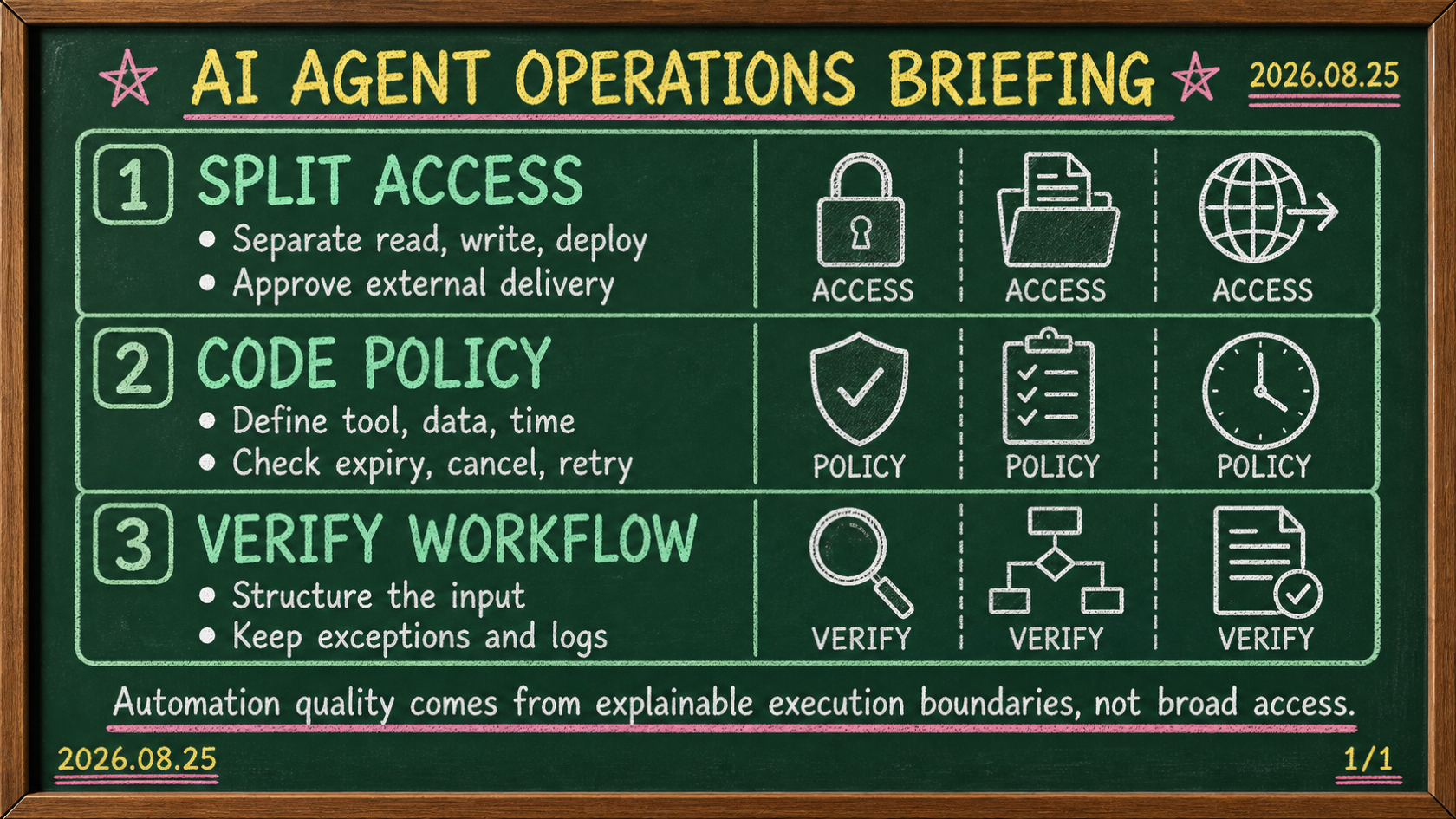
The three topics in this issue point to the same operating model. First, inventory permissions and split them by action and target. Second, translate policy intent into checkable conditions spanning model behavior, data boundaries, and runtime state. Third, build Korean work automation around document inputs, approvals, security requirements, exceptions, and verification records. A workflow proves its maturity less through a successful demo than through its behavior during revocation, pause, retry, cancellation, and recovery.
1. AI agent authorization and security guardrails — inventory access and separate actions
Start authorization design by listing the access already connected to an agent. Identify the tools it can call, the service accounts or API keys it uses, the classes of data it can read or write, the systems to which it can send results, and whether it can schedule jobs or invoke downstream tools. Without this inventory, a team adds capabilities while treating the actual execution surface as an assumption. Authority is not an abstract attribute attached to an agent’s name. It is operational information distributed across tools, targets, actions, time windows, and request context.
Then separate reading, writing, payment, and deployment. An agent that retrieves and summarizes material does not need the same controls as one that changes a customer record. Work that creates financial cost or triggers deployment can have narrower authority and more explicit approval requirements. External delivery can remain a distinct stage after internal drafting. These are not claims about a particular product feature; they are a design method for matching controls to changes in consequence. Copying a person’s broad job-level access into one API credential erases those distinctions.
Natural-language requests should not be treated as execution authority by themselves. “Send the latest proposal to the client” can leave recipients, document scope, freshness criteria, timing, attachments, and edit rights unresolved. An agent can infer missing details to prepare a proposal, but confirming an external delivery is a separate action with a separate policy question. A safer pattern structures the proposed action, lets a user verify its target and expected result, and permits the actual tool call only within an approved scope.
 Source · NISTAI Risk Management FrameworkNIST material for framing the management of AI-related risk.
A guardrail should do more than return allow or deny. Operators need to know which policy condition stopped a request, users need to know what is missing, and approvers need enough context to judge the target and scope of the change. If an approval screen only offers a button and hides the target, expected outcome, change scope, expiry, and cancellation method, human review is unlikely to function as a meaningful control. At the same time, requiring equally heavy approval for every reversible, narrow read operation can bury important signals in routine noise.
Secret isolation belongs in the same design. A shared key spanning every connection makes a problem difficult to contain. Credentials should be scoped to a tool or target where possible, and a team should be able to suspend a particular connection independently. Logs should link the request, policy decision, tool invocation, result, and approval or denial rationale. They should support reconstruction of the path from request to outcome rather than serve only as an archive after the fact.
Finally, build revocation and a kill switch into the workflow from the beginning. If a suspicious connection can only be handled by disabling the whole agent, safety and business continuity are forced into an unnecessarily large trade-off. Tools, service accounts, data categories, connection targets, scheduled jobs, and policy rules should be independently suspendable where practical. Teams should also test what happens to in-flight and scheduled work when authority is withdrawn. The critical question is not only whether access can be granted, but whether it can be stopped narrowly and reversed clearly.
2. Dogwood policy language — translate natural-language intent into policy and execution boundaries
AWS presents both authoring Dogwood policies from natural language in Amazon Bedrock AgentCore and securing AI agents with temporal policies in Amazon Bedrock AgentCore. The operational question raised by those topics is straightforward: policy must cover more than the words a model produces. Teams need to distinguish the model that proposes an action, the data involved, and the runtime state in which a tool call is attempted. Before concentrating on a language or syntax, define the boundary that the policy is meant to govern.
The first boundary is the model. It can interpret a request and suggest the next action, but a suggestion is not automatically an authorized execution. The second is data. A retrieval tool may touch public material, internal general documents, customer information, or sensitive work records, and those categories should not be treated identically. The third is runtime state: actual tool calls, prior results, approval status, cancellation, execution time, and retry state. Policy becomes the operating contract that determines which proposed actions may reach which data and tools under those conditions.
Policy-as-code thinking can also make cost, security, and reproducibility visible. It can express when an external call is permitted, which actions can create cost, how duplicate work is handled on retry, and when an approval must be renewed. A natural-language policy draft remains a starting point, however. “Run important work only after approval” leaves key terms unresolved: what counts as important, who approves, how long approval remains valid, which exceptions exist, and what constitutes execution. An operational policy resolves those gaps into conditions that can be checked against real tools, targets, states, and time.
 Source · Amazon Web ServicesAuthoring Dogwood policies from natural language in Amazon Bedrock AgentCore | Amazon Web ServicesAWS introduces the topic of authoring Dogwood policies from natural language in Amazon Bedrock AgentCore.
 Source · Amazon Web ServicesSecuring AI agents with temporal policies in Amazon Bedrock AgentCore | Amazon Web ServicesAWS covers the topic of securing AI agents with temporal policies in Amazon Bedrock AgentCore.
Time is a practical example of a policy boundary meeting real work. A task approved in the morning may not be eligible to run later in the day. A scheduled job may need to stop after a deadline. An approval may need confirmation after a defined interval. A cancelled request may need to block all downstream calls. In each case, the question is not simply whether a tool is allowed; it is whether the tool is allowed now, for this request, in this state, after the required earlier conditions have been met.
Once the policy target is clear, testing becomes more concrete. Teams can examine an attempted write without approval, an external delivery that bypasses review, a retry that could create duplicate work, or a scheduled job continuing on an expired approval. The practical aim is not to model every imaginable exception immediately. Start with the transitions where risk changes: read to write, internal data to external transmission, ordinary work to payment or deployment, and a primary call to downstream execution.
Policy also supports reproducibility. Operators need to know which policy was applied, when it was applied, why a request was denied, and how a change in the rule altered the execution path. If policy text and actual tool contracts diverge, the system becomes difficult to predict. Policy authoring, code review, runtime logs, and exception documentation should therefore be treated as different representations of one work boundary, not as isolated artifacts owned by separate teams.
3. AI work automation for Korean teams — treat documents, approvals, security, and exceptions as one workflow
AI work automation in Korean organizations will meet established practices for documents, approvals, collaboration, and customer communication. Constrained work can begin with extracting action items from meeting notes into a draft list, classifying inquiries, filling defined templates with candidate information, or organizing material from several documents into a comparison table. Work that confirms a customer commitment, changes contract terms, or affects sensitive personnel, evaluation, or financial judgment needs clearer review and approval routes. Tasks displayed in the same interface do not necessarily carry the same operational consequence.
Anthropic’s published guidance on effective agents recommends beginning with simple, understandable agent workflows. That is a useful approach for organizational automation as well. Instead of connecting every system at once, make the stages visible in one workflow: input cleanup, draft generation, review request, approval or exception handling, execution, and result logging. When automation conceals human judgment, no one can readily explain the outcome when an exception occurs. When it is clear where a person intervenes and where the system pauses, even a narrow pilot can produce operational learning.
Input cleanup deserves early attention. A workflow should structure the information an automation needs where possible: document title, owner, request purpose, target system, required attachments, whether sensitive information is included, and deadline. Korean-language documents can arrive in varied phrasing and formats, so a free-form document should not be converted directly into an executable instruction. A safer flow presents extracted fields and missing items for review. When input is incomplete, it should enter a review or exception queue rather than push execution forward through assumption.
 Source · AnthropicBuilding Effective AI AgentsAnthropic’s published guidance advocates beginning with simple, understandable agent workflows.
 Source · ZapierWhat is AI automation? A complete guide | ZapierZapier material providing a general overview of AI automation and its operating context.
Approvals and exception handling are not add-ons at the end of an automation. They are part of the workflow definition. Teams need to establish who reviews an automated result, where an edited result is recorded, who takes over when the owner is unavailable, how repeat requests avoid duplicate execution, and who communicates an error to colleagues or customers. An automation that only accelerates normal cases can create more manual work in the exceptions that operational teams actually have to resolve.
Webhook and integration tests should be run separately before deployment. Test incomplete input, duplicate event delivery, a delayed or failed external response, an execution attempt before approval, and a scheduled follow-up remaining after cancellation. The point is not to complicate every integration. It is to verify which event triggers which action and exactly where work must stop. Scheduled execution follows the same logic: when timing, deadlines, approval validity, or owner availability affects the result, scheduling is part of policy rather than a mere convenience feature.
Verification logs create a shared operational record. A work item can carry a request identifier that connects an input summary, tools used, approval status, policy decision, execution result, reason for failure or cancellation, and any human correction. For business owners, that record supports handoff; for operations staff, it supports recovery; for security teams, it supports inspection of authority and data flow. Alongside volume, teams can review edit rates, paused jobs, blocked executions, retries, and duplicate-run outcomes to distinguish genuine workload reduction from new hidden review costs.
Operator’s note
Choose one agent today and create an authorization inventory. Do not only list tools; identify whether each action reads, writes, sends externally, initiates payment, or deploys. Add the target system, credential used, data category, required approver, expiry condition, and necessary log record. This is both a security checklist and a product requirement. It will quickly reveal where one API key spans unrelated tools and data categories that should be separated.
Next, set only three approval boundaries. Good candidates are immediately before external delivery, immediately before saving a record, and immediately before a payment or deployment. For each boundary, write the automatic-allow condition, human-approval condition, hard-stop condition, and approval-expiry condition. These rules do not need to be complete on day one. The important outcome is converting paths the team will never permit from ambiguous instructions into reviewable operating rules.
Third, test exception paths with the relevant webhooks. Check what happens with missing input, repeated events, cancellation while approval is pending, and suspension of a connection while work is running. A workflow that succeeds on the normal path is only a starting point. A workflow that retains consistent state and logs through failure, cancellation, retry, and authority revocation is one that an operating team can rely on over time.
Finally, distinguish low-risk personal productivity automation from an organizational execution system. A tool that organizes notes or drafts internal text can be tested quickly in a narrow scope. A tool that accesses customer data and changes an external system should expand only after it has authority separation, approvals, secret isolation, verification logs, and a kill switch. Applying one operating standard to both categories makes one unnecessarily slow and the other unnecessarily risky. Speed comes from applying different controls to work with different consequences, not from removing control altogether.
Operating AI agents is not simply a matter of connecting more tools. It requires splitting authority by action and target, translating natural-language intent into checkable policy, and recording the boundaries between model, data, and runtime execution. When approval authority, API keys, time windows, and failure states are explicit, operators can explain why an agent acted and why it stopped.
Korean work automation can begin from the same principle. Clean up inputs, place approval and exception handling inside the flow, test webhooks and scheduled execution, and connect outcomes through verification logs. Rather than delegate an entire job at once, begin with small, repeatable, verifiable stages. The objective is not to erase human responsibility, but to build an execution boundary that people and systems can responsibly share.
Sources
- Authoring Dogwood policies from natural language in Amazon Bedrock AgentCore | Amazon Web Services ↗
- Securing AI agents with temporal policies in Amazon Bedrock AgentCore | Amazon Web Services ↗
- OWASP Top 10 for Large Language Model Applications | OWASP Foundation ↗
- AI Risk Management Framework ↗
- Agents SDK | OpenAI API ↗
- What is AI automation? A complete guide | Zapier ↗
- Building Effective AI Agents ↗
Related posts
Read →Related tools