Daily Issue, August 27 — Test the Agent, Protect the Physical Operation, Find the Hidden Execution
Agent evaluation is becoming an operating practice for measuring complete tasks, tool calls, and recovery rather than a demo score. Physical AI in manufacturing needs field data, digital-twin validation, and explicit safety stops. Agent security must also discover and control unapproved agents and their authority paths.
DAILY NEWSLETTER · 2026-08-27 · AGENT EVALUATION · PHYSICAL AI · AGENT SECURITY
Daily Issue, August 27 — Test the Agent, Protect the Physical Operation, Find the Hidden Execution
As AI moves from generating answers to calling tools and touching operational equipment, the questions change. How do we measure whether an agent completes the same task safely? How does manufacturing data connect to real safety boundaries? And how do we identify and stop agents and authority paths that were never approved? Those are today’s three concerns.
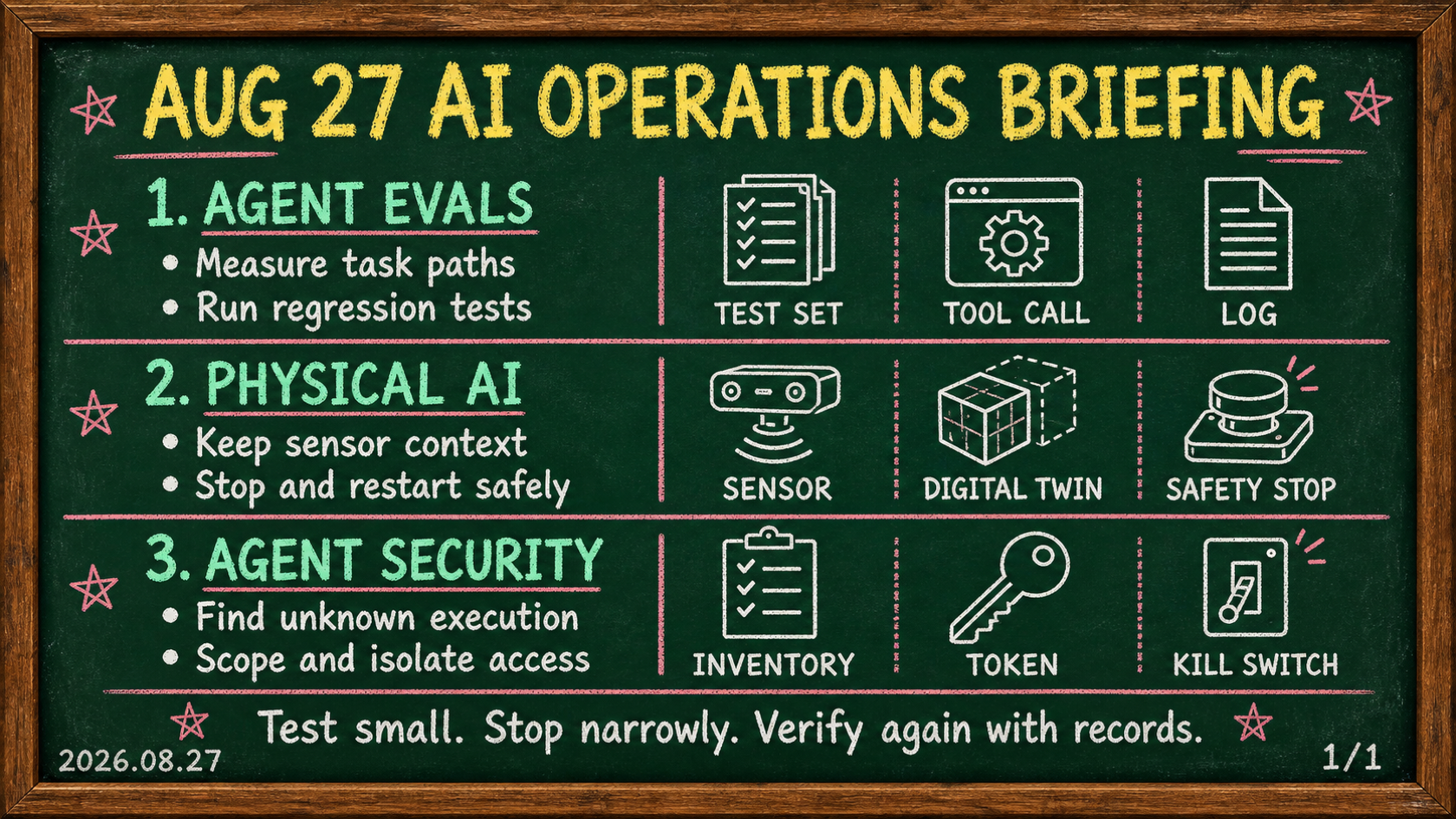
Today’s orientation — performance, physical outcomes, and authority meet in one execution record
An agent system is more than a model response. It interprets a request, retrieves material, chooses tools, checks intermediate results, and may change an external system. In manufacturing, the result can touch schedules, quality, machine condition, and worker safety. In security, the key question is who executed what with which credentials, and whether an approved scope actually covered that call. Evaluation cannot be separated from operations, safety cannot be separated from field data, and security cannot be separated from the account and token paths that make execution possible.
The practical unit linking all three topics is the execution record. For evaluation, record the input, expected outcome, tool calls, judgment, retries, and cost. For physical AI, record sensor state, environmental conditions, control commands, stops, and human intervention. For security, record agent identity, delegation, access token, policy decision, and resulting change. Connected records let a team treat a performance regression, safety event, or privilege misuse as different risks in one operational flow—not unrelated issues owned by different departments.
This is not an argument to halt automation. It is an argument to test bounded work against clear criteria, pair simulation with field validation in physical environments, and assume that unobserved agents are also operational assets. Fast expansion comes not from broad credentials or a large demonstration, but from a system that can locate a failure, stop narrowly, repair it, and verify the same conditions again.
1. AI-agent evaluation and benchmarking — measure the path to task completion, not just an answer
Agent evaluation begins by asking not only what a model knows, but how work was completed. Consider a workflow that classifies a customer question, drafts a reply, searches internal documents, updates a ticket, and routes an exception to a person. A fluent final sentence is not a success if the agent consulted the wrong document, used an unauthorized tool, or modified the ticket twice. An evaluation set should therefore cover the final artifact as well as tool choice, target scope, stop conditions, human handoff, latency, and cost.
OpenAI’s official evals guide describes using evaluations to test and improve model outputs. Applied to agents, that means defining observable pass conditions for each task. A retrieval task can be checked for whether it used an allowed information domain and returned supportable evidence. A modification task can be checked for whether it changed only approved records. An external-delivery task can be checked for whether its recipients and attachments match the reviewed scope. A broad impression such as “good answer” does not support repeatable measurement. Outcomes split into pass, hold, block, and human handoff do.
Test data should resemble the difficult parts of actual work. A collection of clean, ordinary requests makes an agent look strong in a demo while leaving it weak against ambiguous instructions, missing details, stale documents, conflicting authority, or tool failures. Include incomplete inputs, competing document versions, duplicate events, failed API responses, expired approval, and malicious or irrelevant external text. These are not traps for the model. They define the moments when the system should stop, ask, or hand work to a person.
 Source · OpenAI APIWorking with evals | OpenAI APIOfficial documentation on testing and improving model outputs through evaluations.
Source · Amazon Web ServicesAmazon Bedrock AgentCore - AWSAWS material introducing AgentCore for operating agents in application environments.
Source · OpenAI APIWorking with evals | OpenAI APIOfficial documentation on testing and improving model outputs through evaluations.
Source · Amazon Web ServicesAmazon Bedrock AgentCore - AWSAWS material introducing AgentCore for operating agents in application environments.
Benchmark numbers are useful, but they are not substitutes for a deployment decision. Public benchmarks provide a common comparison language, not a replica of a company’s tool names, document structure, approval rules, customer data, or recovery procedure. The same model can behave differently when the prompt, retrieval scope, tool schema, or retry setting changes. Use external results to narrow candidates, then decide from an internal task suite that considers completion rate, correct blocking, human review load, latency, and cost per task together.
Safe failure deserves its own outcome category. An agent that asks for missing information, refuses an out-of-scope action, or stops after a tool error without duplicating a change is showing a different—and important—capability from answer accuracy. Counting every hold as a failure rewards reckless execution. Counting every block as a success removes usefulness. Separate a completed task, a safe hold, an appropriate handoff, a policy violation, and a harmful execution according to the business consequence.
Finally, do not make evaluation a one-time pre-launch event. Rerun representative tasks whenever a team adds a tool, changes policy, refreshes a document repository, or changes model versions. When a result worsens, inspect the execution path rather than only the headline score: Did the retrieved evidence change? Did the call order change? Did an approval wait disappear? Did retries increase? This regression discipline treats an agent as a changing work system rather than software that is installed once and forgotten.
2. Physical AI in manufacturing — a digital twin does not replace a real stop procedure
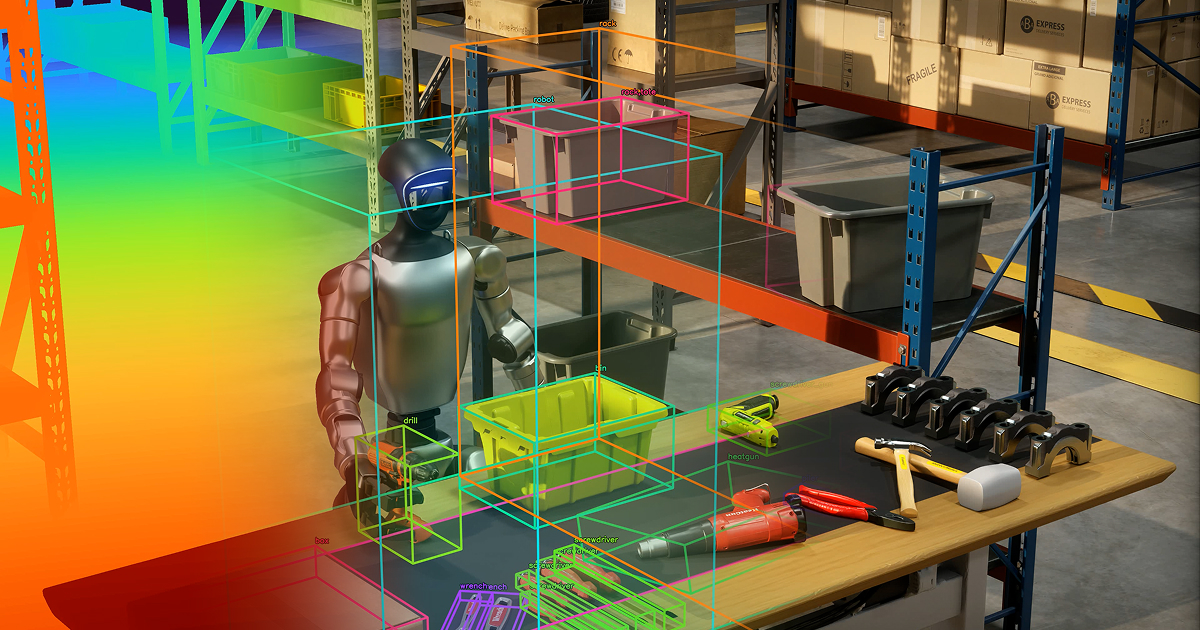
Physical AI in manufacturing goes beyond an on-screen recommendation. It handles signals from cameras, robots, conveyors, inspection machines, and work sequences. NVIDIA’s manufacturing and Omniverse material frames AI use in industrial environments and physical-AI workspaces. The key asset is not only the model; it is data that can explain which equipment, process state, and environmental conditions produced an observation. Light, reflection, dust, speed, loading, worker movement, and equipment wear can all change how the same perception or control model behaves.
That is why collecting more data is not enough. Teams need to manage where and when a record came from, its equipment and process context, and sensor-calibration status. A visual inspection set filled with normal examples does little to prepare a system for rare defects, occlusion, network delay, or changed lighting. In zones where people and equipment move together, records of near misses, manual stops, warnings, and restarts are equally valuable. They are not evidence that the model should be punished; they are evidence for whether a safety boundary works under real conditions.
Digital twins and simulation are powerful because they reduce the cost of experiments. A team can vary layout, robot paths, object shapes, camera placement, and lighting in a virtual environment to construct failure cases. Passing a simulation, however, is not authorization for autonomous operation on a production line. Real settings retain friction, part variation, sensor noise, network delay, and unpredictable human movement. Follow virtual validation with constrained field trials—limited speed, limited zone, and active supervision—and revise risk assumptions from what is observed.
 Source · NVIDIANVIDIA AI in ManufacturingNVIDIA industry material on AI applications in manufacturing environments.
 Source · NVIDIANVIDIA Omniverse for Physical AINVIDIA material introducing Omniverse for physical AI.
Safety operations should not depend solely on model confidence. Define, process by process, when automatic motion is allowed, when the system slows down or switches to human review, what signals require an immediate stop, and who may authorize restart. A safety stop is not the opposite of success. It is normal behavior that limits harm when there is uncertainty, a protected-zone intrusion, or sensor failure. Separate control commands from safety interlocks so an AI recommendation cannot bypass the safety layer.
Start with narrow, observable work: highlighting candidate defects for human review, prioritizing machine-anomaly signals, or evaluating robot paths in a restricted zone. Then review false positives, misses, production delay, manual interventions, stop frequency, restart time, and worker feedback alongside throughput. Higher output alone does not show safe adoption if operators cannot explain a stop or create informal workarounds.
Data governance is part of field safety. Video and sensor streams can contain identifiable worker information, machine operations, and supply-chain or quality data. Separate collection purpose, retention, access, external transfer, and reuse for training. In a network of plants and suppliers, one site’s data access must not silently become authority over the full production network. Link the data that improved a model with the deployed version and production line where it operates so the scope of an anomaly can be contained.
3. Agent-security controls and unauthorized-agent discovery — agents outside the inventory are still security subjects
Agent security is not completed by one prompt filter. Workplace messengers, browser extensions, automation platforms, personal API keys, experimental bots, and subagents can multiply until the list known to security differs from the actual execution population. An unauthorized agent is not necessarily malicious code. It may be an unsanctioned tool connection, a scheduled job left on a departed employee’s account, a test automation with an overly broad token, or a personal work bot that bypasses the approval route. A team cannot attach policy or accountability to a subject it has not found.
The first response is an agent inventory. Record more than a name: owner, purpose, model provider, callable tools, connected data, service account, token scope, network destinations, schedules, subagent status, and last activity. Comparing cloud logs, API gateways, SaaS administration consoles, credential stores, and browser or automation approval records helps identify undeclared connections. This is not a one-time audit. It should update when a token is issued, a tool is connected, or policy changes.
OWASP’s Top 10 for Agentic Applications for 2026 is a public framework for major risks in autonomous and agentic systems. Operationally, it means examining several layers together: inputs, planning, tools, memory, delegation, external results, and authority. Test whether instructions embedded in a web page or document change tool use, whether an agent expands privilege beyond need, whether a delegated task exits the original approval scope, and whether sensitive data reaches an unexpected destination. Monitoring that sees only a normal final answer can miss this path.
 Source · OWASPOWASP Top 10 for Agentic Applications for 2026A public security framework for critical risks in autonomous and agentic AI systems.
 Source · NISTAI Risk Management FrameworkNIST framework material for managing AI-related risk across an organization.
Control begins after discovery. Give every agent a person or team owner and a work purpose. Scope credentials narrowly by tool and target; do not put reading, writing, external transmission, payment, and deployment behind one token. Require short-lived approval and human review for high-impact calls. Treat external input as data, not trusted instruction, and validate tool parameters and targets against a separate policy rather than trusting only model-generated text. For material changes, also record whether reversal is possible and the state before and after execution.
Action logs serve service quality as well as investigation. A single request ID should connect the requester or calling identity, agent and model version, retrieved evidence, tool invocation, policy decision, approver, outcome, and reason for failure or cancellation. Do not replicate sensitive source material indefinitely in logs, but do not remove all evidence needed to reconstruct an incident either. Set a deliberate balance between data minimization and investigability, with independent access and retention controls for the logs themselves.
Practice revocation and isolation. If an agent becomes suspicious, a response limited to “turn everything off” or “do nothing” will be slow and disruptive. A team should be able to suspend a particular token, connector, data source, scheduled job, model deployment, or network destination independently. Test that in-flight work enters a safe hold, downstream calls are blocked, owners are notified, and restart requires the right review. A security control is complete not when its block button exists, but when operational teams can use it without confusion.
Operator’s note
Choose one real agent today and create an evaluation sheet with roughly ten representative tasks. For each, specify input, expected outcome, allowed tools, prohibited actions, human-handoff condition, and time or cost limit. Include missing input, repeated requests, expired approval, and tool failure—not only normal cases. Record the outcome as completed, safe hold, human handoff, policy violation, or harmful execution rather than as one score.
For one manufacturing process, draw the data flow. Identify what sensors and cameras observe, who can see the data, which signals switch automatic behavior to slow, hold, or stop, and who restarts it. Link digital-twin findings and field-trial findings to the same version record. Without that small map, model improvement and safety review can end up working from different facts.
Finally, have security and business teams do a short joint search for agents outside the inventory. Compare recently issued API keys, automation connectors, scheduled jobs, and external-transmission logs; isolate items with no known owner or purpose. Where immediate deletion is not possible, narrow token scope, block external transmission, and observe. Document the order—discovery, isolation, owner confirmation, policy registration, re-evaluation—so security becomes an operating mechanism for safe expansion rather than a last gate that blocks adoption.
An agent’s value is verified in repeatable work, not in an impressive demo. It needs evaluation that includes tool use and recovery, physical data that connects simulation to field validation, and security records that expose execution subjects and authority paths.
The most practical next step is small: test representative work, verify stop conditions in one process, and bring unknown agents into the inventory. Feed the results back into policy and the evaluation set, and automation becomes not only faster but explainable, stoppable, and recoverable.
Sources
Related posts
Read →Related tools