Daily Issue, August 30 — Verify Agent Behavior, Approve Tool Calls, Bound Payment Authority
Operating AI agents requires more than checking answer quality. Teams need to verify behavior against policy, apply scoped approval to MCP tool calls, and establish clear transaction, review, and audit boundaries for payment-related actions.
DAILY NEWSLETTER · 2026-08-30 · POLICY VERIFICATION · MCP APPROVAL · PAYMENT BOUNDARIES
Daily Issue, August 30 — Verify Agent Behavior, Approve Tool Calls, Bound Payment Authority
As agents take on real work, the question is no longer only whether they produce a convincing answer. Teams need to know whether an agent stayed within policy, acted under the right approval, and stopped before crossing an irreversible boundary. Today’s issue connects behavioral-policy verification, MCP tool-call approval, and payment authority.
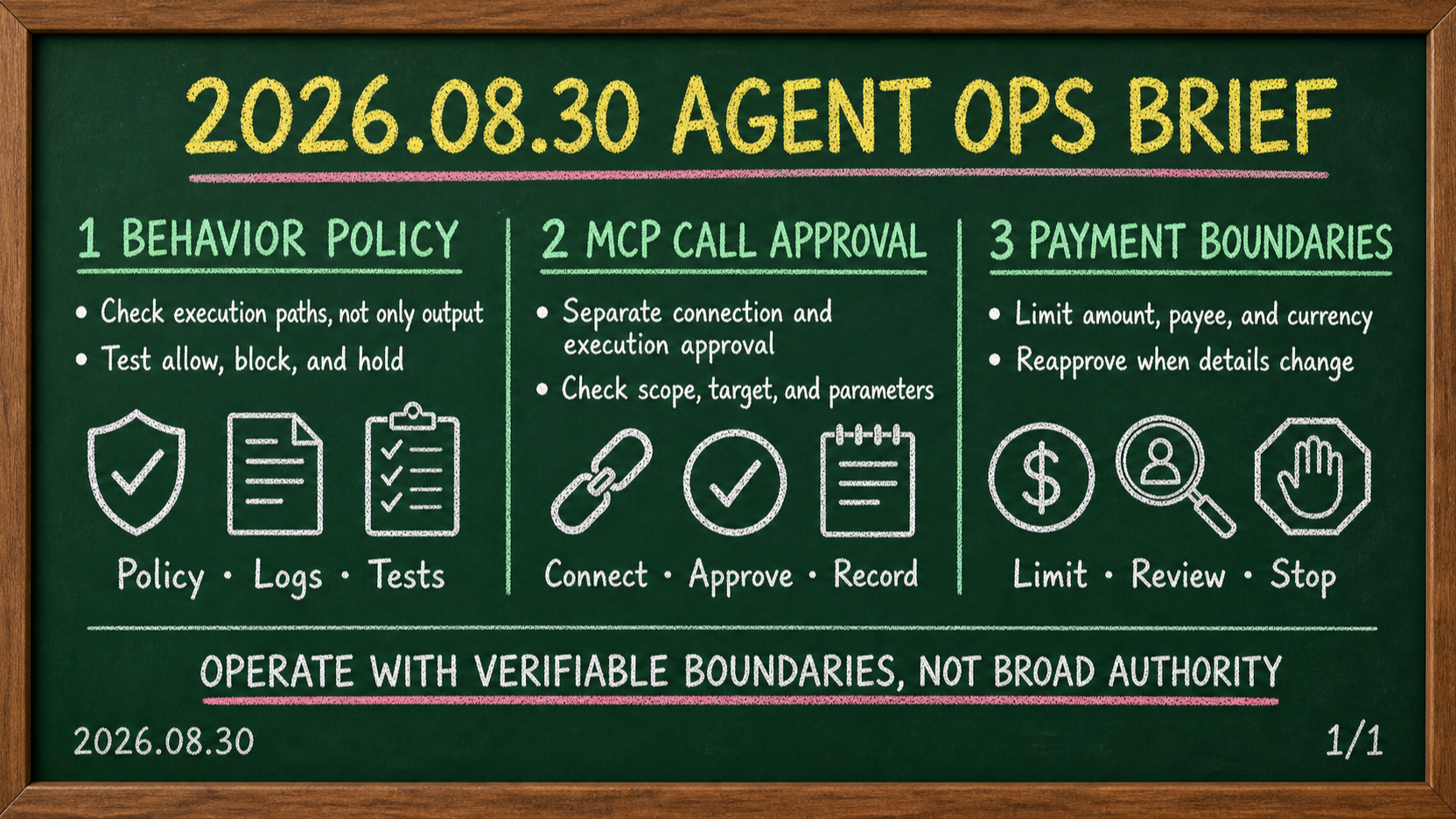
Today’s orientation — autonomy comes from verifiable boundaries, not broad credentials
An agent can now do more than read a document and draft a response. It may search internal systems, update records, send messages, call external services, or prepare a purchase and payment request. Looking only at the model’s reasoning is not enough. Operational risk appears in the selected tool, the accessed account and data, the destination and parameters of a call, and any human-review point that was skipped. The operating standard should therefore be observable behavior and recorded policy decisions—not an inferred intention.
The three subjects are one operating problem. Behavioral-policy verification asks what an agent may do and where it must stop. MCP approval asks who granted access and what scope applies to a particular tool interaction. Payment boundaries establish the amount, recipient, purpose, approver, and reversibility required before money moves. Each protects the distinction between what an agent is technically capable of doing and what it is authorized to do in this request.
Well-designed controls do not make every automation equally slow. Low-risk, repetitive retrieval can proceed within an established scope. Writing, external delivery, privilege changes, and payment-related actions can require narrower credentials and additional review. The goal is not to block every call in the same way; it is to apply approval depth according to impact. Without that distinction, teams tend to choose between manual work everywhere and excessive authority everywhere.
1. AI agent behavioral-policy verification — test the execution path, not only the result
Behavioral-policy verification asks how an agent completed work, not only whether its final text looks correct. Imagine an agent that searches internal material, updates a support ticket, and drafts a customer message. Its answer may be accurate, yet the operation is still a failure if it read an unauthorized document, altered another customer’s record, or sent the message before review. Policy needs to cover retrieval scope, tool selection, change targets, external transmission, and human handoff alongside output quality.
Policies are easier to test when written as observable conditions. “Handle sensitive information carefully” is difficult to evaluate. “Search only approved data classifications,” “modify a customer record only when the request identifier and target ID match,” and “require approval before adding an external recipient or sending an attachment” are concrete. Define whether the expected outcome is allow, block, hold, or human handoff. That makes it possible to distinguish a model-quality issue from a policy gap or an insufficient control in the tool layer.
A useful test set includes more than ordinary requests. Add missing identifiers, conflicting documents, expired authority, duplicate requests, tool failures, and instructions embedded in external material. These cases are not traps. They reveal whether the agent asks for clarification when it lacks confidence, refuses an out-of-scope action, avoids a duplicate change after failure, and routes work to an appropriate owner. A safe hold can be evidence that the policy is working rather than evidence that the system failed.
NIST’s AI Risk Management Framework provides an official framework for managing AI-related risk. For agent operations, that means considering the point where models, data, tools, users, and procedures meet. Keep representative policy tests as a recurring operating suite, not as a pre-launch checklist. Rerun them when a model, tool, document repository, or authority rule changes. If behavior regresses, inspect the changed policy decision and tool path rather than only a headline score.
 Source · NISTAI Risk Management FrameworkNIST’s official framework for managing AI-related risk.
 Source · OWASPOWASP Top 10 for Agentic Applications for 2026OWASP material covering key security risks in agentic applications.
2. MCP tool-call approval workflows — separate connection authority from execution approval
When an agent connects to tools and services through MCP, permission to connect should not automatically mean permission to perform every possible action. Tool availability and authorization for a specific call with specific parameters are different decisions. Reading a calendar and deleting a calendar entry, querying data and exporting it, or drafting a message and sending it may belong to the same service but have very different consequences. Bundling execution authority into a convenient connection makes the real boundary hard to see.
The MCP Authorization specification addresses authorization at the protocol level. In practice, authorization should be translated into narrowly scoped access. Tokens and scopes should be limited to the required server, resource, and action; dormant connections should expire or be reviewed. Read-only work should not include write authority, external-delivery rights should be separate from routine retrieval, and one credential should not silently unlock several unrelated business systems.
A tool-call approval flow should show information a reviewer can actually assess. Instead of merely asking whether tool use is allowed, show the system involved, whether the operation reads or writes, the target being affected, whether data leaves the organization, and the expected impact. An agent-generated summary can help, but it is not sufficient evidence. The actual parameters sent to the server and the result of independent policy checks must match what the approval represents.
Approval is a sequence rather than a single prompt: classify the request, inspect required scopes, add human or policy review for high-impact actions, execute, and record the decision with the result. Define retry behavior for cancellation and failure. If a tool response changes the target or the relevant context, do not reuse an earlier approval blindly. The context at approval time may no longer be the context at execution time.
 Source · Model Context ProtocolAuthorization - Model Context ProtocolThe official MCP specification covering authorization.
Source · NISTAI Risk Management FrameworkNIST’s official framework for identifying and managing AI-related risk.
Source · Model Context ProtocolAuthorization - Model Context ProtocolThe official MCP specification covering authorization.
Source · NISTAI Risk Management FrameworkNIST’s official framework for identifying and managing AI-related risk.
3. AI agent payment approval boundaries — payment authority is not one broad permission
Payment creates one of the clearest external consequences an agent can produce. That is why “the agent can make payments” is not an adequate authorization model. Collecting a purchase request, comparing quotes, building a cart, preparing payment information, and confirming a transaction should be treated as distinct steps. An agent may be allowed to organize options or prepare a draft without being allowed to commit a payment. Each stage needs different information and a different approval standard.
Practical boundaries start with scopes and transaction limits. Define the legal entity or cost center, permitted vendors, currency and amount ceiling, number of transactions covered by an approval, and approved contract or item range. Enforce those limits in the payment tool and policy layer rather than only in instructions to the model. If the model misreads an amount, recipient, or external instruction, an out-of-bound request should still stop before execution.
Human review should be proportionate to transaction risk, not a uniform click-through step. A new vendor, high value, exceptional item, recurring charge, international transfer, or altered recipient account can require additional review. A reviewer needs enough context to assess the purpose, payee, amount, currency, supporting material, and change from prior approval. If the amount, destination, or recipient changes after approval, route the request back through review rather than relying on an earlier decision.
Payment operations also need an audit trail and an isolation path. Link the request creator, involved agent and model version, policy result, approving person, execution result, and relevant transaction identifiers. Avoid copying sensitive financial data into logs unnecessarily, but retain enough evidence to reconstruct the transaction. If behavior becomes suspicious, the team should be able to suspend a particular payment token, vendor connection, account scope, or scheduled task without turning off every automation.
Source · OWASPOWASP Top 10 for Agentic Applications for 2026An OWASP framework that can inform risk review for autonomous and agentic systems.
Source · Model Context ProtocolAuthorization - Model Context ProtocolThe official MCP specification for authorization in tool and service connections.
Operator’s note
Choose one production agent and document its action boundary today: accessible data, callable tools, permitted write targets, allowable external delivery, and conditions that require handoff. Then run around ten representative cases that include not only normal completion but blocking, holding, reapproval, and recovery from failure. Record outcomes as policy pass, safe hold, appropriate handoff, or policy violation rather than reducing them to one score.
Review MCP connections by service. Check whether reading and writing, internal retrieval and external delivery, and ordinary tasks and payment-related tasks have been separated into different scopes. Verify that approval displays the real target and impact, that changed parameters trigger renewed review, and that unused tokens and connectors expire. The user-approved boundary and the server-enforced boundary must be the same boundary.
Begin payment automation with the smallest useful transaction unit. Let an agent compare options and prepare requests first, while limiting amount, currency, vendor, account, and transaction count before human approval. Connect the request, policy decision, approval, and outcome under one identifier, then rehearse stopping a single connector or credential. Boundaries designed before expansion make it easier to contain impact when something goes wrong.
Agent trust does not come from a promise that the system will “handle it.” It comes from repeatedly verifying permitted behavior, checking the right authorization context for tool calls, and applying narrow transaction limits and human review where outcomes are difficult to reverse.
The practical next step is to trace one real workflow end to end: request, policy decision, tool call, approval, execution, audit record, and cancellation path. That reveals the missing boundaries. Closing them in both policy and system layers makes an agent not only faster, but explainable and controllable in real operations.
Sources
Related posts
Read →Related tools