Daily Briefing, August 22 — Permission Boundaries, MCP Approval, and Self-Hosted Sandboxes
Today’s briefing covers how to separate agent permissions, put approvals around MCP-connected payment and data changes, and isolate self-hosted agent runtimes. It is a practical map of the operating boundaries teams need before agents become real business tools.
DAILY NEWSLETTER · 2026-08-22 · PERMISSIONS · MCP APPROVAL · SANDBOX
Daily Briefing, August 22 — Permission Boundaries, MCP Approval, and Self-Hosted Sandboxes
Once an agent begins calling real tools, operating boundaries matter before model capability. Today’s briefing connects three decisions: how to make permissions narrow, how to put payment and data changes behind an approval flow, and how to isolate a local or self-hosted runtime. The shared principle is straightforward: before handing work to an agent, build a system that can stop it, reverse it where possible, and explain what happened later.
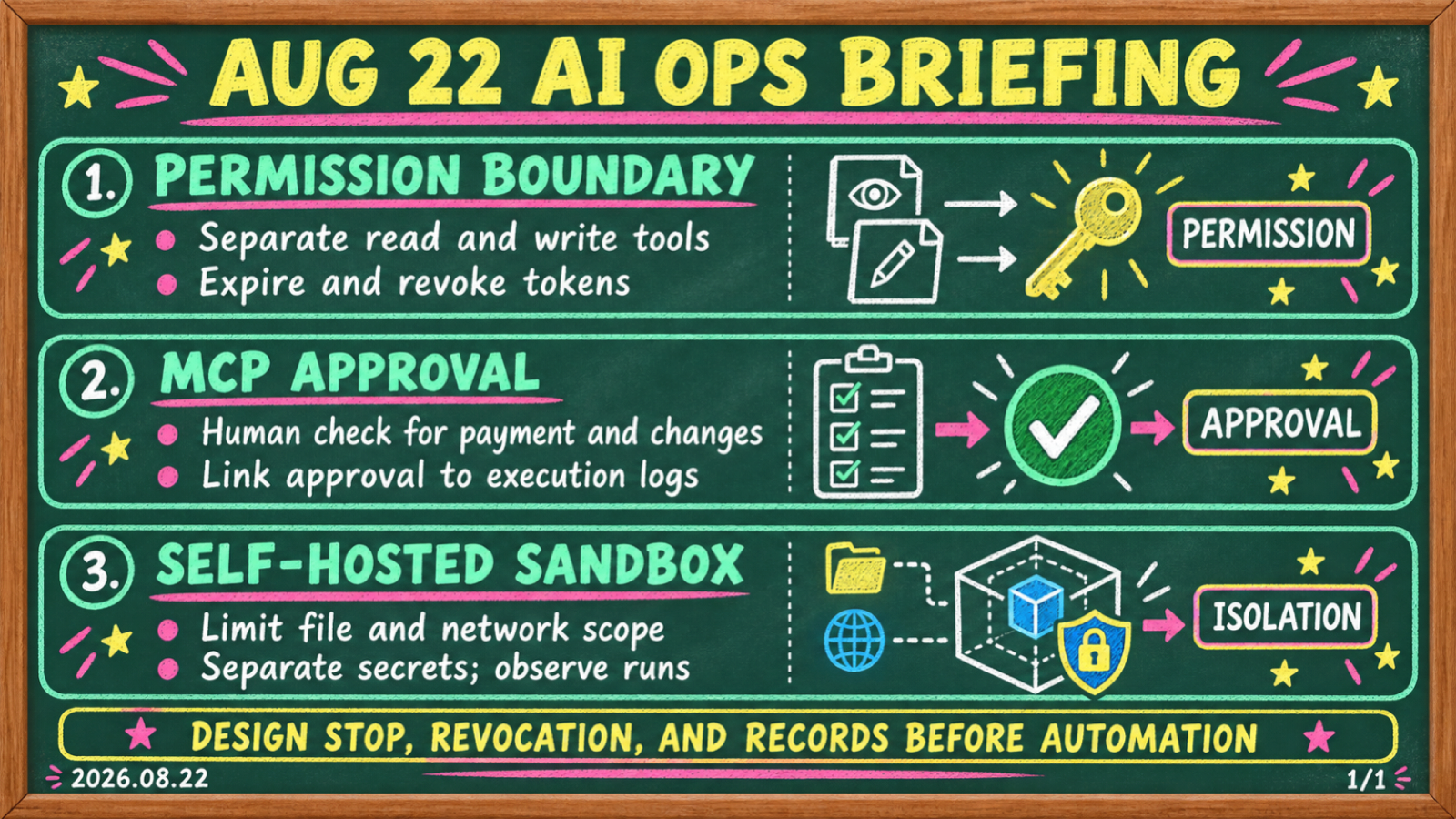
Three things to carry into today
First, an AI agent’s permissions should be broken down by tool action, not by a broad role name. Second, when MCP connects payment or data-changing tools, approval conditions and evidence should be designed before the connection goes live. Third, self-hosting can keep data and runtime closer to the team, but it does not automatically make file access, network access, or secrets safe.
1. AI agent permissions — do not confuse “can do” with “may do now”
Permission discussions are often reduced to adding an API key. In a production system, though, the same tool may read information, draft a response, send something externally, modify data, or move money. Those actions have very different consequences. Labels such as “CRM access” or “payment access” are too broad to capture them. The first decision is not the agent’s job title; it is which calls are read-only, which are irreversible writes, and who is allowed to alter that boundary.
This distinction becomes practical when a team connects Korean SaaS products or internal systems. An agent that summarizes customer support needs to read a record, but changing a customer tier or issuing a coupon needs another boundary. Looking up an invoice is not equivalent to confirming a refund. Separating tools into read, propose, awaiting approval, and execute can feel slower at the start. It sharply limits the blast radius when a workflow fails or is misused.
 Source · Model Context ProtocolAuthorization - Model Context ProtocolThis official specification establishes authorization as a distinct operating concern in an MCP connection.
 Source · IETF DatatrackerRFC 9700: Best Current Practice for OAuth 2.0 SecurityIt frames token-based access control as a security practice rather than a convenience feature.
The smallest useful unit of policy is one tool call. Assign each call a target system, permitted action, input range, executor, approval requirement, and expiry condition. “Read customer details” can return only defined fields. “Draft a reply” can have no ability to send it. “Create a refund request” can be automated while “confirm refund” stays behind a human check. This is a stronger control surface than telling a model to be careful in a prompt.
Revocation belongs in the same design. When a project ends or a role changes, the team should know how API keys, sessions, connected tools, and scheduled jobs stop. A global kill switch can be necessary during an incident, but ordinary operations benefit from per-tool expiry and withdrawal. A reliable system does not begin looking for logs after a failure; it links the permission that enabled an action to the record of its result.
A small audit is enough to start. Choose one frequently used automation, list its calls, and mark each as read, write, external transmission, or money movement. Add an approval stage to writes and transmissions first. That exercise exposes gaps in the existing workflow faster than a model migration or a large governance document.
2. MCP payment and approval design — put a checkpoint between language and execution
MCP provides a common interface through which a model can connect to external tools and data. The convenience is that every framework does not need to learn a tool from scratch. It also means that a single MCP server can expose several business capabilities. For payments, order changes, or account-permission updates—actions that leave effects outside the chat—“connected” must not be interpreted as “safe to run automatically.”
A payment approval design generally works best in three stages. The agent first turns a request into a structured proposal: purpose, target, and amount or intended change. A person or a separate policy layer reviews and approves it. The system then performs the call with a limited execution credential tied to that approval, recording the request, approval, response, and executor together. The essential control is not a chat message asking “shall I proceed?” It is a verifiable link between what was approved and what was executed.
Source · Model Context ProtocolAuthorization - Model Context ProtocolThe official MCP documentation makes clear that the convenience of a tool connection does not remove the need for an authorization flow.
Teams can apply the principle beyond payments. An agent may propose an order-address change from a customer message. The actual change should show the order number, before-and-after values, and request basis to an operator before it runs. Inventory adjustments, discount-code issuance, and bank-account edits fit the same pattern. Automation prepares and assists with judgment; an explicit approval preserves the final decision for a high-impact state change.
Keep test and production separate as well. A call that succeeds in a test environment does not have the same meaning in production, where customer records, real money, notification channels, and downstream automations are attached. Tool descriptions should identify the environment, allowed targets, amount or quantity limits, execution window, and retry policy. An approval view can stay concise, while the log retains a request identifier and outcome that make later reconstruction possible.
An audit log is a recovery map, not surveillance decoration. At minimum it should connect the agent or service account, the tool called, the input that was approved, the actual response, and any retry after failure. Sensitive source text and secrets do not belong copied verbatim into that log. The operator needs to answer which tool changed what, then be able to revoke that tool’s access immediately if needed.
3. Self-hosted agent security sandboxes — local execution is only the start of boundary design
Local and self-hosted agents are attractive because teams can keep tighter control over data location and runtime. A team working with internal documents, private APIs, or development environments can build a workflow without sending every piece of context to an external service. But “it runs on my machine” is not a security control by itself. If the agent can read and write files, run shell commands, control a browser, and make network connections, those abilities define the attack surface.
A sandbox works by narrowing what an agent can do and separating the paths through which an effect can escape. Restrict the working directory, avoid putting secrets in the default environment, allow only necessary network destinations, and use short-lived values instead of long-lived credentials. For a coding agent, the container that reads source code should not be the same space that holds deployment credentials. Putting all permissions in one runtime produces the quickest demo and the hardest incident response.
 Source · Docker DocsDocker SandboxesThis documentation describes isolated execution environments for agents and their tools.
 Source · n8n DocsHost n8n | Deploy | n8n DocsIt is a starting point for reviewing the operating environment when an automation runtime is self-hosted.
Files, networks, and secrets need independent review. For files, separate readable and writable folders and block accidental movement into parent paths. For networks, check whether an agent can send data to arbitrary external destinations or reach internal admin endpoints. Secrets can leak into model conversations, logs, and task output, so masking and access separation are required. In a self-hosted setup, these controls must not remain only as a developer-laptop preference; write them into policy and operating documentation.
Observation and shutdown are part of the sandbox. The team should be able to identify the image or version that ran a job, the tool calls and network requests it made, and the residue left after a failure. New models and plug-ins should first be tested with limited data and permissions rather than sent directly to production. During an incident, operators should be able to cut an agent’s token, queue, network route, and scheduled work in sequence instead of stopping the entire automation platform.
Self-hosting is not the opposite of cloud. Most real systems combine a local runtime, an internal automation server, external model APIs, and SaaS tools. Boundaries cannot live in only one place. Runtime isolation, MCP tool permissions, workflow approvals, and external API token policy need to form one connected flow. That is how a team preserves the benefits of local processing without letting a single tool call become an unexpected external change.
Operator’s note
Taken together, these three issues change the order of agent implementation. Do not begin with model choice and tool connection. First divide the work into read, propose, approve, execute, and recover. Then attach the necessary tools and data to each stage. MCP can express that contract at the tool layer; approvals stop high-risk actions; a sandbox limits the reach of the runtime itself.
Small teams do not need a massive control program to begin. Pick one automation where an external change happens, place one human check and one structured log line before it, then iterate. Automate token expiry and permission revocation next. Separate the execution environment after that. The goal is not to automate everything quickly. It is to know what an automated task leaves behind and how it stops.
This week, four questions are enough to start: What information can this agent read? Which state can it change? What does it show whom before a change? Which key and job do we disable first after failure? If the team cannot answer those in plain sentences, the connection surface is still too broad.
The next signal to watch is how naturally authorization and approval experiences become part of products as agent tool connections broaden. Each new tool should prompt the same check: did the permission surface and the log path grow with it?
For today, choose the riskiest automation you have and split its reads, writes, approvals, and execution record. That small boundary is the practical start of connecting payment MCP and self-hosted agents to real work safely.
Sources
Related posts
Read →Related tools