August 21 AI Daily — Approval Boundaries, Readable Documents, and Text With Provenance
An August 21 daily on agent payment approvals and MCP authorization boundaries, reviewable document OCR, and watermarking and provenance labeling for AI-generated text.
DAILY NEWSLETTER · 2026-08-21 · AGENT PAYMENTS · DOCUMENT OCR · AI AUTHORSHIP
August 21 AI Daily — Approval Boundaries, Readable Documents, and Text With Provenance
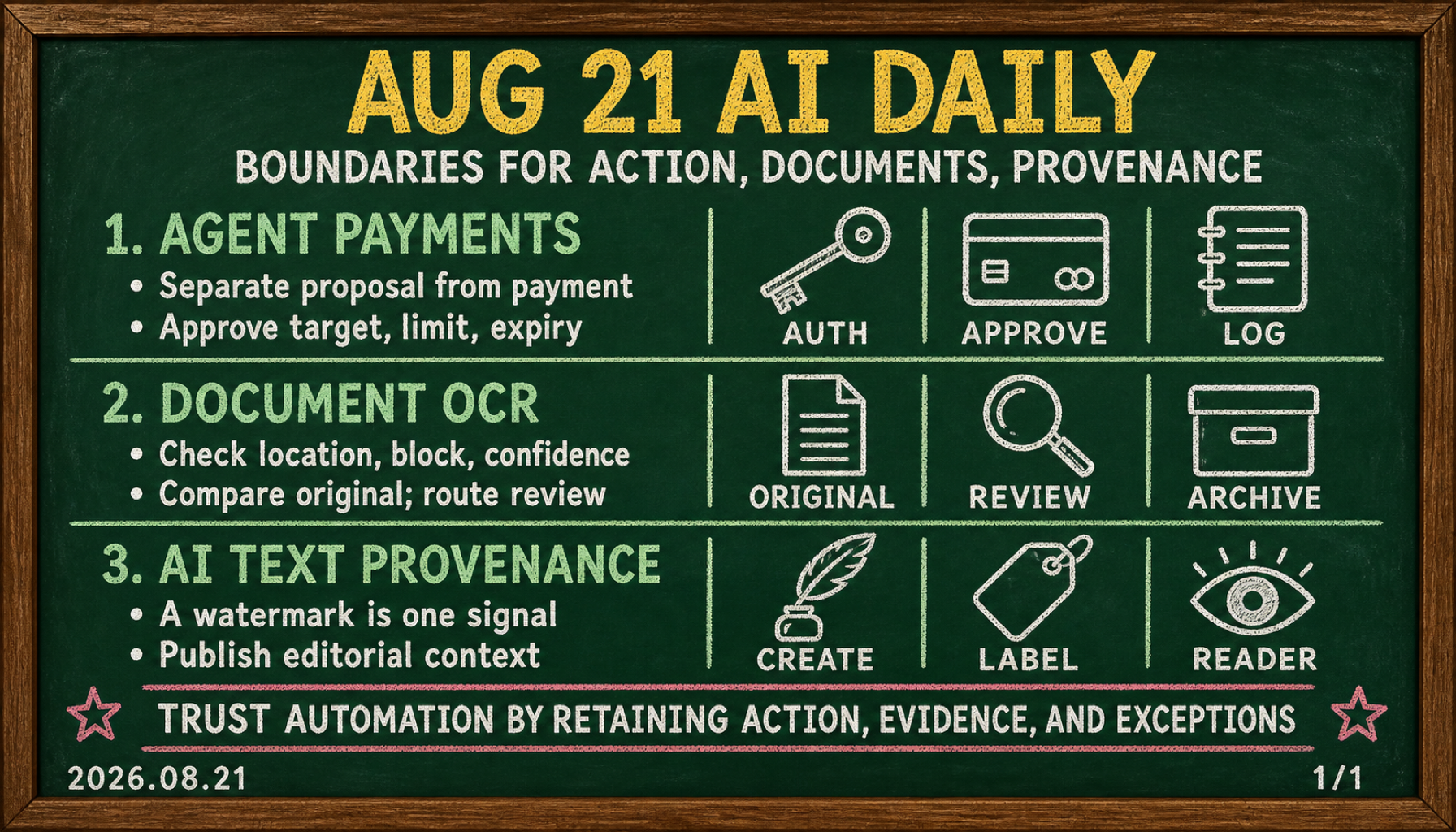
Today’s three topics ask one operating question from different directions: how far may automation act, what must people inspect again, and how can a result explain where it came from? When an agent enters a payment flow, a useful recommendation and an actual charge need different boundaries. When OCR reads document structure, extraction becomes richer, but it should not instantly become a business decision. And watermarking and provenance labels for AI-written text are not a single detection verdict; they are a way to give readers context.
Three things to take from today
The source report is dated August 20, 2026, while the publication date remains August 21, 2026. First, a commerce agent may improve a buying experience, but payment approval and tool access cannot be treated as one broad permission. Second, OCR outputs such as paragraph locations, structural blocks, and confidence are material for a more precise review flow, not a seal of correctness. Third, AI text watermarking and Content Credentials are signals at different layers. Rather than expecting either one to settle authorship for every text, teams need to decide how to communicate the context of generation, editing, and publication.
A common operating principle runs through all three scenes: retain the external effect an automated system creates together with evidence that explains that effect. A payment request needs its target, cost range, validity period, approver, and outcome state. Document processing needs the original location, extracted block, confidence, editor, and destination to stay connected. A published text needs a reader-visible account of editorial responsibility and publication context, whether or not a generation signal is present. More than the name of a technology, these connections determine whether a workflow can be understood and trusted.
1. Payment boundary: separate an agent’s proposal, approval, execution, and tool authorization
Stripe’s Agentic commerce documentation discusses AI-agent commerce use cases and payment workflows. The first distinction to make in such a flow is between an agent finding and proposing a product and an agent moving someone’s money. Building a cart or comparing alternatives can be part of helping a person decide. Finalizing a payment request, or producing the external effects of cancellation or refund, is a separate step involving cost, counterparty, timing, and user confirmation. Keeping both under the same permission may increase convenience, but it also increases the possible scope of error and makes the path of responsibility harder to follow.
An agent’s role is therefore better written as small verbs than as a broad sentence. Instead of “helps with purchases,” specify searches for products, organizes proposals, prepares a cart draft, prepares a payment request, or transmits an approved request. Attach a permitted target, amount or quantity range, expiry condition, person able to stop it, and way to check the result to each verb. A record that a user approved a payment needs to show more than a click time. The seller or recipient, expected cost, currency, request purpose, validity period, and retry policy should remain connected on one screen or under one task identifier so their meaning is not lost later.
 Source · StripeAgentic commerce | Stripe DocumentationDocumentation covering AI-agent commerce use cases and payment workflows.
Payment delegation and tool authorization are not the same problem. The Model Context Protocol Authorization specification says servers must validate access tokens issued for them and must not accept or forward tokens intended for other resources. The principle creates a boundary against treating an access token received in one system as a master key that can drift into another. An agent’s ability to call an MCP tool does not mean that the tool may execute any payment or access any customer information. Authorization that checks the resource and intended recipient, approval that checks the cost and counterparty of a transaction, and a post-execution result check need to remain separate questions.
 Source · Model Context ProtocolAuthorization - Model Context ProtocolThe specification says servers validate tokens issued for them and must not accept or forward tokens intended for other resources.
In practice, it is better not to leave the approval screen as the only safeguard. Before a request exists, reduce the data an agent can consult and the tools it can call. While constructing a request, narrow the counterparty and cost conditions. When transmitting it, connect confirmation from a user or authorized operator. Afterward, record success, failure, cancellation, and an unclear state separately. If an external response is interrupted, first check the state of the existing request rather than immediately send the same payment again. A retry can look like communications recovery, yet in the outside world it can recreate an effect.
This structure can feel elaborate because one conversational interface hides the boundaries between many systems. A user says “make the payment” in a few words; an operator needs to see recommendation, selection, authorization check, request construction, external transmission, and outcome receipt as separate steps. A good experience does not make the user perform all of that work, but it does not conceal what is happening at critical moments. The information needed for approval should be short and readable, while the retained record should be specific enough to reconstruct an event later.
2. Document boundary: separate OCR output into automated handling, review, and comparison with the original
Mistral AI’s OCR 4.1 documentation describes paragraph-level bounding boxes, structural block labels, and block-level confidence scores, and lists the service as public preview. Those elements encourage teams to view OCR as an input stage that handles location and role in a document alongside text, rather than as character conversion alone. A downstream system can receive not only a line of text but also an indication of where its paragraph appeared and which kind of structural block it was recognized as. A reviewer gains a clue for moving between a result and the original. Still, those signals do not make a document’s meaning automatically final. Numbers, contractual wording, and identity information can warrant comparison with the original because a single character may have significant consequences.
A confidence score is not an automatic-approval score. It may signal the model’s reading of a particular block, but it does not answer for the magnitude of error a business can accept. Repeated low-value material and material involving a person’s rights or an important contractual term may need different review routes even if their scores are the same. Document quality is not uniform either. A clean digital original, a faint scan, a page with tables and signatures, and material using several languages can fail in different ways. An adoption assessment should resemble the distribution of material that really enters the workflow, not a test made only from easy examples.
NIST’s AI RMF 1.0 presents the GOVERN, MAP, MEASURE, and MANAGE functions. For an OCR flow, the framework is more useful as a way to find omitted questions than as a massive compliance list. Ask in sequence: who uploads which document, what information may be inside it, where the extracted result travels, which errors are measured, and who stops, corrects, and communicates when an issue arises. These questions distinguish a model’s performance description from the distribution of responsibility in an organization. A better output format does not complete a workflow if the basis for processing and the owner of review are left open.
Source · NISTArtificial Intelligence Risk Management Framework (AI RMF 1.0)An AI risk management framework presenting the GOVERN, MAP, MEASURE, and MANAGE functions.An operating flow becomes easier to understand when it has three routes. Send results with clear rules and low consequences of error to automated handling. Send low-confidence results, or results with a high cost of error, to a review queue. Send damaged files, missing pages, or material with an unclear basis for processing to an exception route. A review screen should show more than extracted text: it should show the location of the relevant block in the original. When a person changes a value, retain what was changed and why, then connect that correction to the fact that the result was sent onward.
Retention of the original is also part of review design. Keeping only OCR output makes a later misread difficult to investigate. Retaining every original without limits increases access and retention risk. Set the range of documents that may be uploaded, ways to separate or mask sensitive information, storage location and duration, access roles, and deletion or return procedures together. The goal is not to keep every document forever. It is to set the time and authorization needed for review and reproduction while avoiding accumulation outside that scope. Document automation is both a process for obtaining text and a process for determining what evidence is shown to whom and when.
3. Text boundary: connect watermark signals and provenance labels to reader context
Anthropic’s official article explains how Claude text watermarking works. In discussions of AI-generated text, the word watermark can sound like a simple decision button. In operations, the more important question is not merely whether a signal exists. Teams also need to consider which tool was used and for what scope, how much human editing occurred, what a reader can know, and what the absence of a signal means. Turning a missing watermark into proof of human authorship, or using the presence of one watermark to settle responsibility for an entire text, both call for caution.
Editorial and operating teams are better off not reducing the writing process to one binary. A person may write a draft while AI revises sentences; AI may produce a draft while a person performs fact checking, structural editing, and accountable decision-making. A tool can also be used differently for translation, summarization, title suggestions, or coding help. Public disclosure should therefore communicate a meaningful scope to readers rather than end with the short phrase “AI used.” It is more helpful to retain context such as which stage used a tool, who holds final editorial responsibility, and how important claims and quotations were checked.
The C2PA technical specification addresses Content Credentials and provenance. It offers a technical frame for representing and examining provenance information about content. It should not, however, be described as a technology that detects all AI text. Content bearing provenance information can provide a starting point for examining that information in context; the absence of information does not prove any particular method of authorship. As content passes through multiple tools and editing stages, which records remain connected and which do not also become part of operations.
Source · C2PAContent Credentials : C2PA Technical Specification :: C2PA SpecificationsA technical specification addressing Content Credentials and content provenance.Text trust does not require handing readers an excess of technical detail. It requires an explainable publication process. For text released externally, retain internal records of the origin of a draft, major editing stages, checking of quotations and claims, and the publication approver. Give the reader a concise disclosure suited to the nature of the work. Where changes are substantial, provide a way to understand the prior published version and the reason for change. This record is not an interrogation tool for deciding whether a text was generated automatically. It is a path of accountability for knowing what to correct and whom to notify when bad information is found.
Watermarking and provenance labeling are not competing single answers. One may concern a signal left in a particular generation process, while the other may concern the expression of a content history and context. What an organization needs to decide is not only which technology to attach, but also which conclusions operators and readers will withhold when information is missing, altered, or republished. A practice that does not hide uncertainty—and clearly separates what is confirmed from what is not—can sustain trust in AI-assisted writing for longer.
Operator note: retain four records for one request and one piece of content
Before connecting a new capability, use the first record for actions. What may the agent propose and what may it execute? Which documents may OCR read, and which system receives its result? At which stage—drafting, translation, or editing—is a writing tool used? Use the second record for boundaries. For payment, write the target, cost, and expiry; for tools, the resource and intended recipient; for documents, the processable range and review criteria; for text, permitted publication uses and editorial responsibility. Use the third record for evidence. Keep request input, approval, original location, output, editor, published version, and change history under one task identifier or in records that can be connected.
Use the fourth record for exceptions. Where does an unclear payment response stop? Who compares an OCR result with the original when it falls outside review criteria? What does the organization tell a reader when content provenance information is absent or cannot be read? An exception is not a place for concealing failure. It exposes the point at which automation must not proceed with confidence. The four records can be maintained by separate teams, but they need to join into one story when an event occurs. Then the payment approval and tool call, the document original and correction, and the text’s generation and publication do not remain unrelated fragments of logs.
Human review does not reject automation. It clarifies responsibility where an action is hard to reverse or has a large effect on cost, rights, or reputation. When the scope of automatic handling is clear, people can concentrate on high-risk moments instead of rereading every result from the beginning. Without boundaries and exceptions, even a small error becomes difficult to locate and teams tend to return to more manual checking. Good operations do not choose between people and tools. They place each at the moments where confirmation matters.
Records do not promise to eliminate trial and error. They make it possible to stop and learn within a smaller scope when trial and error occurs. Begin with conservative approval conditions and review criteria, then adjust them using real requests and correction cases. When expanding the automatic route, retain what changed from the prior criteria and who approved the change. This modest history keeps a team’s judgment from disappearing when a tool or model changes. A user need not receive the same explanation every time, but an operator should be able to answer the same question consistently.
The material on agentic commerce and MCP authorization says payment approval and tool access should not be collapsed into one authority. OCR 4.1’s paragraph locations, structural blocks, and confidence information, together with AI RMF’s GOVERN, MAP, MEASURE, and MANAGE functions, create review questions before an extracted result becomes a business conclusion. The material on Claude text watermarking and C2PA Content Credentials shows that trust in AI-written text depends less on a simple detection claim than on how provenance and editorial context reach a reader.
Today’s conclusion is not to make automation look larger. It is to make clear what one request can do, which path a document or text has taken, and who can approve, correct, and explain it. At the next adoption, open four records—action, boundary, evidence, and exception—before the feature description. Connecting payment tools, OCR, and generative tools on top of those records creates a workflow that is both more careful and more explainable.
Sources
Related posts
Read →Related tools