August 20 AI Daily — Payment Boundaries, Document Context, and Domestic Models That Can Be Operated
An August 20 daily on separating agent payment and MCP authorization, routing layout-aware OCR for review, and evaluating domestic AI and Everybody's AI as services with operating conditions.
DAILY NEWSLETTER · 2026-08-20 · PAYMENTS · DOCUMENT AI · DOMESTIC MODELS
August 20 AI Daily — Payment Boundaries, Document Context, and Domestic Models That Can Be Operated
Today’s three scenes look like separate news stories, yet they meet in the same operating question. When an agent requests payment, what is delegated and what must a person approve? When OCR reads a document’s structure, which results can move automatically and which must go to review? When evaluating domestic AI models and a public AI service, can a team look beyond an announced result and ask under what data, cost, GPU, security, and support conditions the service can keep being used? Before adopting a capability, an operator needs to design the boundary of action and the record of its result.
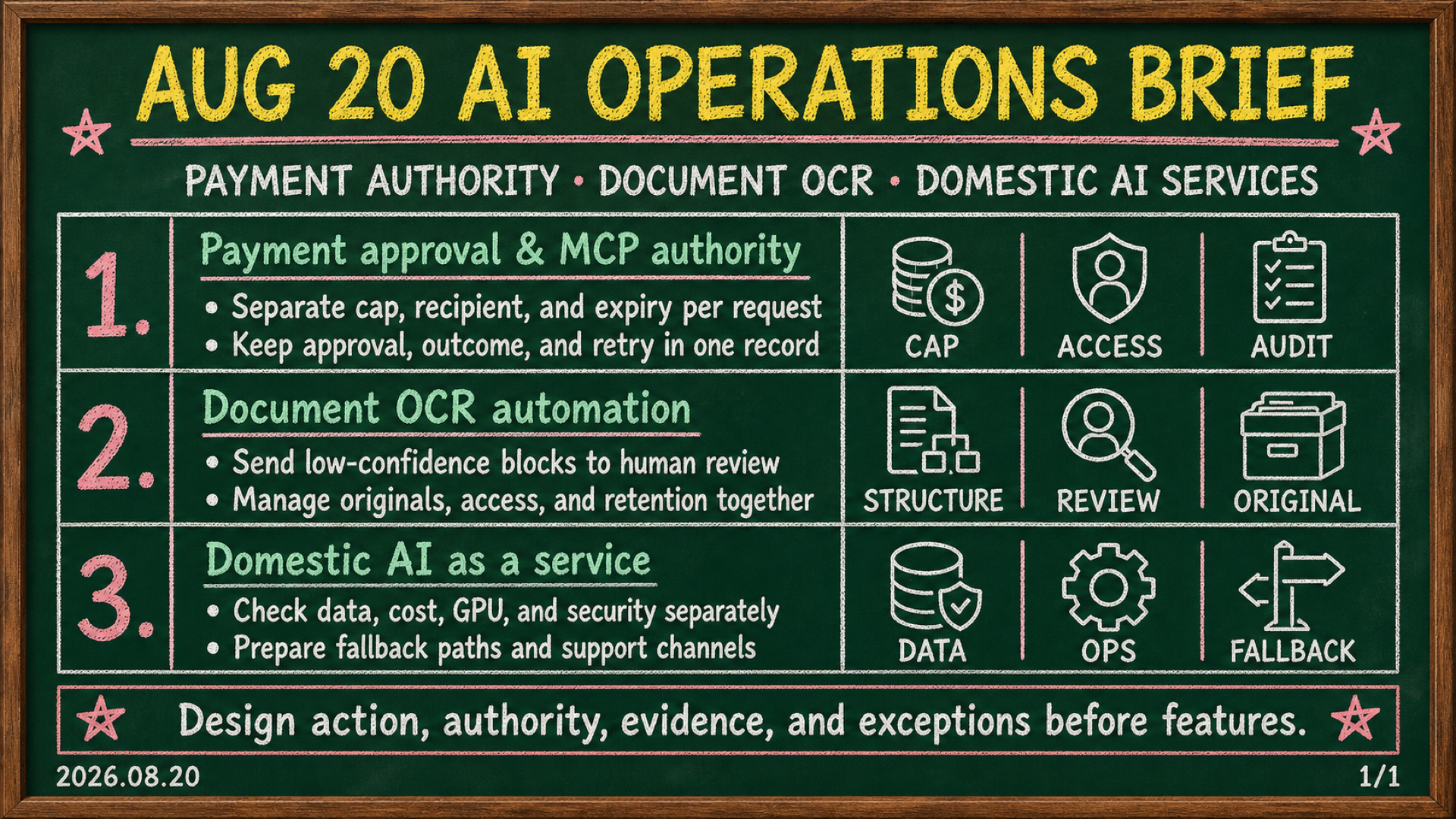
Three things to take from today
First, an agent’s participation in commerce is not only a matter of connecting a payment method. Payment delegation, tool authorization, human approval, and audit and retry records need separate boundaries. Second, layout-aware OCR can make extracted results richer, but it changes a workflow only when confidence, review routing, sensitive-document handling, and retention of originals are explicit. Third, news about sovereign foundation models and Everybody’s AI is not material for a winner’s board. It is an occasion to ask whether a usable service can sustain its conditions for data, cost, compute, security, support, and substitution.
One operating principle applies across all three topics. Do not treat an action an automated system can perform as one indivisible unit that also settles responsibility for its outcome. For every request, retain the permitted target and cost, validity period and authorization scope, nature of the input material, reviewer, and way to reverse course. This record is not paperwork for displaying control. It is a work ledger for finding the cause of a problem without repeating the same external action.
1. Payment boundary: separate an agent’s delegation, tool authority, approval, and record
Stripe’s Agentic commerce documentation presents situations in which agents can manage product feeds, carts and checkout flows, and accept payments as intermediaries. The flow matters because the moment an agent acts for a customer, the authority to find and propose an order and the authority to finalize payment can easily end up behind the same button. Operators are better off not bundling product-information updates, cart assembly, payment requests, seller verification, refunds, and cancellations into one blanket authority. For each action, they should write down whose instruction initiated it, for which amount and counterparty it is valid, whether it may finish automatically, and when a person must stop it.
The Agentic Commerce Protocol seller-backed payment handler RFC is a Draft RFC and should not be read as a finalized standard. Its examples of delegated tokens nevertheless offer a useful way to think about making payment delegation small. They include maximum amount, currency, merchant, and expiry, and show a handler ID and token being passed to the seller. Those elements turn the broad sentence “allow the agent to pay” into a ceiling, currency, counterparty, validity period, and processing actor. The existence of a draft is a clue for considering a design direction; it does not guarantee the security or interoperability of a particular implementation.
Payment delegation and authorization to access a tool are not problems to solve with the same secret value. The Model Context Protocol Authorization specification says that HTTP MCP servers must verify that access tokens were issued for that server, and must not accept or forward tokens intended for other resources. It also requires user consent when dynamic registration is proxied to third-party authorization servers. This means that an agent being able to call a tool is distinct from that tool being allowed to execute a payment or access customer information. Bind tool authority to a resource and audience, bind payment delegation to cost and counterparty, and retain the approvals for both separately even when they share one task identifier.
 Source · Model Context ProtocolAuthorization - Model Context ProtocolSays HTTP MCP servers must verify tokens issued for themselves and must not accept or forward tokens for other resources; proxying third-party authorization-server registration requires user consent.
Approval therefore does not end with one yes-or-no decision. A screen reviewed by a person needs to show at least the seller or tool, maximum cost, currency, expiry time, purpose of the request, expected result, and retry rule. If the response disappears after a payment attempt, a team should query the existing request identifier and outcome state before sending the request again. A single call may create an order, charge a payment, reduce inventory, and notify a customer. In that case, a retry is not merely communication recovery; it is an action that may recreate external effects.
The unit to preserve in an operating note should be smaller than the name of a payment method. It should reach a sentence such as: this task may request no more than this amount, in this currency, to this seller, once only, before this time, and may call only this tool on this MCP resource. Beneath it, join the point of human approval, the request generated by the agent, the result returned by the external system, and the failure, cancellation, or retry state. This structure is not a barrier meant to stop agent work. It is the minimum boundary for retaining a path of responsibility as the scope of delegation grows.
2. Document boundary: separate OCR results into automatic handling, review, and retention of originals
Mistral AI’s OCR 4.1 documentation identifies the service as Public Preview as of July 16, 2026 and says that it provides paragraph-level bounding boxes, structural block labels, and block-level confidence scores. Its model ID is mistral-ocr-4-1, and the documentation lists OCR at $4 per 1,000 pages and annotated pages at $5 per 1,000 pages. This means that a downstream workflow can receive more than text converted from an image: it can receive where a paragraph was, what kind of block it is, and how much confidence is attached to the result. A displayed confidence score is not a guarantee that the business result is correct. The real input conditions—document type, scan quality, handwriting, tables and stamps, mixed languages, and disordered pages—remain separate subjects for validation.
NIST’s AI RMF 1.0 is a voluntary, rights-preserving, use-case-agnostic framework that presents the GOVERN, MAP, MEASURE, and MANAGE functions, with GOVERN as a cross-cutting function. Rather than laying it over OCR automation as a mechanical checklist, it is useful for restoring questions that are often missed in a document flow. Who uploads the document, what sensitive information it contains, where the extracted result goes, how errors are measured on samples, and who stops, corrects, or notifies when a problem appears all need answers. An output format from a technology and the distribution of responsibility in an organization are different matters; organizing one does not solve the other.
Source · NISTArtificial Intelligence Risk Management Framework (AI RMF 1.0)Presents GOVERN, MAP, MEASURE, and MANAGE as a voluntary, rights-preserving, use-case-agnostic framework, with GOVERN as a cross-cutting function.A practical flow is best divided into three paths. Blocks with clear rules and low consequences of error may move from automatic extraction to a downstream system. Blocks with low confidence, or with a high cost of error such as amounts, contract terms, or identity information, should go to a review queue where a reviewer sees the result with its location in the original. Damaged files, unsupported formats, missing pages, or documents whose ownership or processing basis is unclear should be classified as automation exceptions. This reduces the chance that a confidence score is mistaken for an approval score, and it lets a team later see why a person corrected a particular result.
For sensitive documents, record both the period before and after transmission. Define which documents may be uploaded, masking or separation rules, retention location and duration, roles allowed to access them, contractual terms with external processors, and deletion or return procedures around the original. Deleting the original while retaining only OCR output makes it difficult to investigate a later misread; retaining originals indefinitely without restriction creates another risk. Retaining an original does not mean accumulating it forever. It means setting the duration, access, and integrity conditions needed for review and reproduction.
Before adoption, test a set that reflects the actual distribution rather than a few representative pages. Include clean structured forms, crooked or faint scans, documents with multiple languages, material with tables, signatures, or seals, and long-retained files; record errors by type. Use the result to determine automatic-handling criteria, review priority, how human corrections feed back into the process, and the unit for observing cost. OCR’s value is not limited to extraction volume because it forces a workflow to decide which sentence it can trust and which sentence it must inspect again before the document becomes a business decision.
3. Service boundary: read sovereign AI and Everybody’s AI through the conditions of continued use
On August 18, the Ministry of Science and ICT announced the second-stage evaluation result for the Sovereign AI Foundation Model project, advancing Upstage, SK Telecom, and LG AI Research. The attachment filenames include Solar Open2, A.X K2, K-EXAONE 2.0, and Motif 3. The announcement can be a starting point for reviewing models developed and operated in Korea, but the result alone cannot establish that a model is a suitable service for a particular organization’s work. After the model name and stage result come separate questions about the location and transfer conditions of input data, inference cost and contract form, needed GPU and deployment form, access control and audit, incident response and support channels, and the degree to which another model can replace it.
Source · Ministry of Science and ICT「독자 AI 파운데이션 모델」 프로젝트 2차 단계평가 결과 발표Announces the August 18 second-stage result advancing Upstage, SK Telecom, and LG AI Research, and names the models appearing in the attachment filenames.Electronic Times wrote on August 18 that six lead businesses or consortia had entered the public call for a free AI chatbot and agent service. It describes SK Telecom’s participation based on A.X K2 and A.dot experience, and a KT consortium including Upstage, Motif Technologies, and NC AI. The surface of a free service can lower the barrier for users, but it adds questions for operators. Teams need to establish who is accountable for each data flow, how chat histories and attachments are handled, who responds when outages, policy changes, or model replacement occur, and how a public service connects to or remains separate from private tools.
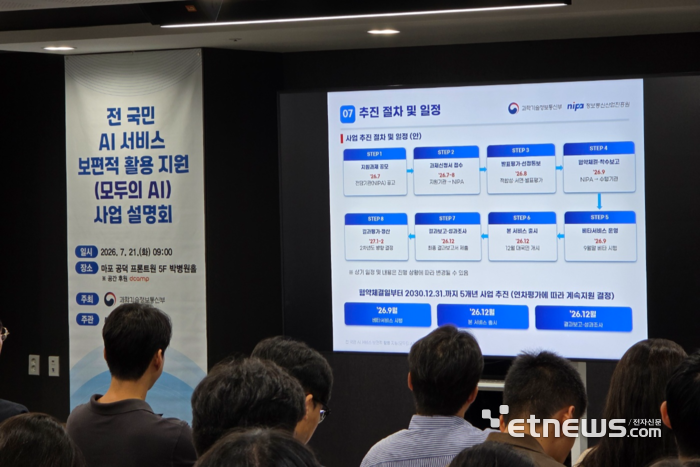 Source · Electronic Times모두의 AI, 6파전 경쟁 확정…통신·AI·플랫폼 기업 출사표Reports six lead businesses or consortia in the public call for a free AI chatbot and agent service as of August 18, including selected participation details.
The Korea Economic Daily described the same second-stage evaluation as a three-team field and an evaluation composition of benchmark 40, experts 35, and users 25. That composition is material for reading which perspectives informed an assessment, but it does not substitute for an individual organization’s total cost of use, security fit, or level of operating support. A public evaluation and a service-specific evaluation have different purposes and responsibility boundaries. Organizations can use the published result as a reference while separately validating quality in their own language, work, documents, and integration environment; waiting time at peak demand; fallback paths during an outage; and whether update notices and version pinning are available.
When treating a sovereign model as a service, the first goal to set is not the abstraction of “the best model” but an operating contract that can be replaced. Do not lock inputs, outputs, prompts, evaluation data, call logs, and integration specifications into a form only one provider understands. When obtaining GPUs directly, record capacity planning and security patches; when using a model provider, record data handling and the unit of cost; when mixing both, record where each request goes and how failover works. Ask from the beginning about the scope of support-ticket responses, security-incident notification, model-version changes, and termination or migration procedures. Only then does later substitutability become an actual option.
The current news is therefore more useful as a service-design question than as a board separating winners. For each workload, write the needed quality standard and prohibited errors, data that may be handled, monthly cost ceiling, required region and GPUs, administrator and user authority, and a channel for obtaining help. Then apply the same questions to domestic models, overseas models, and self-hosted models. The purpose of comparison is not to concentrate points on one model. It is to establish whether a team can explain the result a user receives, continue the work during an outage, and move to another option when necessary.
Operator note: divide a new capability into four records before approval
Whether the feature reviewed today is agent payment, OCR, or a new model, use the first page to record actions. Write which input it receives, which system it sends the input to, which external effects it can create, who can initiate it, and who can stop it. Use the second page to record authority. Join the tool, resource, seller, currency, maximum cost, expiry, and human-approval condition at the level of one request. Use the third page to record evidence. Retain the original document or request input, model or tool version, configuration, response, editor, outcome state, and retry identifier. Use the fourth page to record exceptions. Decide where low confidence, excess amount, authorization mismatch, sensitive information, timeout, and unclear external response go.
These four pages need to connect. When a person corrects a sentence in OCR, join the block in the original, reason for correction, and business system that received the result. When a payment request appears to have failed, query the payment-delegation conditions, token used for the tool call, seller response, and retry status through the same identifier. When changing a model, compare the output difference, location of data processing, cost change, and rollback method against the previous record. If records are stored apart, each team may be able to say its own screen was normal while an operator cannot reconstruct the full event.
Human approval is not evidence that automation is weak. It is a way to make responsibility clear at points that are difficult to reverse or have major effects on cost, rights, or customer experience. Drafting, classification proposals, and low-risk information organization can be automated under clear input boundaries and records. Actions with large external effects—finalizing a payment, sending a sensitive document outside, expanding authority, or replacing a model at scale—need human confirmation. Good operations do not make everything manual. They distinguish in advance the paths that may run automatically from the paths that need a pause and a look.
The flow of agentic commerce, the draft of seller-backed payment delegation, and MCP’s token-verification principle all caution against collapsing payment and tool access into the same phrase. OCR 4.1’s paragraph location, blocks, and confidence information, together with AI RMF’s GOVERN, MAP, MEASURE, and MANAGE functions, create questions that keep an extracted result from becoming an immediate business conclusion. The recent sovereign foundation model and Everybody’s AI news carries the same lesson. Announcements and participation fields are starting points; service value becomes visible only when data, cost, compute, security, support, and substitutability are checked under real conditions.
Today’s conclusion is not to increase the number of new AI capabilities. It is to make clear what one request can do, how much it can spend, which material it reads, who approved it, and which result remains. With clear boundaries, automation becomes both more careful and more reproducible. At the next adoption, open the four records for action, authority, evidence, and exceptions before the feature description, then connect the model and tools on top of them.
Sources
- Agentic commerce | Stripe Documentation ↗
- agentic-commerce-protocol/rfcs/rfc.seller_backed_payment_handler.md at main · agentic-commerce-protocol/agentic-commerce-protocol · GitHub ↗
- Authorization - Model Context Protocol ↗
- OCR 4.1 - Mistral AI | Mistral Docs ↗
- Artificial Intelligence Risk Management Framework (AI RMF 1.0) ↗
- 「독자 AI 파운데이션 모델」 프로젝트 2차 단계평가 결과 발표 ↗
- '국가대표 AI' 선발…SKT·LG·업스테이지 3파전 압축 ↗
- 모두의 AI, 6파전 경쟁 확정…통신·AI·플랫폼 기업 출사표 ↗
Related posts
Read →Related tools