August 19 AI Daily — Three Boundaries for Operational AI: Deployment, Payments, and Inference
An August 19 briefing on FuriosaAI deployment compatibility and public-sector AI operating criteria, x402 and MCP boundaries for payment and authorization, and the hardware, performance, quantization, and licensing checks behind local inference.
DAILY NEWSLETTER · 2026-08-19 · DEPLOYMENT · AUTHORIZATION · LOCAL INFERENCE
August 19 AI Daily — Three Boundaries for Operational AI: Deployment, Payments, and Inference
Today’s thread begins with three boundaries that need to remain distinct when AI enters production. The first is the deployment boundary: which models can run on which accelerator under which configuration. The second is the transaction boundary: how an agent’s access to resources and paid actions can be limited, authorized, and recorded. The third is the execution boundary: how hardware specifications, quantization, measured token generation, and model-use conditions should not be collapsed into one performance promise. Before connecting capabilities, teams need to identify permitted actions, allowed cost, verifiable output, and the human approval points that remain accountable.
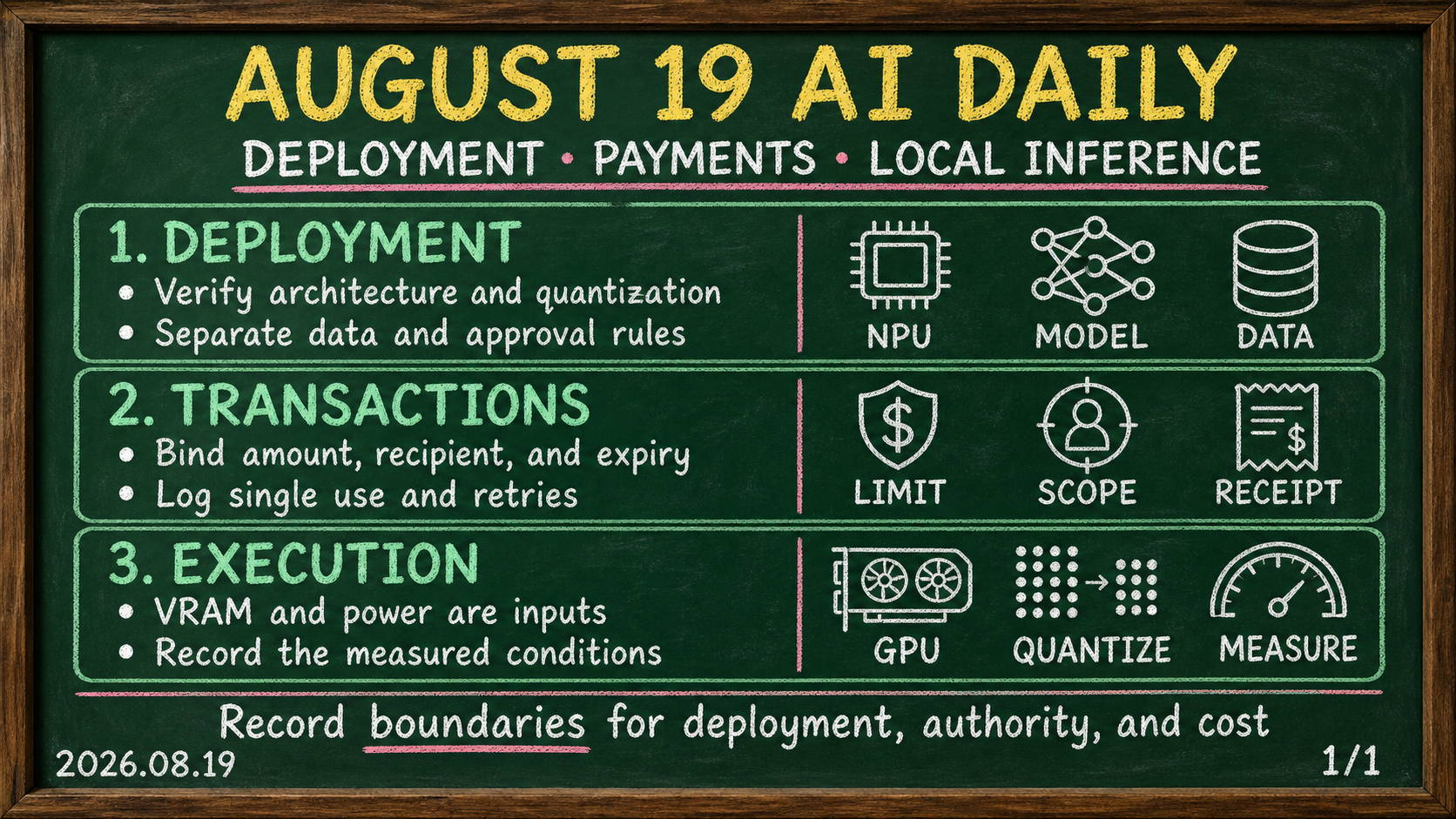
Three things to take from today
First, a model being able to run on an accelerator is a technical condition that still requires verification of supported architecture and deployment configuration. Second, agent payment and resource access should be bounded through explicit limits such as maximum amount, single use, deadlines, recipient binding, scopes, and retry records. Third, local inference requires hardware specifications, quantization, software configuration, measured performance, and model-access conditions to be read together; a single benchmark result cannot be generalized into a universal throughput claim.
- A support list is not a guarantee that every model will run quickly in every environment. It is a starting point for verifying the target architecture and deployment configuration.
- Authorization and payment are better designed as per-request limits on amount, target, time, and repeat use than as broad agent autonomy.
- Hardware specifications and token-generation numbers are useful inputs, but they lose meaning when model, quantization, batch, configuration, and test conditions are removed.
1. Deployment boundary: connect supported models, personal-data handling, and public AI implementation into one operating contract
FuriosaAI’s supported-models documentation states that supported Transformer-architecture models can be compiled and run with Furiosa-LLM. Its model guides address quantization and parallelization, and the documentation also notes that FXB can be used. This establishes an official starting point for checking compatibility and a reason to read model-specific configuration guidance. It does not establish that every model variant, every precision, every parallel configuration, or every workload will produce the same outcome. Operators should therefore record more than a model name: the model variant, quantization method, parallel configuration, compilation result, and execution environment all belong in the deployment record.
Source · FuriosaAI Developer CenterSupported Models — FuriosaAI Developer Center 2026.3.0 documentationStates that supported Transformer-architecture models can compile and run on Furiosa-LLM, with model guides covering quantization, parallelization, and possible FXB use.Deployment feasibility is separate from whether data processing is appropriate. Korea’s Personal Information Protection Commission presents generative-AI personal-data handling criteria around four lifecycle phases and sets out minimum safeguards for each phase. A design that runs a model on a particular accelerator does not replace those criteria. Teams still need to assess what is collected, why it is used, where it is stored, and who can access it across intake, development or training, service delivery, and follow-up management. Changing the location where a model runs does not automatically justify the purpose or scope of personal-data processing.
Source · Personal Information Protection Commission · 2025-08-06생성형 인공지능(AI) 개발·활용 위한 개인정보 처리 기준 제시한다Presents generative-AI personal-data handling criteria across four lifecycle phases and identifies minimum safeguards for each phase.Deployment documentation should not end with a technical document stored apart from data-handling documentation. One task record should connect the model and runtime, the type of input data, the data-access actors, retention or deletion criteria, and conditions that require human approval. This is not paperwork for its own sake. It is the minimum unit for retracing what changed after an outage, misuse event, or data-scope change. “Supported” describes execution compatibility; it does not simultaneously establish fitness for purpose, lawful data handling, or production readiness.
Korea’s Ministry of the Interior and Safety guide for public-sector AI adoption and use covers planning, budgeting, contracting, implementation, and operation, and it discusses RAG for using current internal documents. The guide is directed at the public sector, but its structure is useful for preventing a technical adoption from being reduced to a one-time model choice. Goals and data scope in planning, responsibility and procurement conditions in budgeting and contracts, validation in implementation, and updates and management in operations require separate records. Using RAG can create a route to current internal documents; it does not automatically resolve the accuracy of those documents, access control, or responsibility for keeping them current.
A practical first check is straightforward. Before a new model or accelerator deployment, write down what compiles, which configuration runs, what data enters the system, who approves the work, and which signal stops it. Conduct performance tests separately under conditions close to the actual input format, and assess personal-data handling separately from model-performance language. The distinction among planning, budgeting, contracting, implementation, and operation shows why approval at one stage does not eliminate risk at the next.
2. Transaction boundary: limit and jointly record an agent’s payment, access, and retries
Coinbase’s x402 `upto` scheme documentation covers a maximum amount, single use, a deadline, and recipient binding. These elements offer a way to break the broad idea that an agent “can pay” into small, explicit constraints when an agent requests network resources or paid services. A maximum amount defines a cost ceiling; single use constrains repeated consumption of the same authority; a deadline bounds the permitted time; and recipient binding connects authorization to an intended target. The document does not guarantee complete security for every service or suitability for every payment flow, but it makes clear why cost authority should not be handled as an unrestricted token.
Once payment authority has a defined boundary, the next question is how to preserve the result. The x402 offer-and-receipt extension covers a signed offer and receipt. From an operating-record perspective, this supports a design in which teams can examine who proposed what under which conditions and which result was returned. A record does not automatically resolve every dispute or error. It can, however, reduce the chance that approval conditions and actual outcomes disappear into separate systems when an agent creates a request and receives a payment or service-use result. A request identifier, target, limit, deadline, and outcome state should be joined within the same task unit.
Payment and resource access should be designed separately. The Model Context Protocol Authorization specification addresses resource, audience, scopes, and short-lived tokens. Resource identifies what is being accessed; audience identifies the intended recipient of the token; scopes define the permitted authority; and short-lived tokens provide a time boundary. Together, these create more precise questions than the statement that an agent “is authenticated.” Teams should be able to identify which resource a token is for, which audience should receive it, which work scope it permits, and when it expires.
Retries require an independent operating rule as well. In an environment with network delays or lost responses, a request may need to be sent again, but retry behavior is closely tied to the risk of executing the same external action twice. Payment limits and single-use conditions, access-token scope and expiration, and a value that identifies a retried request should therefore not be treated as disconnected capabilities. The approval record, call record, outcome record, and retry status need to remain together so that an operator can determine what actually happened once.
When connecting an agent to paid tools, define the action unit before defining the amount. Specify the allowed target, maximum cost, validity period, required scope, retry allowance, and conditions that require human intervention. Issue authority only after those conditions are clear, then record the call. This order is not a ritual for reducing autonomy. It is an operational procedure for a system whose cost and permission consequences persist outside the model, allowing a team to investigate an error without blindly repeating the action. Payment completion and data access should not be judged by a successful response alone.
3. Execution boundary: read L4 specifications, token measurements, quantization, and model access conditions separately
NVIDIA’s L4 product page lists 24GB of memory, 300GB/s of memory bandwidth, and a maximum TDP of 72W. These are clear inputs for infrastructure review, but they are not a promise that a particular model will fit or that a particular request volume will be served. Memory capacity can be affected by components beyond model weights, while bandwidth and power figures do not independently describe service performance. An L4 evaluation should use those specifications as a starting point and separately measure the actual model, precision, concurrency, input and output lengths, and serving-software conditions.
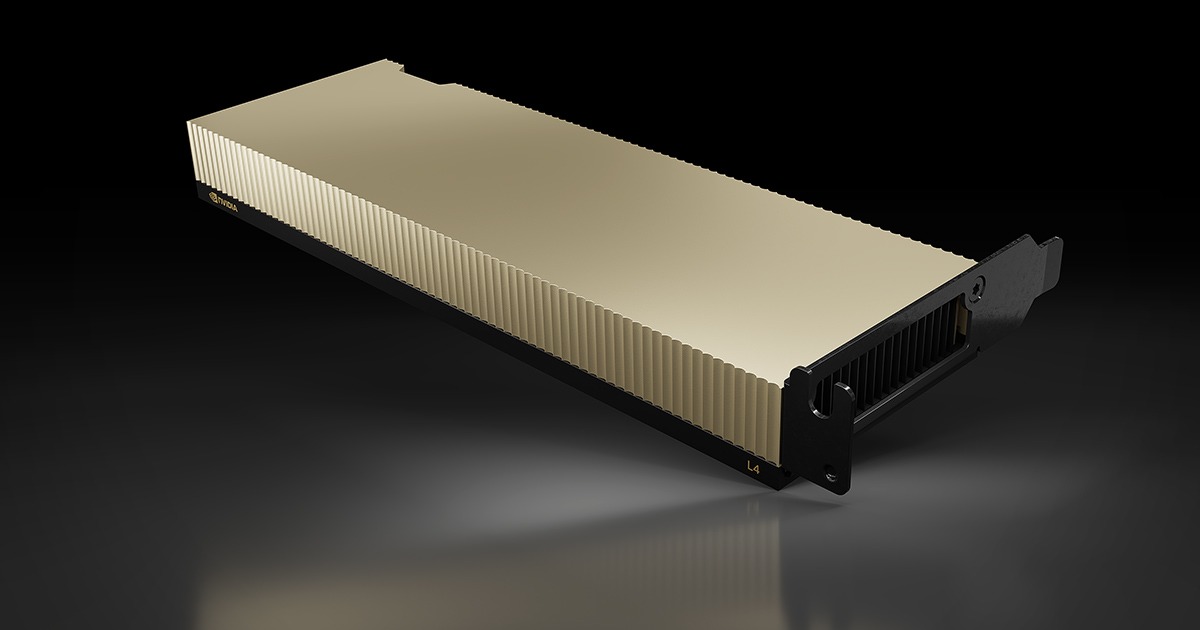 Source · NVIDIAL4 Tensor Core GPU for AI & Graphics | NVIDIALists the L4 specifications of 24GB memory, 300GB/s memory bandwidth, and a maximum TDP of 72W.
llama.cpp’s token-generation performance tips provide a useful example of why test conditions must not be erased from a performance number. The document includes a particular test using a 48GB A6000 and a 4-bit 30B model, where token-generation performance ranges from below 0.1 tok/s to 9.1 tok/s depending on configuration. That range shows that configuration can materially affect the result. It is not an L4 benchmark, a result for every 30B model, or a throughput statement for every quantization and serving environment. Turning a measurement from one documented condition into a general performance table removes the evidence that made the measurement meaningful.
Quantization should be viewed as more than a one-line choice of “smaller memory footprint and faster model.” Before placing a quantized model into production, teams need to verify whether the intended model and format are supported by the target runtime, whether output meets quality criteria under actual request formats, and which configuration can be restored if the deployment fails. Precision choice is not only a cost-and-performance decision; it is also a matter of verifiable output quality and controlled change management.
Model access conditions must also remain separate from deployment specifications. Finding a public model page is not evidence that the model can be used without restriction in every environment. The process for obtaining the model, applicable license conditions, the organization’s intended use, and the manner of redistribution or service delivery all require separate review before adoption. Adequate hardware and runtime support do not automatically satisfy access and use conditions.
The most useful local-inference artifact is not one “tokens per second” number. It is an experiment record containing the model name and version, quantization method, GPU and memory, runtime and configuration, input and output length, concurrent-request conditions, measurement window, and observed errors. That record makes it possible to identify what needs to be tested again when moving to different hardware or a different model. A benchmark does not replace a purchase or deployment decision. Teams need an experiment design that tests the request patterns, acceptable output quality, operating cost, and access conditions of the actual job.
Operator note: rewrite a feature list into three columns—authority, cost, and evidence
Today’s review can focus on one new model or API. In the deployment column, record the supported architecture, model variant, quantization and parallelization configuration, actual compilation or run result, and input-data boundary. In the authorization column, record the intended resource, audience, scopes, token expiration, and external actions that require human approval. In the cost column, record maximum amount, single-use status, deadline, recipient, idempotency key, and the offer-and-receipt or outcome record. If the three columns are not linked through one task identifier, later performance, authorization, and cost issues will be difficult to trace as one event.
The second check concerns the source of every number. Record 24GB, 300GB/s, and maximum TDP of 72W as L4 product specifications. Record the below-0.1-to-9.1 tok/s range as a measurement from a documented 48GB A6000, 4-bit 30B test under particular configurations. Do not combine them into an L4 throughput claim. When quantization, runtime settings, request length, concurrency, or model-access conditions change, measure again. This distinction is not decorative caution; it is what lets the next decision-maker ask a reproducible question.
The final check is the approval boundary. A supported model, a formally valid payment request, or an issued token does not by itself justify immediate external action. Put human review conditions around deployment, data transmission, paid calls, permission changes, and model replacement—steps that are difficult to reverse or have substantial effects. Research, drafting, configuration proposals, and performance measurements can use automation when their input boundaries and records are clear. The operating goal is not to block all work. It is to preserve an explainable record of what executed, under which conditions, and with whose responsibility.
FuriosaAI’s supported-model documentation, the Personal Information Protection Commission’s lifecycle-based minimum safeguards, and the Ministry of the Interior and Safety’s guide spanning planning, budget, contract, implementation, and operation show why AI deployment cannot end with one model decision. Supported Transformer architecture, quantization and parallelization, data-handling criteria, and RAG access to current internal documents are separate checks; none automatically guarantees the others.
x402’s limits, single-use condition, deadline, recipient binding, and signed offer and receipt; MCP’s resource, audience, scopes, and short-lived tokens; and Stripe’s idempotent retries provide components for treating agent external actions as small, recorded units. NVIDIA L4 specifications and llama.cpp’s documented measurement case offer the same lesson for local inference. The standard for operational AI is not broader authority or a larger headline number. It is the ability to verify deployment, authorization, cost, performance, and use conditions separately while preserving the human boundary of responsibility.
Sources
- Supported Models — FuriosaAI Developer Center 2026.3.0 documentation ↗
- 생성형 인공지능(AI) 개발·활용 위한 개인정보 처리 기준 제시한다 ↗
- 공공 AI 구축, 더 쉽고 빠르게 「공공부문 AI 도입· 활용 가이드」 배포 ↗
- x402/specs/schemes/upto/scheme_upto.md at main · coinbase/x402 · GitHub ↗
- x402/specs/extensions/extension-offer-and-receipt.md at main · coinbase/x402 · GitHub ↗
- Authorization - Model Context Protocol ↗
- L4 Tensor Core GPU for AI & Graphics | NVIDIA ↗
- llama.cpp/docs/development/token_generation_performance_tips.md at master · ggml-org/llama.cpp · GitHub ↗
Related posts
Read →Related tools