August 16 AI Daily — Session Collaboration, Model Choice, and the Operating Craft of Leading AI
An August 16 briefing on Claude Code’s cross-session messaging and forked context, OpenAI’s GPT-5.6 model choices and multi-agent beta, and the operating discipline required to work with AI without transferring human responsibility.
DAILY NEWSLETTER · 2026-08-16 · SESSION COORDINATION · MODEL CHOICE · RESPONSIBLE LEADERSHIP
August 16 AI Daily — Session Collaboration, Model Choice, and the Operating Craft of Leading AI
Today’s thread starts with a simple constraint: connecting more agents does not automatically create better operations. Claude Code introduces paths for naming another session, sending it a message, and forking a subagent with inherited conversation context and prompt cache. OpenAI documents model selection across Sol, Terra, and Luna, plus a beta capability for coordinating multiple subagents in parallel. At the same time, working with AI may resemble leadership in some respects, but AI is neither a person nor a bearer of responsibility. The human operator must still define context, review, stop conditions, and authority.
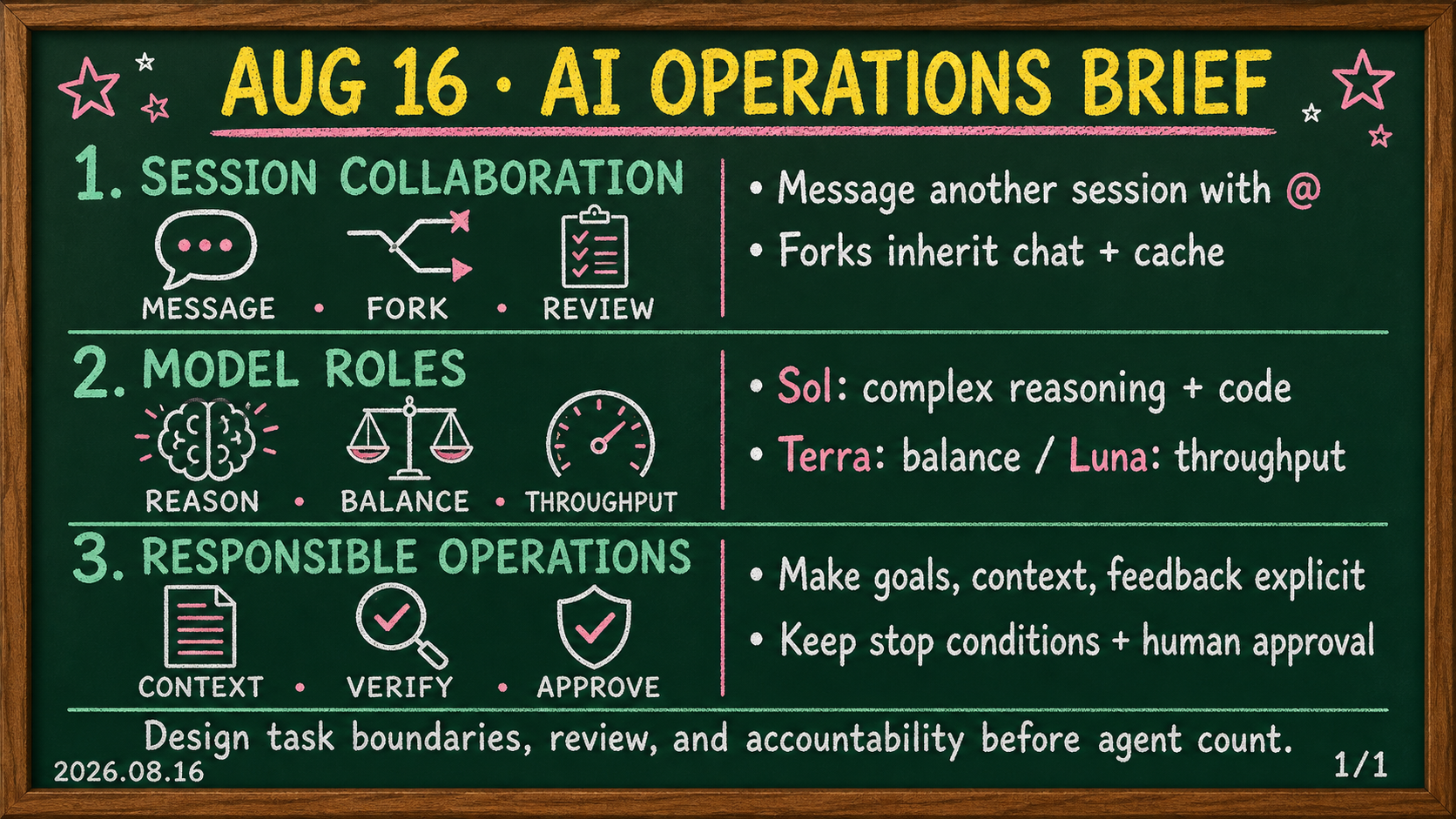
Three things to take from today
First, cross-session collaboration is a communication path for dividing work, not a guarantee that results will be correct, consistent, or responsibly completed. Second, model tiers and multi-agent capabilities are not instructions to use one strongest model everywhere; they are prompts to match roles to task complexity, cost sensitivity, throughput, and reviewability. Third, the leadership analogy must not become an accountability analogy. People must retain responsibility while making goals, context, feedback, and stop conditions explicit.
- The ability to message a session and fork its context is different from an assurance that multiple tasks will automatically converge on a sound answer.
- Model choice is a deployment question shaped by complexity, cost, throughput, and a path for reviewing failure—not a ranking exercise.
- The useful AI operating skill is not pretending an AI bears responsibility; it is designing work clearly enough that a responsible person can supervise it.
1. Claude Code cross-session collaboration: context and messages connect, but judgment does not automatically transfer
A public Claude Code release describes using @ to mention another Claude session by name and using SendMessage to reach it. The same release says a forked subagent inherits the full conversation and prompt cache. These capabilities expand the ways a workflow can refer to another execution stream or pass results between roles such as research, implementation, and review. They do not establish that every session is always connected, that a message is automatically incorporated into a final conclusion, or that inherited context is always appropriate to the current task.
Operationally, a fork is not the same as opening a blank work window. Inherited conversation and prompt cache can let a subagent work from requirements and prior decisions that have already been assembled. It also means that earlier assumptions, unresolved questions, and temporary instructions require active handling. A forked role should therefore state not only what it receives, but what it must verify again. A research role can receive an evidence boundary; an implementation role can receive a permitted change boundary and test method; a review role can receive risk conditions to inspect rather than an implied power to approve.
A separate release about Auto mode also needs to be read at its stated scope. It says Auto mode is available without an environment-variable opt-in for Bedrock, Vertex, and Foundry. That is not evidence that the mode became a universal default across all Claude Code environments. Deployment context, authentication, organization policy, and provider-specific configuration remain matters to check. Turning a scoped release note into a general deployment claim makes operational documentation outrun the environment it is meant to describe.
Teams can make session collaboration more reliable by standardizing the message itself. A request can carry a task identifier, role, input boundary, expected artifact, prohibited actions, and stop condition. A response can distinguish its conclusion from its supporting evidence, remaining uncertainty, and the next decision that requires a person. This is not a request for hidden reasoning. It is a minimal handoff record that helps different execution streams distinguish verified facts, proposals, and unresolved states.
Once one session begins to reuse another session’s output, a small error can become settled input for the next stage. The answer is not to have a person repeat every step. It is to place review points at boundaries with difficult-to-reverse or high-impact effects: deployment, transmission, deletion, permission changes, and changes to an external system. Subagents can prepare drafts, research, and test results. The authority to create real-world change and the responsibility for the final decision should remain on a clear human approval path.
2. GPT-5.6 model selection and the multi-agent beta: divide roles, then define the task boundary
OpenAI’s model documentation presents GPT-5.6 Sol as its flagship for complex reasoning and coding, Terra as a performance-cost balance, and Luna for cost-sensitive, high-throughput workloads. This is not a universal leaderboard or a claim that one model is best for every job. It documents a basis for matching deployment choices to the depth of reasoning required, the nature of the request volume, cost constraints, and the form of output that people can inspect.
 Source · OpenAI APIModels | OpenAI APIDocuments GPT-5.6 Sol for complex reasoning and coding, Terra for a performance-cost balance, and Luna for cost-sensitive, high-throughput work.
Model choice is therefore closer to task decomposition than to deciding whether a single most capable model should be the default. Interpreting complex requirements or reviewing code has different needs from classifying many inputs or formatting a structured draft. A description of lower cost or higher throughput does not imply that a model may take external actions without review. Data access, tool permissions, approval rules, and output validation remain operating policies separate from the model role.
 Source · OpenAI APIModel guidance | OpenAI APIDescribes a Responses API beta in which a GPT-5.6 instance coordinates multiple subagents in parallel and synthesizes their results, in a way similar to ultra mode in Codex.
The model guidance describes a multi-agent beta in which a GPT-5.6 instance can coordinate multiple subagents in parallel and synthesize their results. It is described in the context of the Responses API beta and as similar to ultra mode in Codex. What the documentation establishes is the possibility of parallel delegation and synthesis. It does not establish a fixed number of agents, nor does it establish a separate official GPT product under an “ultra” name. As a beta capability, its interface and behavior deserve confirmation in the actual deployment environment.
In a multi-agent design, the first decision should be the synthesis rule, not the agent count. If subagents reach different conclusions, teams need to decide how conflicts are surfaced, who recognizes missing evidence, whether unsupported conclusions are marked, and whether a failed subtask stops the whole workflow or produces a partial result. The fact that a coordinating model can synthesize results does not supply those rules. Synthesis should not merely make outputs sound smooth; it should preserve the boundary and uncertainty of each contributing result.
A practical starting point is to separate work into three layers: generation, verification, and execution. The generation layer reads, structures, or drafts. The verification layer checks evidence, form, and constraints against defined criteria. The execution layer changes an outside state through deployment, modification, or transmission. The first two layers may benefit from parallel work, while the third can require separate approval and stop conditions. This distinction applies regardless of model name. Work that must be processed quickly and work that must be decided cautiously do not belong under the same automation rule.
For each model role, record more than an expected cost or quality profile. Record permitted inputs, outputs, and tools as well. Specify which model may read which class of data, which result is limited to an internal draft without human review, and which job must receive a person’s confirmation before anything is sent externally. Multi-agent maturity is not demonstrated by the number of concurrent flows. It is demonstrated by how clearly the system can stop, expose a conflict, and explain itself when a flow fails.
3. Working with AI: leadership is a useful analogy, not a transfer of responsibility
Allen Bargi’s essay argues that working with AI can feel more like leadership than coding, and that abilities such as making context clear and giving feedback become more valuable. The observation identifies a limitation of issuing vague requests and judging only the final output. But AI is not a person and does not carry responsibility. The leadership analogy is useful when it clarifies the quality of instructions and feedback. It becomes harmful when it is used to transfer judgment, accountability, or ethical obligation to a system.
Source · Allen BargiWorking With AI Feels More Like Leadership Than CodingOffers the view that clearer context and feedback make leadership-related skills more valuable in AI work, while AI must not be treated as a person or responsible actor.The discussion space where the essay was shared shows that the analogy gives developers and operators something to consider, but volatile reactions and individual comments do not need to be treated as settled facts. The operational translation is more important. Context clarity means stating the goal, provenance of inputs, permitted tools, prohibited actions, output form, and stop condition. Feedback means more than saying an answer is good or bad; it records what must change under which criterion and what evidence is missing. A human operator designs these conditions and remains responsible for stopping or changing scope when an exception occurs.
 Source · Anthropic EngineeringBuilding Effective AI AgentsExplains adding complexity only when needed, using workflows for well-defined work, and relying on ground truth, human feedback, stop conditions, and sandboxing.
Anthropic Engineering advises adding complexity only when needed and using workflows for well-defined work. It also identifies ground truth, human feedback, stop conditions, and sandboxing as important elements of effective agents. That is not an argument to hand every task to an autonomous agent. For clear, repetitive work, a predictable workflow with explicit checks may be more appropriate. Even when a task calls for exploration or uncertainty, the scope of autonomy and the point at which work stops should be defined first.
In practice, replace the broad question “Can AI do this?” with “Which stage can it perform, with what evidence, and under which failure condition?” A research task can be required to return a source list and gaps. A code-change proposal can be required to return its change boundary and test result. A synthesis task can be required to show conflicting findings rather than hide them. Stages that produce external effects, such as deployment or an outward-facing message, can remain behind a human approval boundary.
Feedback should also go beyond repeated rewrites of an instruction. When the same error recurs, inspect whether the input boundary is unclear, the tool result lacks a ground-truth check, the handoff format is ambiguous, or the stop condition is missing. This is not primarily a matter of persuading AI. It is the work of improving the system’s task design. An operating model is stronger when the next run gains a verifiable condition, rather than requiring a person to write a longer explanation after each failure.
Operator note: connect, select, and retain responsibility in one task record
Today’s useful review target is not necessarily the most elaborate agent system. Choose one recurring task already used by the team. First, document whether it is a single session or passes messages and context to another session or subagent. Then classify each stage as research, drafting, verification, or execution. For every handoff, attach a task identifier, expected artifact, unresolved item, and stop condition. That makes cross-session communication a traceable work handoff rather than an extension of chat.
Next, map the model roles. Distinguish steps requiring complex reasoning or coding, steps that need a performance-cost balance, and steps where cost sensitivity or throughput matters. This is not a permanent assignment table for model names; it is a hypothesis to revisit as inputs and operating constraints change. Whatever model is chosen, do not delegate authority to alter an external system on the basis of the model’s tier. Tool access, approvals, and human review require separate design.
Finally, leave a record of decisions for which a person remains accountable: who approved the task purpose, which condition permits external action, what ground-truth criterion must be checked, which signal stops work, and what can be reversed if something goes wrong. Include a path for rejecting an AI-produced draft or recommendation. This record is not decorative oversight. It is the operating map that tells a team what to inspect and who must decide when the system behaves unexpectedly.
Claude Code’s session mention, message delivery, and forked-context inheritance widen the design options for collaborative work. They are not proof of universal automatic collaboration or automatic correctness. The documented Auto mode scope is also limited to specific provider environments and should not be generalized into a universal default.
The distinctions among GPT-5.6 Sol, Terra, and Luna, along with the multi-agent beta, show that teams can deploy model roles according to the task. Working with AI, however, is not a transfer of leadership responsibility to AI. It is the work of making human goals, context, feedback, stop conditions, and approval paths more explicit. More important than the number of connected agents is where a task stops, how its evidence is reviewed, and who remains responsible for the outcome.
Sources
- Release v2.1.232 · anthropics/claude-code · GitHub ↗
- Release v2.1.207 · anthropics/claude-code · GitHub ↗
- Models | OpenAI API ↗
- Model guidance | OpenAI API ↗
- Working With AI Feels More Like Leadership Than Coding ↗
- Working with AI feels more like leadership than coding | Hacker News ↗
- Building Effective AI Agents ↗
Related posts
Read →Related tools