August 14 AI Daily — MCP Authorization, Reasoning-Trace Protection, and On-Device Agents
An operational briefing on MCP OAuth authorization boundaries, protecting exposed reasoning traces from LLM APIs, and deployment conditions for on-device agent models.
DAILY NEWSLETTER · 2026-08-14 · MCP AUTHORIZATION · REASONING TRACE SECURITY · ON-DEVICE AGENTS
August 14 AI Daily — MCP Authorization, Reasoning-Trace Protection, and On-Device Agents
Today’s three topics ask together how far an agent may reach, which parts of a model response become assets or secrets, and how a smaller model should be deployed on a real device. Connections are becoming easier and execution is moving closer to users, but authorization, logging, and deployment boundaries need to become more explicit.
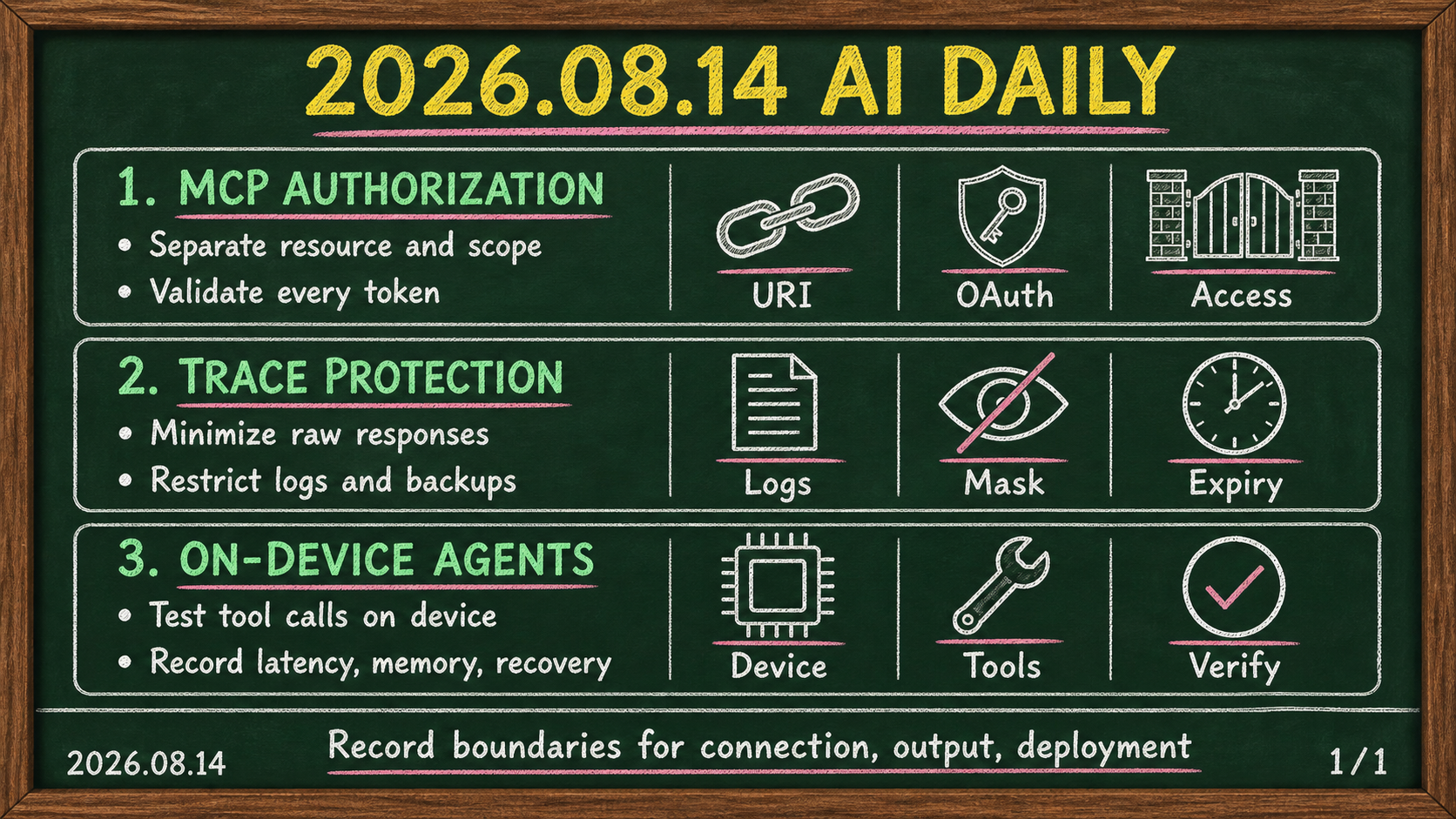
Today’s orientation
First, MCP’s HTTP transport does not force authorization on every server. Where a server does support it, however, the specification covers explicit OAuth 2.1 resource-server and client roles, protected-resource metadata discovery, and request-by-request validation. Second, the reported proprietary-LLM API reasoning-trace issue was not an event in which encryption was broken. Some APIs returned opaque reasoning blocks that could be reused, showing that such output and its logs can become sensitive operating assets. Third, an on-device agent model is less about the slogan of “a small model that eliminates cloud” than a deployment task requiring verification of tool calling, multistep work, memory, speed, context, and supported languages on the actual target device.
- Record the resource identifier, caller, destination server, allowed scope, and token-validation location for every MCP connection.
- Treat reasoning blocks and tool logs as candidates for output minimization, masking, and access control rather than ordinary debugging text.
- Do not deploy a compact agent model from published figures alone; test tool errors, latency, memory, and recovery paths on target hardware and real work.
This briefing uses the supplied primary materials and reporting. It omits claims from Korean upstream material that could not be confirmed by the supplied evidence. In particular, it does not present claims about traffic or events at a particular Korean service, a general obligation to clean up APIs, or unverified product figures and device support as fact.
1. MCP authorization: do not treat convenient connection and delegated authority as the same thing
Connecting an MCP server to a tool does not mean that a model immediately gains access to every resource. Authorization for HTTP-based MCP servers is optional. When a server supports authorization, though, it acts as an OAuth 2.1 resource server, while the MCP client acts as an OAuth client accessing a protected resource. This distinction separates the status that a user interface labels “connected” from the credential that actually reaches a particular resource in a particular request. Operators need to manage not only a connection list, but also the protected resources and authority boundaries behind each connection.
The specification describes discovery of protected-resource metadata through RFC 9728. A client can use metadata presented by a server to locate relevant authorization-server information. The practical point is to avoid an architecture where a developer reuses an arbitrary authorization server or a broad generic token for every MCP destination. The relationship between resource and authorization server, the method of client registration, and permitted scopes require review per server. An operating view should retain more than one “MCP connection”: resource URI, authorization server, client identity, allowed tools, scopes, expiry, and owner should all be visible.
 Source · Model Context ProtocolAuthorizationDefines OAuth 2.1 roles, protected-resource metadata, and token-validation flows when an HTTP MCP server supports authorization.
The request’s resource parameter and validation of a token’s intended audience make this boundary concrete. The mere fact that a token was issued must not make it acceptable to any MCP server or API. A server needs to confirm that it is the expected destination and that the token audience was issued for that resource server. If several tool servers in one organization share a broad token, misuse or exposure of one connection can expand authority to others. Short lifetimes, minimum scopes, and clear audience validation are not obstacles added for their own sake; they reduce the radius of delegated authority.
Authorization checks do not end at connection time. Every protected-resource request needs validation of a valid access token, and access tokens must not be placed in URL query strings. Query strings can remain in browser history, proxies, server access logs, and analytics tools in more places than expected. Failure-log design for tool calls therefore also needs to avoid retaining Authorization headers, token-exchange responses, authorization codes, and session identifiers verbatim. The response “store every request when something fails” can replicate credentials much more broadly.
In deployments that proxy an OAuth flow, the redirect URI is an especially important boundary. MCP security best practices call for exact redirect-URI matching, secure state generated for each request, and validation of that state on return. Wildcards, loose prefix matching, and shared callback URLs can seem convenient, but create room for authorization responses to flow down an unintended path. State is not merely interface state; it is security material binding a request to its response. Servers and proxies should treat state values and codes as secrets in logs as well.
Source · Model Context ProtocolSecurity Best PracticesCovers exact redirect URIs, secure per-request state and validation, and consent flows following approval in MCP OAuth deployments.
A consent screen is not decoration around the authorization flow. The security guidance emphasizes requesting consent after the user has actually approved the action. Collecting consent before a user can determine which resource and authority are being approved blurs both context and responsibility. Operators should show more than a service name on an approval screen: target resource, intended action, scope, expiry, and revocation path belong together. In a product where an agent calls tools for a person, “the model needs it” is less verifiable than “this request is attempting this action on this resource.”
The practical minimum is a combination of a connection inventory and request evidence. The inventory holds resource server, authorization server, client registration, redirect URI, scopes, token lifetime, and emergency-revocation owner. Request evidence links request ID, user or service principal, tool, target resource, policy decision, approval, and result code only to the necessary extent. There is no need to retain every prompt or full token. What matters is the ability to reconstruct not only who connected a service, but which request reached which server under which authority.
2. Reasoning traces: opaque output can become reusable assets and sensitive data
Researchers affiliated with ELLIS Tübingen, the Max Planck Institute, and other institutions reported that certain opaque reasoning blocks returned by proprietary LLM APIs could be reused. Their paper presents an experiment that injects a stronger model’s reasoning trace into a compatible weaker model. This is not a claim that model weights were extracted or encryption was cracked. It is an observation that reasoning-related output included in, or returned through, an API response could be used as input to another model. The starting point is therefore not the assumption that a thinking process is safe because it is not rendered on screen, but an inspection of what actually remains in API responses and operating logs.
The researchers report 315,320 publicly accessible blocks, 367 artifacts containing personally identifiable information, and 182 credentials. Those figures are results from the research sample and method, not a universal conclusion that every LLM API exposed data in the same way. Even so, they leave systems designers with specific questions. If an opaque field is in a response body, it can be copied into application logs, error tracking, data warehouses, customer-support systems, and evaluation datasets. Not rendering a field in the interface is not proof that it was never stored, transmitted, or reused.
 Source · arXivStealing Reasoning Traces from Proprietary LLM APIsReports reuse of certain opaque reasoning blocks returned by proprietary LLM APIs, along with observations of public blocks and sensitive artifacts.
The first operational change is log classification. Combining reasoning blocks, hidden fields, provider-specific extended responses, tool arguments, and error dumps into one category of “text useful for debugging” rapidly widens retention. Raw opaque reasoning output should normally not be collected; where it is genuinely required, it belongs under short retention, strict access control, masking, and separate storage. Observability and reproducibility matter, but they do not mean every complete response must be retained indefinitely. Teams should first define signals that remain useful without source text: request ID, model identifier, latency, token or cost measure, policy decision, and error category.
The intermediary layers surrounding a provider API are also in scope. Default SDK serialization, exception trackers, application-performance monitoring, proxies, support-ticket attachments, and prompt-evaluation pipelines can copy unexpected response fields intact. Blocking rules should not depend only on one field name, because a provider may adjust its response format, field names, or nesting. An allowlist for response schemas, with separate rules for values reaching customer or operator interfaces and values entering long-term storage, is more robust. When a new model or SDK version is introduced, a functional test should be accompanied by a check for sensitive-field ingress in actual log samples.
WIRED reported that providers adjusted their APIs while also noting that the researchers could not establish a causal link showing that the traces had caused real-world model distillation. The distinction matters. The ability to inject a stronger model’s trace into a weaker model is not the same proposition as proof that a particular service suffered distillation through that method. Security response can focus on reducing the observed exposure surface rather than making inflated conclusions. Remove raw output from paths that do not require it, and narrow access, retention, and onward transmission where a path does require it.
 Source · WIREDA New Trick Reveals AI Models’ Inner ThoughtsReports API adjustments by providers and the limitation that researchers could not establish causation for real-world distillation.
Incident-response questions change as well. Ask not only “was it shown to a user?” but also “where was it stored, who could read it, and was it reused in another dataset or model input?” Scope review can include API gateways, application logs, analytics pipelines, vector stores, support tools, and backups. Concern about reasoning traces does not require indiscriminate deletion of every model response. A balanced approach defines needed operational signals by business purpose, then applies approved access and expiry when raw output is genuinely needed for a limited investigation.
3. On-device agents: verify deployment boundaries before celebrating a smaller model’s speed
Liquid introduces LFM2.5-2.6B as a 2.6B-class on-device agentic model aimed at tool calls and multistep tasks. The company reports 220 tokens per second on Apple M5, 113 tokens per second on Ryzen AI, memory use below 2.5GB, and 30 tokens per second on a phone. These are figures reported by Liquid, not performance guarantees for every device and workload. Token throughput can vary with prompt length, quantization, runtime, tool wait time, heat, power state, and concurrent work. For an agent, perceived latency is determined not only by model generation speed but by the total of planning, tool calls, validation, and retries.
An on-device deployment can create options to reduce data paths and latency. Putting model files on a device, however, does not automatically make an agent offline, risk-free, or management-free. Teams need to inspect whether tool calls reach remote APIs, whether search, synchronization, or telemetry is active, where model updates come from, and which cloud fallback path is used on failure. When product documentation says “local processing,” it should separately describe paths for input, embeddings, inference, tool calls, logs, and updates. If any of those paths are remote, user expectations and actual behavior can diverge.
Source · LiquidLFM2.5-2.6B: Deploy Agents EverywhereIntroduces a 2.6B-class on-device agentic model for tool calls and multistep tasks, including company-reported device throughput figures.The Hugging Face model card lists LFM2.5-2.6B at 2.69 billion parameters, 30 layers, and a 131,072-token context length, and includes Korean among 16 supported languages. These specifications are a starting point for deployment review, not a guarantee of accuracy or safety in a particular Korean-language task. Even with a long context limit, usable context depends on device memory, runtime configuration, quantization, system prompts, tool results, and response length. A Korean support label likewise does not automatically guarantee domain terminology, structured formatting, safe tool-argument generation, or user experience.
 Source · Hugging FaceLiquidAI/LFM2.5-2.6BThe model card lists 2.69B parameters, 30 layers, a 131,072-token context window, and 16 supported languages including Korean.
The first evaluation for a compact agent model should be a narrow, reversible workflow, not broad open-ended autonomous work. For example, the model can generate a candidate tool call in a fixed schema while the executor accepts only permitted tool names and arguments, with writes or external transmissions routed to separate approval. The model produces plans and candidates; the authorization system decides whether execution occurs. This separation becomes more important with smaller models. A formatting failure or wrong argument selection may arise from a model limitation, but there is no reason for that error to turn directly into a data change or external transmission.
The evaluation table needs more than correctness. Use the same task set to record tool-selection errors, argument-format errors, out-of-authority requests, retry counts, average and worst-case latency, peak memory, battery or thermal impact, behavior without a network, and regressions after updates. Pin the exact model and runtime version, quantization method, prompt template, target device, and operating system. If published and field figures differ, neither side can immediately be called wrong; measurement conditions should be separated first.
After deployment, manage model assets and operating authority together. Set an approved model revision and integrity-verification method, update owner, vulnerability-notice path, prior version for rollback, and a policy for data when a device is lost or reset. Even a local model follows the same principles as MCP authorization once it connects to service accounts, file access, browsers, or internal APIs. The device on which a model runs is one layer of choice; the real risk radius is defined by the data and tools to which that model has access.
Operator’s memo
Today, choose one MCP connection and redraw its authorization flow. Put the user or service principal at the beginning, the client and authorization server in the middle, and the resource server and tool at the end. On every line, record when a token is issued, which audience and scope are validated, and when it expires or is revoked. A path that leaves secrets in URL queries, a shared redirect URI, or a long-lived token that is not revalidated after connection is an immediate candidate for correction.
Next, trace one path that stores LLM API responses. Check which of the application, proxy, error tracker, analytics, customer-support system, and backups retains raw responses, opaque fields, or tool arguments. Separate needed operating signals from source text, and remove raw reasoning-related output from default collection or move it into a restricted investigation path. For data already collected, confirm its scope against retention policy and access rights.
Finally, test an on-device model on one small task. Record not merely a model name but the exact revision, runtime, quantization, device, prompt, tool schema, and network condition. Retain not only successful results but also whether invalid tool calls were rejected by the executor, how latency and memory changed during extended runs, and whether the same outcome can be reproduced after an update. This record shows actual deployment readiness more accurately than promotional language about any model.
Today’s conclusion
MCP authorization, reasoning-trace protection, and on-device agents can look like separate technology stories, but each leads to the same operating question: what may cross which boundary? Authorization narrows tool access by resource and request; output protection includes invisible response fields in the data flow; and local deployment requires verification of execution conditions inside and outside the device.
The standard for today is straightforward. Give every connection a verifiable authority boundary, every sensitive output minimum collection and restricted access, and every on-device deployment a reproducible real-device test. With those three records in place, teams can expand agent connectivity and speed without losing control or recovery paths.
Sources
- MCP Authorization ↗
- MCP Security Best Practices ↗
- Stealing Reasoning Traces from Proprietary LLM APIs | arXiv ↗
- A New Trick Reveals AI Models’ Inner Thoughts | WIRED ↗
- OpenAI, Anthropic, Google API Flaw Let Weaker AI Models Decode Stronger Models’ Reasoning | The Hacker News ↗
- LFM2.5-2.6B: Deploy Agents Everywhere | Liquid ↗
- LiquidAI/LFM2.5-2.6B | Hugging Face ↗
Related posts
Read →Related tools