August 13 AI Operations Brief — Agent Controls, Local Execution, and Sovereign Options
An operational briefing on agentic AI security, verification, and controls; local and on-device agents with open models; and sovereign AI with open-weight models.
DAILY NEWSLETTER · 2026-08-13 · AGENT CONTROLS · LOCAL AI · SOVEREIGN AI
August 13 AI Operations Brief — Agent Controls, Local Execution, and Sovereign Options
Today’s three topics ask less about the model-performance race than about choices after deployment. Agents need verification before action and boundaries on authority. Local execution can reduce data exposure and latency, but it does not erase operating responsibility. Sovereign AI is not a slogan requiring a country or organization to build everything itself; it is the ability to explain and change important dependencies and decision rights.
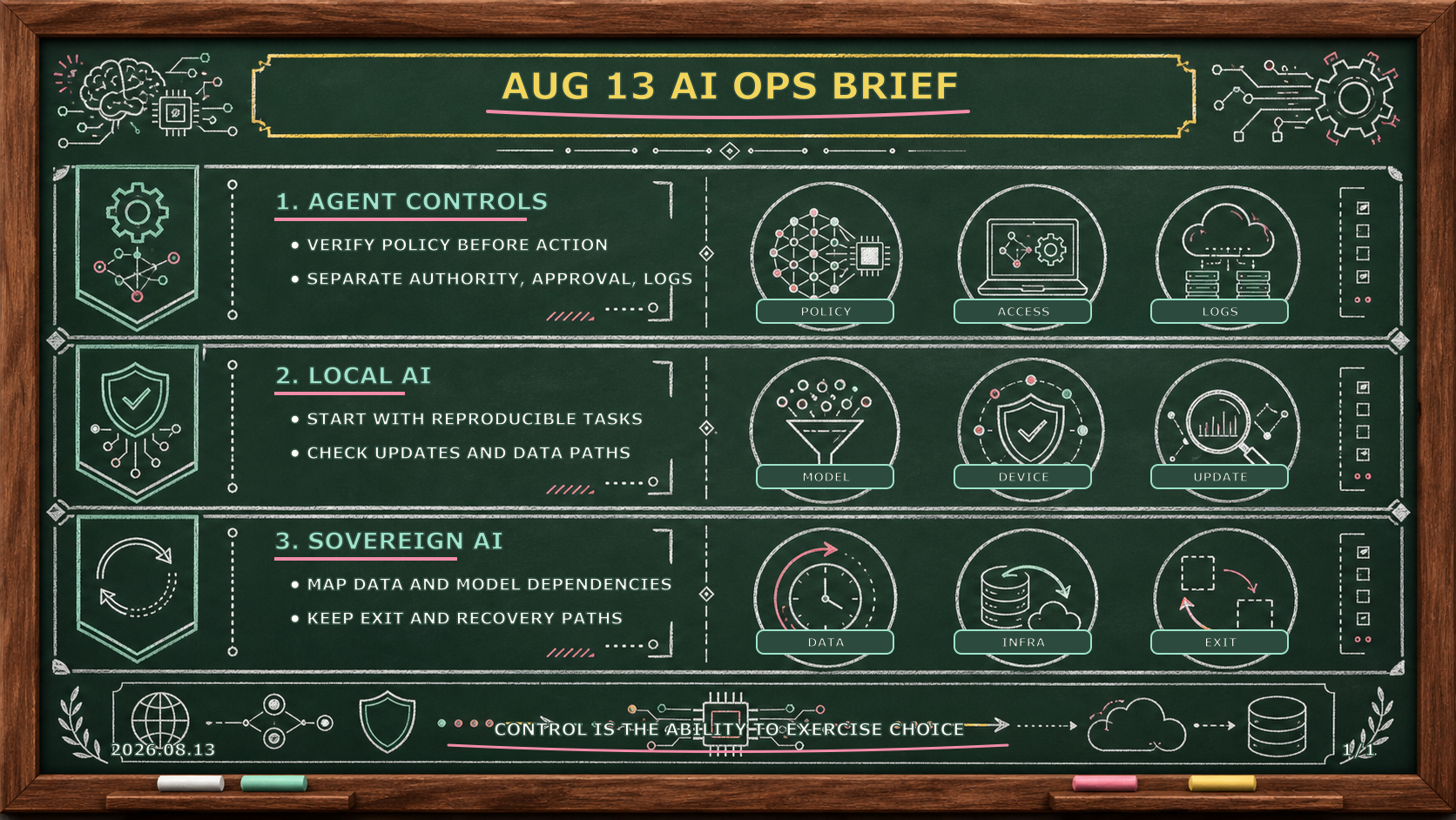
Three things to take from today
First, agent security is broader than checking whether a model says something harmful. It must cover whether an external document changes a plan, which tools run in which scope, and what is checked before output becomes real action. Second, local and on-device AI are not opposites of cloud. They are deployment choices in which a team newly owns responsibility for model files, runtime, hardware, updates, observability, and user-data paths. Third, sovereign AI and open-weight models are not a simple choice to exclude closed suppliers. They are a structure for continuing to decide procurement, security, reproduction, migration, and ecosystem participation.
- Connect an agent’s goal, input, authority, tool calls, approval, and evidence, and separate high-risk action from result generation.
- Evaluate local models first on small reproducible tasks, measuring memory, power, updates, and recovery cost as well as accuracy.
- Assess sovereignty not through ownership of weights alone, but through the combined state of data, infrastructure, operating staff, contracts, and portability.
1. Agentic AI security is a layer of action verification and control, not an answer filter
An agent can do more than answer a question: it can search, read and write files, create tickets, deploy code, and send requests to other systems. That difference changes the security unit from one answer to one task. A sentence may look harmless, but the operating problem has already occurred if the plan it generates reads files outside authority or follows instructions from an untrusted page to transmit information externally. Conversely, even imperfect output can have limited impact if tool authority is narrow, important execution is verified and approved, and the action can be reversed.
NIST’s AI Risk Management Framework presents a voluntary framework for managing risks associated with trustworthy and responsible AI. It should not be read as a completion certificate for an agent product or as a fixed list of security controls. Its view that organizations should treat AI risk as an iterative process of governing, mapping context, measuring, and managing is nevertheless useful. For agents, these activities must be attached not only to product documents but to the flow of an actual request: who started work for which purpose, what data and tools entered context, what was measured, and under which condition work was constrained or stopped.
Source · NISTAI Risk Management FrameworkNIST’s voluntary framework for managing risks associated with trustworthy and responsible AI.The first separation is between generation and execution. A model may propose a plan, draft, or candidate command, but a proposal must not itself become authority to execute. The execution layer should accept only permitted tools and argument forms after policy checks and normalized input validation. An agent given the natural-language goal “send guidance to customers,” for example, must not thereby gain authority to read the entire address book and transmit to an arbitrary external address. Recipient set, template, attachment, sending volume, and time window need separate policy checks; action over a threshold goes to human approval. Verification cannot end with a model’s one self-assessment and must consult independent policy and system state.
The OWASP GenAI Security Project is a community project covering security risks and guidance for generative-AI applications. OWASP’s Top 10 for Large Language Model Applications has brought attention to risk categories including prompt injection, sensitive-information disclosure, supply-chain vulnerabilities, and excessive agency. This is not a certification standard that forces the same solution on every product. It does help prevent reduction of the agent problem to “the model was wrong,” directing attention to inputs, data, plugins and tools, authority, and the deployment supply chain together. The possibility that untrusted text can try to alter the priority of a model’s instructions should be a design starting point for search, browsing, mail, and document-processing agents.
Source · OWASPOWASP GenAI Security ProjectAn OWASP project on security risks and practical guidance for generative-AI applications. Source · OWASPOWASP Top 10 for Large Language Model ApplicationsOrganizes LLM-application risks including prompt injection, sensitive-data disclosure, supply chain, and excessive agency.A usable minimum unit of control is a task manifest. Attach a request ID, requester or service principal, business purpose, input source, permitted tools, permitted scopes, maximum calls and cost, sensitive-data rules, required approval, expiry time, and evidence location to every task. This is ZHS’s operating proposal, not a field list prescribed verbatim by NIST or OWASP. The material point is not that fields exist, but that the executor enforces them. A read-only task must be unable to call a write API, and an expired approval must not permit reuse of the same token or past decision. A policy written only in a prompt is merely part of model output.
Perform verification at three moments. Before execution, inspect the goal, tool scope, data classification, and approval. During execution, observe call count, targets, failed retries, newly discovered outside instructions, and unexpected authority requests. After execution, compare not only the artifact but the action that actually occurred. It can matter more which materials were read, which file was created, and which system was not contacted than that the agent says “the report was made.” Do not indiscriminately copy sensitive source material into history; retain identifiers and the minimum evidence needed to connect request, policy, tool, and result. Limit access and retention separately.
When an agent fails, the need is safe stopping, not more autonomy. Stop execution when an identical error repeats, a tool reaches an unexpected target, new authority is needed, or cost or time limits are crossed. Do not hand a person only the entire conversation history. Provide a summary of goal, input source, policy applied, last plan, actual tool calls, failure cause, reversibility, and next options. The approver should know whether they are deciding to continue, narrow, roll back, or end. Control is not a barrier intended to slow automation; it is an interface for retaining accountability and recovery paths at any speed.
2. Local and on-device agents with open models are a deployment choice, not deletion of responsibility
“Local AI” combines very different configurations: a small model inferring on a personal device, a model running on a server inside a private network, an analysis pipeline in a disconnected environment, and an architecture that mixes cloud models with local preprocessing. It is therefore too quick to conclude that “local is safe” or “an open model is controllable.” Teams need to ask whether data leaves the device, which components use a network, where the model and packages came from, who reviews updates, and how users verify results.
Recent reporting and industry discussion sometimes mention Meta- or NVIDIA-family models and tools alongside the possibility of local agents. A single report, however, must not be generalized into claims about the availability, performance, license, device requirements, or release numbers of a particular model. In particular, unverified release statistics for Meta Muse Glimmer or NVIDIA Nemotron 3.5 are not evidence for this briefing. Product selection should recheck official model cards, licenses, deployment documents, security notices, and reproducible tests on target hardware—not a release headline or one benchmark line. This article does not assert a supplier’s advantage; it addresses a verifiable path to local execution.
Hugging Face’s Transformers documentation describes the library and workflows for using pretrained models across text, vision, audio, and other tasks. It does not guarantee that any model is safe or suitable for a particular device. It can, however, be a starting point for the practical work of loading and evaluating a model through code and a runtime. In a local trial, record more than a model name: pin an exact revision or hash, tokenizer, runtime version, quantization method, prompt template, hardware, and measurement dataset. That is how a team can distinguish a result changed by the model from one changed by a prompt or package the following week.
Source · Hugging FaceTransformers documentationOfficial documentation for the Transformers library used with pretrained models across many tasks.Ollama’s official documentation covers running models and using its API. It likewise does not mean that local execution automatically becomes private, risk-free, or management-free. A local runtime can make downloading and running a model convenient, while the organization still decides artifact origin, an internal registry or allowlist, network policy, API authentication, sensitive information in logs, and patch and vulnerability response. “It worked on a laptop” is only a demo. Once a local agent is connected to service accounts, shared file systems, browser tools, or a code executor, it too requires authority management and audit.
Source · OllamaOllama DocumentationOfficial Ollama documentation covering model execution and API use.The first evaluation task for a local agent should not be broad autonomous work; it should be narrow and reversible. For example, classify internal documents without external transmission, produce a draft in a fixed format, and place it in a human review queue. Record, beyond success rate, types of incorrect classification, reject or hold rate, average latency, peak memory use, device heat or power constraints, regressions after updates, and manual failover time. Personal-device performance may differ across users, so do not market “on-device” as one number. State supported hardware, quality thresholds, and behavior when a device is unsupported in product documentation.
The advantages of an open model are conditional as well. Downloadable weights can broaden options for internal evaluation, domain adaptation, deployment location, and supplier switching. But access to weights does not guarantee full disclosure of training data, safety, commercial rights, or long-term maintenance. Licenses can differ across model, code, dataset, and deployment package, so terms for redistribution, derivatives, and fields of use must be checked. Treat models obtained externally as a software supply chain: inspect provenance and integrity, retrieve from approved repositories, subscribe to vulnerability notices, and keep evaluation records before and after a change.
Local deployment can support data minimization, but it must not be described as an automatic guarantee. Even where input is processed locally, telemetry, error reporting, model downloads, remote search, plugins, and synchronized folders can create separate transmission paths. Instead of broad wording such as “data never leaves the device,” the design document should list storage location and network path for input, embeddings, prompts, logs, caches, and outputs. If a user supplies sensitive documents, review deletion, retention, backups, device loss, administrator access, and residual model context. Local is a choice that brings control closer; it is not proof that control has been exercised.
3. Sovereign AI and open-weight models are operating capabilities that preserve choice, not declarations of independence
Sovereign AI is used to describe the ability of a nation, public institution, company, or regional community to decide and operate important elements of AI according to its legal, policy, security, and economic priorities. It does not mean one fixed technical architecture or an obligation of self-sufficiency. One organization may prioritize data residency, another continuity of a critical service or language and cultural fit, and another transparency and interoperability in public procurement. The better question is not “can everything be ours?” but “what do we depend on, and what can we change or continue to operate when risk rises?”
The Linux Foundation is a nonprofit organization that supports collaboration and sustainable innovation in open-source ecosystems. That role helps frame how open governance and shared maintenance can support infrastructure choice. The existence of the Linux Foundation or an open-source license, however, does not guarantee the sovereignty, security, or long-term viability of a particular AI system. Weights may be public while training and inference compute, data rights, security updates, specialist staff, deployment tools, and legal responsibility remain concentrated with one supplier. Conversely, an organization using some managed services can reduce risk if it has standard interfaces, portable data, and alternative paths.
Source · Linux FoundationLinux FoundationOfficial site of the nonprofit that supports collaboration and sustainable innovation in open-source ecosystems.OECD.AI is the OECD’s AI Policy Observatory, providing AI policy, principles, country material, and analysis. It is a starting point for recognizing that countries do not take identical approaches and that AI governance sits in policy and social context, not technical performance alone. Country materials should not be treated as a conclusion about another country’s legal duties or performance ranking; organizations must separately confirm applicable law and contract. Yet the perspective of balancing public value, trust, responsibility, and innovation moves the sovereignty discussion beyond server location or nationality marketing into a broader operating question.
Source · OECD.AIOECD AI Policy ObservatoryThe OECD’s AI Policy Observatory provides AI policy, principles, country material, and analysis.Translate sovereignty into operating language by making five maps. First is a data map: where data is generated and stored, processed, and deleted under which legal and contractual terms, and whether it can be exported when a supplier changes. Second is a model map: mark which of weights, APIs, embeddings, safety filters, evaluation tools, and prompt templates are external dependencies. Third is an infrastructure map: find single points of failure across accelerators, cloud regions, networking, key management, observability, backups, and disaster recovery. Fourth is a people map: identify who evaluates and patches models, responds to incidents, and reviews contracts. Fifth is an exit map: rehearse the order in which data, applications, and evaluation criteria would move after contract termination, a price rise, sanctions, an outage, or a security incident.
Open-weight models are an important option on this map, not the entire answer. A team may download weights to run them internally or compare several hosting approaches. At the same time, it assumes responsibility for weight provenance and licensing, model-card limitations, vulnerability notices, inference stack, hardware procurement, updates, and gaps in safety evaluation. Procurement documents should therefore include more than the label “open”: exact version, allowed uses, redistribution terms, security-update contact, support on discontinuation, data-export format, evaluation reproduction method, and criteria for switching to an alternative model. Real choice comes not from possessing a file, but from being able to operate it safely and move when necessary.
Sovereignty is also different from isolation. Participation in open standards, interoperable APIs, joint evaluation, security-information sharing, and responsible stewardship of local languages and public data can strengthen even a small organization’s negotiating position without requiring it to own every layer alone. Conversely, granting trust merely because of a supplier’s country or identity misses internal access control, contract terms, auditability, and outage response. Strategy should vary with the risk class of the work. High-impact decisions, sensitive data, and essential public services may require stronger data boundaries, fallback plans, and independent review. For lower-risk support work, managed services may be reasonable where portability and conditions for logs and deletion are secured in contract.
Operator’s memo
The first task available today is a behavior table for one running agent. Put goal, input source, model, permitted tools, authority to write, transmit, or purchase, approver, maximum cost and attempts, and log and evidence locations in one row. A blank does not mean immediate failure, but it exposes an uncontrolled decision. Next, choose one risky tool and prevent execution from a model’s natural-language proposal alone; add structured argument validation and separate approval or a policy check.
Test local AI with a limited, non-sensitive task in one department. Pin the model, runtime, hardware, dataset, and measurement script, and retain results alongside memory, latency, failure, and changes after updates in the same repository. Check which communication occurs both with the network disconnected and connected. This small experiment shows the true responsibility boundary of deployment better than a marketing statement about a particular model.
Do not begin a sovereignty review with the binary “open or closed.” Make the five maps of data, model, infrastructure, people, and exit, with an owner and next review date for every item. When single-supplier dependence is found, prioritize small verifiable steps—an export test, alternative-model evaluation, contractual notice terms, or recovery drill—rather than declaring an immediate wholesale replacement.
Today’s conclusion
Control in the agent era comes not from the degree to which a model is trusted, but from the degree to which action can be constrained, verified, and reversed. Local execution and open weights can broaden options for that control, but bring supply-chain and operating responsibilities with them. The substance of sovereign AI is not declaring ownership of everything; it is the ability to see, explain, and change important dependencies when needed.
Today, narrow the authority of one agent, make one local trial reproducible, and write one dependency line each for data, model, infrastructure, people, and exit. Those records connect security, performance, procurement, and public value in the same language of execution.
Sources
Related posts
Read →Related tools