Aug. 11 Daily Briefing — One Operating Boundary for Agent Actions, Security Identity, and AI Disclosure
A practical operating checklist for agent action approvals, identity and access controls, kill switches, and generative-AI disclosure in Korean product workflows.
DAILY NEWSLETTER · 2026-08-11 · ACTION CONTROLS · AGENT SECURITY · GENERATIVE-AI DISCLOSURE
Aug. 11 Daily Briefing — One Operating Boundary for Agent Actions, Security Identity, and AI Disclosure
Putting an agent into a workflow is not merely a model-quality exercise. Teams need to decide which actions may run automatically, which identity may call which tool, and where people will recognize generated output. This briefing turns those questions into one operating checklist tied to request evidence and release records.
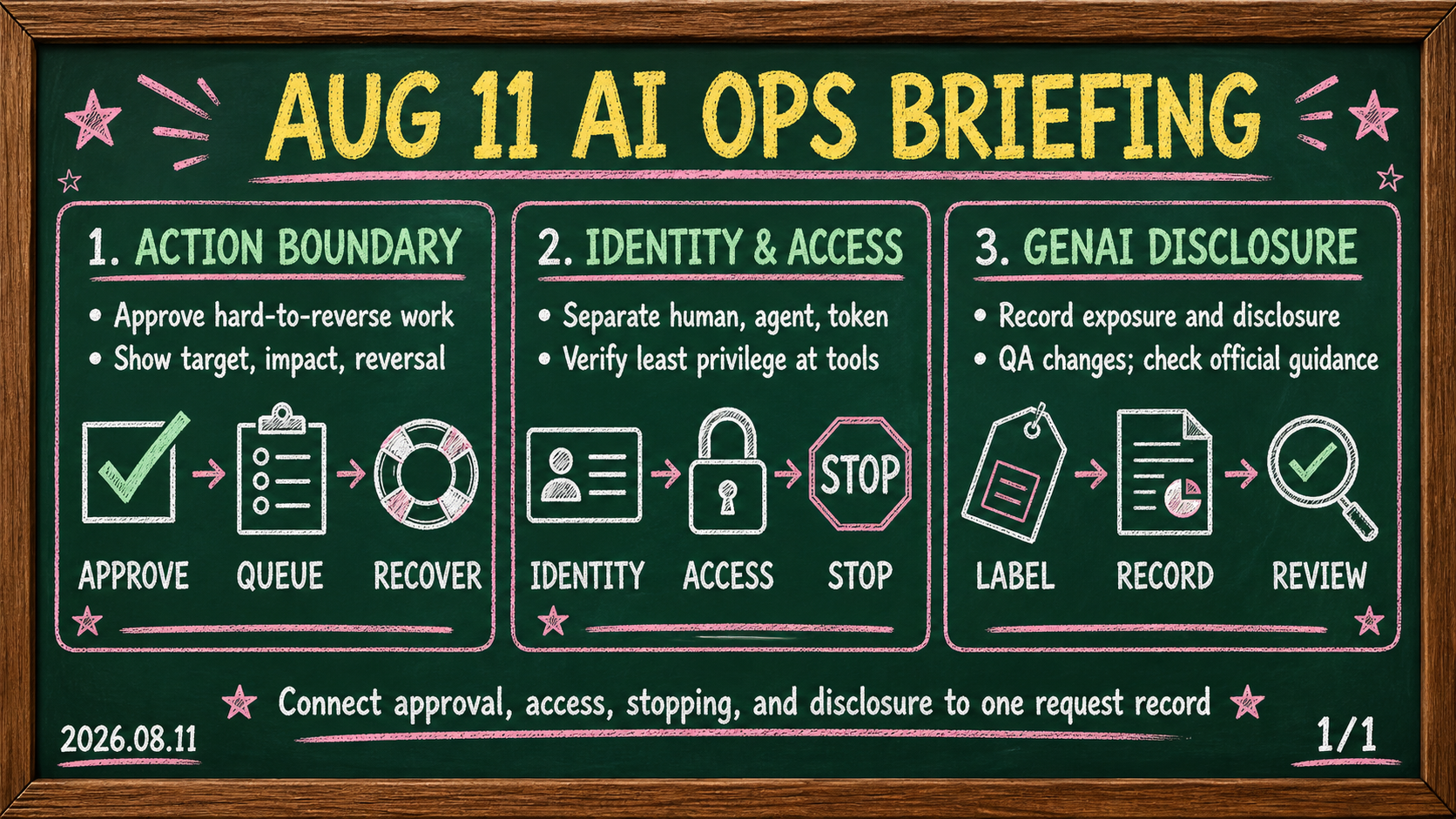
What to carry into this week
First, distinguish an action an agent can perform from an action it may perform now. Second, verify identity and access at the tool boundary rather than relying on model instructions. Third, make generative-AI disclosure part of feature specifications, QA, and change records—not just a line of interface copy. Connected in this way, the three practices let teams expand automation while keeping high-impact execution visible and controllable.
- Classify actions by recoverability, target count, and external impact
- Separate human, agent, and service-account identities
- Record where generated output appears and how its disclosure changes
1. AI agent action-control checklist: separate “can run” from “may run”
Searching documents, summarizing meetings, drafting an internal note, sending a customer message, changing access, deleting data, and initiating a payment can all look like tool use. Their recovery costs are very different. An internal draft can usually be corrected or discarded. External delivery, bulk changes, deletion, access changes, and financial or contractual actions can widen impact as soon as they execute. The deployment question is not only whether a model can finish the task. It is how far the organization can reverse the result when the task goes wrong.
NIST’s AI RMF provides a way to consider AI risk in an organization’s operating context. In practice, that means designing boundaries around the impact and recoverability of an action rather than placing the same approval step on every workflow. Bounded read-only work may be automated; internal writes can be constrained by template, target, and quantity; external sending and permission changes can wait in an approval queue. The important variable is what the tool can change and who is affected, not the confidence or polish of the model’s response.
 Source · NISTAI Risk Management Framework | NISTNIST’s primary framework offers an approach to identifying and managing AI risk in an organization’s real operating context.
A useful action inventory can begin with a few fields: resource, operation, maximum target count, external-delivery status, reversal path, approver, and credential expiry. Adding a note to one CRM record is not the same type of write as sending a message to every customer. The latter may need recipient checks, a target-count threshold, a preview, accountable approval, and a cancellation window. Naming the recovery owner in the same inventory reduces the time lost deciding who has authority to act when something goes wrong.
An approval view should do more than offer an approve button. It should put the objective, source material, target, planned tool call, expected change, expected impact, and reversal path in front of the reviewer together. If the reviewer has to visit several systems to rediscover the evidence and estimate the scope, the automation has not eliminated review work; it has hidden it elsewhere. A decision can only be responsible when its operational range is visible.
 Source · OWASPHome - OWASP Gen AI Security ProjectOWASP’s GenAI Security Project supplies context for placing controls at execution boundaries rather than inside a model’s textual instructions alone.
Stopping rules need as much design attention as approval rules. An unexpected external domain, repeated authorization failures, unusual retries, a rapid increase in targets, a cost spike, or a policy-version mismatch can be reasons to hold work rather than simply open an alert. The response should not be one oversized emergency button. Operators should be able to cancel a single job, freeze a queue, disable one connector, revoke a token, or deactivate an agent identity independently. A global stop that interrupts every workflow is too blunt; a stop that cannot halt the relevant action is not a control.
Use ten recent tool calls as a quick reality check. For each one, reconstruct who requested it, which policy allowed or denied it, what tool touched which target, and whether cancellation or recovery was possible. If the team cannot explain the path quickly, repair the evidence and boundaries before granting broader access. The goal is not to place every action back in human hands. It is to make higher-impact actions wait, make abnormal actions stoppable, and make completed actions explainable.
2. Agent-security checklist: put access, identity, and the kill switch at the tool boundary
Agent security is not solved by adding another instruction telling the model to be safe. The critical exposure sits on the path from interpreted content to a real tool call. Web pages, search results, attachments, and customer messages may contain untrusted text. The model may read that text as data, but the text must never acquire the authority to become a tool instruction. Keep data flow distinct from command flow, and submit every call to an independent policy decision.
OWASP’s work on LLM application risks is a useful reminder that generative AI does not eliminate ordinary authentication, authorization, input handling, or secret-management problems. “The agent asked” is not proof that an action is permitted. A tool service needs to verify the caller identity, stated purpose, target resource, requested operation, allowed scope, and applicable policy version before it permits or denies the call. A model can propose an action; an enforceable policy layer must make the access decision.
Keep at least three identities separate: the person or business system that initiated the work, the agent that plans and requests actions, and the short-lived credential that performs one task. Combining all three in one long-lived token makes it difficult to determine who acted and unnecessarily broadens the scope of a revocation. A read-only summarization task should receive only a limited, short-lived credential for the relevant resources. Invitations, payments, and permission changes should require different authority and approval conditions.
Make access inventories specific. “Document storage access” should become read access to a named folder, file creation, or sharing-permission changes. “Messaging access” should become draft creation, sending to a designated channel, or delivery to an external guest. Narrow scopes make it easier to remove unused authority and limit the impact of a failure. Least privilege is not a slogan; it is operating data expressed as resource, operation, condition, and expiry.
Source · NISTAI Risk Management Framework | NISTIts iterative approach to identifying and managing risk can support regular reviews of agent authorization and control policies.
A kill switch is best understood as a recovery sequence, not merely a feature that turns off the whole service. Operators first need to identify active jobs, queued jobs, active credentials, connected tools, and targets that have already changed. They can then revoke credentials, halt a tool, freeze a queue, and reverse changes where possible. Test this sequence regularly against systems that resemble production. The meaningful measure is whether the process still works when the primary owner is unavailable.
Audit evidence is also a recovery mechanism. Connect the requester, agent, service account, input source, policy decision, tool and arguments, target, result, approver, and any stop or revocation event to one request ID. Secrets and sensitive content should be masked, but access paths and policy decisions should not disappear with them. Exercise allowed, denied, expired, and revoked scenarios under realistic conditions. That reveals whether the control is usable, rather than merely documented.
3. Korea AI Basic Act and generative-AI disclosure checklist: make the label a release record
A generative-AI disclosure review should not end with a sentence added to a screen. The applicable law, subordinate rules, and official interpretations must be checked against the live service at release time through current official sources. This briefing is not legal advice. From an operating perspective, the durable work is to connect the place where people encounter generated or altered output, the disclosure treatment, exceptions, reviewer, and change history to the feature-release process.
Start by mapping the surfaces where a person encounters generated output. Chatbot responses, draft text, images, voice, summaries, recommendations, automatic classifications, and support replies all appear in different contexts. Even when they use the same model, a result shown only in an internal tool differs from one delivered to a customer or shared through a public link. Feature specifications should capture whether generative AI is used, the user-facing surface, the disclosure copy or method, the accountable reviewer, supporting records, and the change date.
Official reference · Korea국가법령정보센터Use this official law-information source to check the current statutory text and whether relevant subordinate rules are available at release time.Record product states such as generated, modified, regenerated, human-reviewed, published, and shared. This gives teams more than the statement that “AI made it.” When a quality issue or customer question arises, they can identify which version was shown to whom and through which path. Exceptions deserve the same care: internally limited test views, administrator-only analysis, substantially human-reworked drafts, and AI-generated files received from outside may present different exposure paths and responsible parties. Document the conditions, decision owner, review date, and treatment when results are reused in another channel.
QA should test more than whether a disclosure string exists on one page. Include first-time users, logged-out states, mobile views, shared links, copied output, notification messages, and external deliveries—actual routes through which users encounter the result. A change in model, generation scope, or reuse channel should send the disclosure treatment back into change review. When the practice is tied to a design system and content policy, new features can apply a consistent operating rule instead of inventing language from scratch.
Official reference · Korea과학기술정보통신부Use the ministry’s official information channel to check current AI-policy notices and related updates.A disclosure record is useful beyond the product team. Operations can identify which automation produced an external result; customer support can trace a question through the same request evidence; policy and legal stakeholders can review the actual deployed state and its changes. Transparency becomes shared data across development, review, and delivery rather than a late design decoration. For a customer-support agent, for example, the disclosure status can sit beside source material, model or configuration information, human-review status, and send approval under the same request ID.
Official interpretations and subordinate rules can change, so teams need a live check before release based on actual functionality and exposure paths. Ask not only whether a disclosure existed, but whether a person could recognize the nature of the result where it mattered, whether the treatment survived a release, and what evidence confirms the deployed state. This operating check does not replace legal analysis; it gives legal and policy review a concrete product state to assess.
Operator note for the week
Reviewing one workflow from start to finish is the fastest way to join these three topics. List its read, internal-write, external-send, secret-access, permission-change, and financial actions. Attach the human, agent, and service identities plus credential expiry to each action. Add an approver, queue, and stop method to actions that are hard to reverse. If the workflow exposes generated output, add its disclosure placement and change record. The permission inventory, approval event, audit evidence, and release record are then evidence of one operation rather than four disconnected documents.
Raise autonomy in stages: read-only work, internal drafting, bounded writes, then external execution. At every stage, test three things: an unauthorized call is actually denied; revoking a credential or stopping a queue controls in-progress work; and a person encountering generated output can recognize the relevant disclosure. These questions remain useful when models and connectors change. Safe expansion depends less on a capability demonstration than on the ability to stop, scope, and explain a failure.
The practical conclusion is straightforward: before giving an agent more work, confirm where its action stops, which identity executes it, and how its generated result is presented to people.
Check official interpretations and subordinate rules against live information, and seek separate legal review where needed. Meanwhile, the most useful operating step is to connect approval, access, stopping, and disclosure evidence to the same request and release unit.
Sources
Related posts
Read →Related tools