Aug. 10 Daily Briefing — One Operating Flow for Agent Controls, Security, and AI Labels
Agent action boundaries, identity and access security, and generative-AI disclosure belong in one operating flow. A practical briefing for Korean teams on approvals, evidence, and release records.
DAILY NEWSLETTER · 2026-08-10 · ACTION CONTROLS · AGENT SECURITY · AI TRANSPARENCY
Aug. 10 Daily Briefing — One Operating Flow for Agent Controls, Security, and AI Labels
Today’s three issues are not separate checkboxes for security, product, and legal teams. What an agent can do, which identity performs the action, and how a person recognizes AI-generated output all define the boundary of a responsible service. This week, inspect real approval points, logs, and disclosure placement before polishing more policy language.
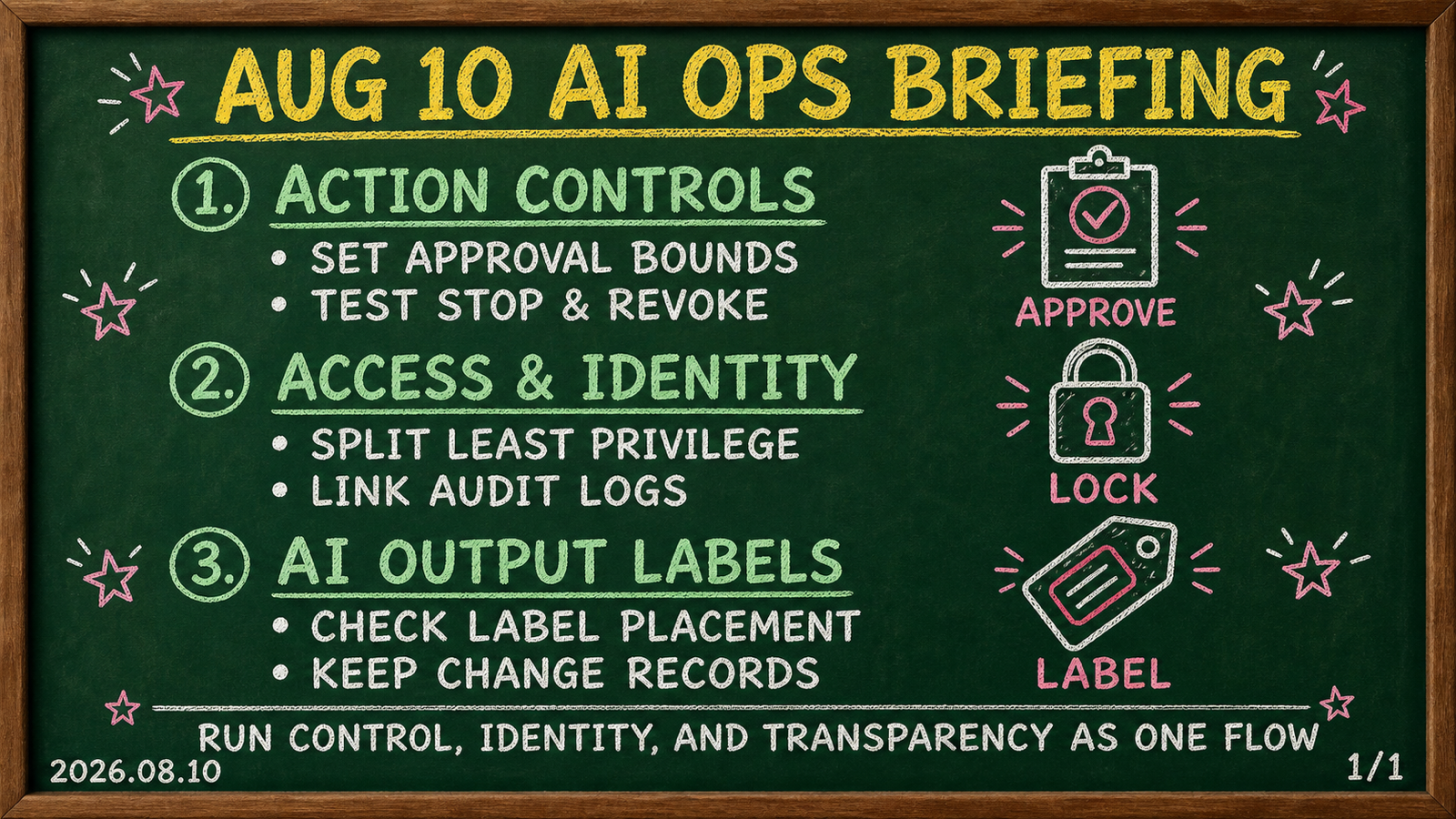
Three things to carry into this week
First, autonomous execution does not require a person to rewrite every answer; it requires an approval boundary before irreversible actions. Second, agent security is decided by identity and least privilege at the tool boundary, not by adding more prohibitions to a prompt. Third, AI-output disclosure is more than a label on a screen: it is a product record that must survive releases and changes.
- Classify actions by risk and recoverability
- Connect identity, access, and audit evidence to tool calls
- Put AI-output disclosure in the release and change workflow
1. Agent action controls: separate “can execute” from “may execute”
Reading and summarizing a document, drafting an internal note, sending a customer message, and changing permissions are not one class of automation. The first two can usually be discarded or corrected. External delivery, deletion, access changes, and payments may widen impact the moment they run. The pre-deployment question is therefore not simply whether a model can complete a task. It is what the team can recover when that task fails. NIST’s AI Risk Management Framework offers a useful starting point: identify and manage risk in the organization’s actual operating context.
 Source · NISTAI Risk Management FrameworkThe primary framework supports classifying agent actions by organizational risk rather than model capability alone.
A workable first policy separates read access, internal writes, external transmission, permission changes, and financial or contractual action. Low-risk reads and bounded internal drafts can pass automatically when conditions hold. External delivery can stop on an unapproved recipient domain; bulk changes can stop when the target count exceeds a threshold; payments can wait for a limit and an accountable approver. An approval view should show purpose, source material, target, planned tool call, expected change, and reversal path together. Otherwise automation has merely moved research and judgment work to the reviewer.
 Source · OWASPHomeOWASP’s GenAI Security Project explains why controls need to exist outside a model’s textual instructions.
Stopping rules deserve the same design work as approvals. Unexpected retries, an unfamiliar external domain, repeated authorization failures, or a cost spike can be signals to hold execution rather than merely create an alert. Operators need to identify pending work, active credentials, connectors, and already changed targets quickly. A single global kill switch is not enough. Cancelling a job, revoking credentials, disabling one tool, and freezing a queue must be independently executable.
In Korean organizations, a single workflow often crosses messaging, groupware, CRM, approvals, and cloud storage. A permissions inventory should therefore name the resource, operation, approver, expiry, and recovery owner—not only the service. Sample ten recent calls and try to reconstruct requester, policy decision, tool invocation, and result. If one call cannot be explained quickly, the workflow has not earned broader authority.
2. Agent security: enforce access at the tool boundary, not in the prompt
Agent security is not solved by asking a model to behave safely. The system must independently determine who is calling a real tool, whether that identity may perform this operation on this target, and whether text embedded in an external document can be promoted into an instruction. OWASP’s material on LLM application risks is a reminder that generative AI does not remove ordinary authentication, authorization, or input-handling problems. The enforcement point must be where a policy can actually deny the call.
Separate human accounts, agent identities, and task-scoped execution credentials. Do not attach every connector to one long-lived token. Issue credentials with a limited lifetime and only the scope needed for a task. A summarization agent with read access has no reason to invite users or spend money. A tool service should check caller identity, stated purpose, target resource, and permitted scope against policy; “the agent asked” is not a sufficient authorization decision.
Source · NISTAI Risk Management FrameworkA repeated identify-measure-manage cycle can be applied to reviewing and refreshing agent authorization policies.
Web pages, search results, attachments, and customer messages are data by default. A sentence inside them must not acquire authority to call a tool. Keep the data path distinct from the command path, and run each tool call through an independent policy check. Record request ID, human, agent and service-account identities, input source, policy decision, tool and arguments, target, result, and approver on one timeline. That evidence makes incident scope and reproduction possible.
An audit trail is a recovery mechanism, not a decorative report. Mask secrets and sensitive bodies, but do not erase access paths or policy decisions. Test allowed, denied, expired, and revoked states on real accounts; remove unused tokens and connectors. Product, platform, and operating teams each own a part of this practice: external action approval, recovery authority, and safe user-facing failure states.
3. Korea’s AI Basic Act and generative-AI disclosure: turn a label into a release record
Product teams should not treat a generative-AI disclosure requirement as text to copy onto a screen. The applicable Korean law, subordinate rules, and official interpretations need to be checked against the live service before release; this briefing is not legal advice. Operationally, the durable task is to connect the place where a user is informed, the wording, exceptions, and change history to the release process. Regulatory frameworks stress transparency and accountability because people need to understand the nature and possible impact of an AI system’s output.
Source · European CommissionAI ActThe European Commission’s primary policy page provides a comparative reference for transparency and accountability in AI regulation.Start with where generated output appears to a person. Draft text, images, voice, summaries, recommendations, and chatbot replies all have different contexts. Then capture states such as generated, modified, regenerated, human-reviewed, and published as product events. Keep disclosure copy connected to the design system and content policy rather than letting every feature invent a label. A new channel or model can then reuse the same rule, and support can identify which output version was shown through which path.
 Source · OECD.AIAI Principles OverviewOECD’s overview links transparency and accountability principles to responsible product operations.
Manual pre-release review alone is unreliable. Add required fields to the feature specification: whether generative AI is used, which user surface exposes it, disclosure copy, accountable reviewer, evidence, and change date. QA should include new and logged-out users, mobile, shared links, copied output, and other real exposure paths. When a model or generation scope changes, the disclosure and notice must also enter change review. The practical test is not merely whether a label existed, but whether a person could see it where it mattered after the change.
That record also supports trust. Users do not need to distrust every result, but they should be able to distinguish where generation was involved and who reviewed it. Support can trace questions through the same event record; legal and policy owners can examine an actual deployed state instead of a slide deck. Transparency is shared release data across development, review, and delivery—not a final design ornament.
Operator note
One checklist unifies the three topics. Choose one workflow and write down its read, write, external-send, secret-access, and payment permissions. Attach an approver and stop method to every irreversible action. If the workflow exposes generative output, add its disclosure location and change record. The permission inventory, approval event, and release record become evidence for the same operation.
Raise autonomy in order: read-only work, internal drafting, bounded writes, then external execution. At each stage test whether an unauthorized call is denied, whether a credential revocation stops active work, and whether a user can recognize generated output. Those questions survive a model change. The capacity to stop and explain a failure—not a capability demo—is what makes expansion safe.
Today’s smallest useful test is to review ten recent calls beside one recent release. Reconstruct requester, authority, evidence, and result for each call; confirm AI-output disclosure and change date at each user surface. If a line does not connect, repair that gap before adding a connector or model. Small evidence turns security, product, and compliance discussions from guesses into operations.
Watch not for a larger autonomy promise next week, but for whether the execution boundary really works: whether an approval has enough context, an unauthorized tool call is denied, and an output disclosure survives a release.
Separating controls, identity, and transparency makes operations heavier. Joining them to one request ID and one release record lets a team repeat more automation with less uncertainty.
Sources
Related posts
Read →Related tools