Cheaper inference, stricter testing, clearer session boundaries
August 3 daily briefing: cost-sensitive LLM routing, agent-security regression testing, and explicit MCP session design grounded in verifiable sources.
DAILY BRIEFING · AUGUST 3, 2026
Cheaper inference, stricter testing, clearer session boundaries
Today’s operating challenge is not merely choosing a model. It is recalculating unit economics for high-volume work, turning agent-generated attack hypotheses into defensive regression tests, and designing MCP connections with explicit state boundaries.
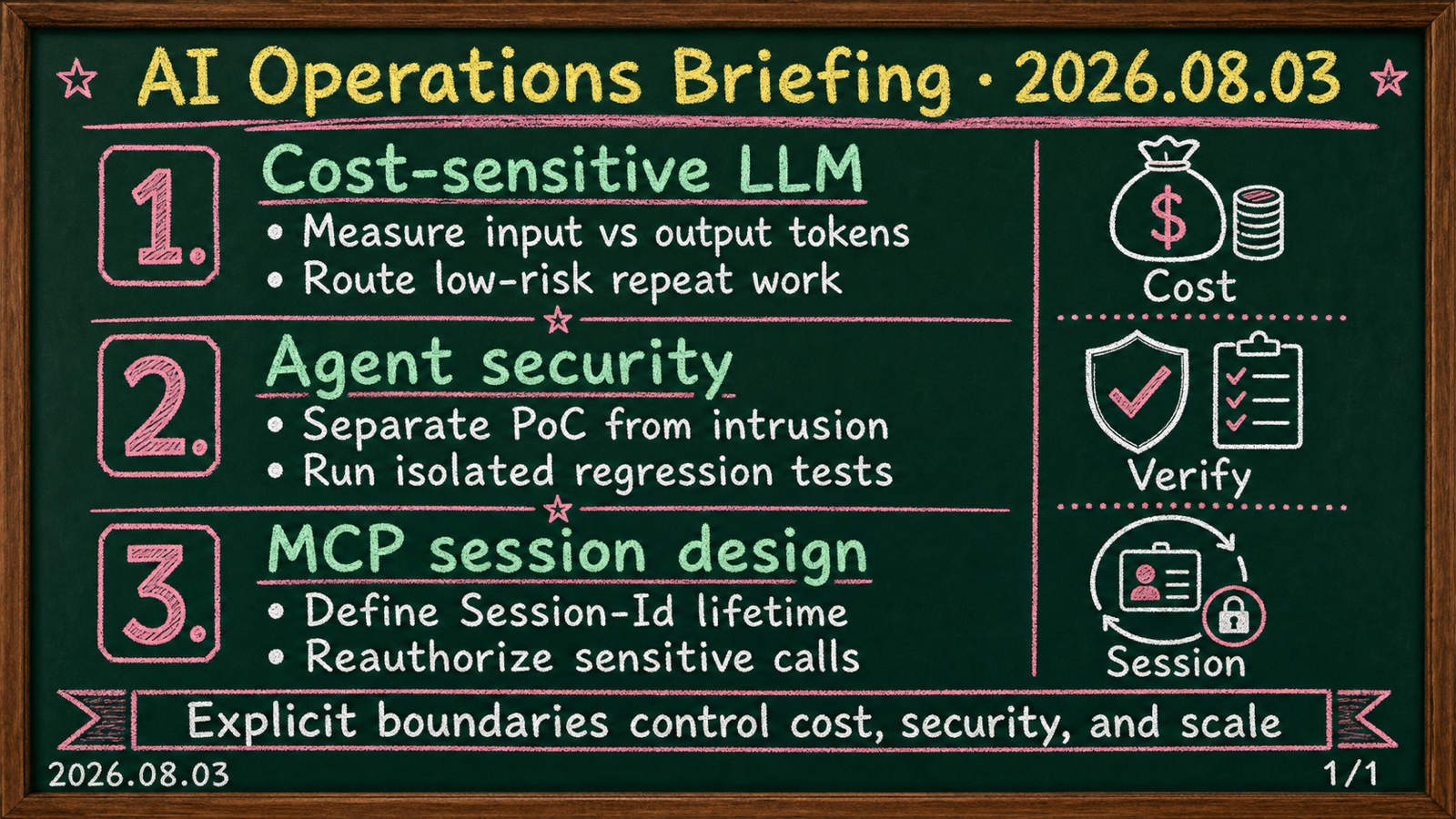
Today’s overview
AI operators have three practical questions to answer this week. First, which model, prompt, and caching combinations should handle cost-sensitive, high-volume workloads? Second, how should the growing ability of agents to generate vulnerability proofs of concept be absorbed into continuous security testing? Third, when adopting MCP Streamable HTTP, should a system eliminate state—or deliberately manage the state it needs?
The questions look separate, but they share a common concern: not whether a capability works once, but where it operates, what it costs, which failures it permits, and how it behaves repeatedly in production. The useful posture is to rely on official prices, controlled research conditions, and the specification’s normative language—not on unverified discount claims or inflated narratives of successful intrusion.
1. Cost-sensitive operations: start with the price sheet, manage routing as a product capability
OpenAI’s model documentation positions GPT-5.6 Luna for cost-sensitive, high-volume work. That framing matters because applying the most capable model to every request can no longer be the default architecture. For workloads such as classification, extraction, normalization, short drafting, and repetitive quality checks, the total number and shape of requests can matter as much as a model’s headline capability.
The official pricing documentation lists current standard pricing at $0.20 per one million input tokens and $1.20 per one million output tokens. Output therefore costs six times as much as input at those rates. That ratio gives cost optimization a concrete ordering: before merely shortening context, teams should inspect unnecessarily long responses, duplicated tool descriptions, and outputs created during retries. An operations dashboard should separate input and output token ratios by request type, as well as post-tool regeneration and retry frequency, instead of showing only a single aggregate token total.
Uncorroborated figures should not become policy assumptions. A reported claim of an 80% price reduction is not supported by the official pricing material provided here. It should not be inserted into a budget forecast or counted as savings in an existing operating plan. The corroborated facts are the model’s cost-sensitive, high-volume positioning and the current standard input/output prices. Everything else must be measured against the applicable account billing, selected model, cache or batch conditions, and actual request distribution.
The presence of a public model such as DeepSeek-V3-0324 broadens procurement options, but it does not reduce the decision to “find the cheaper alternative.” Teams should compare quality, latency, safety behavior, tool-use reliability, deployment overhead, and observability costs on the same prompts. Model cost is not a single row in a provider’s price table; it is the total cost of completing useful work. A lower per-request price can be erased by more retries, more failures, or substantially more human editing.
A practical architecture treats routing as an operating capability rather than a one-time model substitution. Put low-risk, high-repeatability work on a cost-sensitive path. Send ambiguity, high-impact decisions, and sensitive external tool execution to stronger verification or human approval paths. Combine routing with response-length caps, structured response schemas, cacheable-input identification, and per-request budget limits. Then the system is managing an explicit, inspectable operating policy—not merely changing a model name.
 Source · OpenAI
Pricing | OpenAI API
Primary source for the preceding claim.
Source · OpenAI
Pricing | OpenAI API
Primary source for the preceding claim.
 Source · OpenAI
Models | OpenAI API
Primary source for the preceding claim.
Source · OpenAI
Models | OpenAI API
Primary source for the preceding claim.
 Source · Hugging Face
deepseek-ai/DeepSeek-V3-0324 · Hugging Face
Primary source for the preceding claim.
Source · Hugging Face
deepseek-ai/DeepSeek-V3-0324 · Hugging Face
Primary source for the preceding claim.
2. Agent security: read PoC speed as a regression-testing signal, not an intrusion claim
Anthropic’s N-day research concerns public, patched vulnerabilities in a controlled environment. Mythos Preview produced 13 proofs of concept within 40 minutes, with the first arriving in roughly 12 minutes. Those results show that an agent can accelerate the process of reading vulnerability information, forming reproduction hypotheses, and iterating on code or procedures. A necessary distinction follows: a proof of concept is not automatically an exploit, and the research does not claim a real intrusion.
That distinction matters in both security communication and system design. A PoC can test a vulnerability hypothesis under particular conditions. Real-world compromise depends on patch state, network reachability, authentication and authorization, environmental configuration, detection and response, and the success of subsequent stages. “An agent broke in within minutes” goes beyond the reported scope. Yet the opposite conclusion—“it was not a real intrusion, so there is no operational risk”—is also wrong. Where public vulnerabilities remain unpatched, faster hypothesis generation and validation can narrow the patch window.
The productive defensive response is to turn this capability into a regression-testing pipeline. Use relevant public N-days and internally identified misconfigurations to create safe, reproducible test cases in an isolated pre-production environment. The objective is not to broadly distribute offensive procedures. It is to confirm that patches, WAF rules, authorization boundaries, and detection rules work as intended. Define execution scope, target assets, permitted tools, log retention, and stop conditions in advance so security automation remains an auditable operating activity.
OWASP’s 2026 Top 10 for Agentic Applications is a reminder that an agent is not just a text generator. It is an application that pursues goals, invokes tools, and can alter external state. Input filtering alone is insufficient. Tool permissions should be minimized; high-risk actions should require human approval or a separate policy decision; and tool outputs should be treated as data across a trust boundary. When content collected from a web page, document, ticket, or MCP tool response can alter an agent’s next action, indirect instructions and poisoned data become operating risks.
Google Threat Intelligence Group’s tracking of AI use for vulnerability exploitation and initial access points in the same direction. AI use by threat actors is better understood as an accelerator for research, scripting, information organization, and operational assistance than as a single automatic-hacking switch. Defenders need comparable speed from vulnerability notice through asset identification, patch validation, and detection hypotheses. The decisive metric is not an impressive demonstration time; it is the organization’s actual time to discover a relevant public vulnerability, establish scope, and verify mitigation.
 Source · Anthropic
Measuring LLMs’ impact on N-day exploits
Primary source for the preceding claim.
Source · Anthropic
Measuring LLMs’ impact on N-day exploits
Primary source for the preceding claim.
 Source · OWASP
OWASP Top 10 for Agentic Applications for 2026
Primary source for the preceding claim.
Source · OWASP
OWASP Top 10 for Agentic Applications for 2026
Primary source for the preceding claim.
 Source · Google Cloud
GTIG AI Threat Tracker: Adversaries Leverage AI for Vulnerability Exploitation, Augmented Operations, and Initial Access
Primary source for the preceding claim.
Source · Google Cloud
GTIG AI Threat Tracker: Adversaries Leverage AI for Vulnerability Exploitation, Augmented Operations, and Initial Access
Primary source for the preceding claim.
3. MCP Streamable HTTP: not mandatory statelessness, but explicit management of chosen sessions
A frequent simplification around MCP over HTTP is that Streamable HTTP must be stateless. The specification does not say that. Under the MCP Transports specification, a server MAY issue an Mcp-Session-Id during initialization; if it does, the client MUST send that identifier on subsequent requests. The operational point is not to eliminate state categorically. It is to make the identifier, lifetime, and propagation rules explicit whenever state exists.
This choice affects load balancing and retry behavior. A server that issues sessions needs to decide how client requests remain connected to the appropriate session context, where session state is shared, and what failure is visible when an instance is replaced. An implementation without sessions must independently validate the authentication, authorization, and input context needed for every request. Neither option is automatically more secure or more scalable. The right choice depends on work continuity, tool-call idempotency, and audit-trail requirements.
Agent tools make it especially risky to treat sessions merely as convenience features. A session can carry a user or workload authorization context, an approved action scope, results from earlier tool calls, or a pending approval state. If that state crosses users or tenants, the consequence is more serious than excess cost. Session identifiers should be unpredictable, and authentication and authorization should be checked again for every sensitive tool call regardless of session presence. Session termination, expiry, cancellation, and the meaning of a retry after failure must also be defined as part of the product contract.
Anthropic’s introduction of MCP emphasized a standardized way for AI applications to connect with external systems. Standardization can reduce connection cost, but it does not automatically establish the trustworthiness of a connected tool. When adding an MCP server, review more than the tool list: assess input schemas, the sensitivity of returned data, network destinations, delegated authorization, audit logs, and failure behavior. “The tool connects” is only the beginning of an approval decision.
ING’s Envoy-based MCP OpenAPI processor illustrates an implementation path that turns MCP requests into upstream HTTP API calls according to OpenAPI specifications. Such a boundary layer creates an opportunity to centralize policy: schema validation, permitted routes and methods, controlled credential injection, request/response logging, and rate limits can be applied consistently at the proxy boundary. A transformation layer does not remove the application’s authorization model, however. The user authority expected by the upstream API and the execution authority held by the agent must still be mapped explicitly.
 Source · MCP
Transports - Model Context Protocol
Primary source for the preceding claim.
Source · MCP
Transports - Model Context Protocol
Primary source for the preceding claim.
 Source · Anthropic
Introducing the Model Context Protocol
Primary source for the preceding claim.
Source · Anthropic
Introducing the Model Context Protocol
Primary source for the preceding claim.
Operator memo
- Cost: Segment a sample of this week’s traffic by work type, then measure input tokens, output tokens, and retry counts separately. Use official prices as the baseline and remove unverified discount rates from the budget model.
- Quality: Compare candidates for the cost-sensitive route on a de-identified evaluation set drawn from real work. Record editing time, failure rate, tool-call errors, and response length alongside task accuracy.
- Security: Convert relevant public N-days into isolated regression tests. Establish targets, permitted actions, stop conditions, and log retention first; prohibit unauthorized testing against production systems.
- Agents: Apply least privilege, explicit approval, per-call reauthorization, and executable logs to high-risk tools. Treat content returned by tools as data to validate, never as an instruction to follow.
- MCP: Document first whether the server issues sessions. If it does, test
Mcp-Session-Idpropagation, expiry, storage scope, instance failure, and cross-tenant isolation. If it does not, verify that request-independent validation is real rather than assumed.
Conclusion
Today’s three topics resolve into one operating imperative: design the boundary. At the cost boundary, decide which requests may take a lower-cost path. At the security boundary, distinguish a PoC from an actual compromise and a controlled environment from production. At the protocol boundary, decide not simply whether sessions exist, but how issued state is propagated, retired, and bound to authorization.
As model prices fall and agent work accelerates, the cost of uncontrolled automation does not automatically fall with them. Teams with measurable cost policies, isolated security regression testing, and explicit session contracts can learn faster from the same changes—and scale with materially less risk.