July 20 AI Operations Brief — Verification Loops, Regulatory Readiness, and Cost Boundaries
A practical guide to turning AI coding into a verifiable loop, preparing minimum operational records for changes around Korea’s AI Basic Act, and setting task-level cost and authority boundaries for agents.
DAILY NEWSLETTER · 2026-07-20 · VERIFICATION LOOPS · AI BASIC ACT · COST GUARDRAILS
July 20 AI Operations Brief — Verification Loops, Regulatory Readiness, and Cost Boundaries
Today’s three signals ask the same question: once an agent starts doing the work, how does an operator retain control? In coding, the answer is shifting from a single instruction toward repeated testing and repair. In Korea, amendments reported to take effect on July 21 make it timely to organize explanations and change records without jumping to legal conclusions. In autonomous execution, a small failure can become a long chain of retries and external spending unless every task has explicit limits.
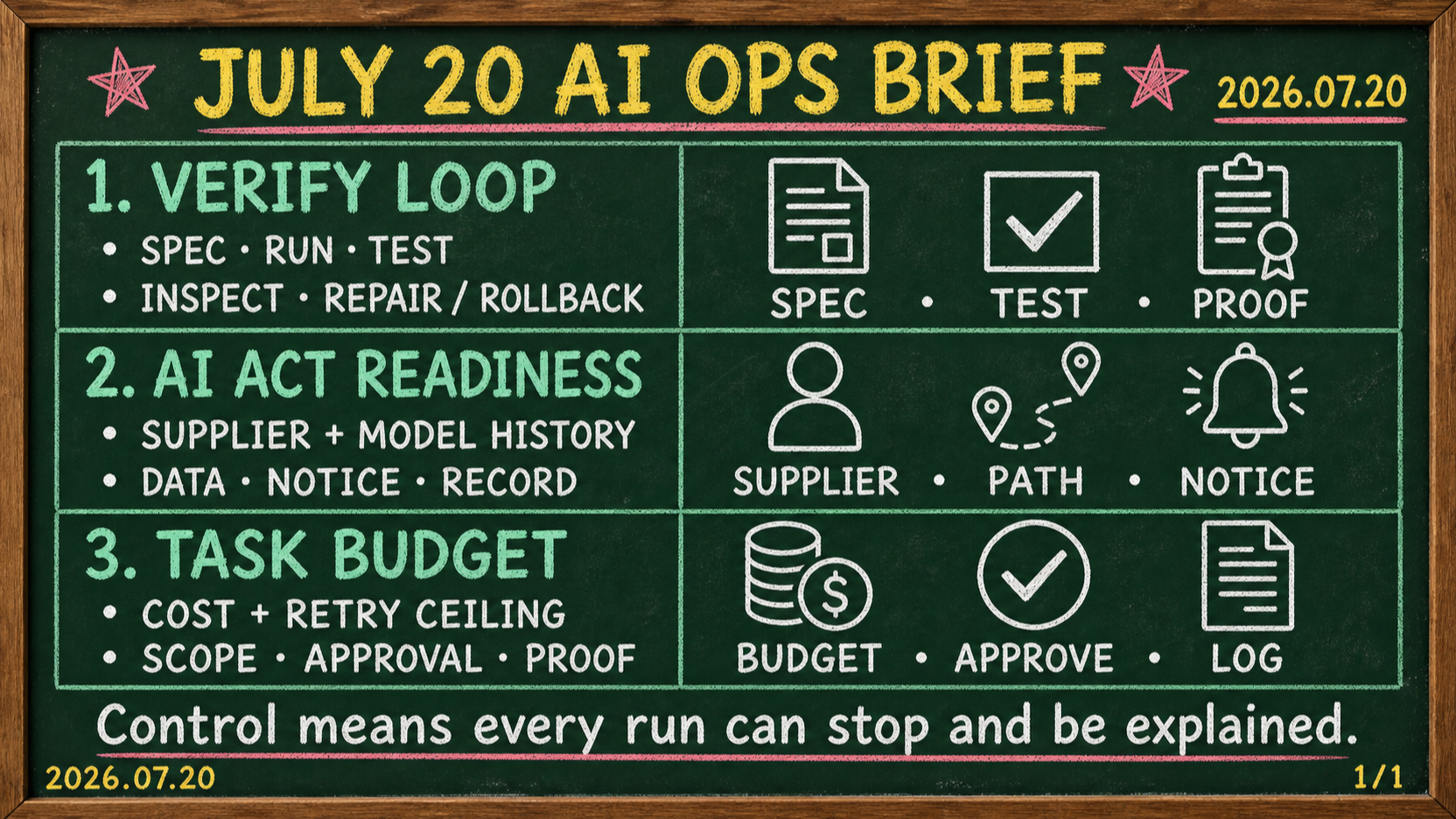
Three things to take from today
First, effective AI coding is not the production of a plausible result at speed. It is the production of tests that expose failure and evidence that closes the repair. Second, regulatory readiness does not begin by calling every checklist item a legal duty. It begins with enough operational records to explain which models and data a system uses and what users are told. Third, cost control is not a month-end billing exercise. It is a runtime design that limits spend, retries, tool scope, approvals, expiry, and evidence for every task.
- Run coding work as specification → execute → test → inspect → repair or roll back → evidence.
- Make supplier, model, data-path, disclosure, approval, and change records retrievable before drawing conclusions about legal applicability.
- Limit not only task cost and retry count, but also the scope of external action and the useful life of an approval.
1. The ability to find and close failure matters more than a perfect prompt
AI Times connected the spread of Karpathy-style AI coding guidance with loop engineering, including reading the code first, creating a failing test, and naming known failure modes. The important shift is away from the belief that one carefully written prompt can guarantee a good result. A patch created without reading the repository can easily violate an existing contract. A run that checks only its success path can conceal broken boundary conditions. Reproducing the failure first puts the target of the repair and the definition of done in the same frame.
Source · AI Times'카르파시 AI 코딩 지침' 확산…"프롬프트에서 루프 시대로 진화"The report connects read-first practice, failing tests, and named failure modes with a repeatable coding-verification flow.A second AI Times report describes generative AI use moving past a single prompt-and-answer exchange toward repeated experiments and verification, then toward a double loop that also examines the research method. This does not establish one universally superior methodology. It does offer a useful distinction between a first loop that fixes the output and a second loop that asks why the process keeps creating the same failure. When an error recurs, the team should inspect the ambiguity of the specification, missing tests, tool permissions, and observability—not simply request another patch.
Source · AI Times'카르파시 루프' 넘어 '이중 루프' 시대로...AI가 스스로 연구 방법 ...The article describes generative AI use extending beyond one-shot answers into repeated experimentation and verification.SelectStar AI likewise introduces loop engineering as an emerging concept discussed by engineers and developers at frontier labs. These sources show the direction of attention; they do not prove a mandatory workflow for every team. ZHS’s operational template is specification → execute → test → inspect → repair or roll back → evidence. The specification states both what should and should not change. The test records the condition that reproduces failure. Inspection covers the diff, logs, interface, and artifact. When the acceptance conditions are not met, the system repairs the result or returns to a safe state.
The value of that template is not the number of times an agent “thinks.” It is whether the next person can verify completion. For a broken payment button, “fix the button” is not a specification. The task should state the expected behavior for a normal payment, a double click, a provider error, and a return to the page, then exercise each path. Even when the tests pass, the operator inspects whether the diff contains unrelated changes and keeps evidence—such as a real browser run or capture—that connects the request to the result.
A loop also needs stop conditions. Repeating the same edit and test without new evidence, or expanding speculative patches when the cause cannot be observed, is consumption rather than verification. Automatic execution should stop at the maximum attempt count, on a repeated identical error, or when new authority is required. At that point it should hand a person the input, latest diff, failing test, log location, and the decision still needed. A good loop is not a machine that spins forever; it ends in a state where success or failure can be explained.
When several agents modify code in parallel, the loop also needs clear ownership. If one agent rewrites a failing test created by another, the original failure condition may disappear. If they share the same working directory, it becomes difficult to tell which change produced the result. Fix the baseline commit, assigned files, run command, and artifact location for each unit of work, then rerun the original failing test before merging. Add any regression introduced by the repair to the same evidence bundle. Parallel execution creates a speed advantage only while the provenance of evidence remains distinct; once agents overwrite one another’s state, that speed returns as verification cost.
2. Ahead of the July 21 change, prepare a minimum operating record without making a legal determination
The Korea Law Information Center page for the Framework Act on the Development of Artificial Intelligence and Establishment of a Foundation for Trust is the official reference point for the statutory text and effective-date information. The confirmed statutory note says the law generally took effect on January 22, 2026, while listed amended provisions take effect six months after promulgation. That schedule alone does not determine whether a particular service is covered, what its exact duties are, or whether sanctions apply. The answer may depend on the organization’s role, the system’s function and users, and current subordinate rules and notices.
Source · Korea Law Information Center인공지능발전과신뢰기반조성등에관한기본법The official page provides the statutory text and effective-date information; provision-specific applicability requires separate review.Yonhap News reports that amended provisions take effect on July 21 and places them within Korea’s developing AI legal framework. AI Times Korea reports the legislative notice for a proposed enforcement-decree amendment intended to strengthen industry support, also describing a July 21, 2026 schedule. For an operator on July 20, the useful response is neither “everything becomes a new duty tomorrow” nor “nothing can be done until legal counsel finishes.” The narrow starting point is to recheck the effective official text and current notices, then make the system’s AI, data, suppliers, and user touchpoints quickly retrievable.
Source · Yonhap News[AI기본법] ① 개정안 21일 시행…한국 AI 법제, 준비 마쳤다The report covers the July 21 effective date for amended provisions and their place in Korea’s AI legal framework.The first minimum record is supplier and model change history. For every function, note which supplier and model family it calls, when the configuration changed, why it changed, and what material risk or user experience differs from the prior version. If the model identifier exists only in a provider dashboard and is not connected to the product release, the organization may be unable to reconstruct the configuration used during an incident. A row linking feature, supplier or model identifier, deployed version, deployment time, and change approver improves operational explainability regardless of the final legal analysis.
The second record is a plain-language data path and the user-facing disclosure. Map where input originates, what preprocessing it receives, which outside service receives it, and which result is retained. This briefing cannot determine whether a given field is personal or confidential information, but no one can review a path that is not known. Collect the interface language shown where users interact with AI, where generated or automated judgment enters the product, and where a person reviews the output. If the disclosure and actual behavior differ, check the product flow and retention policy instead of treating wording as an isolated fix.
The third record is minimum evidence connecting request, version, approval, and change. This is not a recommendation to retain every prompt or private chain of reasoning forever. Connect a request ID to the product, policy, and model versions applied; any necessary approval ID; the material result; the evidence location; and the retention or deletion rule. None of these checklist items should be assumed to be a legal obligation merely because it is operationally useful. Applicability, specific duties, sanctions, and currently effective notices must be confirmed from official sources and, where needed, with qualified legal or regulatory advice. This briefing offers operational preparation, not legal advice or a legal conclusion.
A minimum record is different from a maximum collection. A short inventory with an owner and a review trigger is more useful than a vast log no one can find. Give each record an originating team, accountable reviewer, last-review date, and condition for the next review. Update the row when a supplier term, model, data-transfer path, or user interface changes, preserving the prior state and reason for change. Narrow access and retention for each type of record as well. Copying sensitive input into a new evidence store in the name of readiness does not improve explainability. Point to the evidence while limiting access to the people and duration required for the work.
3. Control agent cost as a task stop-line, not a bill reviewed after the run
AI Times reports that Anthropic ended a temporary free promotion for Fable 5 and moved the product into its regular paid-plan policy. That product change does not describe the cost structure of every AI agent. An earlier report from the same publisher said paid users could use Fable 5 without a separate application up to half of their weekly subscription limit and that Claude Code weekly rate limits were 50% higher through July 19. These reports describe a particular product’s usage policy, not general agent economics or the pricing of other services.
Source · AI Times앤트로픽, '페이블 5' 정식 요금제 편입...프로모션 종료하고 '50% 제...The article reports the end of the temporary free promotion and the move into the regular paid-plan policy.For an operator, cost is more than model usage. It includes retries after failed tool calls, paid search, translation, mapping, image, and other APIs, browser or data-processing SaaS activity, and real purchases, publishing, or message delivery performed in an external system. Limiting only model calls can miss a path where an agent uses a less expensive model for many retries or repeatedly triggers a paid outside action. A practical boundary must therefore express a ceiling on both money and behavior.
The OWASP Top 10 for Agentic Applications for 2026 provides a risk framework in which tool permissions, external inputs, and autonomous execution need to be addressed together. It does not prescribe task-budget fields or spending thresholds. It is useful because an untrusted external input can shape a plan, and broad tool access plus automatic retries can then increase cost and real-world impact at the same time. Treating an overrun only as a finance problem misses permission abuse; looking only at permissions misses the cumulative effect of individually harmless calls.
Source · OWASPOWASP Top 10 for Agentic Applications for 2026The framework offers a way to consider tool permissions, external inputs, and autonomous execution as connected agentic risks.ZHS suggests six task-manifest fields: max_cost, max_attempts, allowed_scopes, approval_id, expiry, and evidence_path. They are an operating template, not an industry standard or a requirement asserted by the sources. max_cost expresses a task ceiling for model, API, SaaS, and external-action costs under the team’s declared accounting basis. max_attempts limits retries after failure. allowed_scopes enumerates permitted behavior, such as read, write, external transmission, or purchase.
approval_id connects a specific action to the person or policy that authorized it, while expiry prevents an old approval from being reused later. evidence_path points to the input summary, attempt results, final artifact, failure log, or rollback record. When a ceiling is reached, the agent should not secretly split the job or route around the limit through another tool. It should stop and show the reason, cost and actions already incurred, remaining options, and information needed for added authority. The operator can then continue, narrow, or end the task. The purpose of a budget is not the cheapest possible run; it is an explainable stopping point for work whose value has become uncertain.
If a parent task creates subtasks or parallel agents, its budget must flow down as a hierarchy. Copying the parent ceiling into every child multiplies the possible spend and retries by the number of children. The parent should reserve a share for each subtask from the total envelope and return only the unused share when that subtask completes or is cancelled. A reservation is not approval for external action, so purchases, publishing, and message delivery still require the relevant approval_id. An operator view should show not only usage, but also reserved cost, attempts remaining, active scopes, and approvals nearing expiry. That makes it possible to narrow the job before the next action rather than after the bill arrives.
Operator's memo
The smallest useful implementation today is a one-page task card. At the top, write the acceptance condition and the scope that must not change. Below it, name the test that exposes failure and the path to the evidence. If the task uses external tools, put the cost ceiling, maximum attempts, allowed scopes, approval ID, and expiry on the same card. Coding verification and cost control then become one execution contract instead of separate documents.
For regulatory readiness, create a current-state table before announcing a large compliance program. Give each function one row that connects supplier, model, input-transfer-storage path, user disclosure location, deployed version, approver, and latest change date. A blank field is not automatically a violation, but it identifies what the team needs to confirm through official material or expert advice. Around July 21 in particular, recheck the Korea Law Information Center and current notices from the competent authorities rather than relying on a saved summary.
The shared metric across all three topics is not the number of completed runs. Ask whether a test exposed the failure, whether the model and policy used for a change can be retrieved, whether execution stopped before crossing a limit, and whether approval and evidence connect to the same request ID. If the team can answer those four questions, faster automation does not have to mean losing the cause and consequence of the work.
Today’s conclusion
The next advantage in AI operations will not come from longer prompts or broader autonomy alone. Teams need verification loops that close from specification to evidence, change records that explain the current system without pretending to settle a legal question, and task boundaries that stop cost and authority together.
A small team can begin with one task: attach an acceptance test and the six manifest fields, then connect one product function to its supplier, model, and data path in a single row. That modest record gives tomorrow’s repair, review, regulatory check, and cost decision a shared operating language.
Sources
- AI Times — Karpathy AI coding guidance spreads as prompts evolve into loops ↗
- AI Times — Beyond the Karpathy loop toward double-loop research ↗
- SelectStar AI — What is loop engineering? ↗
- Korea Law Information Center — Framework Act on the Development of Artificial Intelligence and Establishment of a Foundation for Trust ↗
- Yonhap News — AI Basic Act amendments take effect July 21 ↗
- AI Times Korea — Proposed amendment to the AI Basic Act enforcement decree ↗
- AI Times — Fable 5 moves into the regular paid-plan policy ↗
- AI Times — Fable 5 promotion extension and usage limits ↗
- OWASP — Top 10 for Agentic Applications for 2026 ↗
Related posts
Read →Related tools