July 18 AI Operations Brief — A Simpler Harness, Pre-Execution Boundaries, and Audits That Explain Action
A practical reading of ARC-AGI-3 and the harness debate, policy and authority checks before payments or data changes, and OpenTelemetry-based audit records for agent action.
DAILY NEWSLETTER · 2026-07-18 · HARNESS · PRE-EXECUTION CONTROL · ACTION AUDIT
July 18 AI Operations Brief — A Simpler Harness, Pre-Execution Boundaries, and Audits That Explain Action
Today’s three signals are less about connecting more agents than about deciding what to delegate and what to retain. As models absorb more functions, the harness around them may become lighter. But executions that change external state—payments and data changes among them—need clearer policy and authority checks. To tell whether those boundaries worked, an organization also needs an audit record that connects a model call and a tool action as one event.
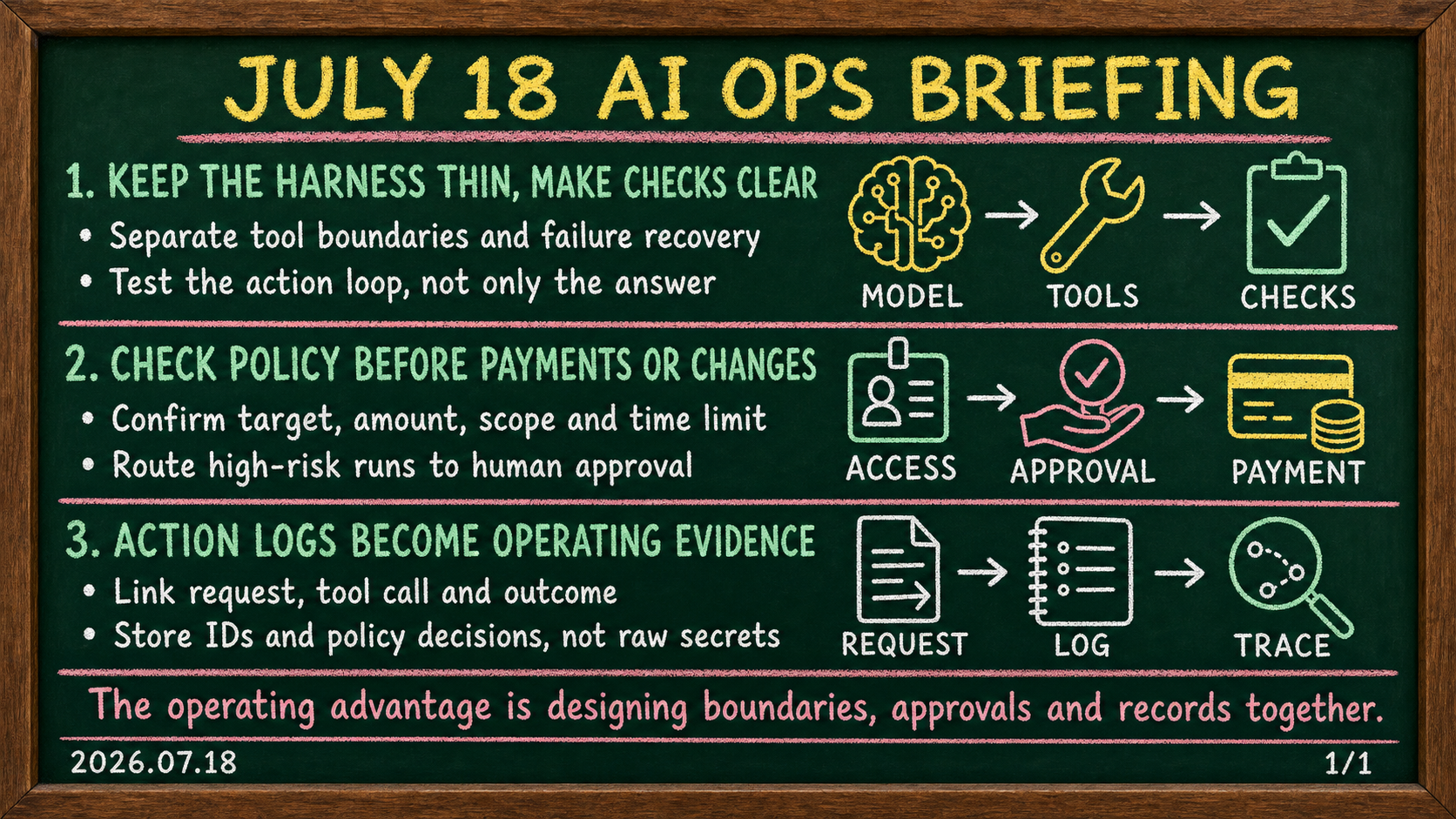
Three things to carry into operations
First, the purpose of a harness is not to pile as many functions as possible outside the model; it is to make responsibility clear at the model–tool boundary. Second, payments, data changes, and external sends are not simply continuations of response generation. They are state changes that policy and authority must judge first. Third, an audit log is not a ledger of all internal model reasoning. It is the minimum evidence needed to reconstruct the path from a request to an outcome.
- Interactive reasoning tasks test an agent’s real behavior, not merely the complexity of its harness.
- For high-risk execution, test policy and authority again immediately before the action—not only when a plan is formed.
- An observability schema joins model calls, tool calls, approvals, and outcomes into a traceable event.
1. A harness may become thinner, but the boundary of responsibility does not disappear
AI Times reported that at ICML 2026 Seoul, OpenAI Vice President Noor Brown expressed the view that a harness should remain simple because next-generation models will absorb many of its functions. Here, a harness means the surrounding control layer that gives a model task context, connects tools, and enables repeated execution. If models become more capable at planning, exploring files, selecting tools, and recovering from errors, some added rules and branches will naturally shrink. Simplification, however, is not the removal of control. As model capability expands, teams need to define more clearly which actions remain model judgment and which are fixed as system rules.
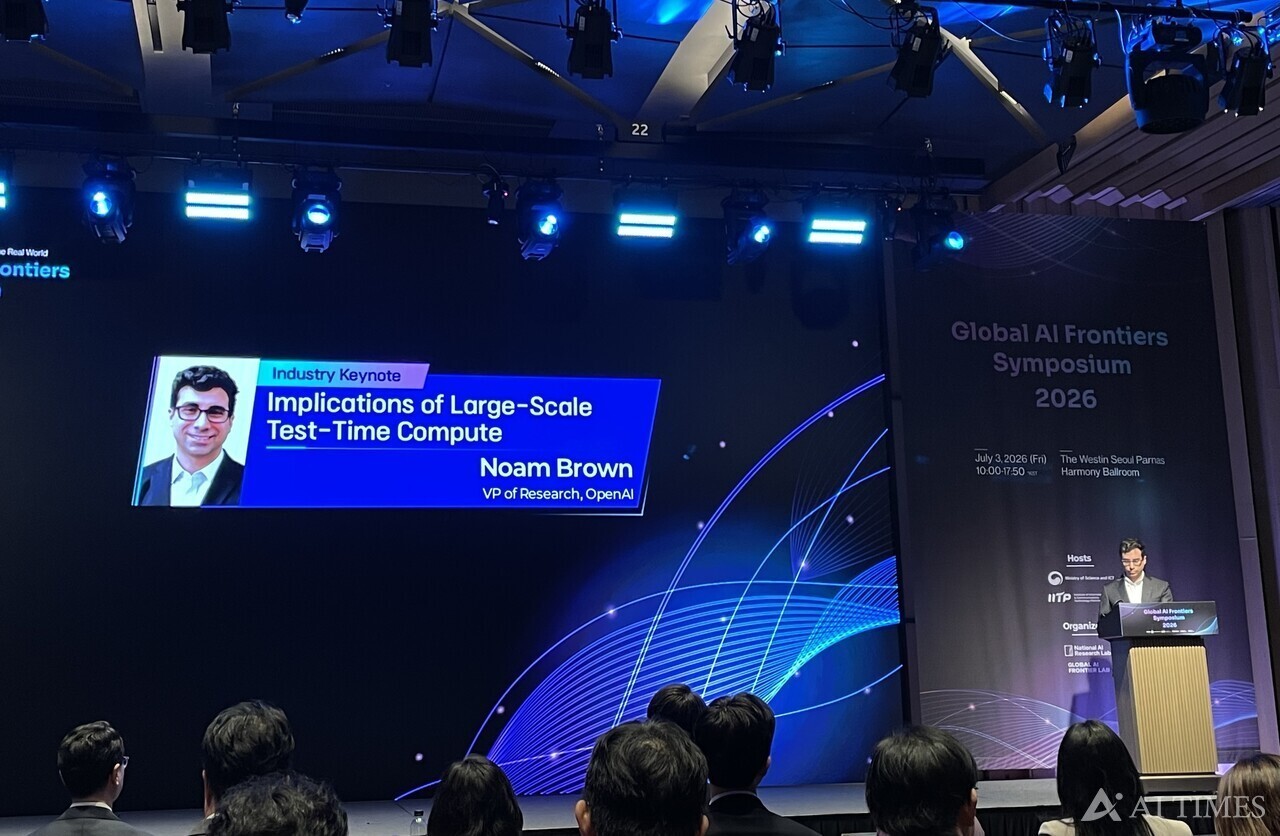 Source · AI Times구글 이어 오픈AI도 '하네스 무용론'..."차세대 모델이 기능 흡수할 것" - AI타임스Reports the view presented at ICML 2026 Seoul that harnesses should stay simple as models absorb functions.
ARC Prize describes ARC-AGI-3 as an interactive reasoning benchmark for agents. The important word is “interactive.” Rather than submitting a one-shot answer, an agent observes an environment, chooses an action, and incorporates the result into its next decision. That means a performance reading cannot stop at a single prompt design. How observations are passed in, how a failed tool call is stopped or retried, and how state is held across a longer task are all part of the work. The operationally useful conclusion is not that a harness is unnecessary. It is that a harness should avoid replacing model reasoning and instead focus on interfaces for environment, authority, and recordkeeping.
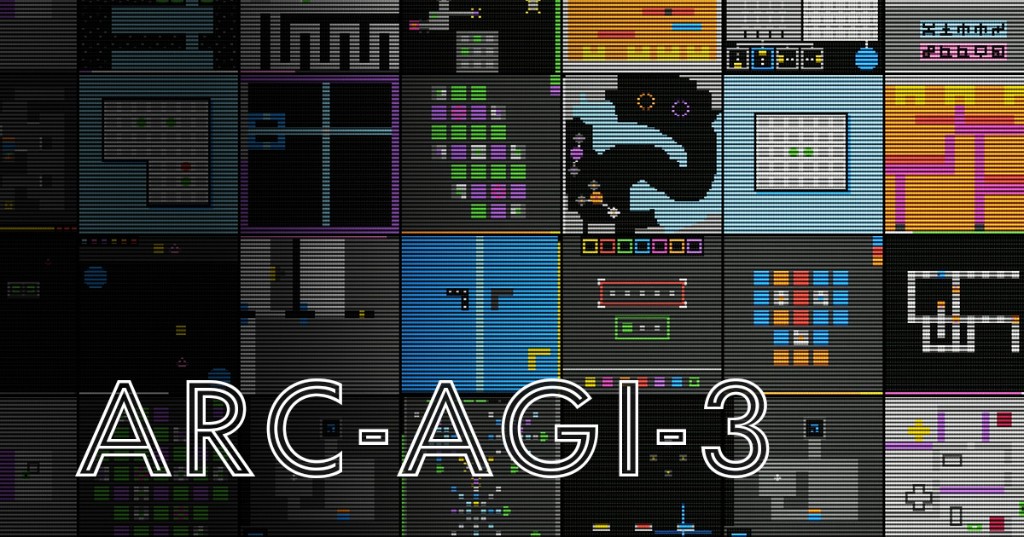 Source · ARC PrizeARC-AGI-3Introduces ARC-AGI-3 as an interactive reasoning benchmark for agents, providing a context that includes actions and environmental responses.
It is useful to view a harness as two layers. The first is convenience functionality that fills a gap in model capability: assembling long prompts, forcing a repeated plan format, sequencing fixed tools, or mechanically retrying a failure. These can be reduced or replaced as models perform them reliably. The second is the product and organizational boundary: user and tenant separation, the scope of secret injection, call budgets, network destination restrictions, payment limits, approval screens, and log retention. Those controls do not vanish when a model improves. Remove the first layer if appropriate, but remove the second and the harness has not become simple—it has become a path with invisible responsibility.
“Simplicity” should be turned into an operational principle that can be checked. Ask how many independent state stores a task needs; where tool authority is decided; whether retry counts and stop conditions live in code or policy; and whether a completed run can be reconstructed afterward. Remove wrappers that model progress has made redundant. Conversely, do not hide rules that prevent or explain external state changes inside a model prompt; place them in a separate layer. That keeps the safety boundary from changing accidentally when the model or its version changes.
An external implementation perspective reinforces this distinction. Schema Harness foregrounds its own harness implementation. It is a reference point for how an implementation can wrap model execution, not evidence for generalizing performance numbers or choosing a deployment. The useful question for an operations team is not which harness is larger or more elaborate, but where this implementation places the boundary between model judgment, tool execution, policy decision, and record creation. If the answer cannot be found in the documentation and code, neither simplicity nor control is easy to verify.
2. Trust the plan, but check payments and data changes again just before execution
GTT Korea covered the risk of unauthorized payments and data changes as enterprise AI agents proliferate, reporting that DevNex checks policy and authority before a change is executed. According to the report, high-risk actions go to reviewers, and intent, plan, policy, approval, and result are connected for traceability. The essential point is not merely placing one approval request at the very beginning of a job. It is comparing current policy and current authority with the exact target, amount, and change scope immediately before an agent acts. An initial natural-language request can appear safe while the concrete result it becomes through tool calls falls outside the allowed boundary.
 Source · GTT Korea기업 AI 에이전트 폭증에 무단 결제·데이터 변경 위험...실행 전 정책·권한 검사로 차단Covers pre-change policy and authority checks, reviewer routing for high-risk actions, and a traceable flow from intent through outcome.
Pre-execution checks work when they separate three questions. First: is this kind of action allowed at all? For example, may the system automatically issue a customer refund? Second: does this requester and agent have authority over this target right now? Third: is the concrete scope of this execution within its limit? The same refund can require different decisions depending on amount, currency, customer account, time of day, cumulative count, and the linked order state. Policy is the allowed action set; authority is the actor’s qualification; and a limit is the size of impact that one execution may create. Compressing all three into one “approved” marker makes it difficult to know what failed after an incident.
OWASP’s Top 10 for Agentic Applications for 2026 is a peer-reviewed agentic-risk framework. It need not be read as a guarantee for any particular product, but it provides shared language for treating agent risk as more than a question of response accuracy. Tool calls, delegated authority, external inputs, data flows, and autonomous execution are interconnected. If an untrusted external document shapes an agent’s plan and that plan reaches a payment tool, prompt defenses alone are insufficient. An independent policy decision and authority check must exist directly before the tool is used.
 Source · OWASPOWASP Top 10 for Agentic Applications for 2026A peer-reviewed agentic-risk framework that provides a lens for examining tools, authority, external inputs, and autonomous execution together.
In an operating design, separate planning from execution. The agent first builds a change plan in a read-only stage. That plan includes the target identifier, expected change, amount or record count, basis, and reversal method. A policy engine evaluates the plan, but does not pass broad execution authority in advance. When the actual tool call is formed, policy is applied again; if necessary, a human reviewer receives a readable diff. The approver does not approve “a refund.” The approver approves “this amount, for this customer, on this order, for this reason.” Give the approval a short expiry and a one-time identifier so it cannot be reused on another target.
Policy failure should also be treated as a normal outcome. When an agent attempts a payment and is denied, do not let it return an opaque error or seek another route. Return which rule denied the action and at what scope, what a human reviewer needs to check, and what safe next choice the user can make. A limit breach, for example, can be a signal for review rather than a cue to attempt automatic split payments. A finding that the agent lacks data-change authority should instruct it to stop or enter an approval path, not to search for credentials with higher privileges.
The smallest useful start is to attach this flow to one risky tool. Select a payment, refund, customer-record edit, access grant, or external publishing action. For that tool, write the allowed actions, prohibited actions, limit, approver, expiry, failure response, and rollback owner. Filling these six fields comes before completing every policy. It makes the organization test how a specific unexpected execution will stop, rather than only describing what an agent is capable of doing.
3. An audit schema does not preserve every “why”; it connects what happened
In its piece on generative AI observability, OpenTelemetry describes standardized records for model calls, tokens, and—on an opt-in basis—content, tool calls, and tool results. This is an important starting point for agent operations. Retain only model calls and the record omits what tools changed; retain only tool results and it omits the request and policy decision that led to the action. Connecting request, model, tool, policy, approval, and result in one trace lets an operator examine a user inquiry, unusual cost, denied authority, or real-world change as one timeline.
 Source · OpenTelemetryInside the LLM Call: GenAI Observability with OpenTelemetryExplains an observability approach that standardizes records of model calls and tokens, with opt-in content, tool calls, and tool results.
A practical action-audit schema need not be grand. At minimum, it connects a trace identifier, parent request identifier, user or service principal, agent and model version, time, execution environment, tool name, masked target identifier, policy decision, applied authority, approval identifier, and result status. Retain values that show impact scope, such as an amount or changed-record count, with appropriate sensitivity controls. Do not make raw customer text, secrets, full prompts, or full tool arguments default collection fields. When needed, use a hash, length, classification, or masked summary that supports an investigation while reducing exposure. Observability is not a contest to collect more; it is a design for connecting the evidence that is needed safely.
The unit of a record is not one event, but a causal relationship. Consider a user request to notify customers who are overdue this month. The audit flow connects receipt of the request, retrieval of the customer list, the model’s sending plan, policy checks for send time, recipient count, and template, approval status, the message-tool call, delivery result, and a failed retry or stop. Only that connection lets an operator distinguish whether an incorrect send began in data retrieval, grew too broad in the model plan, bypassed a policy limit, or was duplicated by the tool. When teams try to find the answer in a single log line, accountability quickly turns into guesswork.
Schema Harness is useful as a reference from an external harness-implementation perspective. Its performance statement is not used as evidence in this brief. Instead, the fact that a harness sits around execution leaves a practical audit-design question. If the harness creates tool calls and manages retries, can it pass a trace identifier, policy decision, and approval status without omission? If the model provider, tool provider, and policy engine produce separate logs, do they still join through a common identifier? These questions remain regardless of the implementation selected.
Source · Schema HarnessFrontier Models with Our Harness Achieve ~99% on ARC-AGI-3 Public — SchemaOffers an external harness-implementation perspective that helps frame how a layer around execution can connect trace and policy state.Audit records are not only for after an incident. They can reveal whether pre-execution policy is denying too often, whether a particular tool repeats retries, where approval waits block a workflow, and whether tool-use patterns change after a model version update. That use does not justify unlimited retention of personal data or sensitive content. Define collection fields, retention period, viewing authority, deletion method, sampling, and the conditions for opting into content collection. Limit each viewer to the minimum information needed. Explainability comes not from exposing more of a user’s input, but from modeling the execution path more precisely.
Operator note
The three topics join into one sequence. As models improve, convenience-oriented harness functionality can shrink. But the moment an agent reaches a real tool, a policy and authority check must sit outside the harness—or at a clearly defined boundary within it. Then the organization must retain evidence of how that check applied to the execution. Capability, control, and recordkeeping become problematic when treated as substitutes. Capability expands the work that can be automated; control defines the actions that may be allowed; and records explain how the two met in practice.
This week’s review can start with three tables. In the first, list every current harness function, separating convenience functions that model improvements may retire from safety boundaries that must remain distinct. In the second, list policy, authority, limit, approver, expiry, rollback, and external-send controls for every payment, data-change, and external-send tool. In the third, list the identifiers retained from request through result, alongside sensitive content that must not be retained. In any table, a blank default or owner is a boundary to fill before the next deployment.
Good agent operations do not make every action slow. Reading, analysis, drafting, and reversible changes can be automated quickly. But actions with lasting effects—money, authority, customer data, and external communication—need an independent decision immediately before execution and a record that can be reconstructed afterward. As harnesses become lighter, those two controls should not be treated lightly.
Today’s conclusion
The July 18 takeaway is that harness size matters less than boundary quality. Model capability may let teams remove convenience wrappers, but payments and data changes still need a fresh policy-and-authority check immediately before execution. Afterward, a minimal audit record must connect request, model, tool, approval, and result. Today, separate one harness function into “convenience” and “safety boundary,” put a pre-execution check around one high-risk tool, and define the identifiers needed to reconstruct that action.
Sources
- AI Times — 구글 이어 오픈AI도 '하네스 무용론'...\"차세대 모델이 기능 흡수할 것\" - AI타임스 ↗
- ARC Prize — ARC-AGI-3 ↗
- GTT Korea — 기업 AI 에이전트 폭증에 무단 결제·데이터 변경 위험...실행 전 정책·권한 검사로 차단 ↗
- OWASP — OWASP Top 10 for Agentic Applications for 2026 ↗
- OpenTelemetry — Inside the LLM Call: GenAI Observability with OpenTelemetry ↗
- Schema Harness — Frontier Models with Our Harness Achieve ~99% on ARC-AGI-3 Public — Schema ↗
Related posts
Read →Related tools