July 13 AI Operations Brief — Connect Public Data, Execute Safely, Leave an Action Record
Seoul’s public-data MCP pilot, work and research agents, and the case for action records all point to one operating loop. This briefing helps teams design connected data, bounded execution, and auditable evidence together.
DAILY NEWSLETTER · 2026-07-13 · PUBLIC-DATA MCP · SAFE EXECUTION · ACTION RECORDS
July 13 AI Operations Brief — Connect Public Data, Execute Safely, Leave an Action Record
Today’s signals came from different places. Seoul has announced an MCP pilot that lets generative AI consult real-time public data; a KAIST field case shows multiple AI agents dividing research and design work; and the demand is growing to record not only what an agent answered, but what it did under which authority. Together they describe a single operating problem.
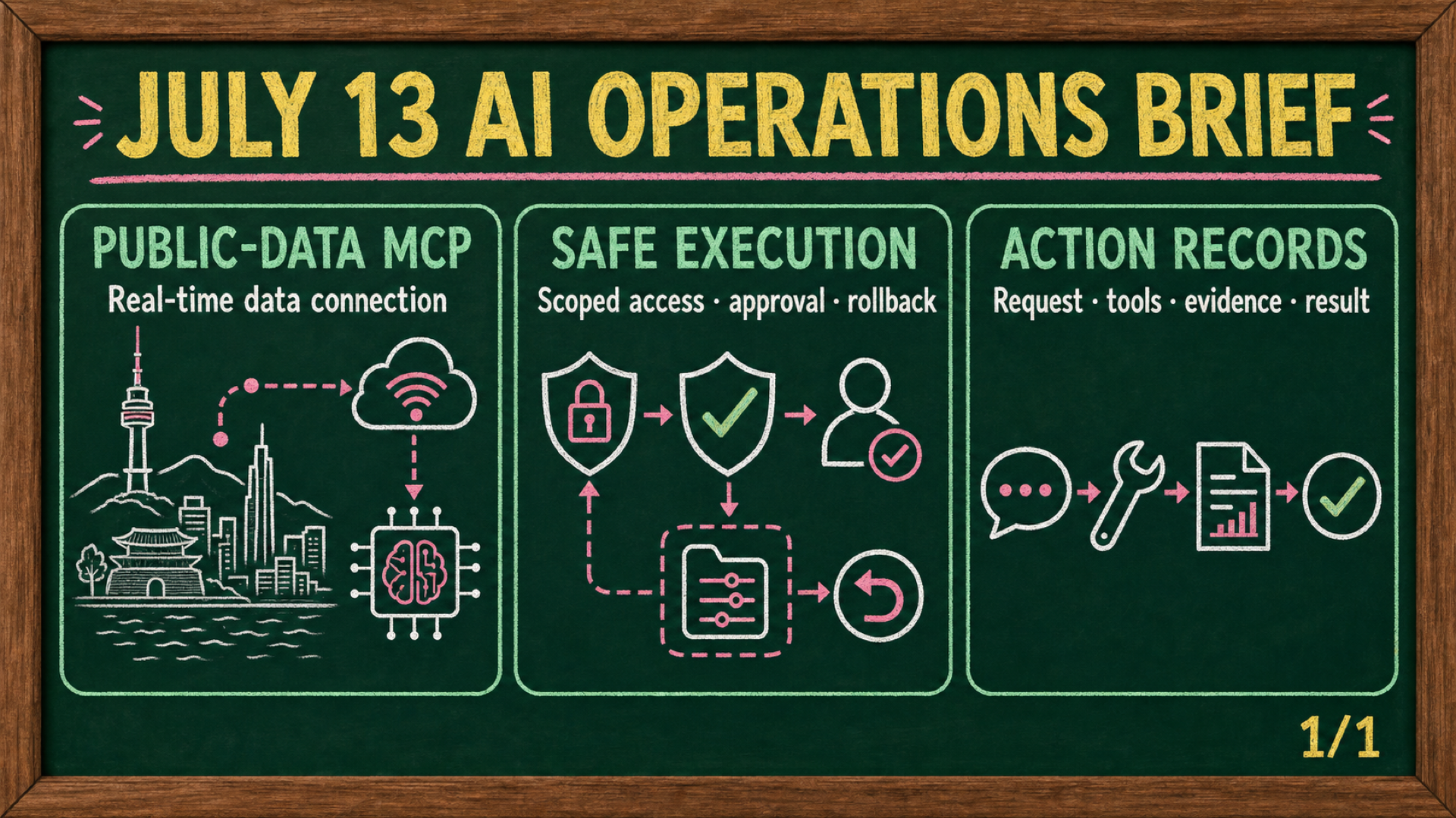
Three things to take from today
First, MCP is not magic that makes a model smarter; it is an interface for bringing the provenance and freshness of external data into a work flow. Second, agent automation creates value not through a demo that completes a long task, but through narrowly scoped authority, human approvals, and recovery paths. Third, a healthy response and a healthy system are not enough. Teams need an action record that connects the request, tool calls, evidence, outcome, and recovery.
- Public-data MCP: handle the source, scope, and freshness of an answer separately.
- Work automation: define read, draft, and execute access alongside approval and rollback for each task.
- Action records: trace the actual path of behavior, not only the final sentence.
1. Seoul’s public-data MCP is an occasion to design a trust boundary—not to declare hallucinations solved
MoneyToday reported that Seoul will pilot MCP so generative AI can answer with real-time public data such as congestion, weather, and public transit. AsiaToday also reported the city’s pilot to let generative AI directly retrieve Seoul’s real-time public data. The published guidance says the application-key page is scheduled to open at 11 a.m. KST on July 14. The meaningful change is not that a chatbot can produce more fluent prose. It is that a response can be tied to the source it queried, the moment it was queried, and the range in which that data remains valid.
 Source · MoneyTodayReal-time congestion, weather, and transit: Seoul connects public data to AIThe report covers Seoul’s planned pilot that connects real-time city data to AI queries through MCP.
It would be an overstatement to say that attaching public data eliminates hallucinations. MCP does not guarantee that a model’s reasoning is correct. A data feed may be delayed, a request may exceed the data’s intended scope, or multiple sources may show conflicting states. Operators still need to define the owner and refresh cadence of each source, the range of permissible queries, failure responses, and a citation format. Even data described as real-time should expose its last-updated time. When a question exceeds the available scope, the system should say it does not know or move the request to another verification path.
 Source · AsiaTodaySeoul pilots real-time public data to improve AI accuracyThe article explains the pilot that allows generative AI to directly consult Seoul’s real-time public data.
The minimum design for a small team is not complicated. For every data connection, distinguish read-only access from the ability to change an external system. Attach a source identifier and retrieval time to a response; when input is incomplete or a tool fails, do not silently reuse an old answer. Where civic data, location and mobility data, or potentially identifiable information overlap, define separate access scope and retention windows. A model may read data, but a separate policy must decide which actions that data may authorize.
This pilot also offers a practical reference point for teams connecting MCP to Korean-language work systems. Before hunting for a new server, list which questions require which sources. For every source, document freshness, authority, citation, and a fallback for failure. Those four fields turn MCP from a tool catalog into a verifiable boundary around external knowledge.
It also helps to split a question that retrieves data from a decision that interprets it. “Is a particular area crowded now?” is a query that can carry a source and retrieval time. “Should I go there now?” adds judgment outside the data, such as weather, travel time, and a person’s purpose. Keep raw data, summary, and recommendation distinct in both the interface and the log rather than merging them into one equally confident statement. The quality of a public-data connection shows not in the number of APIs attached, but in whether a user can tell where fact ends and interpretation begins.
2. Even when agents divide the work, people must design the authority to act and the points at which work stops
HelloDD described a KAIST Terra Lab case in which AI research agents divide roles such as paper discovery, coding, and result organization, while a human researcher reviews the draft and directs the work. Electronic Times reported that the same lab is holding a workshop on HBM design and research-work automation, covering design and simulation automation, document management, and research support. Together, the reports show agents moving beyond question answering into multi-stage work. They also show that the researcher remains responsible for the final direction. The value of collaborating agents is not to remove people from the flow, but to make the moments requiring human review clearer.
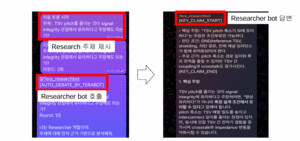 Source · HelloDDAI research agents collaborate—from semiconductor design to simulationThis field case shows multiple AI agents dividing research and design work while people review the direction of their output.
When teams start automation, they often ask whether an agent can handle an entire project. The more important question is which actions the agent may take independently in that job. Searching documents and drafting a comparison can be done with read access. Writing a proposed code change can happen in an isolated branch. Sending a customer email, changing a production system, or spending money should not execute without separate approval. Dividing authority by the side effect of an action—not by a feature name—keeps responsibility clear even as the automation surface grows.
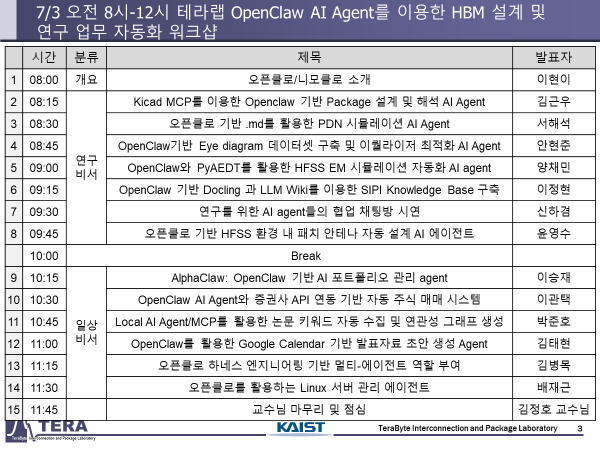 Source · Electronic TimesKAIST Terra Lab holds an HBM design and research-work automation workshopThe report introduces agent applications for design, simulation, document management, and research support.
A safe desktop or browser environment should be read through the same principle. An isolated screen alone does not make a system safe. Teams must also define which account signs in, whether files can be downloaded or uploaded, what data may be entered on external sites, and what remains after a session ends. A short work contract can state the purpose, allowed tools, input data, expected artifact, approver, and stop condition. When an agent asks for a tool outside that contract or an unexpected write privilege, the flow should move to an approval queue rather than continue automatically.
Rollback is not language for an incident-response document; it is part of task design. Decide in advance whether a bad file change has a previous version, which owner can cancel an incorrect external submission, and whether a doubtful simulation result can be stopped before it reaches a downstream system. In a chain where multiple agents pass results to one another, an error in one step can be amplified as fact in the next. Verifiable artifacts and human gates between stages reduce the cost of recovery.
3. Action records are not an extension of error logs; they are an evidence structure for agent trust
IT Chosun noted that conventional monitoring has focused on server failures and response latency, while AI services can produce incorrect answers, hallucinations, wrong source documents, or tool calls outside authority even when the response appears normal. WorkOS argues that existing application logs are necessary but not sufficient for auditing agent activity. The latter is company technical guidance rather than independent validation, but the shared operational problem is concrete: a final model sentence and a server status code cannot fully reproduce one agent run or establish responsibility for it.
 Source · IT ChosunAI agents that work on their own: action records determine trustThe article highlights wrong sources and out-of-authority tool calls that ordinary healthy-response monitoring may miss.
An action record is not a demand to save every trace of internal reasoning. It is a proposal to connect the minimum evidence required to follow a run. Record who requested a task and for what purpose; which policy and approval began it; which tool received which input and returned what; which evidence reached the final artifact; whether an external state actually changed; and whether a failure was recovered. Tie those elements to one execution ID. That allows an operator to investigate where a boundary failed instead of relying on the vague impression that an answer looked wrong.
 Source · WorkOSWhy AI agent audit logs are different from application logsThis technical guide argues that ordinary logs alone do not adequately audit an agent’s authority, actions, and delegation relationships.
More logging is not automatically better observability. Retaining sensitive prompts and raw source data indefinitely can create a new security problem. Where originals are not needed, teams can retain reference IDs, hashes, data classification, and access controls instead. A user-facing view can show the task state, changed target, and approval request, while deeper audit detail is reserved for operations and security staff. Designing retention and query permissions at the outset keeps evidence from becoming surveillance data that obscures accountability.
A small team can begin with tool calls that have an external side effect. Put requester, approver, authority scope, tool name, result link, changed target, and rollback status into one execution row. Each week, revisit the three jobs with the most failures or human interventions. Separating recurring stops into authority gaps, weak source data, or tool errors lets the team expand autonomy not through a one-time promise, but through adjustments made on evidence.
Operator’s note
Today’s three stories form a sequence. Connecting external data through a public-data MCP requires management of provenance and freshness. Letting an agent work from that data requires a separation between read and execution authority, plus approval and rollback. Recording how that authority was used supplies the evidence needed to allow the next run a broader scope. Strengthen only one of connection, execution, and records, and the other two remain operational risk.
This week, take one automation that already runs and express it as one operating contract rather than three separate documents. On the left, place the source data and its refresh time; in the middle, allowed tools, approval points, and stop conditions; on the right, the execution ID, outcome, and recovery link. Then test whether that one page answers: Why this data? Why was this action allowed? What actually changed? If the answers remain vague, improve the boundary and record before reaching for a larger model or more tools.
AI operations maturity is difficult to measure by the count of autonomous runs alone. A team must be able to process more work at the same pace while explaining data provenance, the basis for authority, and the state after failure. Teams that connect those three thinly but consistently can apply an operating principle to new MCP servers and agent tools instead of repeatedly rebuilding product-specific settings.
In practice, this principle works better when responsibility is explicit. A data owner verifies refresh cadence and permitted use; a work owner defines the completion criterion for automation; and a system owner manages permissions, secrets, and network boundaries. Even where one person holds all three roles, naming them separately in the operating document makes omissions easier to find. An approver should not merely press an “execute” button, but verify the target of change, evidence, expected impact, and route back.
Operating metrics should also look beyond run counts. Review the share of jobs stopped while awaiting approval, requests for authority outside policy, cases handed to a person because a source could not be verified, and time to rollback by task. Those measures are not surveillance meant to shrink automation; they signal where autonomy can safely expand. If people repeatedly intervene at the same point, the answer is not always to remove that point, but to make the required evidence and authority clearer.
What to try this week
Seoul’s public-data MCP pilot makes the experiment of connecting trustworthy external data to an AI flow more immediate. The research and work-agent cases show that automation’s value is not in removing human review. The discussion of action records sets the bar for making that review evidence-based rather than speculative. Before starting the next automation, check whether one job connects data provenance, execution authority, and a recoverable record.
Sources
- MoneyToday — Seoul connects public data to AI with real-time congestion, weather, and transit ↗
- AsiaToday — Seoul pilots real-time public data for more accurate AI answers ↗
- HelloDD — KAIST Terra Lab shares work automation cases from semiconductor design to simulation ↗
- Electronic Times — KAIST Terra Lab holds an HBM design and research-work automation workshop ↗
- IT Chosun — AI agent action records determine trust ↗
- WorkOS — Why AI agent audit logs are different from application logs ↗
Related posts
Read →Related tools