July 11 AI Operations Brief — Factory Software, Choice, and Agent Memory
Today’s brief connects Physical AI in manufacturing, sovereign AI as operational choice, and agent memory as a governed system of recall and deletion. Practical questions for Korean operators and product teams.
DAILY NEWSLETTER · 2026-07-11 · PHYSICAL AI · SOVEREIGN AI · AGENT MEMORY
July 11 AI Operations Brief — Factory Software, Choice, and Agent Memory
These are not three disconnected news cycles. Together, they show the operating structure required when AI begins to move through real production processes, when work must survive changes in external platforms, and when past decisions need to be reused safely. The advantage is shifting from the model itself to exception handling, control, and memory policy.
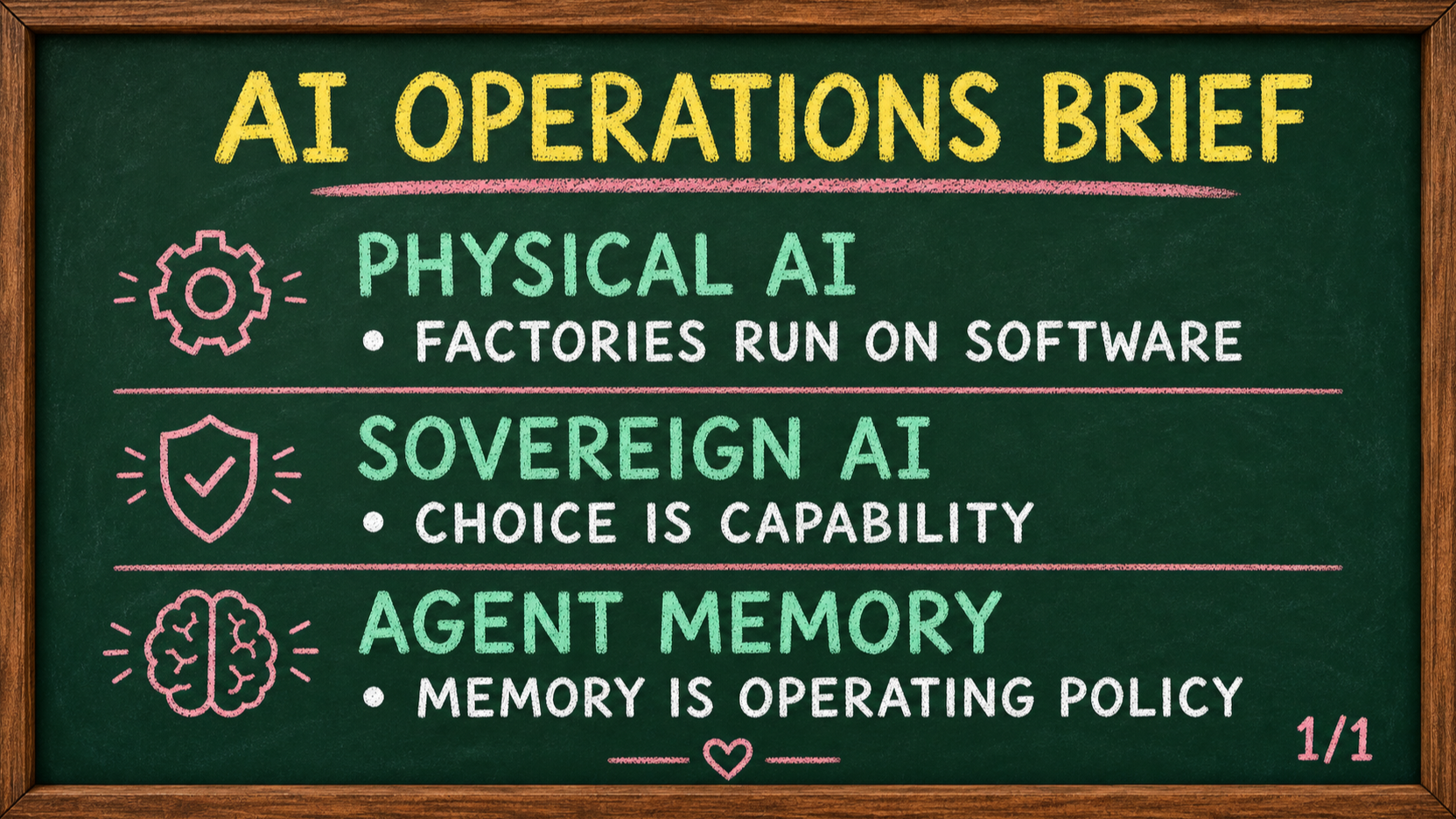
Three things to take from today
First, the value of Physical AI lies less in a robot that looks human than in the software that makes its actions repeatable inside a production process. Second, sovereign AI is less about owning one model than retaining workable choices when platform policies, access, or data conditions change. Third, agent memory is not a longer chat history; it is an operating policy for what to write, verify, retrieve, and forget.
- Physical AI: connecting sensors and robots to a factory operating loop
- Sovereign AI: deployment paths that do not stop when external policies shift
- Agent memory: reusable judgment with records that can expire or be deleted
1. The bottleneck in Physical AI is not the robot body. It is factory software.
Physical AI is moving toward the center of manufacturing because models are beginning to connect cameras, sensors, and robots to actions in the physical environment. Yet a robot completing a task once is fundamentally different from completing it safely through changing shifts, lighting, part tolerances, and human traffic. The value is not the naturalness of a demo. It is the loop that detects exceptions, pauses, hands work to a person, recovers, and still meets quality requirements.
 Source · ETNewsManufacturing innovation driven by Physical AI and humanoids in 2026The analysis places humanoids and Physical AI in the context of manufacturing transformation.
That is why a Physical AI program should not begin as a robot procurement project. Teams need to define how process state is represented, which signal is trusted when sensors disagree, and how outcomes flow into manufacturing execution, quality, and safety systems. A model may understand a natural-language instruction, but an action cannot be validated unless it is connected to shop-floor objects, permissions, safety zones, and a definition of done. Factories need an auditable layer that records not only what happened, but why the action was permitted.
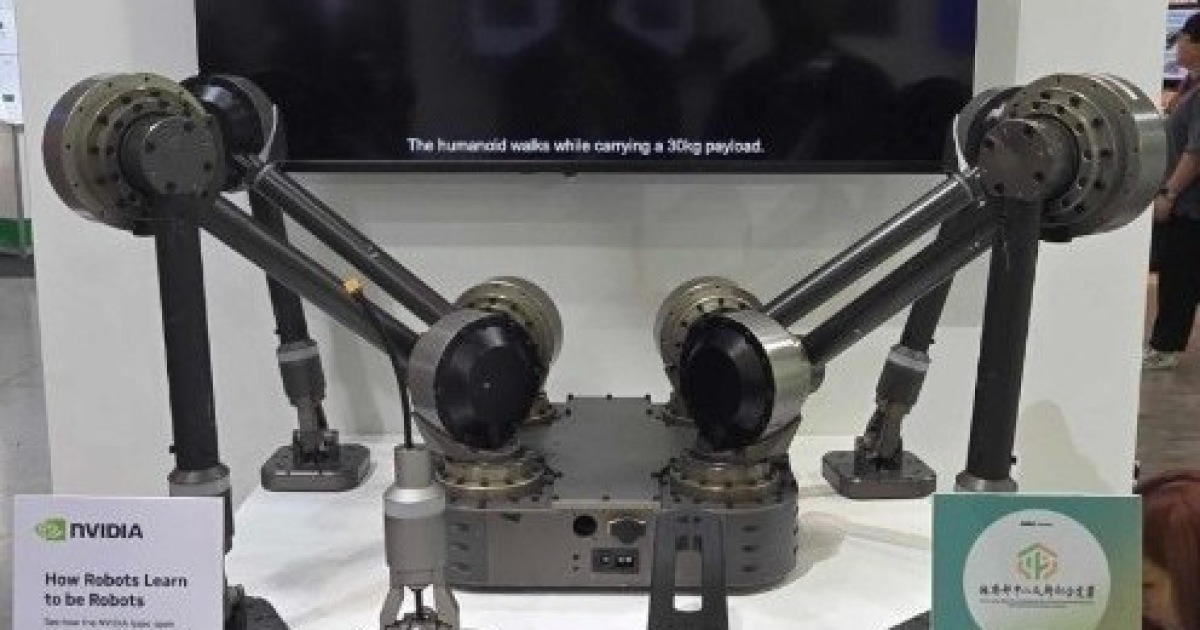 Source · News1Korean NPUs and Physical AI raise expectations for a humanoid-focused full stackThe report illustrates the Korean ecosystem’s effort to connect domestic NPUs with Physical AI.
Korean manufacturing has both an opening and a constraint. Dense production sites, equipment vendors, and mature quality standards offer a strong base for pilots. At the same time, every factory has its own data formats, machine interfaces, and safety-accountability boundaries. The first project should therefore be a single high-frequency process with a clear definition of success and a safe rollback path—not “one humanoid.” Parts sorting, visual inspection, or material movement can create useful early evidence if teams capture exception handling and work history from the start.
Operators should ask four questions: Is the operational data referenced before an action current? Who can change safety and quality conditions, and are those changes logged? Can a person stop and recover a failed action easily? When a procedure moves from one line to another, what can be reused and what must be revalidated? The operating system for Physical AI is not the name of a single platform. It is the data, action, and feedback structure that answers those questions every day.
2. Sovereign AI is about preserving operational choice, not only local models.
Sovereign AI is often reduced to a question of whether a country builds its own frontier model. The operational question arrives earlier: can a service continue when an outside model changes its content policy, API terms, or data-processing conditions? The case raised by VANK around generative AI and Dokdo makes that dependency tangible. Platform classifications and safety policies can produce outcomes that do not match local context, and users inherit that policy layer along with the model.
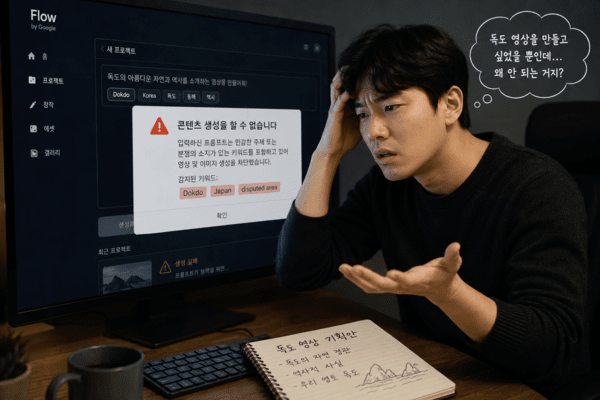 Source · Korea NGO NewsVANK calls for faster sovereign AI development over the Dokdo classification issueThe article raises a concrete example of how external generative-AI policy can shape content production.
In practice, sovereignty does not require rebuilding every model and layer of infrastructure at home. The more useful test is whether an organization can set a boundary for sensitive data, keep alternate models or private deployment paths for critical work, and evaluate behavior against its own standards. A team can still use global models while reducing dependency through data exportability, retention policies for prompts and documents, evaluation sets that compare models, and tested failover procedures. Conversely, a “local” label alone does not guarantee control when deployment, updates, and observability remain opaque.
 Source · Maeil Business NewsA call for Korea to secure sovereign AI firstThe interview links core AI capabilities to real policy and governance choices.
In public-sector, defense, and manufacturing environments, where data egress, latency, and auditability matter, deployment is itself a product capability. Private-network inference, on-device processing, regional controls, separated access permissions, and the ability to replace a model are not only security checks. They define what a product team can promise customers and whether work continues during an incident. That is where national strategy and enterprise operating design meet.
A useful first exercise is to map external dependency for one workflow. List every model, API, vector store, OCR system, and translation service; trace where data travels; then assign an owner and a switching sequence for access loss, price change, or quality degradation. The result does not automatically justify a full in-house stack. It does prevent teams from treating convenience and control as the same thing, and it reveals where alternate paths are actually worth building.
3. Agent memory is policy for recall, verification, and forgetting—not just storage.
For agents that call tools and run multi-step work, memory is not optional. A plain chat history cannot reliably retain which exception occurred last time, which fact a user confirmed, or which sequence is safe to execute. But putting every record into a long-term vector store is not a solution either. Old decisions can override current policy, a model’s inference can return as an established fact, and unnecessary personal data can remain indefinitely.
 Source · ITWorldFour agent memory frameworks for helping LLMs remember conversationsThe overview examines frameworks for persistent context and knowledge in AI agents.
A practical design can separate at least four layers. Session memory holds temporary context until a task is complete. Fact memory stores user-confirmed information or claims supported by reliable source material. Relationship memory represents links among people, projects, documents, and decisions. Procedural memory holds tested sequences and stop conditions. The point is not architectural ornament. Separation limits the blast radius of a wrong memory and makes correction and deletion rights explicit.
 Source · ComputerworldNew procedural memory framework promises cheaper, more resilient AI agentsThe report describes an approach that reuses validated procedures to improve agent cost and resilience.
Procedural memory is particularly valuable in operations. Rather than rereading all logs and inventing a new hypothesis for every incident, an agent can reuse a sequence such as checking current state, comparing recent changes, classifying an error, applying stop conditions, and validating recovery. Yet a procedure is not permission for uncontrolled automation. Each one needs scope, required permissions, human approval points, acceptance tests, and an expiry date. A once-successful procedure can become unsafe when the environment changes.
Memory policy starts at write time: which events can create durable records, how model inferences are separated from user-confirmed facts, where source evidence is linked, and who can edit or delete it. It continues at recall time: retrieve only what the current task needs, prefer newer evidence and higher-authority instructions when records conflict, and never present uncertain memory as settled fact. In production, an agent that can forget and recheck well is more trustworthy than one that appears to remember everything.
Operator note
All three topics ask the same question: not simply whether AI can do more work, but who can understand, control, and recover the work it does. A factory needs managed safety conditions and feedback for action. Platform dependency needs alternatives for policy change and outages. Agent memory needs authority and expiry so past judgment does not corrupt the present.
That suggests starting a roadmap at the operating boundary rather than a model feature list. What data may the AI access? Where does it stop when it fails? What result must a person verify? Why can the next operator trust the decision record? Once those four sentences are clear, choices about models, tools, and deployment become much more concrete.
Small experiments work across all three domains. A manufacturing team can begin by logging exceptions in one process. An enterprise AI team can document external dependencies and fallbacks for one workflow. An agent team can attach source and expiry to one category of memory. Measure the result by less time spent stopping, recovering, and auditing—not by the polish of a demo.
What to watch this week
Read Physical AI pilots through shop-floor integration and safe retry behavior, not robot appearance. Translate sovereign AI from an abstract self-reliance claim into workflow-level alternatives and data boundaries. Evaluate agent memory through evidence, authority, and deletion policy—not storage volume. Each current points in the same direction: AI is becoming operated infrastructure, not merely a system that generates answers.
Sources
- ETNews — Manufacturing innovation driven by Physical AI and humanoids ↗
- News1 — Korean NPU and Physical AI full-stack expectations ↗
- Korea NGO News — Dokdo and sovereign AI ↗
- Maeil Business News — A call to secure sovereign AI in Korea ↗
- ITWorld — Four agent memory frameworks ↗
- Computerworld — Procedural memory framework ↗
Related posts
Read →Related tools