ZHS Daily Briefing | July 10, 2026 — AI That Runs Factories, Preserves Choice, and Learns from Experience
The center of AI competition is moving beyond model benchmarks. The next advantage will depend on whether robots can work reliably on real production lines, whe
ZHS DAILY ISSUE · 2026.07.10
AI That Runs Factories, Preserves Choice, and Learns from Experience
The center of AI competition is moving beyond model benchmarks. The next advantage will depend on whether robots can work reliably on real production lines, whether critical decisions can remain independent of external platforms, and whether agents can accumulate experience instead of restarting from zero every time.
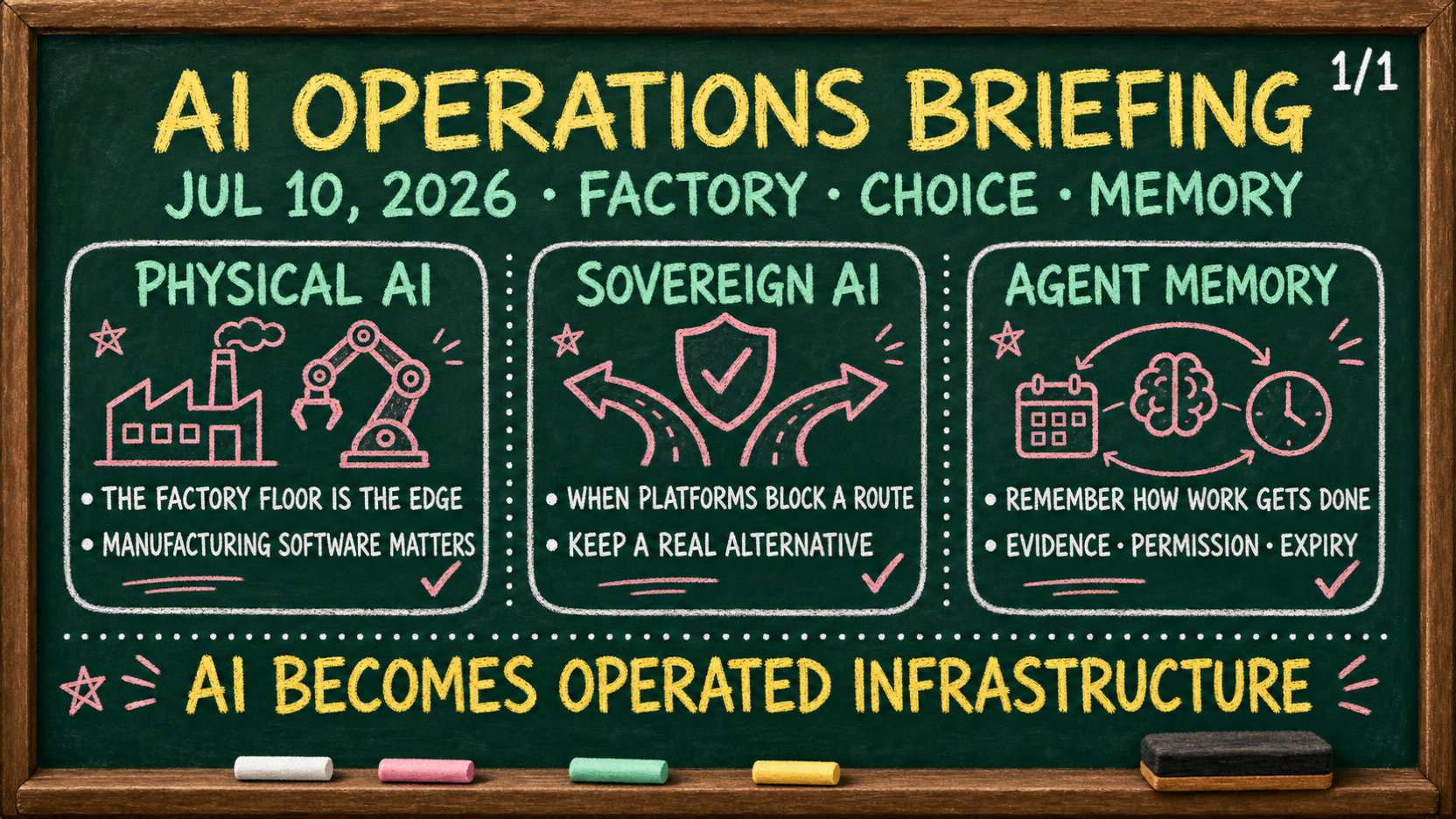
Three Things to Watch Today
- Physical AI is shifting from robot demonstrations to manufacturing software. Process data, simulation, safety validation, and shop-floor integration matter more than the humanoid body itself.
- Sovereign AI is not a slogan about technological self-reliance; it is about retaining options. A foreign platform's policies and filters can define the boundaries of content, industry, and public decision-making.
- Agent memory is becoming an operating layer, not a RAG add-on. Session, graph, and procedural memory need separate designs if teams want both lower cost and higher reliability.
TOPIC 01 · PHYSICAL AI
The Real Battleground for Humanoids Is the Factory Floor—and the Software Behind It
Physical AI is back at the center of attention. But reading this moment simply as progress toward robots that walk like people misses the point. In industrial settings, what matters is not whether a robot can reproduce a choreographed motion on stage. It is whether it can perform repetitive work safely in an unpredictable production environment while meeting quality, speed, and cost targets at the same time.
Electronic Times examined the movement of humanoids into manufacturing through pilots involving Hyundai and Boston Dynamics, Tesla's Optimus, BMW and Figure, and Mercedes-Benz and Apptronik. The context is similar to Jensen Huang's CES 2026 comparison of robotics to a “ChatGPT moment.” Just as language models changed the mainstream interface for digital systems, Physical AI could mark the point at which digital models begin connecting judgment directly to action in the physical world.
 Source · Electronic TimesPhysical AI and humanoids driving manufacturing innovation in 2026The manufacturing context behind humanoid trials and Software-Defined Factory transitions
Source · News1Domestic NPU + Physical AI: a K-full-stack opportunity for humanoidsA snapshot of Korea’s 149 physical-AI startups and the robot/AI software mix
Source · Electronic TimesPhysical AI and humanoids driving manufacturing innovation in 2026The manufacturing context behind humanoid trials and Software-Defined Factory transitions
Source · News1Domestic NPU + Physical AI: a K-full-stack opportunity for humanoidsA snapshot of Korea’s 149 physical-AI startups and the robot/AI software mix
Yet automotive assembly remains one of the clearest examples of work that is difficult to automate. Even within the same vehicle model, options and component conditions vary. Reflections, dust, worker movement, and part tolerances all destabilize sensor input. Tightening a single screw is not merely a robotic-arm control problem once torque, approach angle, collision avoidance, quality inspection, and exception handling are included. The system also needs operating logic for deciding whether to stop, retry, or hand the task to a person when something fails.
That is why the decisive layer in manufacturing is moving from hardware specifications to software. Companies need to standardize process data, learn from failures in digital twins before they occur on the floor, and connect robots, vision systems, MES platforms, and quality systems into a single feedback loop. This is why the idea of a Software-Defined Factory, or SDF, is gaining attention: a factory understood not as a static collection of machines, but as a software system that can be continuously updated.
The Korean ecosystem is responding to that shift. A Physical AI startup map compiled by Startup Alliance includes 149 companies, with robotics accounting for 70 of them, or 47%. AI and software companies account for 28, autonomous driving for 27, and drones and UAM for 24. Efforts such as POSCO DX and Mobilint's NPU demonstrations also point to a push for computing and inference infrastructure tailored to manufacturing environments.
Those numbers do not automatically translate into industrial competitiveness. If anything, a crowded market can also signal rising integration costs. Factory customers are not buying a robot; they are buying a measurable productivity outcome. Physical AI providers therefore need to prove more than what their models can do. They need to show which process can reduce cycle time by how much, under which conditions it fails, and who restores operations when the system breaks down.
The first customer for Physical AI is not the company seeking the most human-like robot. It is the factory seeking the most measurable productivity gain.
Population aging and manufacturing labor shortages give Korea a clear demand base. Its position as a manufacturing powerhouse also creates an opportunity to accumulate shop-floor data and operating references. But moving robots into factories is less important than designing data ownership, safety standards, process interfaces, and workforce retraining alongside them. Humanoids may become the final interface of factory automation, but manufacturing software is what makes that interface work.
TOPIC 02 · SOVEREIGN AI
Sovereign AI Is Not About Building Every Model Yourself. It Is About Not Losing Your Options.
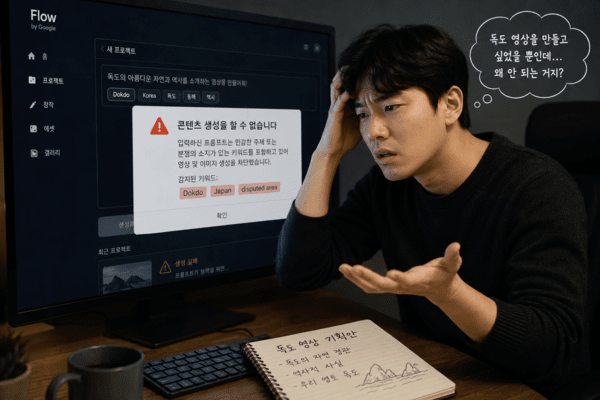
A reported case involving the blocking of generative AI content for a Dokdo promotional video brings the Sovereign AI debate out of abstract policy language and into an operational reality. VANK said that Google's video-generation tool Flow prevented it from creating promotional content related to Dokdo. When disputed-territory keywords interact with safety policies, an external platform's classification system may determine which expression is permitted before the user has a meaningful choice.
The central issue is not assigning blame for an isolated service error. Global AI services must simultaneously manage laws, sanctions, safety policies, and reputational risk across many countries. In that process, regional historical and political contexts can fall behind broader platform policies. Users may believe they are simply using a model, but in practice they are also using the provider's policy layer, content filters, data-handling rules, and API access conditions.
Cha Meeyoung of the Max Planck Institute has argued that Korea must secure Sovereign AI before it can meaningfully debate its governance choices. The concern behind the statement that “only countries with sovereign AI have options” is not exaggerated. Without domestic capabilities in infrastructure, models, data governance, talent, and deployment, a country may become dependent on another operator's technical, pricing, and policy decisions before it has even decided how to regulate AI.
 Source · NGO NewsVANK calls for faster sovereign-AI development after Dokdo content restrictionA concrete case of an external AI platform’s policy layer setting the boundary of expression
Source · Maeil BusinessCha Meeyoung: Korea needs sovereign AI before it can retain real optionsWhy AI capability changes the practical room for policy and governance choices
Source · NGO NewsVANK calls for faster sovereign-AI development after Dokdo content restrictionA concrete case of an external AI platform’s policy layer setting the boundary of expression
Source · Maeil BusinessCha Meeyoung: Korea needs sovereign AI before it can retain real optionsWhy AI capability changes the practical room for policy and governance choices
Still, defining Sovereign AI as every country independently building a frontier general-purpose model from end to end is too narrow to be practical. A more useful definition has several layers. First, organizations must be able to determine which jurisdiction and security boundary handle sensitive public and industrial data. Second, they need the capacity to improve and evaluate models for Korean language, domestic institutions, and industrial contexts. Third, even when foreign models are used, there must be alternative routes and negotiating leverage. Fourth, safety, copyright, and expression rules need to be configurable in ways that can be tested and audited.
This is where the NPU and Physical AI conversations reconnect. In environments such as manufacturing sites and public-sector networks, where data cannot easily leave the premises and latency matters, cloud APIs alone are insufficient. Organizations need chips, lightweight models, and operating tools that can run inference on-device or in private environments. Sovereign AI is not only a national-scale model project; it is also a question of building controllable deployment structures for specific industries.
Conversely, a “domestic” label alone does not create sovereignty. If the origin of training data is unclear, evaluation systems are weak, or updates depend on foreign infrastructure or closed supply chains, control remains limited. Sovereignty appears not in ownership documents but in the ability to execute a real alternative when outages, policy changes, or geopolitical risks occur.
The test of AI sovereignty is not a declaration of independence. It is whether work can continue through another route when an external platform blocks the first one.
The same question applies to companies. Connecting customer support, document analysis, code generation, or video production to external models can accelerate early delivery. But without a design for maintaining operations through policy changes, price increases, model replacements, or revised data-retention terms, a company is effectively outsourcing core operational decisions to an external roadmap. Multi-model strategies, data portability, internal evaluation sets, and workflow-specific fallbacks are practical sovereignty mechanisms long before they become national policy.
TOPIC 03 · AGENT MEMORY
What Agents Need to Remember Is Not Just Conversation—It Is How Work Gets Done
As agents begin calling tools and handling longer-running work, memory has become a foundation for reliability rather than an optional feature. Traditional RAG solves many problems by retrieving relevant documents and placing them into the model context. But RAG alone struggles to reliably capture questions such as: What did this user decide last week? Why did this task fail previously? What sequence of tools should be used to complete this job safely?
The agent-memory frameworks covered by ITWorld do not treat memory as a single vector database. Session memory preserves the context of the current conversation and task. Long-term memory stores user preferences, recurring facts, and prior decisions. Graph memory tracks relationships among people, projects, documents, and decisions. Procedural memory holds execution sequences and failure-avoidance rules for achieving specific goals.
Procedural memory is particularly important for practical agents. Research discussed by Computerworld explores how agents can improve cost efficiency and resilience by reusing validated procedures instead of solving every problem through massive contexts and repeated reasoning. When investigating a deployment incident, for example, an agent can apply a remembered workflow—check system state, compare recent changes, classify error patterns, assess rollback conditions, then validate—instead of reading all logs and inventing a new hypothesis from scratch each time.
 Source · ITWorldFour agent-memory frameworks for helping LLMs retain contextAn overview of session persistence and graph-based knowledge management beyond basic RAG
 Source · ComputerworldNew procedural memory framework promises cheaper, more resilient AI agentsA direction for reusing validated procedures instead of re-solving every task from scratch
This approach means more than lower token costs. A long context can contain more information, but it does not guarantee that the information relevant to a current decision will be prioritized correctly. Old instructions can override newer policy, irrelevant conversations can distort tool calls, and retrieved results can be trusted too readily. A good memory system is not one that stores more. It is one that distinguishes what to retain, what to forget, and what to verify again.
In production environments, write permissions for memory are especially important. If a temporary preference stated once by a user becomes a permanent profile attribute, later experiences can be distorted. If critical constraints are not stored, the agent will repeat the same mistakes. At a minimum, a memory design should separate facts, preferences, inferences, procedures, and original evidence. Facts confirmed directly by a user should not carry the same storage location or confidence level as conclusions inferred by a model.
Deletion and expiration are part of the design as well. When a project ends, related working memory should be removed or moved under a different retention policy. The scope and retention period for personal or sensitive work information should be defined before storage. More searchable long-term memory may make an agent appear smarter, but it also expands the surface area for incorrect recall and information exposure.
A good agent is not one that remembers everything. It is one that retrieves evidence-backed, time-bounded memory only when it is needed.
Product teams should not stop at adding a “memory feature.” They need to define which events trigger memory writes, who can edit or delete memories, what source a recalled item points to, and which rule takes precedence when old memory conflicts with current policy. As model quality converges, this operating design will become a meaningful differentiator for user trust and repeat usage.
OPERATOR NOTE
All Three Topics Lead to the Same Operating Question
Physical AI, Sovereign AI, and Agent Memory may look like separate industry themes, but they raise the same question: as AI moves deeper into real work and social infrastructure, who controls decisions, recovers from failures, and accumulates experience?
On a factory floor, teams need to be able to recover from robot failures locally. Governments and companies need alternative paths when external platform policies change. Agents need to reuse prior experience while retaining the ability to correct and delete bad memories. In every case, the critical factor is not a larger model. It is an operating structure that remains controllable.
For this week's product and business review, three questions are worth asking. How well does our AI handle real-world exceptions? If an external model or platform becomes unavailable, do we have a route to continue operating? Does the information our agent remembers have a source, permission boundary, and expiration date? If the answers are unclear, revisit the operating design before revisiting the technology stack.
Conclusion
The next phase of AI is not a contest to produce better answers on a screen. It is a contest to build systems that work repeatedly in the physical world, preserve optionality amid external dependencies, and accumulate experience efficiently. Each of today's trends moves AI from a “model” toward operated infrastructure. Organizations that design for that transition first will gain both speed and trust in the next wave.
Sources
Related posts
Read →Related tools