The Operating System That Separates AI Buyers from AI-Working Organizations
An AI operating system is not created by buying models or increasing training attendance. It emerges from an execution structure that connects frontline problems, learning, validation, and measurable performance. What Forward 2026 revealed.
FORWARD 2026 · HUMAN SKILLS. AI SCALE.
The Operating System That Separates AI Buyers from AI-Working Organizations
The decisive contest in AI adoption is not signing contracts for more models. It is whether the workforce can learn faster, redesign the work in front of it, and turn validated practices into organizational assets. Forward 2026, held on July 7, was less a technology-trend event than a discussion of the execution structure organizations now need.
Many AI problems are not model problems. They are problems of who makes which judgments, and what experience is retained for the next team.
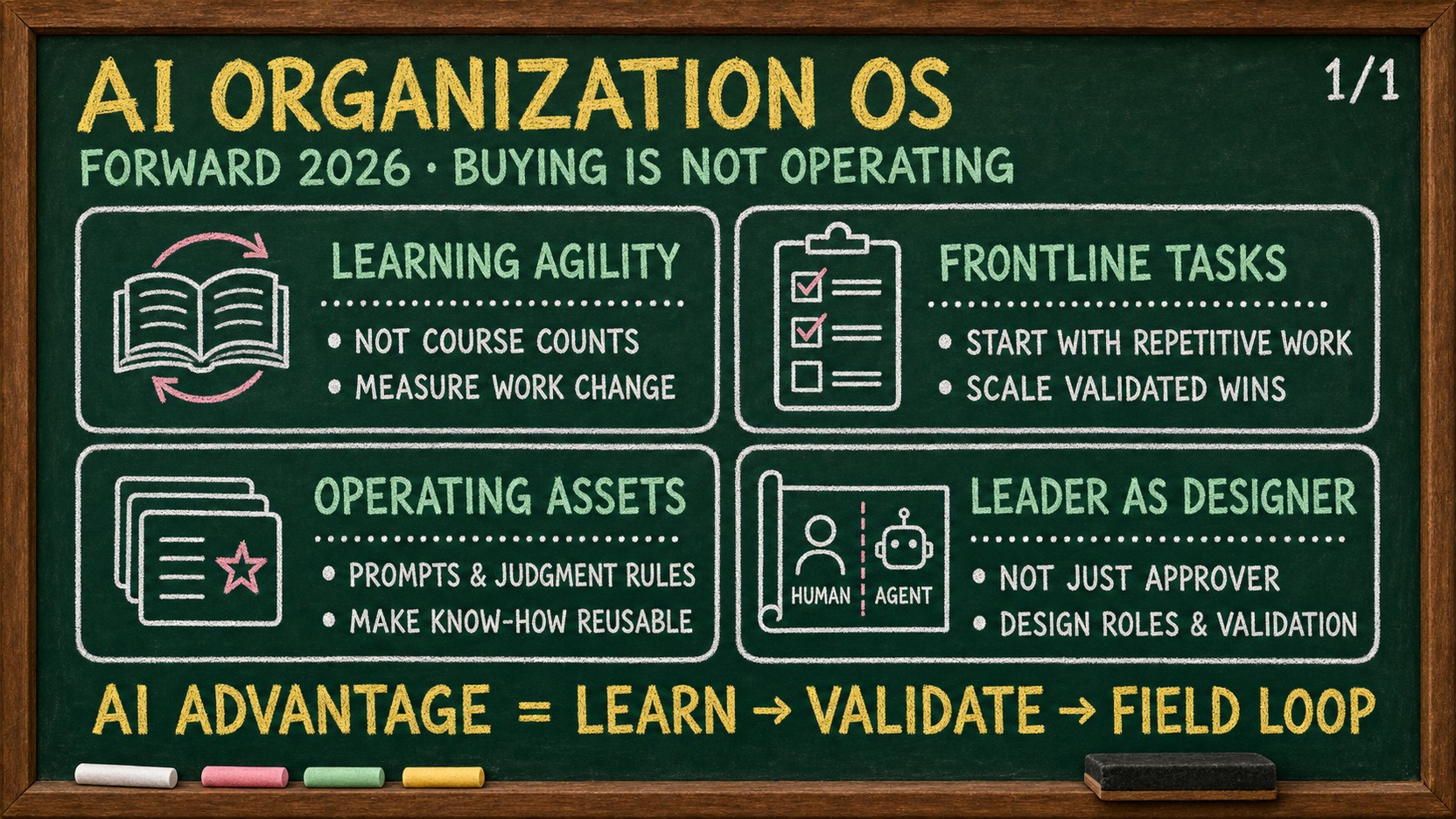
KEY TAKEAWAYS
Four Things That Must Change Before Adoption Can Scale
1Learning is a production system, not a benefit
Do not measure course completion alone. Measure whether time spent on real work, error rates, and decision practices have changed. Reskilling is not simply an HR program; it is an operating capability.
2Small frontline assignments are where scale begins
Rather than issue an abstract enterprise-wide transformation mandate, start with one task that is repetitive and costly to get wrong. A small success creates evidence, trust, and budget for the next one.
3Prompts and work language must become shared assets
When individual techniques remain inside individual accounts, the organization pays for the same trial and error repeatedly. Validated instructions, data definitions, and judgment criteria are reusable operating assets.
4Leaders must become system designers, not approvers
An AI-era leader is not the person with the most answers. The role is to frame problems, establish validation accountability, and define the boundaries between human and agent work.
When the Workforce Shrinks, Hiring Alone Cannot Create Speed
Forward 2026 presentations described Korea’s workforce as roughly 29 million people and cited a projection that the working-age population could decline by about 25% by 2044. Exact projections vary by source and reference year, but the premise of abundant labor supply is already weakening. Companies are operating in an environment where adding headcount is no longer a sufficient response to growing workloads.
The usual response is a combination of automation and hiring. Both matter, but neither is sufficient on its own. At some point, the speed at which current employees connect new tools to their own work matters more than the speed of finding AI-skilled talent in the external market. A small group of outside experts cannot, by itself, change how an entire organization works.
Operating view: The answer to labor scarcity is closer to redesigning work so the same people can operate with higher judgment density—not simply automating people away. AI is a catalyst for that redesign, not a substitute for organizational capability.
That is why learning agility cannot remain an HR metric. The time a team needs to learn a new way of working, test it, discard what fails, and establish a standard becomes the organization’s competitive speed.
Technology Agility and Talent Agility Do Not Replace Each Other
The event separated two kinds of agility. Technology agility is the ability to discover, adopt, and productize technology. It belongs to the engineering work of lowering cost and improving quality. Talent agility, by contrast, is the ability to respond to threats and opportunities, learn continuously, and update roles through systems and processes.
Many organizations concentrate their budgets on the first. They compare models, conduct security reviews, and build pilot environments. But when the second is weak, adoption stops at the demo. Frontline teams do not know what they can safely delegate. Middle managers cannot define responsibility boundaries. Data teams receive requests without the business context needed to act. The technology may be ready while the work is not.
1Everyone needs AI literacy
Not every employee needs to build models. But every employee should be able to read an output, check its basis, and understand that input quality shapes output quality. Without this foundation, frontline users tend toward two extremes: overtrusting the system or leaving it unused.
2Specialists need operating capability
Technical roles need more than implementation skills. They need deployment, observability, security, and evaluation practices. That includes deciding who detects quality degradation after a model is connected, what threshold stops the process, and how sensitive-data incidents are handled.
MIT Sloan’s discussion of agentic organizational change similarly emphasizes a redefinition of management rather than simple tool use. As more work moves to agents, managers become less responsible for distributing tasks and more responsible for designing goals, exceptions, and verification structures.
The Unit of Corporate Learning Should Be Work Change, Not Content
A Udemy presentation cited more than 1.3 million learners, over 100 enterprise customers, and a 36% share for mobile learning. These figures indicate broader access to learning, but access does not guarantee performance. As content libraries grow, the cost of deciding what to learn can grow with them.
Effective corporate learning should not be a bundle of courses detached from the job. It should be a loop that changes a current failure point in the work itself: identify the capability required, recommend a path for the individual, test it through a real assignment, and connect the result to performance. The event’s formulation—“Skill → Validation → Performance”—compresses that sequence.
A useful diagnostic: An organization that only asks, “What did people learn?” after training is consuming learning. An organization that asks, “Which work step disappeared, which judgment became faster, and who can reuse this method?” is operating learning.
Validation should look more like a frontline deliverable than an exam score. Did the time required for a first report draft decrease? Were omissions in support records reduced? Is the screen used by reviewers clearer? Real friction in the work must remain the reference point.
A Small Success Is Not Just a PoC. It Is a Prototype Operating Model
One notable point from the Shinhan EZ General Insurance case was its decision to create direct experience before every regulatory and infrastructure uncertainty had been resolved. The presentation described using the local Qwen3-14B model and beginning with a single repetitive, error-prone task. The organization did not attempt to solve every problem at once.
The process was straightforward: establish a shared language, practice, select a frontline problem, create a small success, and extend it into an operating model. This order addresses organizational trust before technical proof. Only when frontline teams can experience a result do conversations about security, budget, and process become concrete.
3Choose the first assignment by repeatability and accountability
The first use case should not be the most impressive-looking one. It should have reasonably structured inputs, a clearly identified reviewer for the output, and errors that can be reversed. Document classification, internal knowledge retrieval, draft generation, and omission checks are useful early candidates because human review can remain in the loop.
By contrast, making an enterprise strategy initiative with unclear ownership—or a workflow with tangled data definitions—the first case makes it easy to mistake organizational failure for model failure. The purpose of early success is not enterprise publicity. It is to obtain execution rules that can be repeated in the next workflow.
An AI Project That Never Reaches the Frontline Does Not Know the Friction of Work
The image of a Palantir FDE discussed at the event was not that of a presenter in a meeting room. It was someone embedded in the field, asking where work gets stuck, where data lives, and who owns the decision. This matters because model performance is not the bottleneck in many AI projects. The real constraints are often hidden in data-access rights, exception handling, approval stages, and responsibility handoffs between departments.
Field deployment is different from a conventional consulting visit. It requires watching the screens used by people doing the work, collecting failed inputs, and tracing the final point at which an output enters a decision. In that process, the question shifts from “What should we automate?” to “Which judgment can we make faster and more consistently?”
ZHS interpretation: FDE-style execution is not about bringing a model into an organization. It is about translating the organization’s real language into models and workflows. An AI strategy without frontline contact usually ends up with success criteria that have no frontline contact either.
The success metrics change as well. Accuracy benchmarks alone are insufficient. Teams must also determine whether staff find exceptions sooner, whether customer responses decline, and whether approvers can make decisions with fewer back-and-forth cycles. The change in decision flow matters alongside model quality.
Prompts and Ontologies Are Organizational Capital, Not Individual Tricks
The event proposed internal systems such as a Prompt Sharing Bulletin Board, an AI Data Curator, and a User Ontology. The names may differ, but the underlying idea is the same: do not let effective ways of asking, the meaning of data, and the context of work remain hidden in individual practice.
A prompt-sharing board quickly becomes stale if it is only a collection of sentences. It should record the work it supported, the inputs required, the outputs that failed, and the person responsible for final review. That allows the next user to understand the operating conditions instead of merely copying wording.
4An ontology is not an AI dictionary. It is an organizational agreement
If terms such as customer, contract, risk, completion, and priority mean different things in different departments, AI will amplify that confusion. A user ontology is a data model for a tool, but it is also a mechanism for agreeing on how the organization defines and evaluates the things it manages.
The Human Capital × Token Capital perspective mentioned in a The Milk session connects directly to this point. An organization that manages token cost alone may reduce consumption, but it will struggle to create compounding value. Tokens become more than an expense when human judgment rules and context accumulate in reusable forms.
Leaders Move from Management Mode to Command Design Mode
A session by Professor Hong-ki Kim of Seoul National University summarized leadership capability as Problem Framing, Critical Validation, and Collaboration & Communication. These are not entirely new virtues in the AI era. They are capabilities that once remained at the individual level and now need to be elevated into the operating system.
Weak problem framing leads teams to ask AI only the questions that are easiest to answer. Weak critical validation lets plausible outputs flow into decisions. Weak collaboration and communication turn one team’s local improvement into another team’s confusion. The less feasible it becomes for leaders to personally review every answer, the more important these three capabilities become.
The move from Manager Mode to Founder Mode and then to a “Dorsey Mode” of directing AI agents may be deliberately provocative, but the direction is clear. Breaking work into small units and assigning them is no longer enough. Leaders must design goals, specify the scope agents can handle, establish exceptions for human intervention, and feed learning back into the next design.
As Anthropic notes in its work on human-agent teams, effective collaboration does not come from blending roles into ambiguity. It comes from making clear who defines the goal, who executes, who validates the result, and when work returns to a human.
Move the AI Adoption Question from Models to Decision Structure
If decision speed, organizational structure, and revenue structure remain unchanged after AI adoption, the project may have stopped at tool distribution. This is an uncomfortable but useful diagnosis because it forces an organization to define what must change after adoption, rather than simply deciding whether to adopt.
The questions an organization needs to answer are not numerous. Which judgment takes the longest? Where is the data required for that judgment, and who owns it? Who has authority to stop the process when an error occurs? Does a validated way of working remain with one individual, or transfer to the next team? Without answers to these questions, changing models will lead back to the same stopping point.
An AI operating system is not the name of a large platform. It is a repeatable structure that connects learning to work, validates it in the field, accumulates human judgment alongside token use, and gives leaders responsibility for designing the flow. Buying technology may be the beginning, but it is not evidence that the operating system exists.
Frequently Asked Questions
Should we expand AI training across the company first?
Expanding company-wide training alone is not recommended. Shared literacy is necessary, but it should be paired with two or three real work assignments that connect learning to application. Training persists when it meets a frontline problem.
What criteria should guide the first AI assignment?
Assess repetition frequency, the cost of errors, accessibility of input data, and the clarity of review ownership together. Early projects benefit from tasks where humans can review outputs and failures can be reversed.
Can prompt sharing alone turn AI practice into an organizational asset?
No. The usage context, input conditions, prohibited conditions, result-validation method, and owner feedback must accumulate together. Prompts should be managed as part of workflow design.
Should we choose a local model or an external model?
The answer depends on the conditions of the work. Sensitive data, latency, cost, operating capacity, and quality requirements should all be compared. More important than the model choice itself is building an evaluation, security, and frontline-validation system after that choice is made.
The Real Change Is Not AI Usage. It Is How the Organization Works
Forward 2026’s shared message was concise: competitive strength in the AI era belongs not to AI itself, but to organizations that learn and execute through it. This is not a sentimental people-first slogan. In an environment of changing workforce structures and shorter technology cycles, an organization’s most practical defense is the speed at which its existing people can solve new problems.
The next quarter’s AI plan does not need to begin with a model list. One workflow that repeatedly stalls in the field, one accountable owner for that workflow, and one verifiable success criterion are enough. Organizations that repeat this small loop—turning learning into performance and performance into organizational assets—will move ahead with less trial and error.
Models can be rented. The language and judgment structure of an organization that knows how to execute cannot.
Sources
Related posts
Read →Related tools