GPT Live Did Not Improve the Voice. It Broke the Turn-Taking Rule.
OpenAI's GPT Live moves voice AI from walkie-talkie turns to full-duplex conversation with live interpretation, background delegation, and on-screen context. Here is the operator checklist.
OPENAI · GPT LIVE · FULL DUPLEX VOICE
GPT Live Did Not Improve the Voice. It Broke the Turn-Taking Rule.
OpenAI’s GPT Live, released on July 8, 2026 local time, is not mainly a prettier speech model. It converts voice AI from a walkie-talkie that waits for clean turns into a phone call that can tolerate overlap, hesitation, and repair. Live interpretation, background search delegation, and on-screen context are secondary expressions of that shift. For operators, the product opens two fronts at once: interface redesign and agent orchestration.
The quality of voice AI is not diction. It is knowing whose turn it is, and when silence is the correct move.
KEY TAKEAWAYS
Four points worth keeping
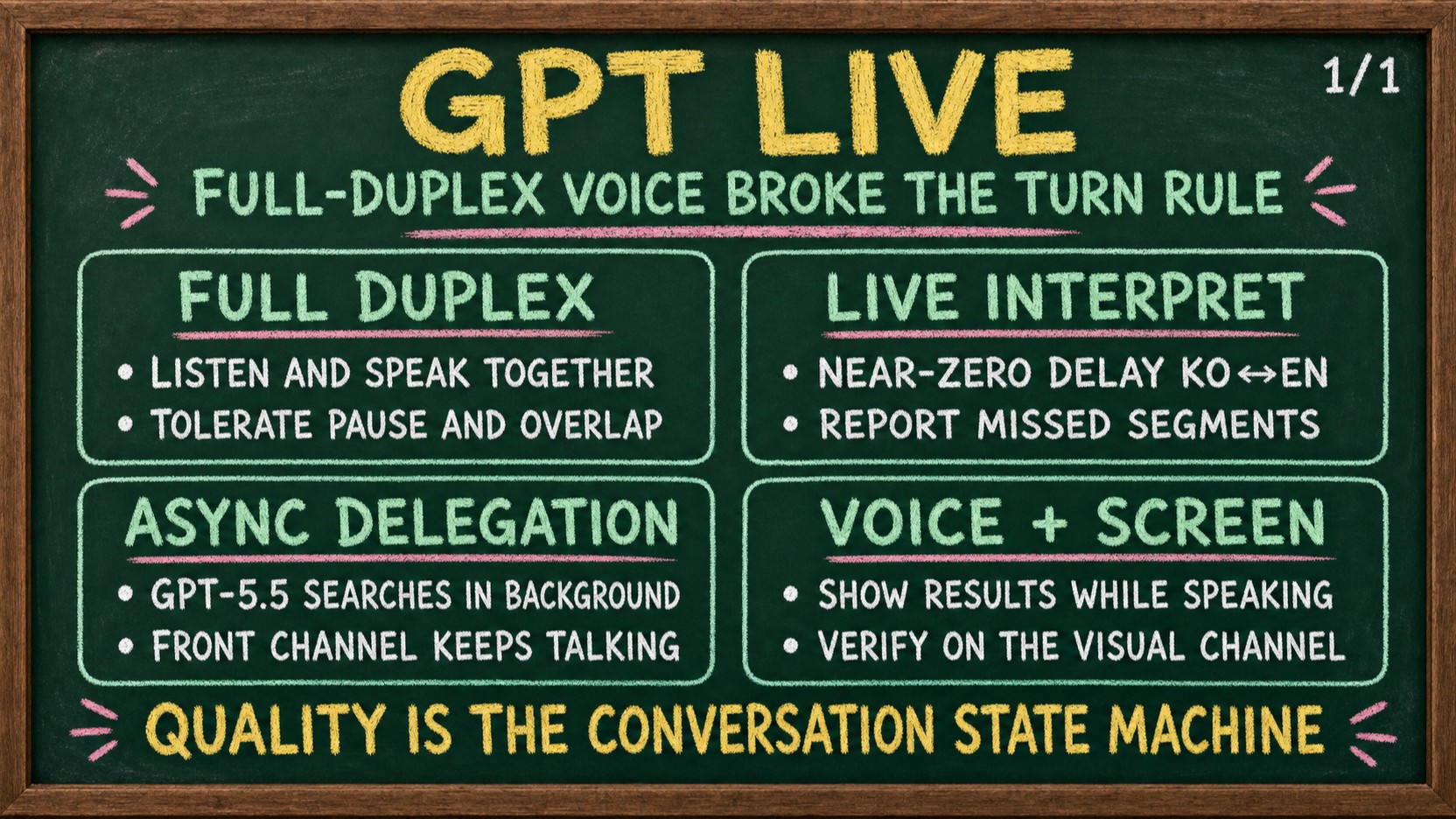
1Full duplex is the product
Listening and speaking run together. Endpointing and streaming cut dead air. The real change is conversational structure, not vocal tone.
2Interpretation must survive overlap
Korean-English live translation continues with low delay even when speech collides. Self-reporting missed segments after a long video is an operating signal, not a bug report only.
3Delegation is agent design inside voice UX
Search and hard reasoning run on GPT-5.5 in the background while the front channel keeps talking. Asynchronous handoff has entered the consumer interface.
4Voice still needs a screen
Weather and search cards appear while conversation continues. Even a voice-first product keeps visual channels for verification.
What changed: walkie-talkie to phone call
Classic ChatGPT voice was essentially turn-based. One side spoke; the other waited; silence triggered a response. If a user paused to repair a sentence, the system often treated the utterance as finished and jumped in. Maeil Business News’ Sunnyvale field report makes the contrast concrete. GPT Live keeps going when speech overlaps, and it can wait when a user says, in effect, “hold on.”
 Source · Maeil Business News
A field report on GPT Live’s natural talk, live interpretation, and non-blocking search
Primary Korean reporting from a Sunnyvale hands-on session.
Source · Maeil Business News
A field report on GPT Live’s natural talk, live interpretation, and non-blocking search
Primary Korean reporting from a Sunnyvale hands-on session.
The technical name is full duplex: listen and speak at once, estimate when an utterance ends, and stream the reply. In product terms, the model is continuously estimating whose turn it is. When that estimate is slightly wrong, you get backchanneling. When it is badly wrong, you get interruption spam. That is why GPT Live quality is not only word-error rate. Silence policy, overlap tolerance, and recovery behavior are first-class quality axes.
What live interpretation reveals
When the reporter asked for Korean-to-English interpretation, translation began before the sentence finished. Overlapping talk with a neighbor still produced usable interpretation. A three-minute English news clip was rendered into Korean with little interruption. Some segments drifted or broke, and the model later admitted that a few sentences were missed. That admission is the useful part. For operations, a system that can name its gaps beats a system that fails silently.
Operator view: The primary metrics for live interpretation are not only latency and completeness. They are omission disclosure and recovery paths. In meetings, support, and field guidance, a silent miss is more expensive than a corrected one.
English product coverage points in the same direction: new voice models for more natural live conversation, better handling of interruption and repair, sequential rollout across ChatGPT web and mobile. Put the Korean field report beside the English product narrative and one conclusion hardens. The voice race is now a race over conversational state machines.
 Source · TechCrunch
OpenAI releases new voice models for more natural live conversations
English product reporting on the live-conversation direction.
Source · TechCrunch
OpenAI releases new voice models for more natural live conversations
English product reporting on the live-conversation direction.
Delegation turns voice UX into an agent surface
The most operator-relevant scene is delegation. Asked to summarize recent performance for San Francisco Giants player Jung Hoo Lee, GPT Live said the user could keep talking while search continued. Hard search and reasoning ran on GPT-5.5 in the background; the front channel stayed conversational; results returned when ready. That is an asynchronous sub-agent pattern inside a consumer voice UI.
Management research around agentic systems keeps returning to the same structure. MIT Sloan’s work on navigating agentic AI emphasizes that managers design goals, exceptions, and validation rather than personally executing every step. Anthropic’s human-agent team writing assumes the same boundary problem: people do not fill every turn; they design responsibility and approval. GPT Live’s delegation is that pattern brought down to everyday interface level.
ZHS angle: Orchestrators already know the pattern. Keep the front channel stateful; send heavy work to background workers. The hard part is what happens when results return: who approves, on what evidence, and how the conversation recovers after failure. The smoother the voice channel becomes, the easier it is to hide the approval layer.
Voice plus screen, and the hardware bet
Showing weather or search cards while continuing to talk looks like a small feature. It is also a design thesis. OpenAI’s product leadership has argued that voice can become a primary computing interface and that complex Codex or ChatGPT work may eventually run through speech. GPT Live still keeps a screen. Numbers, schedules, and sources that must be fixed in view remain visual.
That is why the acquisition narrative around Jony Ive’s AI hardware startup io sits next to this launch. A screenless voice device may be part of the long path. GPT Live itself does not abandon screens. The more precise formula is: open with voice, close with multimodal verification. Operations systems should do the same. Start work by voice if useful, but leave confirmation, audit, and records in text and visual logs.
The same-day competitive signal: Grok 4.5
On the same day, xAI (also referred to as SpaceXAI in some coverage) launched Grok 4.5 for coding and agent work. Musk framed it as Opus-class capability at higher speed and lower price, with reported pricing of $2 per million input tokens and $6 per million output tokens. The company still acknowledged that it had not fully surpassed top competitors on peak performance. The parallel launches mark two fronts: humanized voice interfaces, and cost-efficient coding agents.
Operators need both. A smooth voice channel without reliable, auditable background work is empty delegation. A cheap coding agent without usable front-channel interaction remains hard to place in the field. GPT Live and Grok 4.5 attack different bottlenecks of the same market.
Five checks before you adopt it
1 Silence policy: wait two to three seconds for repair, or fill every gap?
2 Overlap policy: where is interruption welcome, and where is it banned?
3 Delegation signaling: how are start, progress, completion, and failure spoken?
4 Omission disclosure: must interpretation and summary name what was missed?
5 Screen sync: where do numbers, schedules, and sources get pinned after speech?
Without those five, a GPT Live-like product becomes a friendly voice attached to an opaque agent. Friendliness is not trust. Trust comes from state disclosure and recovery paths.
The other side
Full-duplex voice can raise fatigue. When a partner always seems ready to respond, ordinary silence starts to feel like failure. Fluent live interpretation can skip verification. Background delegation can hide the true scope of work. Voice-first hardware stories improve accessibility and also expand always-listening risk. The more natural the product becomes, the more explicitly it must surface auditability and refusal.
FAQ
Q1. How is GPT Live different from older ChatGPT voice?
It removes hard turn-taking. Listening and speaking run together, and the system can hold context through overlap and short pauses. Interpretation, delegation, and screen cards sit on top of that change.
Q2. Can live interpretation be used for real work immediately?
It is useful for short conversation and field guidance. In contracts, medicine, or law, treat omission disclosure and text-log review as required, not optional.
Q3. Is delegation the same as a normal agent architecture?
The pattern is the same: a front channel keeps state while workers run heavy jobs. The product question is how visible the approval and verification layer remains.
Q4. What is the paid versus free difference?
Reporting says paid users get GPT Live-1 and free users get a Mini variant in a staged rollout. Exact limits depend on account, region, and release stage, so verify in-product.
Conclusion
GPT Live matters less as a better voice and more as a conversational state machine made into a product.
Full duplex, endpointing, streaming, background delegation, and screen sync look like separate features. Together they move AI from an answer tool to an interface that shares a human time axis. Search and reasoning fall into hidden workers; the user does not have to stop talking.
The remaining operator job is sharper. Do not confuse fluency with trust. Design the boundary of delegation. Force the system to say what it missed. The interface that lasts is not the most natural voice. It is the conversation where a human judgment point remains visible.
Sources
- Maeil Business News — GPT Live field report ↗
- TechCrunch — OpenAI releases new voice models for more natural live conversations ↗
- OpenAI — Introducing GPT Live ↗
- SpaceXAI Docs — Models (Grok 4.5 pricing) ↗
- MIT Sloan — How to Navigate the Age of Agentic AI ↗
- Anthropic — Building Effective Human-Agent Teams ↗
Related posts
Read →Related tools