July 12 AI Operations Brief — Work Agents, Evidence of Action, and Organizational Context
Work agents, action-centric observability, and ontology automation are converging into one operating question: who can act, how that action is proven, and which organizational context guides it. A practical briefing for Korean product and operations teams.
DAILY NEWSLETTER · 2026-07-12 · WORK AGENTS · ACTION LOGS · ONTOLOGY
July 12 AI Operations Brief — Work Agents, Evidence of Action, and Organizational Context
Today’s three stories appear to concern product launches, security observability, and data design. In practice, they point to the same operational boundaries every organization must set when AI moves from answering questions to doing work: what it may execute, how that execution can be proven, and which business context should guide it.
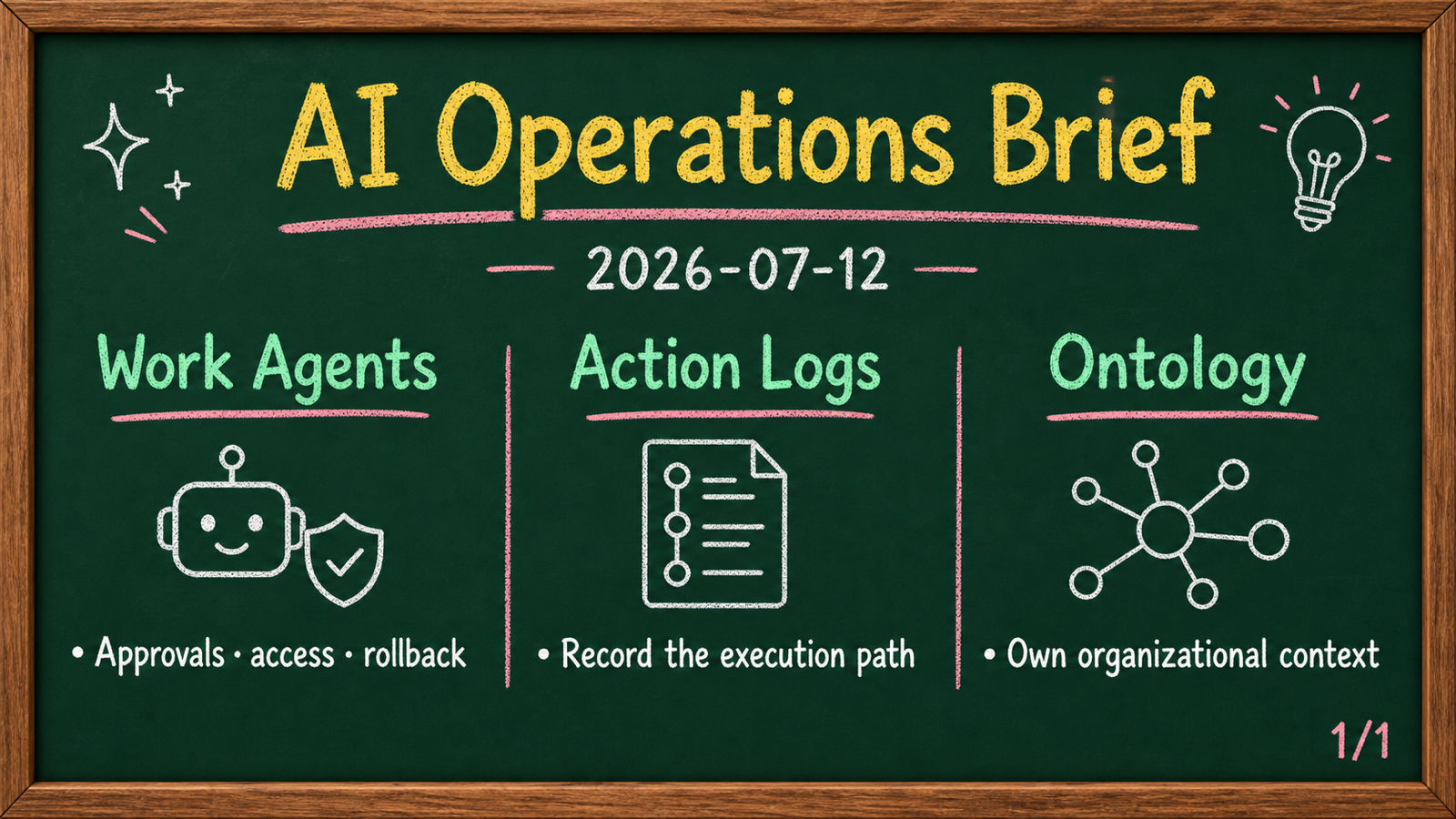
Three things to take from today
First, the competition around work agents does not end with the promise to complete longer tasks. Real value comes from teams that operate approvals, tool access, spend limits, and recovery after failure. Second, an agent earns trust not through a plausible final sentence, but through a record of which systems it used, under which authority, and with what result. Third, ontology automation may accelerate the first draft of structured knowledge, but it does not automatically settle the terms, relationships, and decision criteria that an organization must own.
- Work agents: set the execution boundary before adopting the product.
- Action logs: record the execution path, not just the response.
- Ontology: validate and own organizational context after automation creates a draft.
1. As work agents proliferate, the key question becomes where they stop
AI Times reported that OpenAI launched the work agent ChatGPT Work and is moving toward a desktop environment that brings ChatGPT, ChatGPT Work, and Codex together. At the same time, Sisa Journal e described a broader move among domestic and global B2B software vendors from answer-oriented AI toward agents that take action. That is more than another app launch. Once an agent can read files, gather information across systems, and produce artifacts, a team has to design not only the beginning and end of a task, but also every exercise of authority in between.
 Source · AI TimesOpenAI launches a work agent, ChatGPT Work, and starts a Codex-integrated “super app”The report describes the product direction toward an integrated environment for work and development.
The first operating unit for a work agent should be one approvable action, not an undefined “project.” Drafting market research can begin with read access and external search; sending a customer email or changing a CRM status needs a separate approval. Without that separation, convenient automation turns into a single account with excessive privileges. Attach a purpose, allowed tools, data boundary, expected cost, and human-checkpoint to each request, then stop work that attempts to leave that contract.
 Source · Sisa Journal e[DX Briefing] A wave of working AI launches in B2BThe article summarizes the B2B software industry’s shift toward execution-oriented AI agents.
A solo operator or a small team does not need to wait for a giant control platform. Start with one repetitive job that can be reversed. Divide tool access into read, draft, and execute. Put external sending, money movement, and production changes behind an approval queue. Measure spend at the task level, including retries, browser work, and connected-service usage—not only model calls. Finally, define completion as passing a review criterion, not as an agent declaring that it is done.
Rollback is not the last item on a feature list; it is a condition of adoption. Before a run begins, decide whether a failed tool call may retry, must be handed to a person, or should restore a previous state. The broader the authority, the more important the location of the stop button becomes. This week, map one active automation: who approves it, what data it can touch, and what returns to its prior state when it fails. Without that document, an agent may be deployed, but it is not yet operated.
2. Action records are not a monitoring add-on; they are an evidence layer for agent trust
IT Chosun reported an operational view that trust in an AI agent requires tracing one execution flow: not only what the agent said, but which systems it called under which authority, what it received, and how it selected a final action. Byline Network likewise reported that, as agents directly access external tools and data, red-team evaluation is expanding to identity, permissions, data flow, tool calls, and the entire behavior path. The intersection is clear. A healthy server and natural-sounding output do not prevent an operational incident when an agent used the wrong source document or called a tool outside its authority.
 Source · IT ChosunAI agents that work on their own: action records determine trust [AI Operations II]The article argues for tracing tools, permissions, and outcomes as one execution flow.
It helps to distinguish a response log from an action log. A response log records what the model said. An action log records who made the request, which policy and authority led the agent to choose a tool, what input and result followed, whether a human approved the move, and what side effect and recovery occurred. At minimum, connect actor, request, authority, tool call, evidence, result, and rollback state. This is not an argument to retain every token forever. It is an argument to retain the minimum, searchable evidence needed to reproduce an incident and identify responsibility.
Source · Byline NetworkAs AI agents spread, red teams must change: “Verify the entire action”The report covers the expansion of AI red-team evaluation from model answers to identity, permissions, tool calls, and behavior paths.This record is not a ledger only for security teams. For operations, it provides a reproducible investigation path. For product teams, it supplies input for improving automation quality. For users, it supplies evidence for why a result occurred. Conversely, a vast log is not useful when request IDs and work units are disconnected and no one can follow one run end to end. Mask sensitive data, retain reference identifiers rather than unnecessary originals, and define retention and access policy together. Observability is not collecting more; it is providing safe access to the evidence that matters.
The small-team starting point is straightforward. Give every externally consequential tool call an execution ID, then connect requester, approver, scope of authority, and result link in one row. For failures, record not only the error message, but also the state that actually changed and whether it was restored. Review the three jobs that failed most often or required the most human intervention each week. As that loop accumulates, autonomy becomes not the opposite of control, but an operating capability that can expand gradually on top of evidence.
3. Faster ontology automation does not automatically define an organization’s language or responsibility
The Elec reported that Vibe Company released a solution intended to automatically design and construct ontology knowledge graphs from enterprise documents and provide evidence-checked answers on that basis. HelloT reported that Enhance presented cases on AI agent workflow design and ontology-based data structuring at an NIA seminar. Ontology is returning to practical news because agents crossing documents and systems need a structured answer to what words such as “customer,” “contract,” “approved,” and “risk” mean inside a particular organization. Without that, it is difficult to connect an action safely to business context.
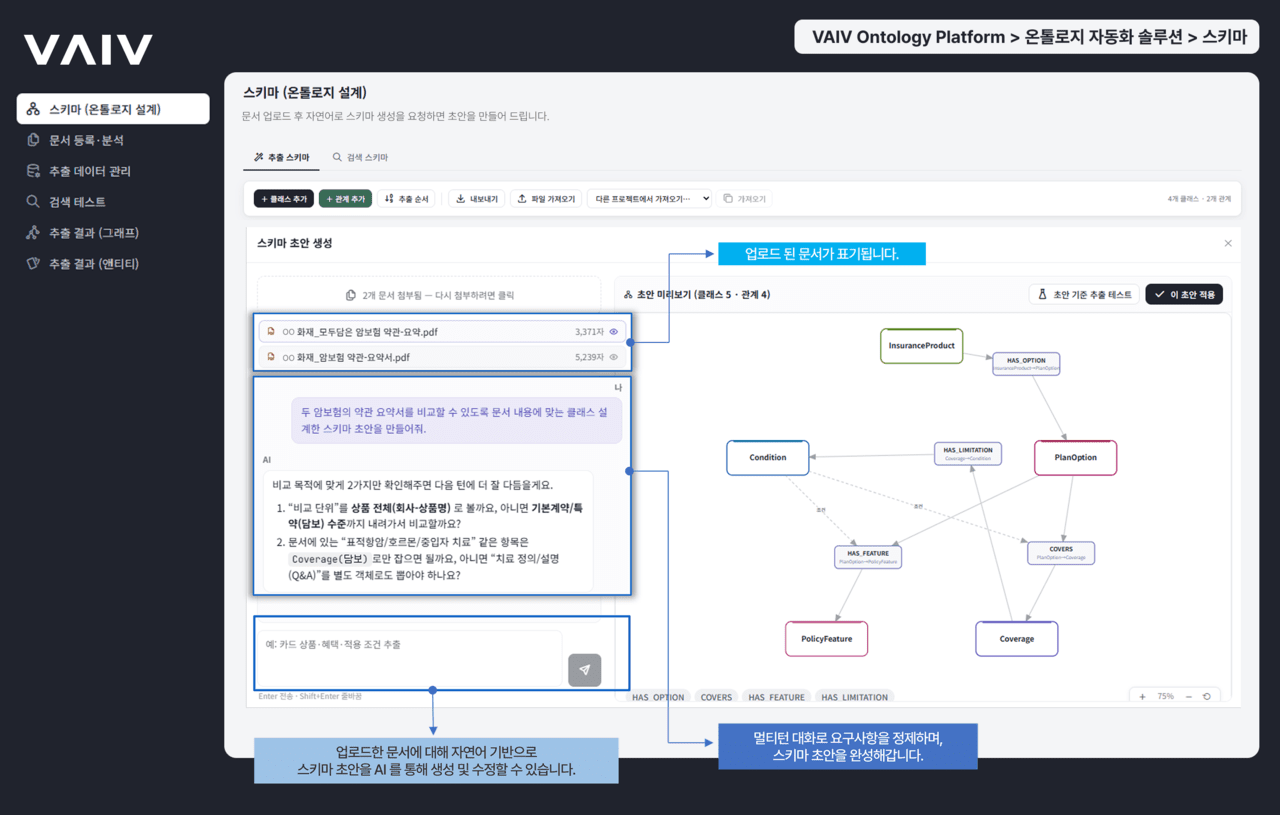 Source · The ElecVibe Company unveils an ontology automation solutionThe article introduces a product approach to automating ontology knowledge-graph design from enterprise documents.
Automation that uses natural language and documents to create a fast first draft can be useful. A generated graph, however, is not automatically the organization’s truth. A “customer” may be a lead for sales, a billing party for finance, and a distinct legal role for privacy processing. A model can surface recurring document patterns and propose relationships; it cannot independently settle the responsibility and permitted actions attached to those relationships. Treat generated output as a draft for domain owners to review, rather than as a finished design.
 Source · HelloTEnhance presents ontology-based AI agent technology cases at an NIA seminarThe coverage introduces cases involving ontology-based data structuring and agent workflow design.
This also separates ontology from the argument that models will absorb every need for a separate harness. Better general reasoning and tool use may remove repetitive prompt wrappers. Yet an organization’s objects, access rules, approval relationships, quality criteria, and change history cannot be owned by a model provider on its behalf. Ontology expresses the context that should remain outside the model; a harness connects that context to practical constraints on action. Even if one implementation becomes simpler, the questions of ownership and verification do not disappear.
These news signals do not justify broad claims about every product’s maturity. The reports introduce an automation solution and seminar cases; they are not independent comparisons of accuracy, operating cost, or deployment outcomes across organizations. Adoption teams should therefore begin not with a massive knowledge graph, but with the nouns and state transitions most often confused in one job. Give each relationship a source, owner, update cadence, and permitted action. Then define the explanation a person should see when an agent uses that relationship to act. That is how organizational context remains owned separately from a model’s temporary inference.
Operator’s note
Today’s three topics connect in sequence. More work agents require a boundary around execution authority. Once that boundary exists, the organization must prove how that authority was actually exercised. To prove an action, it needs consistent organizational context for the customer, document, rule, and state that the agent consulted. A system that has only one of authority, records, or context can look smooth in a demo while remaining difficult to explain in production.
This week’s experiment can combine all three. Choose one real task, write its work contract, tie its tool calls together with an execution ID, and define a small dictionary for the key objects and states used in those calls. Then ask: Why was this action allowed? What changed? Which evidence and context did it use? Where does it return if it fails? If those four questions cannot be answered immediately, the next step is to improve the operating design before changing models.
The differentiator in AI operations is not owning the most autonomous agent. It is increasing the pace of work while reducing the cost of approval and recovery, and still being able to explain an execution later. Product updates will change, but this principle is product-independent. That is why smaller teams benefit from laying down a thin layer of authority, evidence, and context early.
What to watch this week
Work agents create a reason to connect more tools, but also a reason to build approval queues and rollback paths first. The conversation around action records shifts the operating metric from response time toward execution evidence. Ontology automation can make an organization’s language faster to draft, but responsibility for the actions that language permits remains with the organization. Before starting the next automation, test whether one task’s authority, logs, and context can be explained on one screen.
Sources
- AI Times — OpenAI launches ChatGPT Work, a work agent ↗
- Sisa Journal e — B2B industry sees a wave of working AI launches ↗
- IT Chosun — AI agent action records determine trust ↗
- Byline Network — AI red teams must verify the whole action path ↗
- The Elec — Vibe Company introduces ontology automation ↗
- HelloT — Enhance presents ontology-based AI agent cases at an NIA seminar ↗
Related posts
Read →Related tools