Ikigai Is Not a Four-Circle Career Formula. It Is a Sense That Life Is Worth Living.
Ikigai is broader than the popular four-circle career diagram. Read Kamiya Mieko, Okinawan mutual support, and wellbeing research as a practical way to build reasons for living.
IKIGAI · PURPOSE · COMMUNITY
Ikigai Is Not a Four-Circle Career Formula. It Is a Sense That Life Is Worth Living.
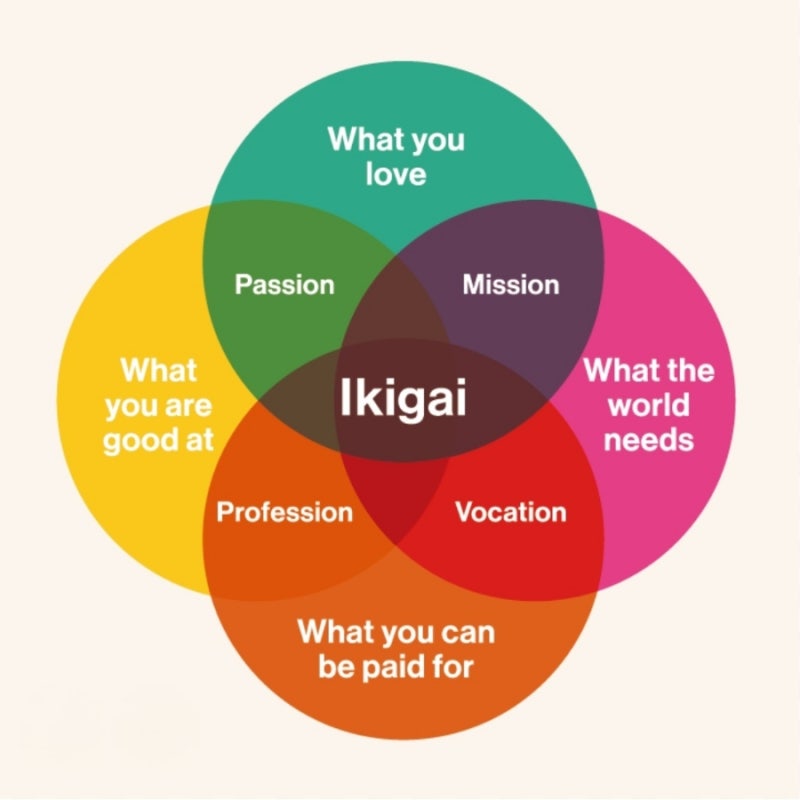
Ikigai is often introduced as the overlap of what you love, what you are good at, what the world needs, and what pays. That diagram is useful for a career review, but it does not contain the whole Japanese idea. The question popularized by Mieko Kamiya in her 1966 work was broader: what objects, relationships, and practices make a life feel worth continuing today?
A reason for living is not an answer sheet. It is a lived sense, adjusted through repeated contact with daily life.
KEY TAKEAWAYS
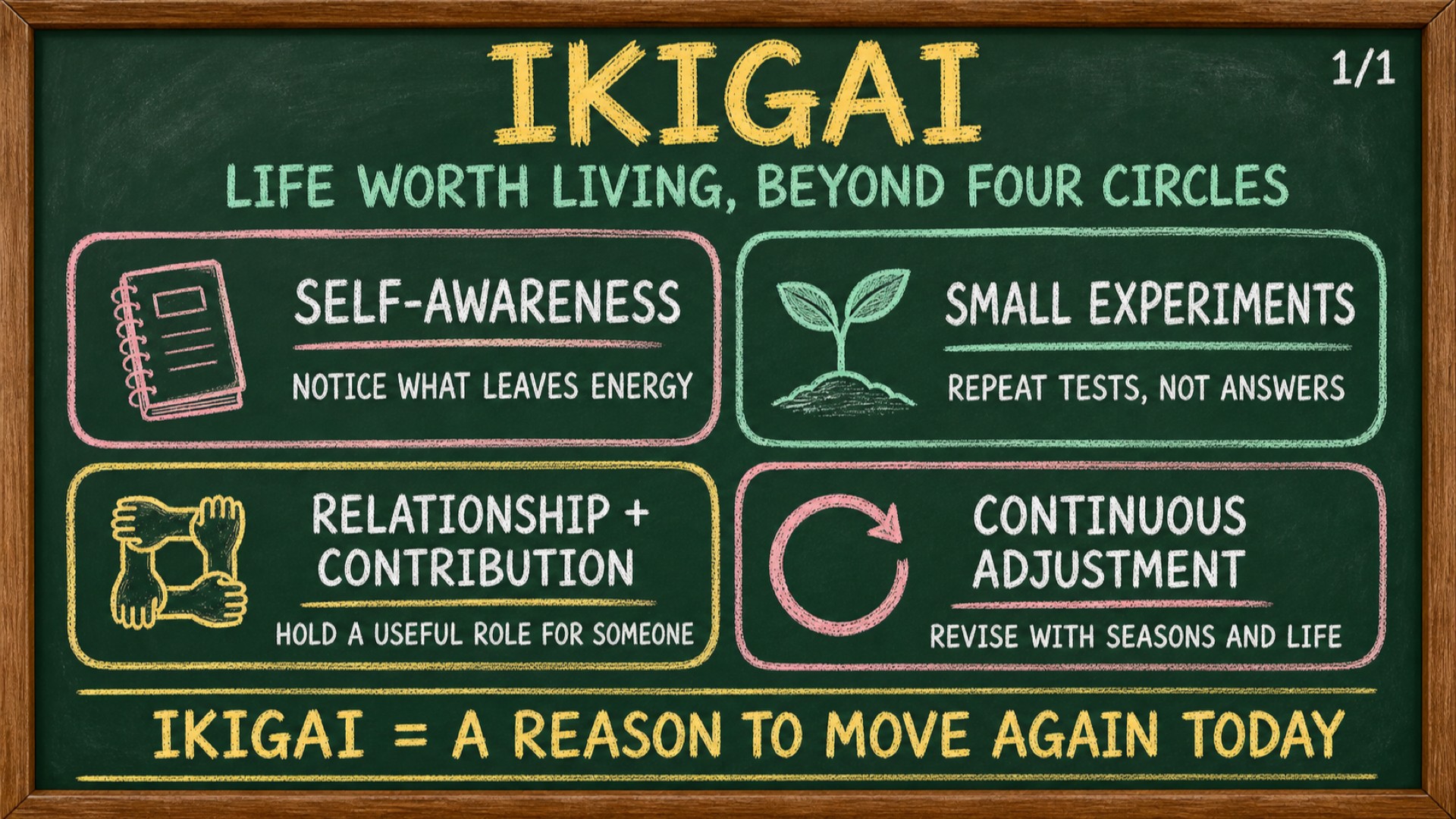
Four corrections worth making first
1It is not only a job formula
Paid work is one possible source. Care, friendship, hobby, and a neighborhood role can also make life feel worth living.
2The four circles are a translation layer
The overlap of passion, mission, profession, and vocation is a modern career frame, not a full traditional definition of ikigai.
3Relationship is not optional
Okinawan moai shows how mutual support can keep individual purpose alive inside a social structure.
4Adjustment matters more than discovery
Ikigai is not a fixed identity found once. It is maintained through experiment, contribution, feedback, and recovery.
What ikigai actually points to
Built from iki, life, and gai, worth or value, ikigai is commonly rendered as a reason for living, a life worth living, or a felt sense that life has value. Translation cannot be reduced to one fixed phrase because the term can include purpose, pleasure, usefulness to others, and a role in relationship. A 2023 psychological review connects it to purpose in life and reason for living while noting that scholarship still has no single consensual definition.
The Korean edition of Mieko Kamiya’s Ikigai matters because it preserves a harder starting point than the productivity version of the concept. Ikigai is not framed as a privilege of people who have already found a winning vocation. It is a question to ask even from a life at an edge. Reducing it to title, salary, or “finding your one calling” misses that starting point.
 Source · Europe’s Journal of PsychologyAn Integrated Cognitive-Motivational Model of Ikigai in the WorkplaceA scholarly review of ikigai as life worth living, purpose, motivation, and attention.
Why the four circles are not the whole story
The diagram of love, skill, social need, and paid work is memorable because it lets people scan a career in one view. The supplied Korean blog applies it to an Airbnb co-hosting project for older hosts in Gangneung: personal energy, accumulated capability, a concrete community need, and a sustainable income model. Used this way, the diagram is practical.
The mistake begins when the diagram is treated as ikigai’s original blueprint. Information is Beautiful credits its modern visualization to Marc Winn in 2014; it is not verified as a classical Japanese diagram from Kamiya’s 1966 book. Where do care work without pay, retirement hobby, tending a garden, or bringing soup to a friend belong? A life can be worth living even when its source does not sit in the center of a professional Venn diagram. The diagram can be a career design tool. Ikigai is the larger question of what moves a person to re-enter tomorrow.
A useful distinction: The four circles ask, “How should I adjust my work?” Ikigai asks, “What makes me move again today?” The questions overlap; they are not identical.
 Reference · Enoch's noteIkigai: Okinawan philosophyA Korean secondary explanation of the popular four-circle frame and one personal project application.
What Okinawan moai adds
Ikigai is frequently paired with Okinawan longevity culture for a reason that is not simply individual willpower. Moai is commonly described as a lasting mutual-support group of friends and neighbors. In the Okinawa Centenarian Study context presented by the World Economic Forum, social connection appears as one condition among many associated with healthy ageing.
That moves ikigai away from a private mission statement. A recurring role that someone else genuinely needs can keep meaning durable. Personal goals often stop when energy drops. A relationship with a small mutual obligation can supply a reason to return. Moai is not a longevity recipe that can be copied mechanically; it is a clue about the social infrastructure that helps purpose endure.
 Reference · World Economic ForumWant to live a long, healthy life? 6 secrets from Japan’s oldest peopleA public summary of Okinawa centenarian research and the role of social connection.
Research says association, not a longevity spell
Ikigai should not be sold as a health cure. A 2022 longitudinal study of Japanese adults aged 65 and older reported that respondents with ikigai had lower subsequent risks of functional disability and dementia over three years, alongside lower depression and hopelessness and better life satisfaction and social outcomes. A Japan Collaborative Cohort Study likewise reported an association between ikigai and mortality.
Association is not a prescription. Health, income, relationships, and capacity to act can also make ikigai easier to feel. The research value is not a promise that purpose makes people live longer. It treats life worth living as a phenomenon tied to function, participation, relationship, and everyday behavior rather than a private mood alone.
Source · The Lancet Regional Health – Western PacificIkigai and subsequent health and wellbeing among Japanese older adultsLongitudinal analysis of associations between ikigai and later health, psychological, and social outcomes.
Burnout needs less answer-hunting, more usable experiments
For someone exhausted or isolated, “your circles have not met yet” can become another performance demand. Ikigai starts more gently. Which activity leaves you slightly less depleted? When were you concretely useful to another person? Which version is small enough to repeat tomorrow?
The workplace model of ikigai makes the same point with different vocabulary: motivation and attention interact with situational conditions and feedback loops. Meaning is not produced inside an individual mind alone. It needs discretion, recognition, visible results, and a difficulty level that can teach. As AI takes repetitive work, the human question is not only what was removed. It is what contribution a person can choose, verify, and extend.
ZHS view: As agents take routine tasks, human ikigai need not come from one grand irreplaceable goal. It can come from choosing direction, checking consequences, and taking responsibility for a useful change.
Five experiments for finding a workable ikigai
1 Self-awareness: keep a two-week log of work that drains energy and work that leaves something behind.
2 Exploration: test one hour of craft, one act of help, or one small collaboration before making a grand career decision.
3 Adjustment: measure repeatability, not excitement alone. Can you still do it next week and recover afterwards?
4 Meaning: ask for specific evidence of what changed for another person.
5 Growth: revise the answer as season, relationships, and responsibilities change.
FAQ
Q1. Must ikigai be connected to a job?
No. Work is one possible source. Care, hobby, friendship, and local contribution can all be part of it.
Q2. Is the four-circle diagram wrong?
It is useful for examining the balance of career and contribution. It is too narrow when presented as the full traditional definition of ikigai.
Q3. Does ikigai make people live longer?
Studies report associations with health and wellbeing outcomes. They do not provide a simple individual cause-and-effect guarantee.
Q4. What if I do not enjoy anything right now?
Do not force a passion search. Start by recording less draining actions and small moments in which you were useful to someone else.
Conclusion
Ikigai is made by people who find a reason for tomorrow, repeat it in relationship, and revise it as life changes.
It is not a one-time aptitude result or a command to postpone life until four circles align. Kamiya’s question, Okinawan social structure, and recent research all point toward activity, connection, and ongoing adjustment.
This reaches beyond self-help. Organizations often turn purpose into a slogan while leaving schedules, authority, and feedback untouched. Ikigai becomes workable when someone has a real action to own, another person able to recognize its effect, and enough room to adjust when circumstances change. Meaning needs a calendar, a relationship, and a feedback loop.
Choose one small useful act today. Check whether it reached someone. Leave it in a shape you can repeat next week. Life worth living often begins at that edge of repetition, not at a distant center.
Sources
- National Diet Library — Mieko Kamiya, Ikigai ni Tsuite (1966) ↗
- Information is Beautiful — Ikigai: Japanese concept to enhance work, life & sense of worth ↗
- Blue Zones — Moai: This Tradition is Why Okinawan People Live Better, Longer ↗
- The Lancet Regional Health – Western Pacific — Ikigai and subsequent health and wellbeing ↗
- Europe's Journal of Psychology — An Integrated Cognitive-Motivational Model of Ikigai in the Workplace ↗
- Japan Collaborative Cohort Study — Ikigai and mortality ↗
Related posts
Read →Related tools