July 21 Operations Brief — Regulatory Change, Verification Loops, and Cost Stop-Lines
A practical operating brief on reported AI Basic Act follow-up changes, loop verification, and task-level stop-lines for agent cost and authority.
DAILY NEWSLETTER · 2026-07-21 · REGULATORY CHANGE · VERIFICATION LOOPS · COST STOP-LINES
July 21 Operations Brief — Regulatory Change, Verification Loops, and Cost Stop-Lines
Today’s three signals ask the same operating question at different layers. When regulatory change is reported, a team needs to explain its current system before rushing to an applicability conclusion. In AI coding, a single plausible answer matters less than a verification loop that finds and closes failure. In agent execution, work needs to stop before it crosses a limit—not after the cost appears on an invoice.
Today’s operating points
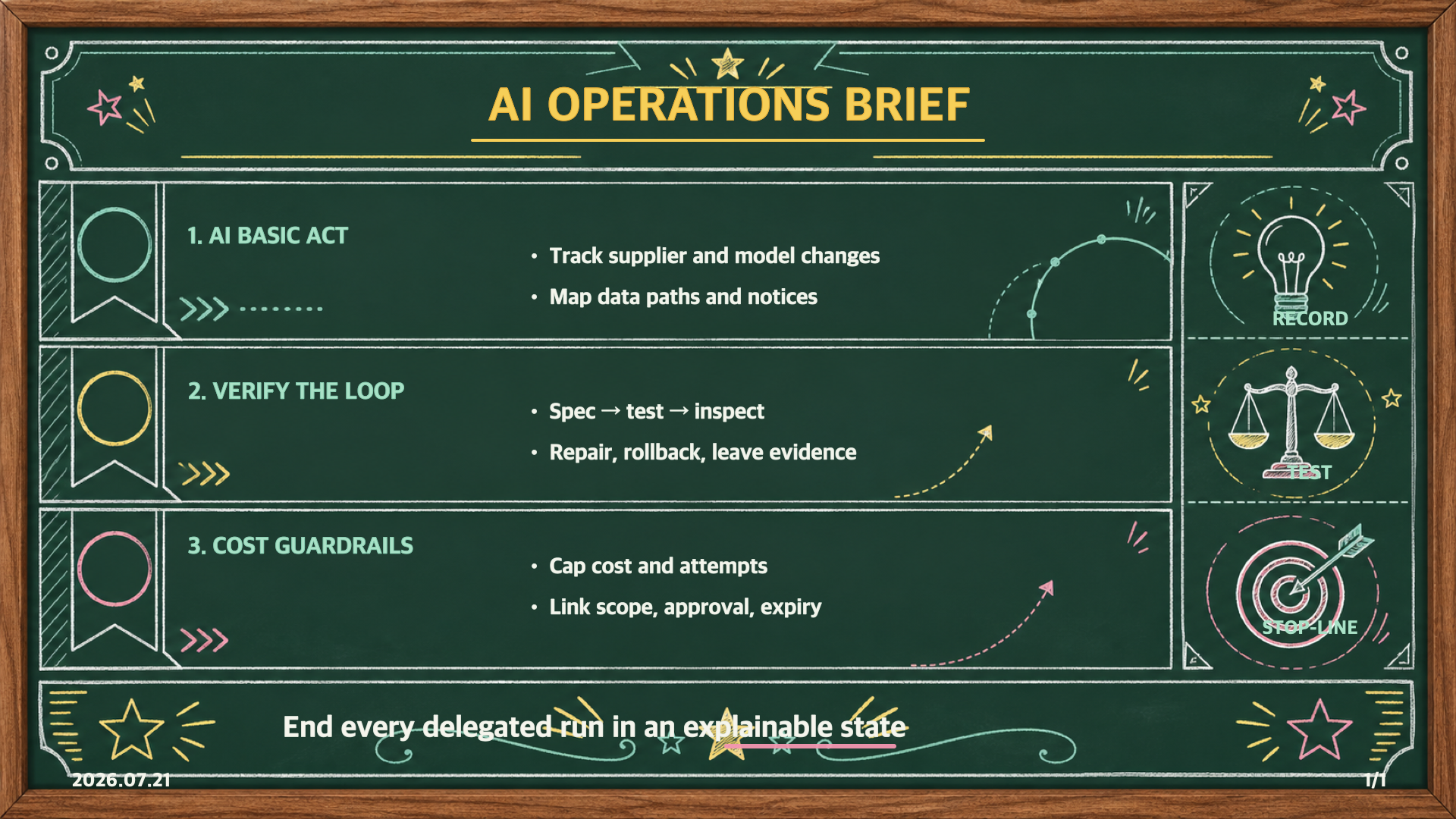
First, reporting on July 21 follow-up measures under Korea’s AI Basic Act is not a signal for an operations team to interpret the law in place of counsel. It is a signal to make the current system retrievable: which feature uses which supplier and model, where inputs and outputs travel, and who approved what. Second, loop engineering is not a technique for writing a longer prompt. It is a way of connecting specification, execution, a failing test, inspection, repair or rollback, and evidence. Third, agent cost is not only a token count. Retries, paid tools, external sends, and real purchases or publishing are part of execution, so money and authority need the same stop-line.
- Before making an applicability claim about regulatory change, make the current configuration and its change history explainable.
- Close coding work around failure conditions and evidence of completion, not a successful-looking answer.
- Put cost, retries, allowed scope, approval, expiry, and evidence location on every agent task so it can stop while it runs.
1. On the AI Basic Act follow-up effective date, retrieve the operating state before making a legal conclusion
Yonhap News covered the July 21 effect of follow-up measures under the AI Basic Act as a test for Korea’s AI industry. AI Times Korea reported a legislative notice for a proposed amendment to the Act’s enforcement decree aimed at strengthening AI-industry support. Both reports provide a context of institutional change and industry support. They do not, by themselves, establish whether a particular service is subject to a provision, what its exact duties are, or whether a sanction is fixed. That assessment requires the latest official statutes and notices together with the organization’s role, system function, users, and data. The job for an operator today is not to substitute for legal analysis. It is to make the current facts needed for that analysis easy to retrieve.
 Source · Yonhap NewsAI기본법 후속 법령 시행…한국 AI 산업 시험대 | 연합뉴스Covers the follow-up measures taking effect in the context of operational and industrial change for Korea’s AI sector.
 Source · AI Times Korea정부, 인공지능 산업 육성 강화 위한 AI기본법 시행령 개정안 입법예고Provides reporting context for the legislative notice on an enforcement-decree amendment aimed at strengthening AI-industry support.
The first preparation is a configuration table by feature. One row records the user-facing feature name, owning organization, supplier and model identifier called, deployed version, latest change date, change approver, and the location of a relevant policy or disclosure. This is not a regulatory-compliance certificate. It is an operations index for reconstructing what was in use at the time of an incident, inquiry, contract review, or product change. When a model name exists only in a provider dashboard and is not connected to product-release records, it is hard to reconstruct which configuration operated when. A single connected row reduces the time legal, security, support, and engineering teams spend searching through different documents.
The second preparation is a plain-language description of the data path. State where input begins, which preprocessing and storage it passes through, which external service receives it, and where the response and artifact remain. This document need not decide whether a particular field is personal or confidential information as a matter of law. But no one can begin reviewing retention, access, outsourcing, or disclosure for a path that is unknown. Connect it to the interface where a user encounters AI, where generation or automated judgment enters the product, and where a person reviews or edits the result. If the disclosure language and the actual flow diverge, check the product behavior and retention policy rather than treating wording as an isolated repair.
The third preparation is minimum evidence of change. It does not mean retaining every prompt and every internal chain of reasoning forever. Link a request or deployment identifier to the applied product, policy, and model versions; any required approval identifier; the material before-and-after difference; the location of test or review results; and the retention and deletion rule. Official materials and expert review must determine which of these are legal duties. Operationally, however, this minimum evidence is what lets a team explain the scope of a model replacement, provider-term change, or interface revision. More records are not automatically better. Copying sensitive source material into a new store may increase exposure while trying to improve explainability.
The state table therefore also needs an owner and a review trigger. Record which team updates the row, who last reviewed it, and which change in supplier, model, data path, or user interface requires another check. A blank field does not automatically mean a violation. It becomes a concrete question for the next confirmation. If the exact external-model version is unknown, check the provider agreement and call configuration; if the disclosure location is unknown, check the live interface and deployment record. The purpose of operations is not to guess at legal text and create a checkmark. It is to support sound decisions by locating evidence and responsibility when change happens.
2. Loop verification is not a perfect prompt; it reproduces failure and closes it with evidence
AI Times reported on the spread of “Karpathy AI coding guidance” as a movement from prompts to loops. The article also cautions that the authorship and authenticity of the cited guidance have not been confirmed. It should therefore not be treated as a settled method from a particular person or as the answer for every team. Still, the described sequence—read the code first, create a failing test, and name known failure modes—addresses an important operating problem. The fact that an agent produced a plausible patch does not show that it preserved an existing contract, avoided a boundary regression, or left a result another person can verify. SelectStar AI’s discussion of loop engineering likewise provides a lens for repeated execution and feedback rather than a single result.
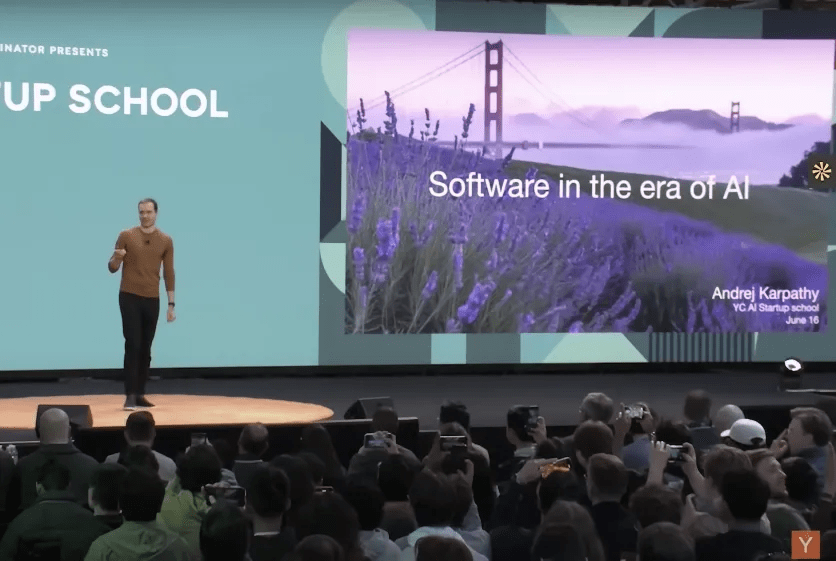 Source · AI Times'카르파시 AI 코딩 지침' 확산…"프롬프트에서 루프 시대로 진화" - AI타임스The article says the authorship and authenticity of the cited guidance are unconfirmed while covering read-first practice, failing tests, and repeatable verification.
Source · SelectStar AISelectStar AIA reference that considers loop engineering as an operating view of repeated execution and feedback to improve an outcome.
Source · AI Times'카르파시 AI 코딩 지침' 확산…"프롬프트에서 루프 시대로 진화" - AI타임스The article says the authorship and authenticity of the cited guidance are unconfirmed while covering read-first practice, failing tests, and repeatable verification.
Source · SelectStar AISelectStar AIA reference that considers loop engineering as an operating view of repeated execution and feedback to improve an outcome.
The first step of a task is not an implementation instruction but a boundary for the specification. “Fix the payment button” can be a task name, but it is not an acceptance condition. State what should happen on a normal payment, a double click, a provider error, and a return after refresh or back navigation. State what must not change as well: an already approved order must not be charged again, a failed payment must not advance the flow, and customer and administrator sessions must not mix. Giving an agent these boundaries narrows its search space. It also gives a human reviewer a basis for judging which changes were intended.
The second step makes failure visible. Where automated tests exist, write a failing test first or fix an existing reproduction procedure in place. Where browser or outside-provider flows are difficult to automate, retain safe evidence such as reproduction steps and expected state, a screen capture, request log, response status, or test order. “Failure” does not mean deliberately breaking a system. It means making the present defect or an unacceptable behavior observable under stated conditions. Without a reproduced failure, there is no comparison point for success after a repair. An agent may find it easy to generate an answer; proving exactly what it repaired is harder.
The third step keeps the execution scope small. For a task, define the baseline commit, assigned files, allowed tools, run command, and artifact location. When unrelated formatting, dependency updates, or broad refactors enter the diff, review cost rises sharply even if tests pass. Giving an agent authority to repair an entire repository does not make a repository-wide change a good solution. Stop and record the reason when unexpected files change or new authority is needed. A narrow change is not merely a conservative preference; it is an experiment design that preserves the relationship between the suspected cause and the repair result.
The fourth step is inspection and evidence after a test passes. Test success, static checks, a real interface or API flow, and diff review do not replace one another. A test checks its stated condition, a diff finds unintended change, and a live flow finds integration failures. Attach the run command and result, capture or log location, final artifact, and remaining limitations to the task card. This record is not for monitoring an agent’s hidden thought process. It is the minimum handoff that allows the next operator to check the conclusion against the same input and baseline.
A loop also needs termination rules. Stop automatic work when an identical error repeats, the maximum attempt count is reached, or a new secret, write authority, or approval for external execution is required. The handoff bundle should be short and concrete: the original specification, latest diff, failing test or reproduction step, observed error, repairs already tried, log and artifact locations, and the decision needed from a person. Accumulating patches while the cause is unknown is not a verification loop; it is accumulated speculation. A good loop is not a device that rotates forever. It ends with success, failure, or deferral in an explainable state.
Parallel agent work also requires separate ownership of evidence. If one agent changes the failing test made by another, the original failure condition can disappear. When several tasks overwrite files in one working directory, it also becomes unclear which change caused the outcome. Separate the baseline, file scope, verification command, and evidence path for each task, then rerun the original failing test just before merging. Put any new regression in the same evidence bundle. The value of parallelism is not simultaneous activity by itself; it appears only when each result can be independently verified.
3. Control agent cost as a task-level stop-line, not a bill
CIO warned of surging AI-agent charges and raised the possibility that token expense could exceed a salary. Its headline is not evidence that every team has the same cost structure. It is safer to read it as a warning against viewing autonomous-execution cost only as a model-call price. OWASP’s Top 10 for Agentic Applications for 2026 provides a framework for examining tools, external input, and autonomous execution as connected risks. It does not establish standard budget fields or thresholds. It is nevertheless useful for operating review because an untrusted input, broad tool permissions, and automatic retries can combine in one flow to increase both cost and real-world impact.
 Source · CIO토큰 비용이 연봉 넘는 시대 온다?···AI 에이전트 과금 폭증에 IT 업계 경고Provides the warning context that growing agent token use and charges can affect operating cost decisions.
 Source · OWASPOWASP Top 10 for Agentic Applications for 2026Offers an agentic-application risk framework for considering tool authority, external input, and autonomous execution together.
Counting cost by task reveals items outside the model call. A failed tool call and its retries; paid search, translation, mapping, image, and other APIs; browser or data-processing services; and real purchases, publishing, or message delivery in an outside system are all cost and impact of one job. Limiting only model budget can miss a detour in which a cheaper model retries dozens of times, another paid tool is repeatedly called, or an external action is created several times. Limiting only authority can miss a growing accumulation of permitted read calls. A money ceiling and a behavior ceiling belong in the same task contract.
ZHS suggests a task-manifest template with max_cost, max_attempts, allowed_scopes, approval_id, expiry, and evidence_path. This is a ZHS operating template, not a standard and not a set of fields required by the sources above. max_cost places a task-wide ceiling under an accounting basis the team defines in advance, including model, API, SaaS, and external-action cost where applicable. max_attempts limits how many times execution may be retried after failure. allowed_scopes enumerates permitted behavior—read, write, external transmission, or purchase—so the answer to “what may this do?” stays narrow.
approval_id ties a request to the person or policy that authorized a specific action. expiry prevents an old approval from being silently reused for a different target or time. evidence_path points to the input summary, results by attempt, final artifact, failure log, or rollback record. On reaching a ceiling, an agent must not secretly split the task or route around the limit through another tool. It should show the stop reason, cost and actions incurred so far, remaining choices, and information needed for additional authority, then wait for a person to continue, narrow, or end the work. The purpose of a budget is not to force the cheapest execution. It is to end work whose value has become uncertain at an explainable point.
When a parent task creates several subtasks or parallel agents, the ceiling also has to descend as a hierarchy. Copying the parent’s max_cost into every child multiplies potential cost by the child count. The parent reserves a share of the total envelope for each child and receives only the unused portion when that child completes or is cancelled. A reservation is not approval for an external action. Purchases, publishing, and customer-message delivery still require the relevant approval_id and scope. An operator view should show reserved cost, attempts remaining, active scopes, and approvals close to expiry alongside actual usage, so the job can be narrowed before the next call.
A stop-line is not only a device for failure. It should work when new information changes a task’s value. If search results are not trustworthy, a tool demands broader data access than expected, or the cost estimate becomes several times the original assumption, the agent needs to make a new case for continuing. A person may authorize more cost, reduce the work to read-only research, or end it. The essential point is that time and money already consumed by automation do not justify the next consumption. When a task contract retains the remaining ceiling and evidence, the decision can be made on the value of the next action rather than on sunk cost.
Operator memo
The smallest useful artifact to create today is a one-page task card. At the top, write the acceptance condition and the scope that must not change. Below it, put the test or reproduction that exposes failure and the evidence location. If the task uses external tools, put the cost ceiling, maximum attempts, allowed scopes, approval identifier, and expiry on the same card. Coding verification, cost control, and approval records then do not scatter into separate documents. The card need not be long. It is sufficient when the next person can tell what was allowed and what was checked without running the task again.
Respond to regulatory change by beginning with one current-state row instead of announcing a vast compliance program. Pick one feature and connect its supplier, model, input-transfer-storage path, user-disclosure location, deployed version, change approver, and last review date. Leave unknown cells as confirmation items. Use the table to recheck the latest official material and, where needed, send a narrow question to qualified legal or regulatory advisers. This sequence avoids making a legal conclusion in operations while preparing the facts that require review.
The shared question across the three topics is not how many runs were completed. Ask whether the failure condition was actually exposed; whether the configuration and policy in force at the change can be retrieved; whether execution stopped before crossing a cost or authority limit; and whether approval and evidence point to the same request. If a team can answer those four questions, faster automation does not have to trade away cause and consequence. If it cannot, fix one task card and one evidence path before connecting more agents.
Today’s conclusion
The July 21 operating task is to avoid consuming institutional change, model capability, and cost pressure as separate news items. In the face of regulatory change, build a minimum record that explains the current system. In coding, build a loop that reproduces failure and closes it with evidence. For agents, set a task stop-line that stops cost and authority together.
Today, choose one feature, create one configuration-table row, and attach a failing test and the six manifest fields to one task that changes it. That small connection creates a shared language for the next change review, regulatory check, reproducible repair, and cost decision.
Sources
- Yonhap News — AI기본법 후속 법령 시행…한국 AI 산업 시험대 | 연합뉴스 ↗
- AI Times Korea — 정부, 인공지능 산업 육성 강화 위한 AI기본법 시행령 개정안 입법예고 ↗
- AI Times — '카르파시 AI 코딩 지침' 확산…\"프롬프트에서 루프 시대로 진화\" - AI타임스 ↗
- SelectStar AI — SelectStar AI ↗
- CIO — 토큰 비용이 연봉 넘는 시대 온다?···AI 에이전트 과금 폭증에 IT 업계 경고 ↗
- OWASP — OWASP Top 10 for Agentic Applications for 2026 ↗
Related posts
Read →Related tools