Gartner's Agentic AI Declaration: Data Management Shifts from Storage to Usage Value Tracking
Gartner declared agentic AI a 'step function' at its Sydney Data and Analytics Summit. Data pipelines are being reorganized around agents that track how data is used, how often, by whom, and whether it leads to desired outcomes.
Gartner · Agentic AI · Data Value Infrastructure
Gartner's Core Claim About Agentic AI Is Not "Smarter Models" — It Is "Agents That Track How Data Is Used"
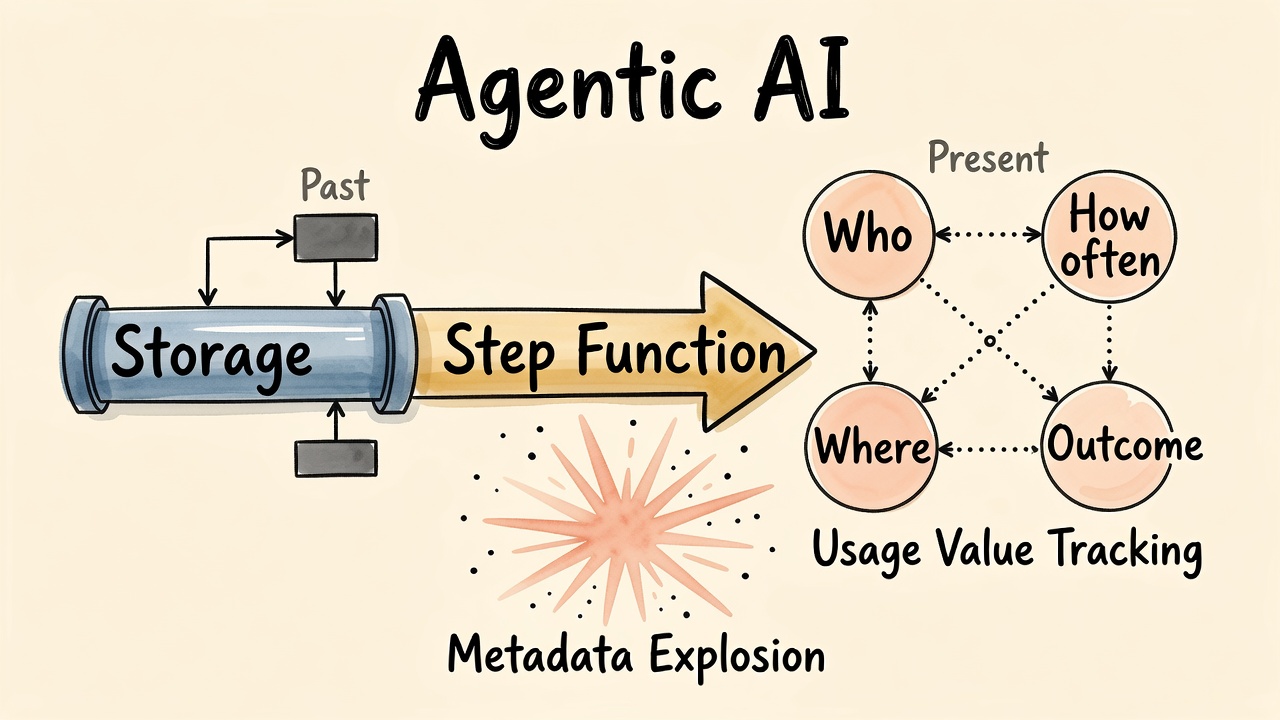
In June 2026, at Gartner's Sydney Data and Analytics Summit, chief of research Erick Brethenoux called agentic AI a "step function." Not incremental improvement — a qualitative leap. But the more consequential declaration came from VP Mark Beyer: "We're no longer building data pipelines for analytics or AI. Rather, we're now building agents that recognize how the data is used, how often it is used, which part of the organisation uses it, and most importantly, whether it leads to the desired outcome." The center of gravity in data management has shifted from storage and transport to real-time measurement of usage value.
It is no longer about building another lighthouse in a vast sea — it is about weaving a network of lighthouses that track each other's light and decide autonomously where to dispatch ships.
1The purpose of data pipelines has changed
The old goal was "collect data for analytics." The new goal, per Gartner VP Mark Beyer, is "build agents that recognize how data is used, how often, by whom, and whether it leads to desired outcomes." This is an explicit paradigm shift declaration.
2Metadata explosion makes agents structurally inevitable
Every data reuse creates 100 new metadata points. At 1,000 accesses, you are overwhelmed in weeks. Humans cannot keep pace, making agents for connectivity, orchestration, and governance not optional but structurally necessary.
3Access frequency becomes a proxy for data value
Gartner VP Adam Ronthal states that "frequency of access is a strongly correlated proxy for value." Dashboards used daily by many people are clearly valuable. Conversely, users downloading large volumes from a warehouse to local environments are not getting the value they want — a signal of platform failure.
4Agentic AI is "combination," not "single model"
Brethenoux warns against the tradition of one school claiming victory. Neurosymbolic AI (neural networks plus symbolic logic), first principles AI (machine learning plus scientific laws), and world model AI all converge on "combination" as the answer.
What Gartner Means by "Step Function"
Erick Brethenoux, Gartner's chief of research for AI, opened his Sydney keynote with a personal note: "I've lived through two AI winters so far. I'm hoping the next one is further away." The assessment from a researcher who survived two winters was measured but firm. Generative AI "advanced this to some amount," but agentic AI — the ability to build independent software entities that do work on your behalf or on behalf of a machine — "is actually a step function." In engineering, a step function describes output that shifts discontinuously when input changes. Not gradual improvement — qualitative transition. Gartner's label for agentic AI is not "evolution" but "leap."
The declaration carries weight because of the numbers Gartner attached to it. In August 2025, Gartner predicted that "40% of enterprise applications will integrate task-specific AI agents by the end of 2026, up from less than 5% today." An eightfold jump in twelve months. Given Gartner's influence on enterprise IT budgeting through Magic Quadrants and Hype Cycles, this figure functions as a compass for corporate spending decisions.
But Brethenoux's core message is not "agents got smarter." It is that "relying on a single AI approach has historically been a mistake." The claim that neural networks alone, or symbolic logic alone, or generative AI alone can solve everything has been the root cause of failure. The convergence argument aligns with MIT Sloan Management Review's Spring 2026 issue on "Agentic AI at Scale: Redefining Management for a Superhuman Workforce," which argued that holding agentic AI accountable requires fundamentally new management approaches. California Management Review's March 2026 issue covered the same ground with "Governing the Agentic Enterprise: A New Operating Model for Autonomous AI at Scale." Three top management journals converging on the same topic in the same quarter signals academic consensus forming.
Metadata Explosion: Why Agents Become "Inevitable"
Mark Beyer, Gartner research VP and distinguished analyst, presented the structural argument: "Every time you reuse data, 100 new metadata points are created about that data. If you access that data 100 or 1,000 times more frequently, you'll be overwhelmed with metadata in a matter of weeks." The more you use data, the more data about data accumulates. Classifying and tracking this metadata manually becomes physically impossible.
At this point, agents transition from "nice-to-have tools" to "essential infrastructure without which the data ecosystem collapses." Beyer's example is concrete: "An AI agent could notice that data quality consistently degrades on Tuesdays and automatically append a warning note to reports generated on that day." This is not simple automation. Three agent capabilities work in concert: pattern detection, meaning judgment, and action execution.
This problem recurs across Gartner's research. In May 2026, Gartner reported that "organizations without semantic AI-ready data risk higher costs, weaker governance, and inaccurate AI agents." Traditional schema-based data models alone no longer suffice because they lack business context and data meaning. The semantic layer — a context layer that gives data meaning — becomes a core component of data and analytics infrastructure for the agentic AI era.
How to "Measure" Data Value: Access Frequency and Outcome Connection
The most operationally actionable part of Beyer's declaration is the data value measurement framework. "We're no longer building data pipelines for analytics or AI. Rather, we're now building agents that recognize how the data is used, how often it is used, which part of the organisation uses it, and most importantly, whether it leads to the desired outcome."
These four questions — who, how often, where, and what result — redefine the purpose of data engineering. The old data pipeline aimed to "move data from point A to point B." The agentic-era pipeline aims to "track whether data, after moving from A to B, was actually consumed, consumed repeatedly, consumed across departments, and in the end connected to business outcomes."
Gartner VP Adam Ronthal's value measurement framework:
- Access frequency: How often and when a data asset or dashboard was last accessed. Higher frequency correlates with value.
- Importance: How much that data influences decision-making. Frequency alone is insufficient.
- Download patterns: When users download significant volumes from a data warehouse to their local analysis environment, they are not getting the value they want from the platform — an early signal of platform disengagement.
Ronthal proposed applying manufacturing principles to FinOps. Like Henry Ford's production line, every step should have a measurable cost and output. Calculating the exact cost of a specific SQL query is a "largely solved problem space" through modern FinOps practices, but accurately measuring the value of that data remains a major challenge. By using metadata to understand consumption patterns, organizations can rank their workloads by value. Once empirically ranked, an agentic optimization framework can be deployed: if a critical report is needed by 9am every day, an AI could deploy agents to select the most cost-effective cloud compute instances, structure the data, and guarantee the SLA without human intervention.
The "Internet of Agents" and Critical Perspectives
The trend Brethenoux called most disruptive is "adaptive collective AI," or the internet of agents — distributing decision-making across multiple systems to solve complex problems. His cited example: a Gartner client using a swarm of drones to inspect wind turbines in the North Sea. The drones independently photograph cracks and color degradation, and upon returning to base, collectively decide whether issues exist and autonomously generate a report. Not a single agent but an agent swarm performing meaningful work.
But skeptical voices persist. Gary Marcus, in his 2026 predictions essay, warned of "structural failures in agentic AI — scaling without grounding, without governance, without reliable reasoning." Brookings, in its April 2026 report, diagnosed that "we cannot govern what we cannot measure," convening 40+ experts to discuss agentic AI evaluation methodology. MIT Sloan and California Management Review simultaneously featuring "agentic AI governance structural gaps" as special topics is no coincidence — it indicates academic consensus forming. Three top management journals converging on the same topic in the same quarter signals that the consensus is crystallizing.
Five Checks for Individual Organizations
Deconstructing Gartner's declaration to operational level, five checks are needed:
- Semantic layer existence: Is there a context layer that gives data business meaning? Schema alone cannot tell an agent "what this column means."
- Metadata management capability: Can you track data access history, transformation logs, and quality state in real time? 10,000 metadata points from 100 reuses cannot be classified by humans.
- Access frequency tracking: Are you monitoring which data assets are used by whom and how often, log-based? This is a prerequisite for using frequency as a value proxy.
- FinOps agent deployment: Is cost optimization manual, or do agents autonomously handle cloud instance selection, data structuring, and SLA guarantee?
- Human oversight loop: When agents make autonomous decisions, is there a clear loop for humans to approve, reject, or modify? "Full autonomy" should not be the goal.
These five have a sequence. Metadata management is meaningless without a semantic layer. FinOps agents cannot optimize without access frequency tracking. The foundation must be built from the ground up.
What Deming Said in 1982
The conclusion Gartner reached in 2026 — Brethenoux's message to "stop managing by numbers and substitute leadership" — aligns strikingly with W. Edwards Deming's 14 Points for Management from his 1982 book *Out of the Crisis*, specifically Point 11b: "Eliminate management by objective, eliminate management by numbers, numerical goals. Substitute leadership." Deming did not criticize numbers themselves but warned that when numbers become the target, people will distort the system to meet them. Reducing data value to a single metric like "access frequency" recreates the same trap. Ronthal's emphasis on "frequency and importance — two core components" is itself a warning that frequency alone is insufficient.
Kahneman and Tversky's 1979 planning fallacy — the bias to underestimate time needed for future tasks — reads in the same vein. When estimating agentic AI adoption timelines, organizations underestimate by assuming "we just need to plug in a model." The real bottlenecks are data, permissions, semantics, metadata, and governance. For Gartner's 40% prediction to materialize, this foundational work must be completed in the remaining six months. Is that feasible? Brethenoux himself referencing "two AI winters" is also a researcher's caution at a moment when expectations are outrunning reality.
Frequently Asked Questions
Q1. What is the difference between a "step function" and "incremental improvement"?
A step function describes output that shifts discontinuously when input changes. Gartner's use of this term for agentic AI means that the emergence of agents performing work independently represents not a "better answer" level of gradual improvement but a qualitatively different stage.
Q2. How should metadata explosion be handled in practice?
Abandon manual classification, automate log-based metadata collection, and design agents to identify and categorize patterns. Gartner recommends piloting "empirically derived value and ranking by value" within the next 12 months.
Q3. Does access frequency always correlate with value?
No. Ronthal presents frequency and "importance" as two core components. Data accessed frequently but not influencing decisions may have high frequency but low value. Frequency is a necessary condition, not a sufficient one.
Q4. What is the most common failure pattern in agentic AI adoption?
Deploying agents without a semantic layer and metadata foundation. Without business context in data, agents will process wrong data well and report confidently incorrect results. This is why Gartner names "AI-ready data" as the top priority.
Conclusion
Who stores the data, who moves the data, and who uses the data — these three roles operating simultaneously within a single agent system is the next-generation data infrastructure Gartner envisions.
Deming said "stop managing by numbers" 40 years ago, yet enterprises still measure data by "storage capacity." Gartner's 2026 call to change the measurement standard to "usage value" is applying the same lesson to the data domain, a generation late. But the direction is right, even if belated. Agents can be the tool and catalyst for this paradigm shift — provided that two guardrails, the semantic foundation and the human oversight loop, are designed alongside.
So that data is used most frequently, most meaningfully, and most freely — where human judgment remains visible.
Sources
- Computer Weekly — Gartner declares 'agentic AI' the next step function ↗
- Gartner — 2026 Hype Cycle for Agentic AI ↗
- Gartner — 40% of Enterprise Apps Will Feature Task-Specific AI Agents by 2026 ↗
- TechEdgeAI — Gartner: Lack of Semantics Causes Inaccurate AI Agents ↗
- MIT Sloan Management Review — Agentic AI at Scale (2026 Spring) ↗
- Brookings — How Can We Best Evaluate Agentic AI? (2026-04) ↗
Related tools
Related posts
Read →Related tools