Palantir's Ontology: Not a Data Warehouse, But an Operating Structure That Turns Information Into Judgment and Action
Palantir's ontology is not a storage layer but a structure that connects fragmented enterprise data into real-world objects and relationships, enabling organizations to judge and act. Why a thin semantic layer is not enough.
Enterprise AI · Ontology · Data-to-Action
Palantir does not sell a data platform. It sells an operating structure that turns fragmented data into context — and context into judgment and action.
Enterprises already have plenty of data. CRM, ERP, WMS, MES, document systems, permission systems — each exists independently. The problem is not data scarcity but data fragmentation. When a delivery deadline slips, finding whether the cause is a parts shortage, equipment failure, supplier delay, or customer order change requires logging into four systems, making phone calls, and digging through documents. Real-time judgment is structurally impossible in this setup. Palantir's ontology is the blueprint that bridges these gaps. It represents data not as values but as real-world objects and relationships, then layers permissions and workflows on top so that judgment reaches execution in a single move. The company itself states that a thin semantic layer cannot achieve this structure.
If a database is an address book, an ontology is an org chart overlaid with a workflow map. Palantir builds the operating system on top — a digital twin of the entire organization.
Key Takeaways
1The problem is data fragmentation, not data scarcity
Enterprises already store data across CRM, ERP, WMS, and MES. But each system exists in isolation, making it impossible to see the full picture. Tracing a single delivery delay requires jumping across multiple systems.
2Ontology turns values into real-world relationships
A database stores order numbers, customer IDs, and part numbers. An ontology represents the chain: customer → order → product → part → warehouse → production line. It stores context, not just values.
3It connects judgment to action in one step
Standard BI tools say "delivery delay risk: 78%." Palantir asks: who handles it, whose approval is needed, which warehouse to pull from, which production line to switch to, and who contacts the customer. The target is execution, not analysis.
4Permissions and workflows live inside the data model
Who can view, who can edit, who must approve, and what process must be followed are all modeled inside the ontology. Security is not bolted on afterward — it is structural from the design stage.
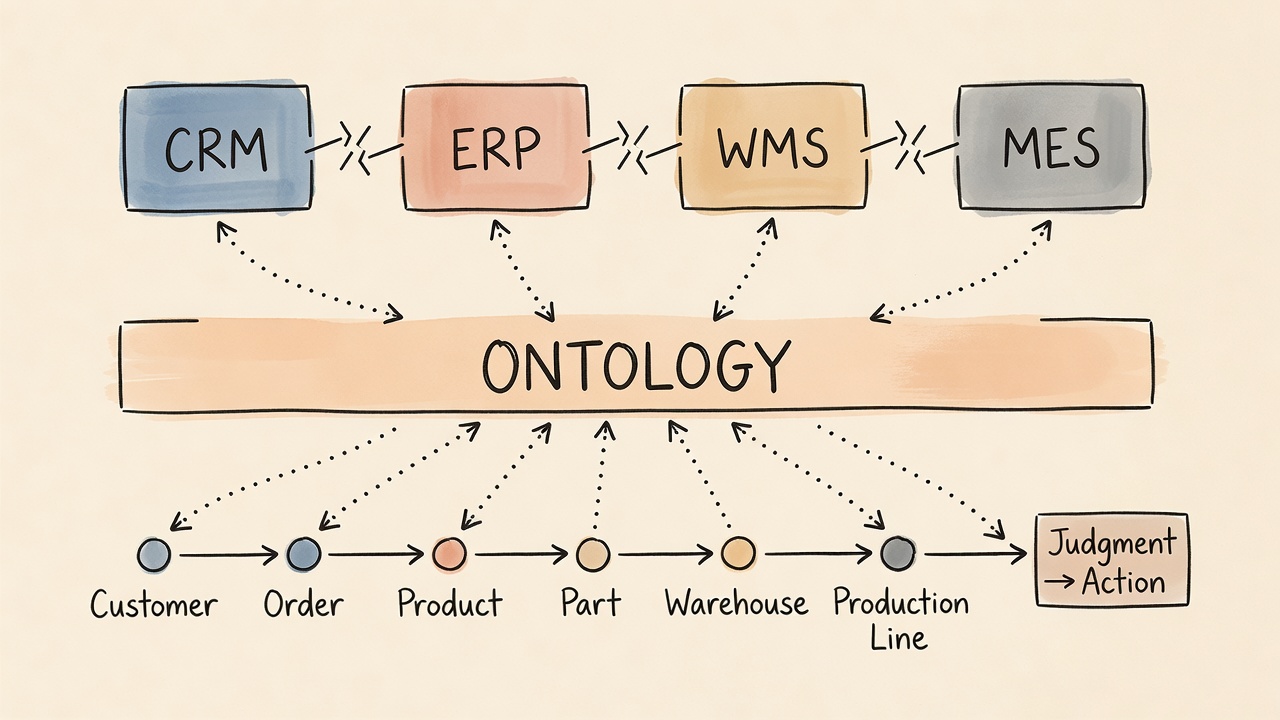
Database vs Ontology: The Difference Between Values and Context
A standard database stores values: order numbers, product codes, prices, dates. Queries are fast and records are precise. "Order 4521, Customer 8830, Part A 200 units, delivery July 15" returns instantly. But ask "if this order is delayed, who is affected?" and the database has no answer. It has values but no context.
An ontology flips the premise. Data is defined as objects — real-world entities — and connected through relationships. Customer Z places Order Y, which contains Product X, which requires Part A, stored in Warehouse W, linked to Production Line L. This entire chain exists within a single model. A 2026 arXiv paper on ontology construction (arXiv 2602.01276) puts it plainly: "enterprise data assets require explicit semantics to support governance, lineage, and downstream intelligence at scale." The point is not to store values but to store context.
Palantir's official documentation is even more direct. "The Ontology serves as a digital twin of the organization, containing both the semantic elements (objects, properties, links) and kinetic elements (actions, functions, dynamic security)." It is not a static relationship map — it is a structure where execution happens on top of the relationships.
The transformation from data → object → relationship → context:
- Database: stores values — order number, customer ID, part number, quantity, date
- Ontology (semantic): objects and relationships — customer → order → product → part → warehouse → production line
- Ontology (kinetic): actions and permissions — who approves, which line to switch to, who contacts the customer
It Does Not Stop at Judgment — It Reaches Action
Most BI tools and standard AI analyses stop at the insight. "Delivery delay probability: 78%." This sentence is useful to an operator, but it provides no execution cue. The next steps — writing an email, requesting approval, contacting the warehouse manager — are still manual. The gap between analysis and action remains.
Palantir's ontology structurally narrows this gap. When the system determines that Part A shortage threatens Order Y's deadline, it simultaneously asks: who should handle this? Whose approval is required? Can a backup warehouse supply the part? Which production line should be switched? Who contacts the customer? The analysis is not left as a report — it is converted into units of action. Palantir's documentation describes this as the ontology's language modeling "the nouns and verbs of operational processes into a legible form for both humans and agents." Nouns (objects) alone are not enough; verbs (actions) must exist for actual work to happen.
Operator's view: "Delay probability 78%" is a notification. "Manager Kim pulls part from Warehouse B, switches to Line 2, approval from Team Lead Park, customer notified" is an execution. Palantir targets the latter.
Permissions and Workflows Are Part of the Structure
A frequently overlooked layer in ontology design is security and permissions. The typical approach: connect the data first, then attach "who can see what" as a separate security layer. Palantir reverses this order. The permission model is designed at the same time as the data integration. Who can view, who can edit, who must approve, and what process must be followed are all modeled as part of the ontology.
This approach becomes more critical in the agent era. A Brookings report from April 2026, convening 40+ experts, concluded: "we cannot govern what we cannot measure." When permissions and workflows live inside the ontology, AI agents can be structurally constrained — which data they can access, which actions they can execute — without bolting on security after the fact. The data model itself embodies governance. Palantir's documentation states explicitly: "the fourfold integration and operationalization of data, logic, action, and security cannot be accomplished with a thin semantic layer or a monolithic design."
Why AI Needs an Ontology
Generative AI is good at producing sentences. Ask a question and you get a plausible answer. But to do real work in an enterprise, sentence generation is not enough. The AI needs to know the latest data, who is responsible, what the approval process is, and where backup resources are located. This information is locked inside deep ERP tables and separate permission systems. An LLM can read the text but cannot independently verify whether it reflects "the current state of reality."
A 2025 Elsevier paper on knowledge graphs and ontologies notes that they are "ever more important as ground truth to escape from Large Language Model hallucinations." An LLM reasoning alone risks hallucination. An LLM operating on top of an ontology verifies facts within a structured relationship graph before producing an answer. In summary: for AI to work in enterprise settings, LLM + organizational data + ontology + permissions + workflows must converge. Palantir positions itself as the company providing that foundation.
Operator's view: An LLM alone cannot do enterprise work. Without current inventory, approval chains, backup lines, and contact networks, its answers are plausible but unexecutable. The ontology hands the AI the "actionable context" it needs.
The Other Side: Is the Ontology Really the Answer?
Palantir's ontology is not universally welcomed in the industry. Engineers who have used it are polarized. On Reddit's r/dataengineering, one user calls it "not as secure as they say and at the end of the day it's largely just Apache Spark wrapped up with a big vendor lock-in." Another notes: "the product is good but the price and lock-in make it a poor choice for 99% of companies." Even if the ontology is theoretically elegant, the cost, implementation timeline, and vendor dependency make it an impractical choice for many.
Warnings come from inside Palantir too. CTO Shyam Sankar cautioned against "AI slop" in May 2026, arguing that simply increasing token usage is not the goal — efficiency and value matter. The implication: even on top of a well-structured ontology, if the AI does not understand the context accurately, actions can go wrong. A strong structure does not eliminate AI judgment errors entirely.
There is a more fundamental question. Does every enterprise need a Palantir-grade ontology? For small and medium businesses, data governance itself is often immature. Adopting an ontology requires first cleaning data and integrating systems — a multi-year effort on its own. The ontology shines when the organization is already mature. For those still struggling with scattered systems and unstable data quality, it may be premature.
Operator's Perspective: Building Data-to-Action Without Palantir
Palantir's ontology is one finished form. You pour data into an expensive platform, model objects and relationships, and layer permissions and actions on top. But operators are increasingly building this structure themselves. At smaller scale, a relational database with foreign key constraints can represent object relationships. Permissions can be handled at the application layer. Actions can be connected via a workflow engine or a simple state machine. The thinking — data → object → relationship → judgment → action — does not depend on any specific product.
The core is not the tool but structural thinking. Do not leave data as mere values — model it as real-world relationships. Do not stop at analysis — connect to action units. Do not bolt on security afterward — include it at design time. Palantir is one implementation of this thinking. Operators can reconstruct it for their own scale and tool environment.
Frequently Asked Questions
Q1. What is the biggest difference between an ontology and a database?
A database is optimized for storing values (order numbers, customer IDs, quantities, dates) and querying them quickly. An ontology adds objects and relationships on top of values to represent real-world context. "If this order is delayed, who is affected?" — a database cannot answer this, but an ontology can follow the relationship chain and respond immediately.
Q2. Why is a standard semantic layer not enough?
A semantic layer adds meaning to data but does not include actions or security. Palantir's documentation states that integrating data, logic, action, and security requires all four layers. If you only need analysis, a semantic layer suffices. But to connect to actual execution in enterprise workflows, the kinetic elements must be present.
Q3. What does an AI agent gain from an ontology?
An AI agent operating on an ontology can verify current data, permission boundaries, approval processes, and backup resource locations within the structure. An LLM alone risks hallucination, but one operating on an ontology verifies facts within the relationship graph before answering.
Q4. Can the ontology way of thinking be applied without Palantir?
Yes. The structural thinking — data → object → relationship → judgment → action — is not tied to a specific product. At smaller scale, a relational database's foreign keys can represent relationships, permissions can be handled at the application layer, and actions can be connected via a workflow engine. The core is the thinking, not the tool.
Conclusion
Who stores the data, who connects the relationships, and who executes the action. When these three layers meet within a single structure, an organization can finally make real-time judgments.
Palantir's ontology is one implementation of this structure. It stores context instead of values, connects action instead of stopping at analysis, and embeds security at design time rather than as an afterthought. In the AI era, this structure carries meaning beyond data integration. For an LLM to operate on an organization's real-time reality, a model that reproduces that reality inside software is prerequisite.
Not every organization can adopt Palantir. But the ontology's way of thinking — data as context, judgment as action, security as structure — can be applied at any scale. Whether you follow the tool or the thinking is a choice that will determine your operational competitiveness in the next decade.
Where judgment is most precise, and action is fastest.
Sources
- Brunch @stem - Palantir Ontology Analogy (Korean) ↗
- Palantir Docs - Ontology Overview ↗
- Palantir Docs - AIP Architecture (Ontology system) ↗
- arXiv 2602.01276 - LLM-Driven Ontology Construction for Enterprise Knowledge Graphs ↗
- Sherwood News - What the heck is Palantir's Ontology? ↗
- Brookings - How can we best evaluate agentic AI? (2026-04) ↗
Related posts
Read →Related tools