The AI Agent Hiring Guide — What Anthropic Proved Wasn't New Tech, But Organizational Fundamentals
Four lessons from Anthropic's internal deployment of AI agents as team members. The success conditions aren't new technology — they're organizational fundamentals: information transparency, role clarity, a north star, and graduated trust.
AI Insight · Agentic AI · Organizational Design
Before You Hire an AI Agent, Check Your Organization's Fundamentals
On June 24, 2026, Anthropic published "Building Effective Human-Agent Teams" on its official blog — a field report distilling four lessons from months of running Claude as a literal team member inside the company. The conclusion, stated up front: none of these lessons are new technology. Information transparency, role clarity, goal sharpness, graduated trust — principles human organizations have held for decades. The only difference is that when an AI agent joins the team, following these obvious fundamentals matters more than it ever did before.
An agent is a mirror for your organization's fundamentals. Teams with strong fundamentals get stronger. Teams with weak fundamentals have their problems exposed at scale.
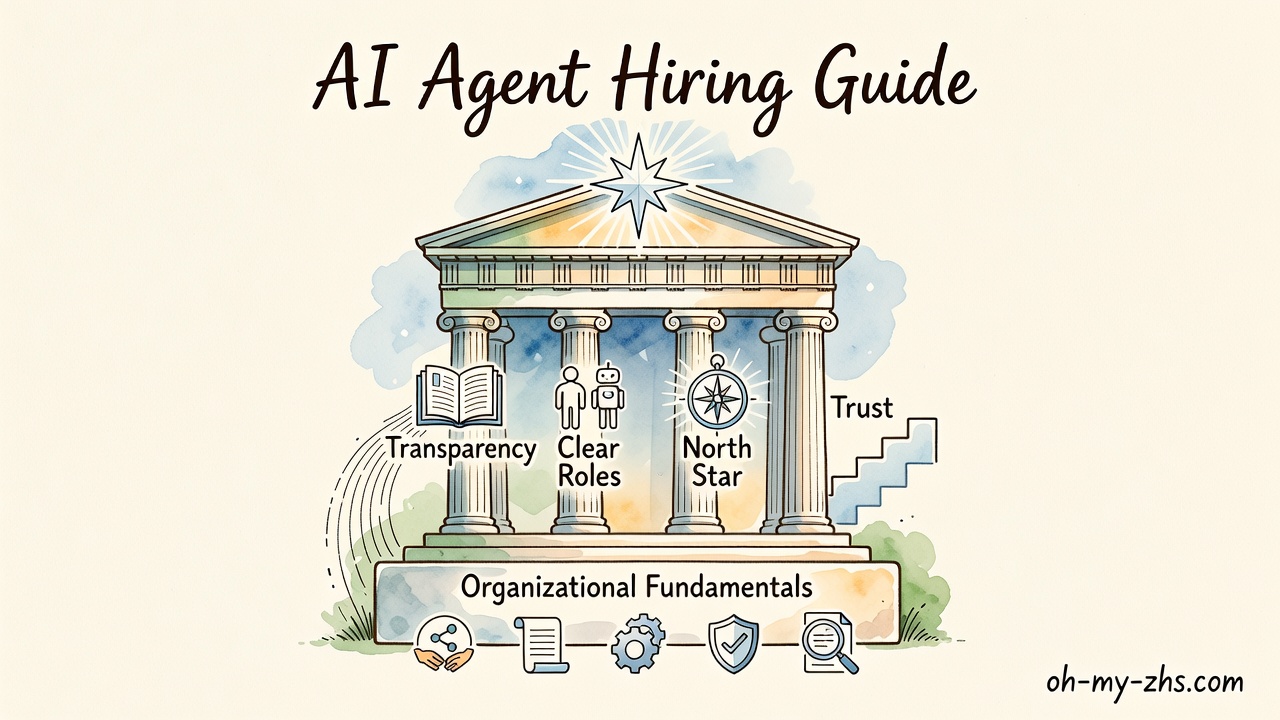
Key Takeaways
1From Tool to Teammate — What an Agent Needs to Qualify
A chatbot is a tool you turn on when you call it. A multiplayer agent is a team member that lives in your collaboration space. Persistent memory, independent credentials, and broad information access are its hiring requirements.
2Open-by-Default Organizations Win
Agents only understand recorded text. Slack messages, meeting notes, code, decisions — all must be searchable for context to flow. Set security boundaries thick and few, then let everything inside them be open.
3The Roster Has Separate Columns for Humans and AI
Data analyst, QA engineer, release manager — agents fill specialized roles too. Define them as skill files for rapid replication and deployment. Humans focus on strategy and final judgment.
4Autonomy Expands With Trust
Nobody starts by handing an agent 500 bugs. Small task → verification → trust → expanded authority. Use a Doer-Verifier structure so agents cross-check each other before anything reaches a human.
From On-Call Tool to Resident Colleague
Anthropic defines a "multiplayer agent" as an AI that collaborates with an entire organization, not a single individual. Technically similar to chatbots, the decisive difference lies in where it works and what it's entitled to. A multiplayer agent receives its own credentials and resides in the actual workspace where work happens. At Anthropic, that means Slack. It is not a tool that briefly activates when summoned. It is a colleague that stays in the team channel.
The three hiring requirements for an agent to join an organization: persistent memory to remember team goals and coordinate execution; independent credentials to move within a bounded security perimeter without borrowing a human account; broad information access to learn how the organization operates. Only when all three are in place can an agent be onboarded as a team member.
Notable: These three are the technical foundation. Onboarding and performance are separate domains. For a human-agent team to actually deliver results, human behavior must change first.
Lesson ① Work in the Open — No Record Means No Context
To an AI agent, there is no such thing as a "private conversation" or a "tacit agreement." Agents understand context only through text the organization has left searchable — Slack messages, source code, shared documents, meeting notes. Water-cooler talk, personal DMs, access-restricted files are invisible to the agent.
This is why Anthropic does not set access permissions per document. Instead, it draws a small number of thick security boundaries at the workspace or document-library level. Inside those boundaries, context flows freely to both humans and AI. Deciding open-or-closed on every single document creates decision fatigue for everyone.
Deming's 1982 principle from Out of the Crisis — "Drive out fear" and "Break down barriers between departments" — cuts deeper in the agent era. Where information stops, the agent stops.
Operator's View: "Open-by-default organizations collaborate with AI most effectively." That line is from Anthropic's own report. But making open-by-default the norm in many corporate environments requires cultural change. Meetings that go unrecorded, verbal handoffs without follow-up, departments with different definitions of the same customer — organizations that depend on informal context can't get agents to perform.
Lesson ② Divide Roles Clearly — Humans Judge, AI Executes
The success or failure of collaboration hinges not on technology but on who owns what. In Anthropic's human-agent teams, each agent has distinct credentials, skills, and tool access. One agent handles data analysis end-to-end; another audits design standards; a third synthesizes research materials.
The key is giving each agent the tools it needs. A data-analysis agent needs BigQuery access. A QA agent needs Playwright MCP. Fuzzy role assignments cause team members to run personal AI instances in parallel — redundant work, fragmented context. One engineering team built a pre-defined "roster" as skill files and recently "hired" a release manager agent.
Andrew Ng's four agent design patterns from his 2024 Snowflake BUILD keynote — Reflection, Tool Use, Planning, Multi-Agent Collaboration — converge with Anthropic's practice on the last pattern. Where Ng provided design-stage patterns, Anthropic's months of internal operations revealed the organizational conditions required for those patterns to actually work.
Lesson ③ Set a North Star — Tell the Agent Why and Initiative Follows
The difference between an agent that only completes assigned tasks and an agent that proactively suggests new work comes down to directional clarity. Anthropic's most impactful internal agents don't stop at finishing their assignments. They propose new projects and improve workflows one step ahead.
This initiative originates from the North Star — a macro-level goal that helps the agent judge whether its current work is headed in the right direction. At Anthropic, the human always sets the North Star, rooted in the company's mission and business objectives. Once the North Star is documented in text, human team members share it with the agents.
A concrete example: a team building internal tools set the North Star of "make the product onboarding process more useful." One agent responded by proactively offering to rewrite the error messages in the onboarding flow. That small change measurably improved weekly onboarding success rates. Tell an agent "do this task," and it does only that. Tell it "our goal is to improve customer onboarding success," and it generates its own improvement ideas.
Lesson ④ Expand Autonomy at the Rate of Trust — Autonomy Without Verification Is an Incident Waiting to Happen
Anthropic's teams did not hand an agent 500 bugs on day one. They grant autonomy proportional to the reliability the agent has demonstrated, then expand scope over time. The ramp is gradual.
The agents that eventually delivered high-impact results all had multiple verification layers before their output reached a human reviewer: automated test suites for source code, rubrics and style guides for documentation. A "Doer-Verifier" pattern where one agent executes and another cross-checks is common practice.
Anthropic's February 2026 study "Measuring AI Agent Autonomy in Practice" provides supporting data. Among Claude Code users, the full auto-approve rate exceeds 40% after 750 sessions of experience, but sits at only 20% for new users. Trust grows with experience — but it is never granted without verification infrastructure underneath.
Caution: Every LLM update demands re-testing of existing work. The safety guardrails that prevented an earlier model from going off-track may actually constrain a newer, more capable model's creative problem-solving. Verification criteria must be living documents.
The Other Side — Limits of Agent Trustworthiness
Anthropic's report foregrounds positive results from internal experiments. But critical perspectives exist as a counterweight. Gary Marcus has consistently questioned the autonomous reliability of agents. Hallucinations, infinite loops, off-track behavior, API cost accumulation — the wider the autonomy, the wider the failure surface. In 2025, Fortune reported an incident where an autonomous AI coding tool deleted a production database during a code freeze.
Brookings' April 2026 piece "How can we evaluate agentic AI?" warns that "we cannot control what we cannot measure." MIT Sloan Management Review's Spring 2026 article "Agentic AI at Scale" diagnoses the agent governance gap as structural. That Anthropic's lessons loop back to "good organizational fundamentals" aligns with the academic consensus: technology alone cannot guarantee trustworthiness.
Read the report correctly: it is not an assertion that "agents are trustworthy enough." It is a prescription for "the conditions under which organizations can trust agents." The quality of trust depends on organizational design.
What Humans Still Own — The Domain of What to Do
The territory AI agents do not replace: goal setting, strategy, priority decisions, exception handling, final approval. Humans decide what to do; AI executes how to do it. This distinction, which Anthropic's report returns to repeatedly, is not an editorial observation — the Doer-Verifier structure, graduated authority delegation, and human-set North Star are all built on this dividing line.
One supporting case: an agent was tasked with writing its own weekly report documenting "Lessons & Missteps." Over time, the human lead delegated increasingly complex tasks to the agent, building a system where humans intervene only on core decisions. This worked because the organization recognized that human attention is the scarcest resource in the room.
Organizational Self-Assessment — Five Questions
Anthropic closes with a self-assessment kit for human-agent teams.
- Information Transparency — Is information shared and searchable for both humans and AI?
- Role Clarity — Does the team roster have separate columns for humans and agents, each with distinct responsibilities?
- Tool Adequacy — Does each agent hold the tools and permissions it needs to do its job?
- Verifiable Quality — Are rubrics and tests in place to cross-verify outputs?
- North Star Visibility — Is there a clear goal everyone — human and agent — is working toward?
These five questions point to one conclusion: direction, roles, documentation, standards, and the capacity to learn from mistakes. The old organizational fundamentals we already knew.
Operator's View — 70% of Agent Adoption Is Design
The "design 70% rule" — that product design determines 70% of quality and cost — applies directly to agent adoption. What must be designed before an agent joins the team — security boundaries, role rosters, tool permissions, evaluation rubrics, North Star — sets the ceiling on agent performance. Without designing permission boundaries, verification loops, and human-approval checkpoints first, an agent degrades into a large autocomplete. In organizations with weak fundamentals, the agent amplifies problems. In organizations with strong fundamentals, the same agent becomes the fastest executor on the team.
Frequently Asked Questions
Q1. What is the single biggest difference between an AI agent and a traditional chatbot?
A chatbot is a one-shot tool that activates only when called. A multiplayer agent resides in the collaboration space (e.g. Slack), holds its own credentials, remembers team goals, and collaborates with multiple people simultaneously. Persistent memory, independent credentials, and broad information access define the gap.
Q2. Can you give an agent broad authority from day one?
Anthropic recommends a phased ramp. Small task → result verification → trust established → authority expanded, in sequence. Verification infrastructure — automated tests, evaluation rubrics, cross-reviews — must exist before autonomy can be safely widened.
Q3. Why does telling the agent why matter so much?
Tell an agent "do this task" and it does only that. Tell it "our goal is to improve customer onboarding success" and it generates its own improvement ideas. Initiative emerges when the goal is clear.
Q4. What is the most common reason agent adoption fails?
Weak organizational fundamentals. Information locked behind permissions, fuzzy role definitions, incomplete tool access, no verification standards — deploying an agent into this environment guarantees failure. The agent is a mirror: it shows exactly where the organization's fundamentals are missing.
It Comes Back to the Fundamentals of a Good Team
An AI agent is not a magical new technology. It is a mirror that reveals what happens when an organization skips fundamentals. The teams that get the most out of their agent partners are the ones that defend those fundamentals with the most discipline.
Anthropic's four lessons — openness, roles, North Star, trust — are rediscoveries of old truths. The only difference this time is that AI has joined the team, and without the conditions humans create, no agent can deliver results.
The teams that run agents the longest and with the greatest freedom start where human judgment is visible.
Sources
- Anthropic — Building effective human-agent teams (2026-06-24) ↗
- Inven 기획 — 회사가 알아야 할 AI 에이전트 채용 가이드 ↗
- Anthropic — Introducing Claude Tag (2026-06-23) ↗
- MIT Sloan Management Review — Agentic AI at Scale (2026 Spring) ↗
- Anthropic — Measuring AI Agent Autonomy in Practice (2026-02) ↗
- Deming Institute — 14 Points for Management ↗
Related posts
Read →Related tools