October 17 Daily Issue — AI Glasses and Recording Authority, Reverse-Engineering Tools for Coding Agents, and Korean NPU On-Device Devices
A working view of AI glasses as a recording-authority problem after the exam ban, what to verify before attaching REA-style reverse-engineering MCP tools to a coding agent, and how to judge Korean-NPU on-device products shown at AI Festa.
DAILY NEWSLETTER · 2026-10-17 · AI GLASSES PRIVACY · CODING AGENT SECURITY · ON-DEVICE NPU
October 17 Daily Issue — Who May Record With AI Glasses, What to Check Before Wiring Reverse-Engineering Tools Into a Coding Agent, and Korea's Domestic NPU Devices
Today's three stories end up asking the same question. When cameras and microphones, analysis tools and inference chips move onto people's faces, into development environments and onto field equipment, can you write down who may see what, and where the data goes? Instead of product tours, this briefing uses three working criteria: where a device is allowed, which files are brought in, and which route the data takes.
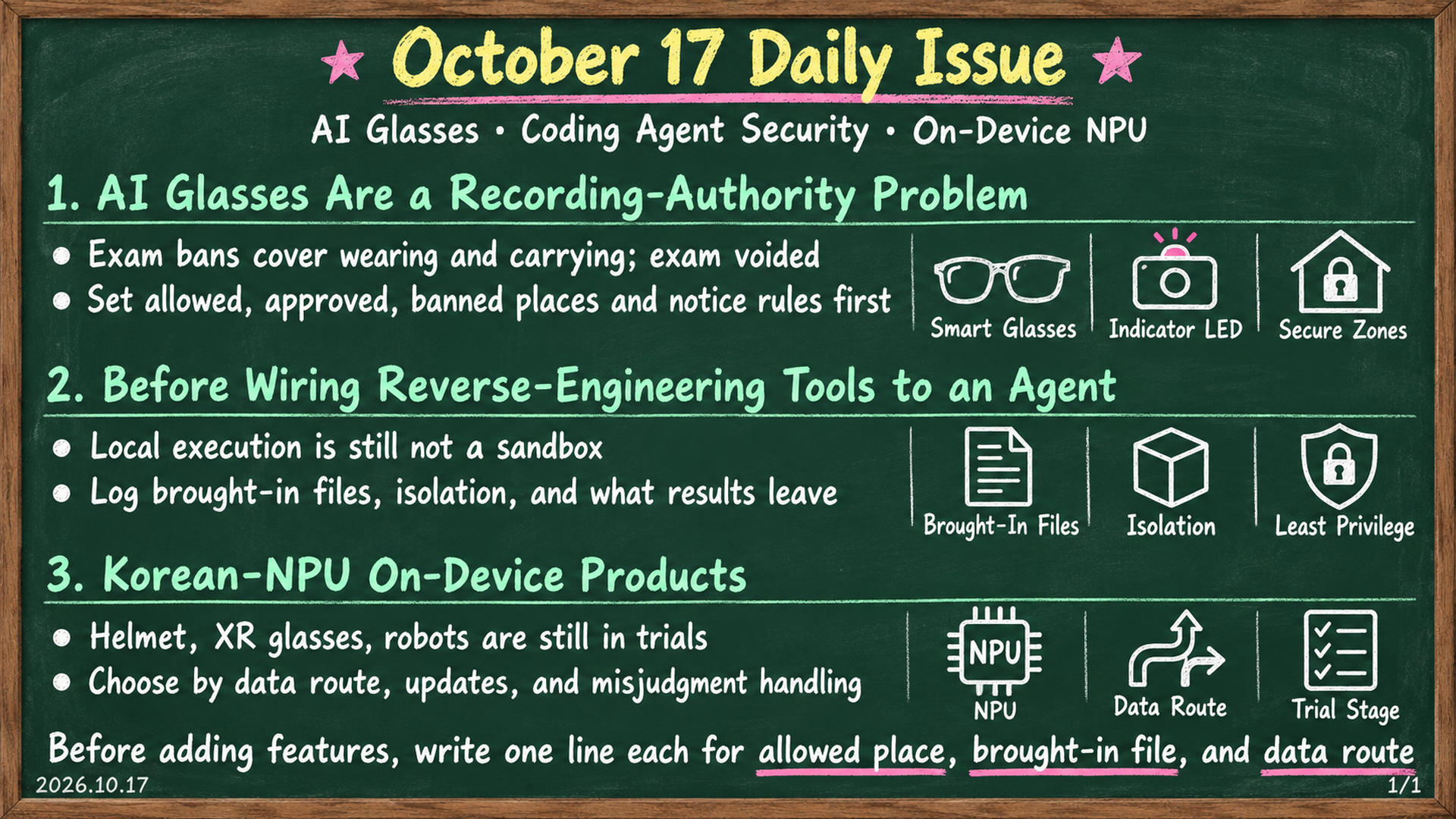
Today's Three Points
The first story is AI glasses. Korean education authorities have classified both wearing and merely carrying smart glasses at the national college entrance exam as cheating, while corporate security leads are working out how to treat the same devices in meeting rooms and labs. The second is REA, an open-source project that bundles reverse-engineering tools into a single MCP server for coding agents. The third is the set of on-device products shown at AI Festa 2026, which opened on October 6, including a smart helmet, XR glasses and a robot vacuum built around Korean-made NPUs.
- AI glasses are less a question of whether to allow the device than of who may record and transmit, where, and over which route.
- For reverse-engineering MCP servers such as REA, settle the responsibility boundary first: brought-in files, analysis output, tool permissions and code reuse, before the install steps.
- Choose Korean NPU devices by how much data stays on the device, how updates work and how misjudgments are handled, not by chip performance alone.
1. AI Glasses Are a Recording-Authority Problem: From the Exam Hall Rules to Meeting-Room Policy
On October 15 the Korea Institute for Curriculum and Evaluation posted its 2027 exam-taker guidance on its website. According to Yonhap's summary, the guidance lists smart glasses among items banned from the exam venue. Wearing them during the exam without handing them in before the first session voids that exam and suspends eligibility for the following year. Simply bringing or carrying them into the venue also counts as cheating and voids the exam. A candidate who refuses a proctor's request to check smart glasses can be treated as having committed serious cheating after review.
Real incidents sit behind the rule. The same report says a test-taker wearing smart glasses was caught at the regular TOEIC sitting in May, and that two universities caught candidates in essay exams: the University of Seoul on October 3 and Yonsei University on October 10. The University of Seoul removed its candidate immediately and barred the person from its exams for three years. The Education Ministry said it would send universities proctor guidance on how to identify smart glasses and how to inspect them. Meanwhile a secondary-teachers' union argued that supervision is being loaded onto individual teachers and demanded clear procedures and a named party responsible for judging suspicious cases.
 Source · Yonhap News수능서 'AI 안경' 착용만 해도 시험 무효·내년 응시자격 정지Korean-language report on the exam guidance, university essay-exam catches and the proctoring-burden dispute.
An exam hall is the simple case. The device is banned outright, refusal is penalized, and a proctor can check. The hard part is everywhere else. The Hankook Ilbo reported that on October 5 the Norwegian government said it would pursue a bill temporarily banning AI smart glasses in parks, beaches, museums, shopping malls and public events, and at schools, kindergartens, health facilities and gyms. The digital affairs minister said people risk being recorded in photos, video and audio without knowing it. The Dutch eyewear brand Hans Anders stopped selling Meta smart glasses in the Netherlands and Belgium over privacy concerns, and cinemas and pubs in Britain restrict their use because of unauthorized filming.
Korea sits in a different place. Per the Hankook Ilbo, a 2023 amendment to the Personal Information Protection Act defined wearable devices that film and transmit video, such as glasses, as mobile video-processing devices. Filming people in public places for business purposes is restricted in principle, with an exception where the filming was clearly disclosed and the other person did not object. Filming in bathrooms, restrooms and changing rooms is barred regardless of consent. Unlike Norway, though, there is no rule that bans wearing the glasses in specified places. Bizhankook adds that the rule is aimed at operators acting for business purposes, so it is unclear whether it reaches an ordinary consumer filming people nearby, and that no law directly prohibits covering the indicator light.
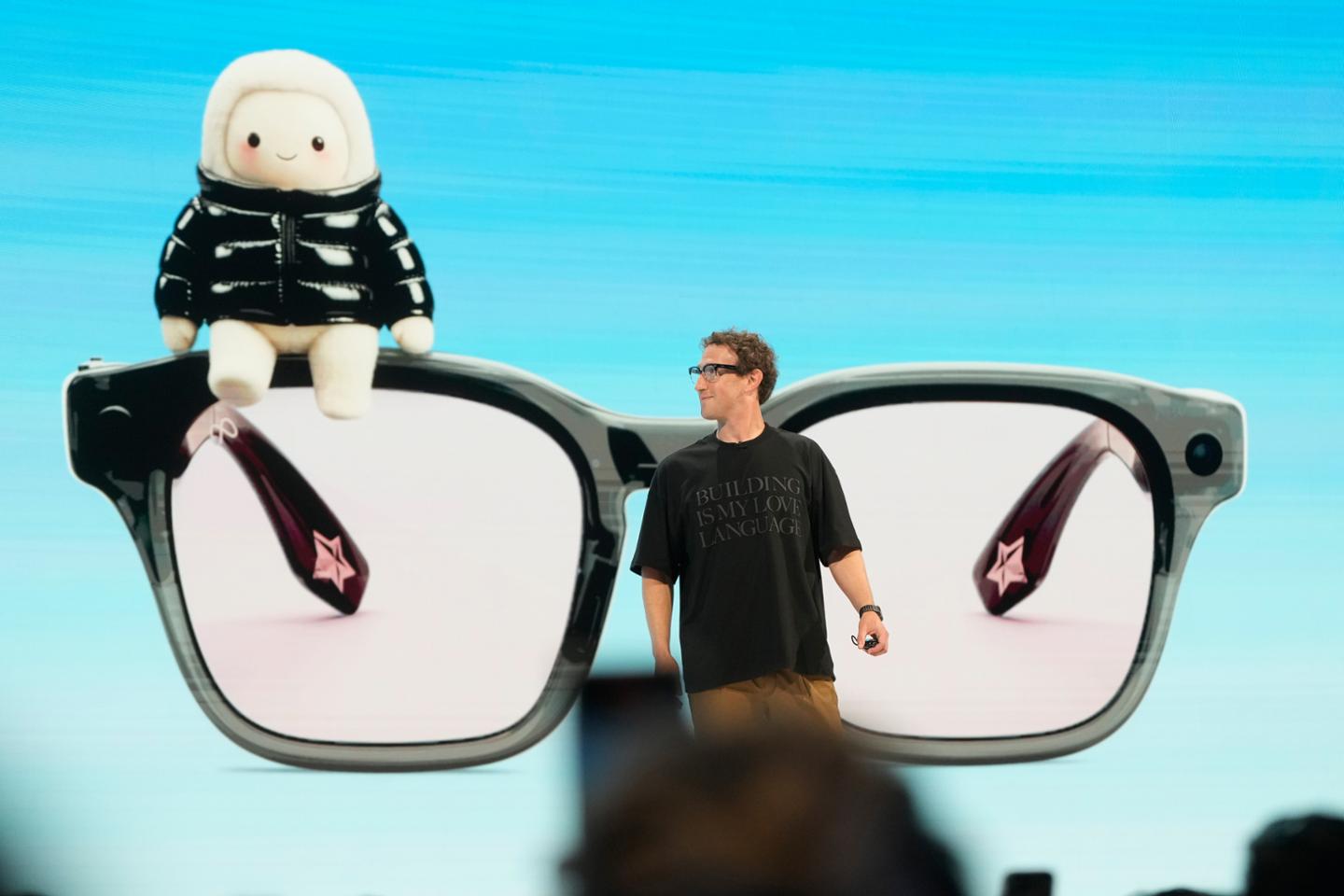 Source · Hankook Ilbo몰래 찍는 AI 안경 막는다… 노르웨이, 학교·병원·쇼핑몰서 사용 금지 추진Korean-language report comparing Norway's place-based ban plan with Korea's mobile video-device rules.
Manufacturer safeguards are not airtight either. Bizhankook reports that Ray-Ban Meta glasses flash a white LED on the front of the frame while recording and, from the second generation, stop the camera if the LED is covered. Samsung says its glasses light LEDs inside and outside while recording and stop the camera when the indicator is covered or damaged. Yet LED-blocking stickers and lens covers are on sale on overseas shopping platforms. The stickers have tiny holes that let light reach the sensor while hiding the indicator from outside, which exploits the fact that the safeguard only detects a fully covered LED. A German data-protection authority in Hamburg noted that the white LED is clearly visible only at narrow viewing angles, short distances and in suitable lighting.
Companies face a more tangled picture. In the analysis relayed by CIO Korea, Jitesh Ubrani of IDC says the underlying risk is not new. Phones have long been able to record whiteboards, screens and conversations, and what changed is how effortless and unobtrusive recording has become, with no phone raised toward a target. He recommends moving past a ban-or-allow binary toward policies tiered by actual risk: strict limits on wearables in board rooms and labs where trade secrets or regulated information are seen and heard, and in ordinary work areas a requirement to tell attendees when a recording-capable device is used in a meeting. Analysts in the same piece add that restricting employees who need prescription smart glasses could invite discrimination claims.
The industrial-security concern is spelled out in The AI's reporting. Semiconductor and display plants seal phone cameras with tape at the gate, but there is no equivalent standard for AI glasses. A manufacturer's chief executive is quoted saying that models without a camera still have a microphone, so process instructions and yield meetings could become audio data. That report was published in April 2026 and said the device-classification criteria under the industrial technology protection law were still at the discussion stage, so the current state should be checked against the original and the statute. It also recounts a class action filed in the United States in March against Meta and Luxottica, triggered by Swedish press investigations reporting that video collected by Ray-Ban Meta glasses was used for manual review and labeling by subcontractor staff.
Translated into operating rules, three questions remain. First, for each place, is the device allowed, allowed with prior approval, or banned? Exam halls and clean rooms are bans, ordinary offices are allow-with-notice, and customer-facing areas are realistically approval-first. Second, have you confirmed whether recorded audio and video pass through the device, the phone or the manufacturer's servers? A Korean startup profiled by The AI says it keeps photos and video on the phone, deletes conversation records within 30 days and hosts servers in Korea, but that is the vendor's own account and should be verified against terms and privacy notices before adoption. Third, after an incident, who secures the records and who is notified? Bizhankook reports that forensic tools have appeared that analyze a connected smart glass's model, serial number, shot time, location and AI queries.
A small team can reduce this to a thirty-minute check: notices for meeting and development spaces, wording for outside visitors, a step at the start of meetings asking whether any recording device is present, and a named contact plus a list of records to preserve if something happens. Effort spent defining places and data routes is easier to enforce than effort spent blocking devices. Ubrani himself says that in hybrid work there is effectively no way to check which glasses an employee is wearing. Notice, training and place rules come before prohibitions that cannot be enforced.
2. Before Connecting Reverse-Engineering Tools to a Coding Agent: What REA Shows About the Limits of Local Execution
REA stands for Reverse Engineer Anything. It is an open-source project that bundles several analysis tools into one MCP server and command-line tool so a coding agent can investigate executables and app behavior without source code. According to the GitHub repository description, it targets native binaries, JavaScript and Electron apps, .NET assemblies and websites, runs its analysis locally, and attaches evidence and limitations to each result. Setup is a single npx rea-agents setup command and the license is MIT. The official setup guide requires Node.js 22.19 or later, 24.11 or later, or 26 or later.
A Korean summary published by PyTorchKR on October 12 says the tool uses a user-chosen engine among Hopper, Ghidra and IDA for native binaries, while JavaScript and .NET are analyzed statically with no separate engine. Each result carries an evidence identifier so observed facts are separated from inference. The summary also notes that analysis output can reach hundreds of megabytes, so the project offers a summary view of roughly 10 KB. That summary was machine-generated, so specific figures should be checked against the original.
The point that is easy to miss is that running locally does not mean running safely. REA's security policy says it uses authenticated session tokens and current-user sockets, but that this is not a sandbox and does not protect against a malicious process already running as the same operating-system user. It also says that opening an untrusted binary delegates parsing and analysis to the selected local engine with that user's permissions. In other words, to analyze a suspicious file you have to isolate the analysis environment, not rely on REA. Use a container or virtual machine and an account with no personal credentials or cloud keys.
Where the data goes also needs its own check. The Korean summary says analysis runs locally but results are passed to the agent's model provider, so it recommends using the command line alone in environments where data transfer is restricted. When an agent calls a tool over MCP, whatever the tool returns, including strings, pseudocode and constants, falls under the model provider's data policy. If the target is internal code or a client's binary, whether that route fits your contracts and security rules matters more than the installation.
The legal boundary is also written into the project. REA's disclaimer says the project does not help circumvent DRM, license checks or anti-cheat systems, bypass access controls, or copy the protected code of proprietary software. Users must obtain the necessary authority over the targets, accounts, devices and data involved and comply with licenses, terms and intellectual-property rights. It adds that possessing a file or the public availability of software does not by itself authorize every operation, and that obtaining an analysis report does not grant rights to the original program.
A team considering adoption can record five things before installing. First, ownership and permission for the target file: is it an in-house product, customer software whose contract allows analysis, or open source? Second, the execution environment: is it an isolated container or virtual machine with no host credentials visible? Third, the scope of results sent to the model provider: are strings and pseudocode material that may leave the company? Fourth, the configuration the install changes. The official guide says setup adds an MCP server and workflow instructions to the agent configuration, keeps backups of existing settings, and asks for approval before applying. Fifth, the distribution source: the README names only the repository, rea.tools and the rea-agents npm package as official, and warns that a similar repository name does not make something official.
The project changes fast. The README itself says new releases include frequent bug fixes. A team should record the version at install time and review before upgrading rather than following updates automatically. Popularity or star counts are not verification. A safer order is to start with one in-house app whose source you hold, run it in an isolated environment, confirm that the evidence and limitation markers are actually useful, and only then widen the scope.
3. Korean-NPU On-Device Products: Look at the Data Route and the Trial Stage, Not the Chip Name
AI Festa 2026, hosted by the Ministry of Science and ICT, opened at COEX in Seoul on October 6 and ran through October 8. ZDNet Korea reported that on opening day Analog Plus (아날로그플러스), PNC Solution (피앤씨솔루션) and Rhinos (라이노스) showed on-device AI products built around domestic neural processing units. Analog Plus's police smart helmet uses a camera to recognize surroundings and has AI flag vehicles committing traffic violations in real time; it carries Telechips' NPU, is in trials in Busan and is due out in mid-next-year. PNC Solution's XR glasses are being developed with DeepX's DX-M1, have been delivered to the National Museum of Korean History and earned European CE certification this year. Rhinos's commercial robot vacuum uses an NPU from Deeper-I (디퍼아이), starts customer-site trials in November and is due out in December.
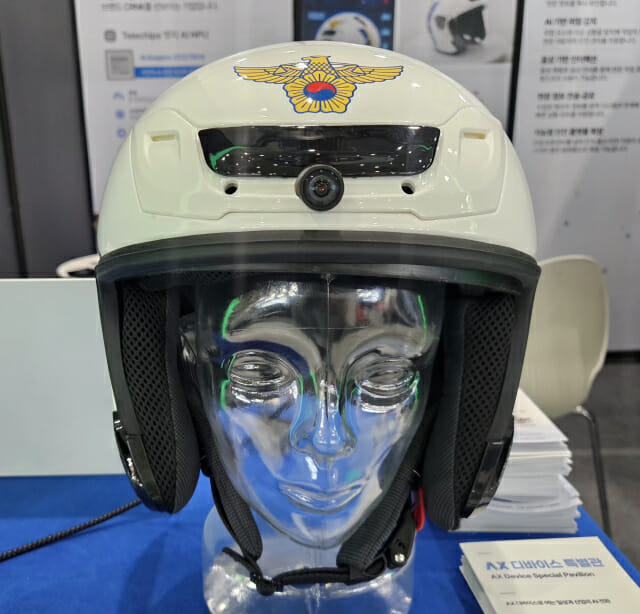 Source · ZDNet Korea'K-반도체' 품은 온디바이스 AI 한자리에Korean-language show-floor report on the domestic NPUs in a smart helmet, XR glasses and robot vacuum, with trial schedules.
Another ZDNet Korea article the same day covered Cuckoo Homesys, RobotWare AI and Nexreal. Cuckoo's AI barista water purifier uses DeepX's DX-M1, which the article says delivers 25 TOPS at 1 to 5 watts. RobotWare AI's poultry-management robot carries Mobilint's second-generation Regulus chip, rated at 10 TOPS on 3 watts. A company representative said trials at poultry farms begin this month, a launch is expected early next year, and the company hopes to cut labor costs by 35 percent. That figure is a company expectation, not a verified result. Nexreal's drone camera uses NEXTCHIP's Apache6 and is planned for trials with police in November.
These products are outcomes of a government program. According to Newsis, the Ministry of Science and ICT ran a call from May 7 to June 5 for three new projects under its AX device development and demonstration program. It described an AX device as one that runs an AI model directly on a built-in NPU, which allows real-time service without going through the cloud and power-efficient, user-specific features. Six projects selected last year, covering a smart helmet, a drone mission camera, an AI barista water purifier, smart glasses, a poultry-management robot and a commercial cleaning robot, are at the prototype stage and move into field trials and market-fit validation this year. Two of the new projects target physical-AI devices built on VLA models that decide actions from visual and language input. Selected firms are matched with NPU and AI-model developers for two years, 2026 through 2027.
 Source · Newsis스마트 헬멧부터 양계 로봇까지…정부, '피지컬 AI' 기기 키운다Korean-language report on the AX device program's aims, last year's six projects and this year's new project direction.
For a business buyer, what these reports reveal is the stage, not the chip name. The smart helmet is in trials with a launch in mid-next-year. The robot vacuum begins customer-site trials in November. The poultry robot starts testing this month. Most of what has been shown so far is a prototype or in trials, and the Korean coverage gives no operating metrics such as battery life or misjudgment rate. In the press release relayed by Hantoday, Analog Plus says the helmet's AI processor and battery are split into a wearable vest to reduce weight, and that the booth demo used a prototype and simulated data. An organization evaluating these devices should keep that difference in view.
On-device does not automatically mean privacy-safe, which connects back to the AI glasses story. Even if video is analyzed on the device, a new data route appears the moment results are linked to a police terminal or a server. The smart helmet is being developed to relay lookup results for wanted or fine-delinquent vehicles through a link to police work terminals. That gives four selection criteria. Does raw video leave the device? What result values are stored, and where? Who updates the model and firmware, and how often? When a misjudgment happens, is there a procedure for a human to step in and leave a record?
Power and performance figures also need a reading guide. TOPS is a theoretical unit of compute, while real latency and accuracy depend on the model, input resolution and memory bandwidth. The chip specifications ZDNet Korea relays are vendor statements, not results measured under identical conditions. For business adoption, feed candidate devices samples of your own site's video or audio and measure latency, false positives and misses, battery life and heat yourself. A domestic chip can be an advantage for supply chain and support, but it is not evidence of fit.
Operator Notes
The three stories belong to different fields but can be read with one checklist. How far does the sensor reach? Where does the data go? After an incident, what can be reconstructed? AI glasses answer through places and notice, reverse-engineering MCP servers through brought-in files and the execution environment, and on-device products through data routes and updates. The more convenient a feature gets, the easier it is to skip these questions.
Teams running agents face one more overlap. Attaching a tool such as REA to a coding agent widens both the set of files the agent can read and the output flowing to the model provider. Adding a tool is adding a delegation of authority. When connecting a new MCP server, record the target files, the execution account, the scope of external transmission and the configuration changes, and first confirm that the backups setup leaves behind can actually roll things back.
What can be done this week is small. Draft a notice about recording and filming devices for meeting and development spaces. Tabulate which tools on your agent's MCP server list can read local files. Send the four data-route questions to the vendors of any on-device device you plan to bring on site. None of the three requires buying a new tool.
What to watch next is how the rules are enforced in practice: how the smart-glasses checks work at the exam venues after the national exam, what form the smart-glasses privacy principles being prepared by the Personal Information Protection Commission take, and what operating metrics the AX device trials produce from November.
This week, before adding another tool, try writing one line each for the allowed place, the brought-in file and the data route. If any line cannot be written, that tool is not yet ready for operation.
Sources
- Yonhap News — 수능서 'AI 안경' 착용만 해도 시험 무효·내년 응시자격 정지 ↗
- Hankook Ilbo — 몰래 찍는 AI 안경 막는다… 노르웨이, 학교·병원·쇼핑몰서 사용 금지 추진 ↗
- CIO — 회의실 기밀이 안경 너머로 샌다?…AI 스마트 안경發 데이터 유출 위협에 CISO 골머리 ↗
- Bizhankook — [내 눈에 AI] ③ “시험 답안부터 데이트 몰카까지…” AI 안경, 안전장치가 없다 ↗
- GitHub — morluto/rea: Reverse engineer anything with agents ↗
- GitHub — rea/SECURITY.md at main · morluto/rea ↗
- ZDNet Korea — 'K-반도체' 품은 온디바이스 AI 한자리에 ↗
- Newsis — 스마트 헬멧부터 양계 로봇까지…정부, '피지컬 AI' 기기 키운다 ↗
- The AI — 내가 보는 것 그대로 유출… AI 안경 ‘보안 공백’ ↗
- AI Briefing — REA, 리버스 엔지니어링 도구 통합 MCP 공개 ↗
- Hankook Today — 아날로그플러스, AI FESTA 2026서 치안용 ‘AX 스마트 헬멧’ 공개 ↗
Related posts
Read →Related tools