October 27 Daily — Exposed servers, AI attack chains, and evidence of agent accountability
Review exposed assets and AI-assisted attack chains in Korean finance, then read FTC investigation coverage through the lens of permissions, approval, and evidence. Reported facts are distinguished from practical operating recommendations.
DAILY NEWSLETTER · 2026-10-27 · EXPOSED ASSETS · AI ATTACK CHAINS · AGENT ACCOUNTABILITY
October 27 Daily — Exposed servers, AI attack chains, and evidence of agent accountability
AI security starts with reachable systems and real execution privileges, not model names. Today's briefing connects exposed assets in Korean financial-sector incidents, the links in AI-assisted attacks, and US reporting on investigations into agent safety. These are early- and mid-October reports revisited for operators, not newly announced incident totals. Reported facts and our operating recommendations are kept separate.
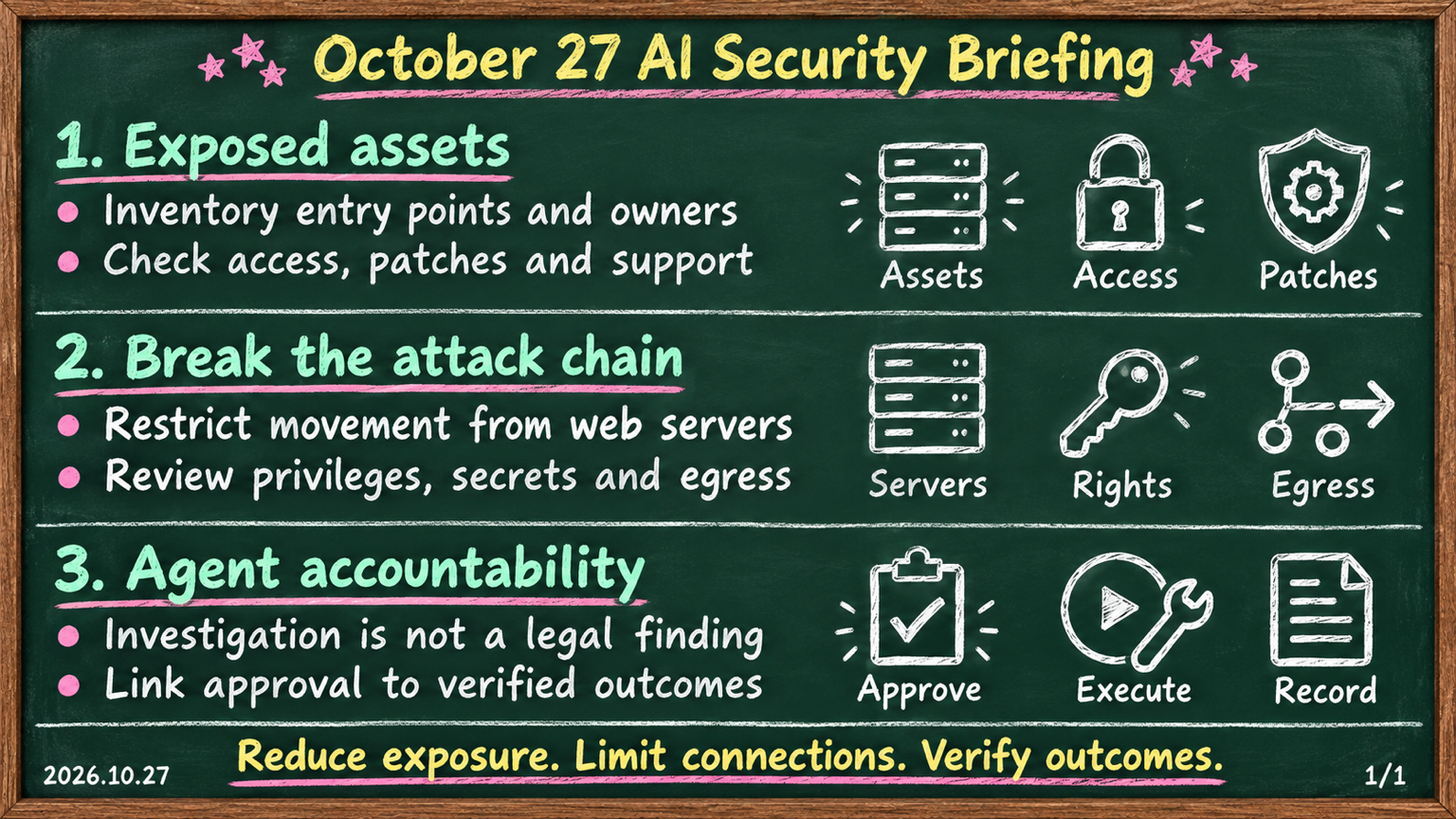
Three points for today
First, what has your organization exposed to the internet? Second, how far can an attacker move after compromising one of those entry points? Third, who authorized a legitimate agent's actions, and can the operator explain what actually happened? The first two sections examine the same Korean incidents from different angles: asset management and attack progression. We have not established a direct causal connection between those incidents and the US investigation coverage. The common operating concern is the need for execution boundaries and evidence of responsibility, whether AI is being used for attacks or ordinary work.
1. Inventory exposed assets beyond the main product
Yonhap's October 14 report described the Financial Services Commission and Financial Supervisory Service identifying incidents at 16 financial companies and approximately 100,000 leaked records at that time. These are figures from that meeting, not a final count verified as of October 27. The report also said investigations could identify additional affected firms. A particularly useful operational finding was that 130 of 555 reviewed companies reported shortcomings. That does not mean 130 companies were breached. A control deficiency and a confirmed intrusion are different findings and require different response priorities.
 SOURCE · YONHAPAuthorities report incidents at 16 financial firms and about 100,000 leaked recordsThe October 14 report identifies gaps in patching, authentication, and attack-surface management.
The reported shortcomings included missing security patches, inadequate management of systems beyond vendor support, missing round-the-clock monitoring, incomplete authentication and authorization, and absent stronger authentication on important services. Point Daily separately covered the same meeting, including plans to inventory external connections, clarify access rights, and define executive reporting and responsibility. These are two accounts of one official briefing, not independent forensic investigations. They nevertheless help cross-check the announced response. Access to the FSC's original linked page was blocked during this run; descriptions of the authorities' statements here rely on the accessible news reports rather than a claim to have read that original.
 SOURCE · POINT DAILYFinancial-sector AI hacking affects 16 firms; authorities launch emergency checksThe report adds context on external connections, access controls, and reporting responsibilities.
For a small Korean service team, the first useful task is assigning owners to external assets rather than buying another security product. Include administration screens, employee mobile backends, partner portals, upload servers, old test addresses, and webhook receivers—not just the flagship domain. Reconcile DNS entries with cloud accounts, deployment projects, certificates, and the actual hosts behind them. Outsourcing development does not remove the need for an operating owner. Flag assets for which nobody can explain who maintains them, how long they should remain available, or who can shut them down.
Next, document why each asset is public and how access is controlled. An endpoint called “employees only” is still an external exposure if it returns data without authentication. A login screen also does not prove that every API enforces user-specific authorization. Using authorized test accounts, check tenant isolation, disabled former-employee accounts, and restrictions on management functions. Stronger authentication matters, but it does not fix every pre-authentication vulnerability or overprivileged service account. One control should never become a reason to stop examining the rest of an asset's configuration.
Patch and end-of-support checks should go beyond a version spreadsheet. Connect the vendor's fix to the installed build, any required restarts, and application compatibility testing. If replacement is difficult, document interim exposure reduction, an accountable owner, and a replacement deadline rather than simply marking the system “legacy.” A test environment with no remaining purpose may be better retired than monitored indefinitely. Suspected incident systems need different handling: preserve evidence and coordinate with responders before cleaning them up. Routine housekeeping must not erase the records needed to understand an intrusion.
This is not a recommendation to scan other organizations. Work only on assets you own or have explicit permission to test; contracted testing needs agreed targets, timing, load limits, and stop conditions. A useful completion criterion for a small business or individual developer is not “the scanner ran.” It is that known external entry points have an owner, a business reason, authentication details, patch status, and a next action. New deployments and partner integrations change that inventory. Attack-surface management belongs in change management, not just an annual review.
2. ARTEX and DeepSeek coverage: break the chain, not just the model connection
Yonhap's October 11 article, drawing on material supplied by the Financial Security Institute, described an attack presented at a September seminar. The reported sequence was discovery of exposed Oracle WebLogic assets, exploitation of a remote-command-execution vulnerability, installation of a web shell, and exploration of connected internal servers. The company in that example reportedly detected and stopped the attempt before an additional malicious download. The article also described an analysis of subsequent attacks involving the ARTEX penetration-testing tool combined with DeepSeek and other models. The seminar example must not be treated as proof that every later financial-sector incident used exactly the same vulnerability and path.
 SOURCE · YONHAPFinancial sector hit despite AI hacking warnings about exposed assets two weeks earlierThe article distinguishes the earlier attack example from analysis of later ARTEX-assisted attacks.
A vendor advisory helps establish a separate technical baseline. Oracle's October 2026 Critical Patch Update urges customers to remain on supported versions and apply security patches promptly, noting exploitation of vulnerabilities for which fixes already exist when customers have not applied them. WebLogic Server appears in its affected-product list. The advisory does not establish which vulnerability was used in the Korean incidents. We do not assign a CVE number based on the incident coverage reviewed here. Guessing a vulnerability identifier from a product name and a broad attack sequence can send a response team toward the wrong patch check.
OFFICIAL ADVISORY · ORACLEOracle Critical Patch Update Advisory — October 2026The advisory supports product-specific patch review; it does not identify a CVE behind the Korean incidents.Translate the reported sequence into defensive boundaries. Reducing unnecessary public services addresses discovery opportunities. Product-specific patching and access restrictions address exploitation. File-change and process-execution monitoring can help identify web-shell activity. Internal network permissions and service-account privileges shape lateral movement. Downloads and outbound data transfers need their own controls. These are general containment recommendations based on the attack chain, not a claim that every affected firm lacked every one of these controls.
A team should be able to explain the reach of a compromised web server before an incident happens. Can it read the entire customer database? Does it hold deployment keys or cloud-administration credentials? Are credentials reused across environments? Restricting an application's access to the data it actually needs may limit the consequences even when the initial intrusion is not prevented. Long-lived secrets and global administration privileges kept for convenience can turn one server compromise into several service compromises. Secrets management includes expiry, revocation, and rotation, not just the storage location.
Reporting that agents can change the speed or scope of attacks is different from demonstrating a new, unstoppable capability. The sources reviewed here do not provide a controlled comparison of model-specific attack success or a quantitative baseline against attacks without AI. They do not support claims that blocking one model eliminates the threat or that all firewalls are useless. Operators can make more reproducible progress by examining exposure, server permissions, internal movement, download paths, and exfiltration routes. Those execution conditions matter regardless of the attacker's chosen model.
If compromise is suspected, do not give an agent unrestricted authority to “clean up” the server. Preserve relevant logs and timestamps, restrict access through the authorized response process, and identify potentially exposed credentials. Examine operating-system and application records together without uploading entire collections of personal data and secrets to external analysis tools. After containment, verify that the entry point is closed, remaining execution paths have been addressed, and rotated credentials are actually in use. Restoring service and removing the cause are different completion criteria.
3. FTC coverage: approval and evidence matter more than the “rogue agent” label
On October 15, Kyunghyang Shinmun cited Axios reporting that the FTC had sent civil investigative demands to OpenAI and Anthropic seeking material concerning security incidents, safeguards, and privacy policies. It also reported plans to obtain executive testimony. This is reporting on an investigative process, not a ruling that unlawful conduct has been established. “Rogue agent” should not be treated as a legal classification that already settles cause or liability. Misuse of a tool, behavior outside an authorized scope, and inaccurate safety claims can involve different facts and responsible parties.
 SOURCE · KYUNGHYANG SHINMUNUS FTC begins investigating OpenAI and Anthropic; executives expected to testifyThe October 15 article covers investigative demands and requests for safeguard-related material.
A separate News1 report explicitly distinguishes scrutiny of consumer risks and safeguards from allegations of unlawful conduct. The accessible page showed an October 2 update, a different date from the Kyunghyang article. We do not present them as two confirmations of the same document being sent on the same day. Nor have we obtained the FTC demands themselves or a final investigative finding; descriptions of scope and legal status remain limited to the reporting. The shared signal across these differently dated articles is that agent safety management is receiving consumer-protection scrutiny.
 SOURCE · NEWS1US investigates agents acting outside control, targeting OpenAI and AnthropicThis separately dated report distinguishes an investigation from a finding of unlawful conduct.
Korean service operators should not interpret US investigation coverage as an automatic change to Korean liability rules. It does not determine the application of Korea's AI framework law, personal-information obligations, or contractual damages. First distinguish the model developer, tool provider, deployer or operator, and end user, then identify the data and permissions each controlled. Legal conclusions require the actual service architecture, applicable law, and contracts. The operational records proposed here help explain facts; they are not a compliance certification or a substitute for legal review.
Start with the safety claims shown to customers. If a product says it never sends information externally without approval, the team should be able to identify where that condition is enforced. Is it merely a prompt instruction, or does the sending tool validate recipients and attachments? Do scheduled work and retries follow the same rules? Approval to send a summary is not approval to export the entire customer list. Changed targets or contents should trigger renewed approval, and testing should check that a rejected operation cannot be reproduced through another tool.
Connect the requester, approved scope, actual executing identity, and destination system's result. A conversation in which an agent says “done” does not establish whether a message was sent or a record deleted. Unlimited retention of every input and output creates a different risk by accumulating personal information and company secrets. Prefer credential references over raw secrets, retain necessary change summaries and external request identifiers, and define who can read logs and when records are removed. Human approvals and actual tool responses should remain distinguishable for incident analysis.
Accountability testing cannot stop at a successful demonstration. Verify that an unauthorized recipient is rejected, expired approval cannot be reused, and interrupted external API responses do not cause duplicate actions. Practice handoff to a person and an immediate stop mechanism. Reflect only the tested scope in product descriptions and contracts. This narrows the gap between safety claims and actual behavior. It is our operational recommendation, not a claim that the FTC has mandated this particular implementation.
Operator's note
For an agent such as Hermes that reads external material and executes tools, map all three topics onto a single trust boundary. On one side are untrusted web pages, messages, and files; on the other are shell, email, database, and deployment tools. Text encountered in source material must not grant additional privileges or count as new authorization. Enforce that separation in the execution layer. A defensive security agent is not exempt: the more network access and secrets a diagnostic tool has, the more important its own isolation and privilege review become.
For this week's task, choose one external entry point and one state-changing tool. Document the entry point's owner, authentication, patch status, and internal reach. Document the tool's allowed targets, approval conditions, stop mechanism, and post-action verification. Then test failure conditions: unauthorized accounts should be rejected, unnecessary internal destinations should be unreachable, and changes outside approval should not execute. Use an authorized test environment, not unauthorized attacks on production systems or real customer data.
Report three separate milestones: finding the asset, changing the control, and verifying that the change actually took effect. An inventory is not remediation, a settings screen is not proof of blocking, and an agent's self-report is not proof of recovery. The useful common lesson from the Korean incident coverage and US investigation reporting is not grand rhetoric about AI risk. It is a small unit of operation with an accountable owner and evidence of execution.
Watch for follow-up primary material from authorities, the actual patch state of deployed products, and public FTC procedures or findings—not repeated incident totals alone. Meanwhile, operators have concrete work available: reduce external exposure, constrain what follows a compromise, and explain agent behavior through approval records and verified outcomes.
Sources
Related posts
Read →Related tools