October 18 AI Operations Brief — Agent Authority, Sovereign Control, and Transparency Records
A practical operating view of MCP agent controls, sovereign AI as data and vendor control, and recordkeeping for Korea’s AI Basic Act transparency requirements.
DAILY NEWSLETTER · 2026-10-18 · AGENT CONTROLS · SOVEREIGN OPERATIONS · AI TRANSPARENCY
October 18 AI Operations Brief — Agent Authority, Sovereign Control, and Transparency Records
Today’s three signals begin in different places but converge on one operating question: how to limit an agent’s reach into tools and data, how to define sovereign AI through control of data, deployment, and vendor exit rather than model nationality, and how to keep the notices and records that make AI-based operation explainable. The operational goal is not more connectivity. It is connectivity that can be explained.
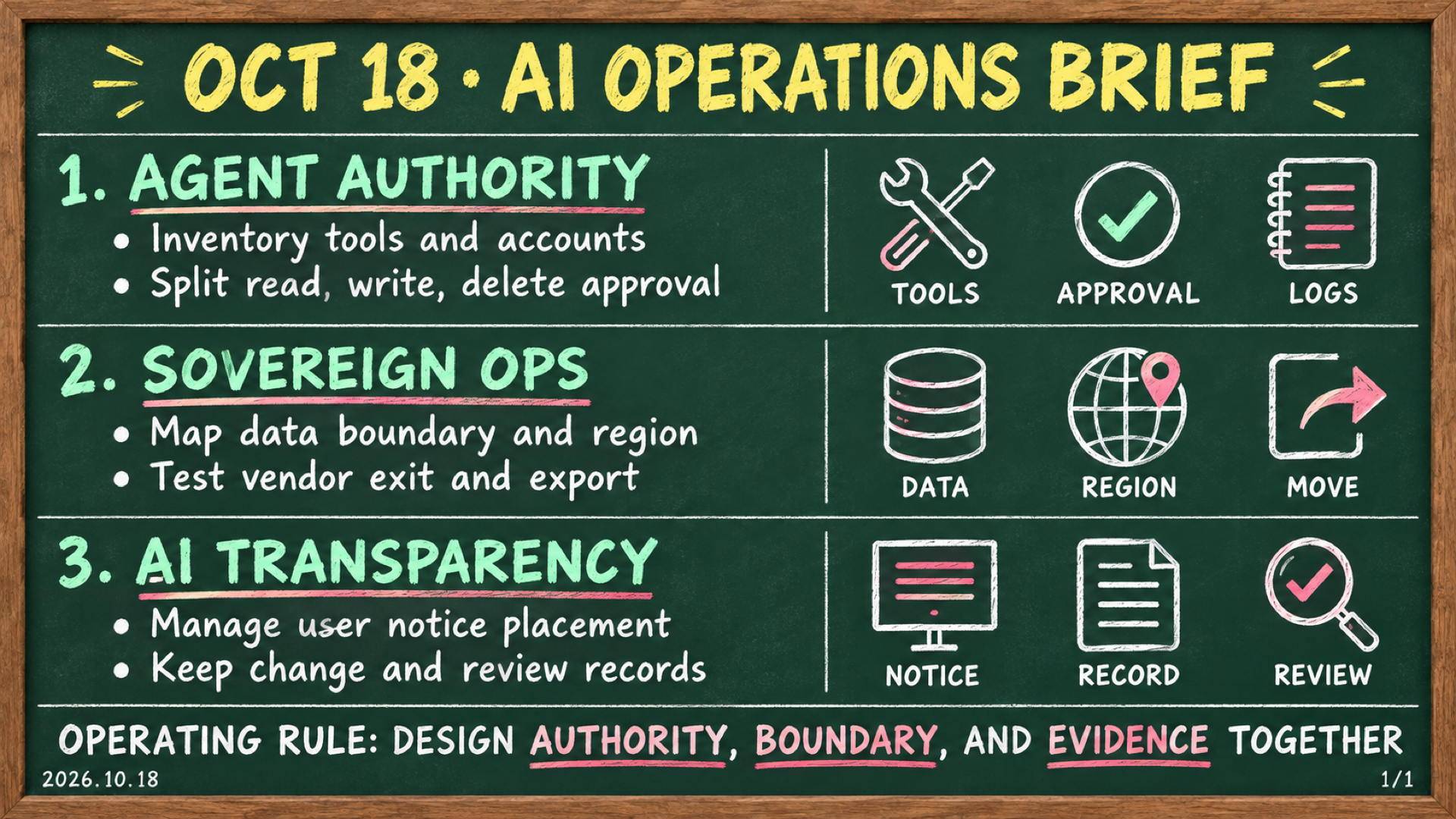
1. Agent control checklist: an MCP connection is an expansion of the attack surface
Microsoft describes MCP as the default way agents reach tools and data, and says that this reach is itself the attack surface. That framing corrects a common mistake: treating an agent as only a conversational interface. Once a model can select and call tools, it becomes software capable of reading and changing external state. Tool descriptions, input schemas, tool outputs, and credentials all become part of the trust boundary.
Adding an MCP server is therefore closer to delegating authority than installing a feature. A familiar server name or a natural-language tool description is not a security guarantee. An agent may encounter malicious instructions in a document or webpage it can read, while tool descriptions and returned values can also influence its behavior. Operators need to ask not only what a tool does, but which account it uses, what it can reach, and what can change if a call goes wrong.
Start with an asset inventory. Tie every model, agent, MCP client, MCP server, connected system, service account, API key, token, data class, and approver into one register. A list of server URLs and tool names is not enough. Each connection needs an owner, business purpose, allowed inputs, read targets, write targets, network path, retention period, and stop condition. A connection whose owner is unknown may function technically, but it is not an operationally approved connection.
 Source · Microsoft Community HubThe state of MCP security in 2026 | Microsoft Community HubMicrosoft frames MCP as the default path from agents to tools and data, and therefore as a material attack surface.
Next, separate authority by the side effect of the action. Read, write, delete, and payment or contract actions should not be collapsed into one category of “execution.” Document search and customer-record access are different permissions; drafting an email and sending it externally are different permissions. Use narrowly scoped read-only credentials for reading, separate credentials for writes to defined systems and resources, and explicit human approval with reconfirmation for deletion, spending, or legally consequential actions.
Approval should be a verifiable transition, not a ceremonial click. An approval view should show the requester, purpose, change target, prior state, expected result, tool, authority being exercised, and rollback path. “The agent will send a customer email” is too abstract; reviewers should see the actual recipients, attachments, sending account, external links, and timing. Friendly summaries can omit material detail, so sensitive tool calls should permit inspection of the original parameters and full schema.
ZDNet Korea reported, in the context of growing enterprise agent adoption, a speaker’s statement that only 11% had reached actual operation. That figure should not be amplified as a universal market statistic. Its value is as field context: a gap often exists between demos, pilots, restricted internal use, and real operational deployment. Production readiness is not whether the model produces convincing text. It is whether ownership has been assigned for authority, accounts, failure handling, evidence, and recovery.
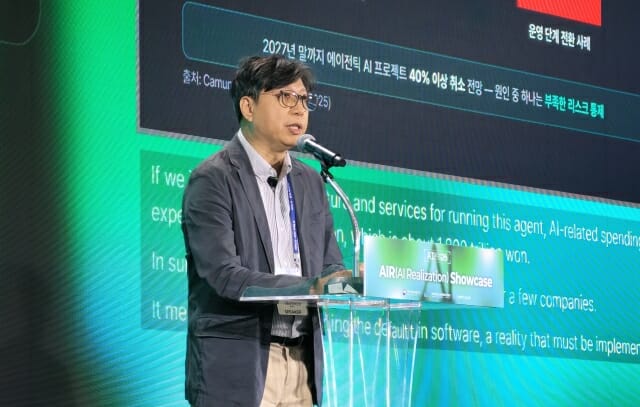 Source · ZDNet KoreaAI 에이전트 도입 늘어도 실제 운영은 11%…문제는The report discusses the gap between increasing enterprise adoption and operating agents in real work; its figure is a speaker statement, not a universal measure.
Least privilege and identity lifetime are the next controls. When one MCP server holds broad credentials across several business systems, one vulnerable component or incorrect tool call can spread across all of them. Separate identities by agent, task, and environment. Prefer short-lived tokens to long-lived static keys. Record token scope and renewal justification. Ensure credentials from a test environment cannot reach production systems.
Finally, design audit evidence and rollback into the work. Every external state change should connect a request ID and execution ID with the requester, approver, policy applied, tool and version, input reference, output reference, changed target, result, failure reason, and recovery state. This does not mean retaining every prompt and raw record forever. Sensitive content can be represented through reference IDs, classifications, hashes, and controlled access. What matters is the ability to reconstruct why a run started, which authority it used, what it changed, and how the state was recovered.
2. Korean sovereign AI operations: design data boundaries and exit capability, not model nationality
Sovereign AI is easily reduced to the origin or brand of a model. That misses the operational questions. Where is data stored and processed, and under which legal jurisdiction? Where do inference, fine-tuning, log analysis, backup, and disaster recovery occur? Which subcontractors and infrastructure providers sit in the supply chain? If a supplier fails or a contract ends, in which formats can the organization retrieve its data, settings, evaluations, and applications? Can all of those answers be presented as auditable evidence?
In a 2026 second-half work-plan pre-briefing published on Korea Policy Briefing, the government said it had secured 35,000 of its target 50,000 advanced GPUs in the first half of the year and was pursuing independent AI-model competitiveness. This is a statement made in a government briefing, not an independently verified finding about device availability or usable capacity. It is still relevant context for organizations planning procurement and deployment: public policy is actively targeting AI infrastructure and independent model capability.
Sovereign operation begins by splitting data flows into controllable classes, rather than asking only whether to use a domestic model. Public-document summarization, retrieval over internal operating documents, customer support involving identifiers, and support for regulated decisions need not share the same deployment path. Set permitted suppliers, processing locations, encryption-key control, log-retention location, cross-border transfer rules, and human-review conditions by data class. That preserves a durable boundary even when the underlying model changes.
 Source · 대한민국 정책브리핑업무보고 사전브리핑The government briefing said 35,000 of a 50,000 advanced-GPU target had been secured and described a policy pursuit of independent AI-model competitiveness.
At procurement time, translate control into contract terms rather than comparing features and price alone. Include the primary and backup data locations, subcontractors, incident-notification deadlines, investigation cooperation, log-access rights, notice of model or API changes, service termination notice, data return and deletion certification, export formats, and migration support. A promise that data will be handled securely does not identify which data remains where or who may access it.
Data residency is more than the location of a primary database. Prompts, retrieval documents, vector indexes, conversation history, safety-filter logs, evaluation data, fine-tuning artifacts, backups, and monitoring telemetry all belong on the data-flow map. A production environment in a Korean region may still involve overseas support access to logs or overseas replication for incident analysis. Mark where each flow is created, transmitted, processed, retained, and deleted.
The Ministry of Science and ICT’s publication, “2026 인공지능 (AI)·정보통신기술(ICT) 산업·기술전망 컨퍼런스 개최,” provides official planning context around AI and ICT industry and technology outlooks. The page does not provide an Open Graph image, so this card intentionally includes no image. It does not validate a product or deployment architecture. It does show that the government continues to address technology outlook and industrial preparation, which is reason enough for operators to revisit their own data and supplier dependencies.
Source · 과학기술정보통신부2026 인공지능 (AI)·정보통신기술(ICT) 산업·기술전망 컨퍼런스 개최An official Ministry of Science and ICT item placing AI and ICT industry and technology outlooks in a policy-planning context.Vendor exit should not be examined for the first time at termination. Test it in a small, normal-operation exercise. Each quarter, choose one workflow and export its prompt templates, system instructions, tool definitions, access policies, evaluation set, conversation-retention rules, retrieval-index metadata, and audit logs. Reproduce a minimum working version in a different environment using the same inputs. This is not an argument for immediately replacing every model. It is a way to identify which dependencies are supplier-specific and which are preserved as internal standards.
Portability is not merely the ability to download files. It is the ability to move without losing meaning. Transition costs increase rapidly when conversation records are locked in proprietary formats, permissions depend on supplier-specific roles, or evaluation results are detached from their original inputs. Abstract model calls through an internal gateway; manage data schemas and policy IDs outside the supplier; and keep output quality, latency, cost, errors, and safety-review outcomes in a common format. This preparation lowers both migration cost and the cost of negotiating operational terms with an existing supplier.
3. AI Basic Act operations: turn notices and determination materials into operating records
Treating AI Basic Act response as a final legal review creates a lag whenever products change. Article 23 of the Enforcement Decree of Korea’s Framework Act on the Development of Artificial Intelligence and the Establishment of a Foundation for Trust, effective August 20, 2026, requires AI businesses providing products or services using high-impact or generative AI to give users advance notice that those products or services operate on that AI basis. This is not legal advice; the applicability of the rule and its exceptions require professional review for each service. Operationally, the important move is to connect the location of the notice and the material supporting it to product change management.
Article 23 allows notice through direct marking on a product or through contracts, manuals, or terms of use; display on the user’s screen or device; clear posting at the place where the product or service is provided; or another method recognized by the Minister of Science and ICT in view of the product’s characteristics. This is not a task of attaching one popup. Teams need to inspect the actual paths through which a user encounters the product or service—documents, screens, devices, and locations—and select suitable notice methods.
Maintain a product-level notice register. One row can hold the product or feature name, purpose of AI use, review status for generative or high-impact AI, user type, screen or document location, notice-copy version, first effective date, change history, exception-review basis, and owner. If an AI feature is enabled or disabled through a feature flag, its notice should move with deployment status. Teams need to detect both cases: a feature enabled before the notice is deployed, and a notice left behind after a feature is retired.
Source · 국가법령정보센터인공지능 발전과 신뢰 기반 조성 등에 관한 기본법 시행령 제23조Effective August 20, 2026, Article 23 specifies advance-notice methods for AI-based operation of high-impact or generative AI products and services, with listed exceptions.The decree permits all or part of the requirements not to apply where use of high-impact or generative AI is obvious from the product or service name, interface, product exterior, or output wording; where it is used solely for internal work; or in other cases prescribed in notice based on product type, output, use pattern, or technical level. An exception should not rest on an informal assumption that the word “AI” is already visible. Record what makes the use obvious, whether the use is truly internal, which published basis applies, and when the determination was made. An exception cannot be reviewed later if its basis was never recorded.
Article 25 also affects the operating record structure for a request to determine whether AI is high-impact. It lists materials including an overview of the product or service, an overview of data used for training, and material that can verify the use, operation process, and results of the product or service. Gathering these only when a request arises becomes difficult after deployment histories and data changes accumulate. It is more practical to treat them as records that should already exist during normal operations.
An overview of training data need not be reduced to publication of all underlying data. An operating record can state source categories, collection and use basis, intended purpose, major processing steps, quality, bias and safety review methods, refresh cycle, access controls, and limitations. For a service using an external model, separate the supplier’s model documentation from the organization’s own retrieval corpus, prompt design, safeguards, and human-review process. Mixing model characteristics with the actual product context obscures responsibility.
Materials that verify use, operation, and results are not only engineering logs. They are operational evidence of where AI operates in a user flow, how inputs and outputs contribute to downstream decisions, when people review or override it, where error reports arrive, and whether feature changes update notices. Link product requirements, UX captures, model and version inventories, release approvals, evaluation summaries, incident and complaint records, and access-control lists. That keeps notices and determination materials connected.
Source · 과학기술정보통신부인공지능 투명성 확보 가이드라인The Ministry of Science and ICT states that it prepared this guideline to support understanding of the AI Basic Act’s transparency obligations under Article 31.The Ministry of Science and ICT published its AI transparency guideline in January 2026. A guideline does not replace legal analysis, but it can help product, operations, and legal teams work from the same factual record. In practice, add the notice location and copy owner to new-feature briefs; add data-overview and user-impact review to release approval; and link supporting documents from change-management tickets. The durable approach is to incorporate the work into procedures that already govern product changes.
The question is not only whether a notice exists. It is whether the organization manages the facts needed to give that notice. Interface copy is the final artifact. Behind it should sit feature scope, data flow, model version, human-intervention points, exception reasoning, and change history. Users need to know that AI was involved not merely because a label exists, but because the fact helps them understand a result and, when needed, verify it, ask questions, or raise an objection. The notice is where operating records meet the user.
Operator memo
This week, choose one AI workflow already in operation and draw three maps. The first shows where data enters and where it is stored, processed, backed up, and deleted. The second shows who may read, write, delete, or spend money, under which authority. The third shows what the user is told and what evidence is retained. If the three maps do not point to the same product name, feature version, and owner, that mismatch is the next operating risk.
Agent tool calls, sovereign AI data boundaries, and AI transparency notices can sound like the separate languages of security, procurement, and compliance. In practice, they are one change-management problem. When a team deploys a new model, connects an external tool, or changes processing location, authority scope, vendor dependency, user notice, and audit material can all change together. Linking them with a common execution ID or release ID reduces the cost of incident investigation, contract review, and user support.
The smallest useful unit is modest: one operating contract for one automation. State its purpose, data class, permitted tools, read/write/delete/payment authority, expiration time, approver, log location, recovery path, notice location, and document links. Before the next release, check which entries changed; then identify which of authority, contract, notice, and evidence must change with them. Expanding autonomy is not chiefly the ability to finish longer tasks. It is the ability to explain, stop, and recover tasks with greater impact.
One check for this week
The next bottleneck in AI operations is not model performance alone. It is whether an organization can explain, in one coherent account, how far an agent may act, where data and systems sit, and what users and auditors are shown. Take one live workflow and review its authority boundary, data exit paths, notice, and evidence together. If the same documents and owners can answer all three questions, the operational center will remain stable as more connections are added.
Sources
Related posts
Read →Related tools