October 24 briefing — Claude approvals, Dots access, and Kimi’s promised weights
Claude expands auto mode, OpenAI reports strong Korean Dots usage, and Kimi promises weights after its API launch. A briefing on approvals, access, and deployment decisions.
DAILY NEWSLETTER · 2026-10-24 · CLAUDE · DOTS · KIMI
October 24 briefing — Claude approvals, Dots access, and Kimi’s promised weights
Claude is replacing repeated approval clicks with automated checks, Dots is gaining traction in Korea as a persistent work agent, and Kimi K3.1 Pro is available through an API ahead of a promised weights release. Together, these developments expand what operators can delegate—and make the boundaries of that delegation more consequential.
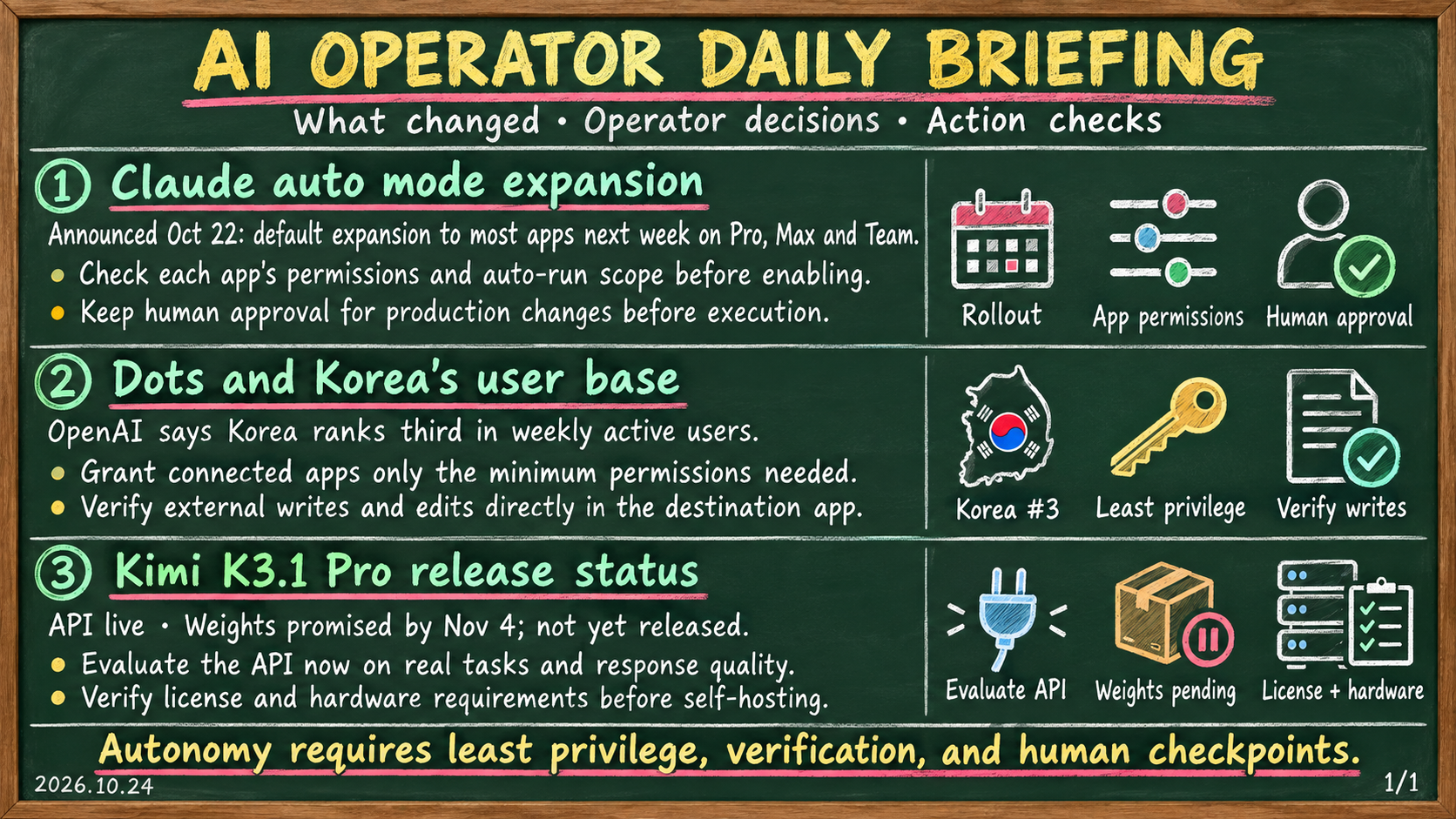
Three points for today
The October 24 briefing looks at approval, connectivity, and where models run. Claude's changing default is not unlimited permission. Dots' usage ranking is not evidence of safe enterprise adoption. Kimi's release announcement is not the same as weights being downloadable today. The workflow boundaries and checks below are operational recommendations, not claims that every product supplies every control described.
1. Claude's auto mode expansion changes the approval habit
Anthropic added an October 22 update to its existing Claude Code auto mode announcement: auto mode will roll out next week as the default for new sessions in most Claude apps on Pro, Max, and Team plans. Instead of asking users to approve each action, an automated check blocks risky actions while Claude looks for another route. This is a rollout announcement, not confirmation that every account has already changed. Enterprise is not part of a simultaneous blanket switch; Anthropic says administrators will receive an email before the default changes for their organizations.
Separate the dates and products. Claude Code began moving new sessions on those plans to auto mode on August 14. This week's update extends that direction to most apps. The official article explicitly says the research data below the update is specific to Claude Code. Findings from a coding environment should not be treated as a complete safety assessment of every mobile workflow or third-party connection. Korean administrators should first map which employees use web, desktop, or mobile and what tools those sessions can reach.
Approval fatigue is part of the rationale. Anthropic reports a controlled study with 1,053 paid professional testers in which human reviewers caught 13.6% of dangerous commands, compared with 89% blocked by auto mode. The study substituted a dangerous command into a permission prompt in a research environment; approving it did not actually execute a harmful command. It does not establish that automation is always safer than a human. Miss rates from a separate adversarial evaluation also are not incident rates across real service traffic. The practical lesson is narrower: a high volume of approval prompts does not, by itself, create effective oversight.
CellCog's supporting analysis covers the October 22 expansion and makes a useful distinction: Claude Code configuration and keyboard shortcuts should not be presented as universal instructions for the apps. The official announcement checked for this briefing does not establish the exact manual-mode menu location in every client. Teams should inspect mode selection and administrative controls in their actual accounts and record the before-and-after policy where possible. Do not distribute an unverified menu name or configuration key simply because a rollout has been announced.
 Source · CellCog
Claude Code auto mode: how it works and how to turn it off
Supporting analysis separates the apps announcement from Claude Code configuration.
Operationally, separate reading, drafting, and external changes. Summarizing public material, writing tests, and editing an isolated branch are relatively reversible. Deleting production data, messaging customers, uploading to a public repository, or expanding infrastructure privileges have much larger consequences. Put those behind explicit approval rules where supported and access controls in the underlying services. Do not assume a Claude Code rule covers every app execution path: test whether each route really refuses the prohibited action. A classifier is an additional check, not a replacement for account-level permissions.
A useful trial this week is to test both normal and prohibited operations in a non-sensitive project. Can file edits proceed while production changes stop? When blocked, does the agent pause rather than switch to public sharing or another account? Does work remain pending when nobody is available to approve it? Use dummy data rather than secrets or customer information. Record the denial reason and the question returned to the operator, not just successful runs. That is how a new default becomes a policy the team can actually understand.
2. Dots ranks third in Korean usage: define access before connecting apps
Yonhap and ChosunBiz report that, at OpenAI's October 22 developer event in Seoul, OpenAI Korea lead Kyung Hoon Kim said Korea ranked third globally in weekly active Dots users. This is a company-reported service usage ranking. It does not measure adoption across all Korean businesses, productivity gains, or security outcomes. Two outlets corroborate what was said at the event; they are not two independently sampled measurements of the ranking.
 Source · Yonhap
OpenAI says Korea ranks third in weekly Dots users
Reports the usage statement and delegated workflow examples presented in Seoul.
Dots is presented as an agent that continues working on delegated responsibilities rather than ending with a single answer. Yonhap describes a legacy API migration example in which the agent traces dependencies, writes and runs code, and returns a pull request for review. The operationally useful detail is the reviewable artifact at the end. A small Korean engineering team can use a similar division of responsibility: delegate investigation, testing, and a proposed change, while a separate owner controls production rollout. A demonstration is not a guarantee of success in every repository.
ChosunBiz reports that Dots connects through ChatGPT to more than 4,000 apps and lets users configure app and computer access along with work instructions. That is not a reason to enable every connection, nor evidence that every integration exposes the same read/write controls. More connections can expand both the information an agent sees and the systems it can change. A useful access register therefore records not just service names, but accounts, data scope, permitted actions, approvers, and revocation procedures.
 Source · ChosunBiz
OpenAI presents its AI collaboration plans and Korean Dots adoption
Reports app connectivity and the event explanation of access controls.
For customer support, begin with access to a defined inbox and permission to draft replies. Keep sending behind approval and separate refunds or contractual changes from routine correspondence. For document summaries, connect the relevant project material rather than the entire company drive. This does not imply that Dots offers a particular switch for every boundary. Where product controls are insufficient, restrict sharing in the source service or use a dedicated account. If the boundary still cannot be enforced, leave that workflow disconnected.
Korean organizations should pay particular attention to personal and company accounts being mixed. A quick experiment that connects internal documents through an employee's personal account can leave access revocation unclear when roles change. Legal suitability depends on the contract and data involved, but teams can at least document the connecting identity, data owner, and storage and sharing paths. A narrow workflow verified end to end is easier to investigate than a single agent with access to the complete customer list and internal strategy documents.
Verification ends in the source system, not when the agent says it is done. For a calendar event, check the calendar, time zone, and invitees. For code, open the actual pull request and test results. For a sent message, verify the recipient and content and check that retries did not send duplicates. A persistent agent can repeat an external change after a partial failure, so retain identifiers and completion state for the items it processes. That is part of the workflow design, not merely an extra instruction in the prompt.
3. Kimi K3.1 Pro: API availability is not a weights release
Moonshot's technical announcement says Kimi K3.1 Pro and its Highspeed variant are available in Kimi products and through the API, with full weights promised by November 4, 2026. As of October 24, a release commitment and a downloadable checkpoint are different things. Describing it as a new open-weight model that teams can immediately install locally would be inaccurate. Self-hosting teams can start testing task suitability through the API and prepare evaluations to repeat once weights and licensing are available.
 Source · Moonshot AI
Kimi K3.1 Pro: advancing open intelligence
Specifies current API availability and the promised weights release by November 4.
The official announcement emphasizes long context and improvements in coding, 3D creation, financial research, and agentic work. Independent evaluator Artificial Analysis also reports gains in agentic performance in its October 23 analysis, while explicitly noting that the weights have not been published. Read together, the sources offer a reason to evaluate the model and a reason not to finalize a self-hosting plan yet. The intended distribution model and the current delivery channel should remain separate in procurement and infrastructure discussions.
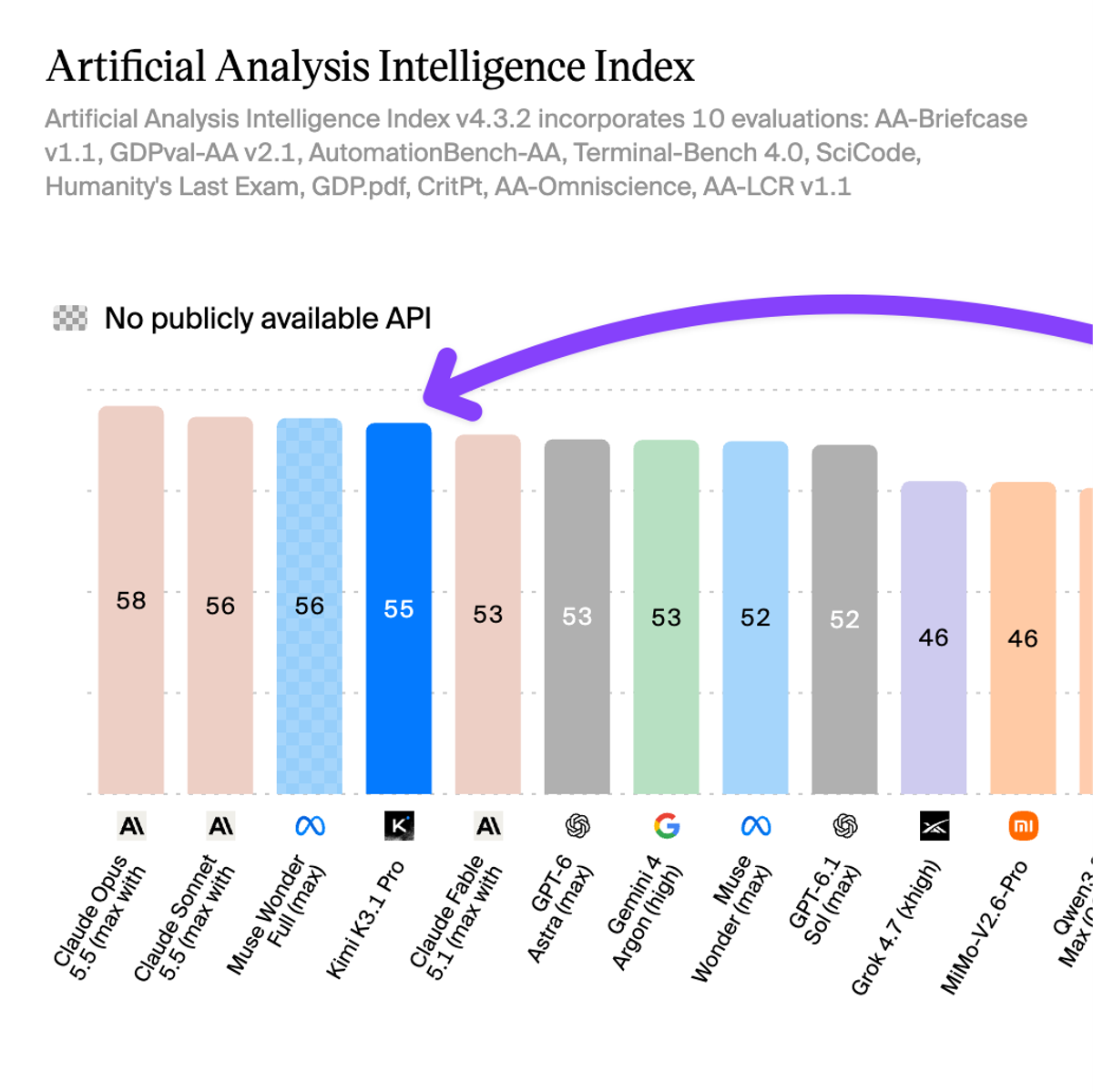 Source · Artificial Analysis
Kimi K3.1 Pro launches fourth on the Intelligence Index
Provides independent evaluation and explicitly notes that weights remain unpublished.
Benchmark comparisons require attention to who ran them and under what conditions. A vendor report and an independent evaluator can obtain different results on an evaluation with the same name because of harnesses and settings. Taking the largest figure from a chart does not predict the success rate in a particular codebase. A better internal test set uses recurring work: interpreting Korean requirements for an existing API change, diagnosing a failing test, and producing a source-grounded report from several documents. Compare models under the same conditions.
Measure completion rather than plausibility. Does the code run? Do the tests actually pass? Do cited documents exist? Does the model acknowledge an intermediate failure instead of inventing a result? As tool calls multiply, the quality of one answer becomes a weaker proxy for the whole job. Record recovery time, human repairs, and consistency across repeat runs. A lower token price does not automatically mean a lower cost to finish if retries and manual correction are substantial. These are evaluation criteria, not claims that this briefing measured Kimi's production economics.
Self-hosting needs a separate assessment. Moonshot describes a mixture-of-experts architecture with 2.8 trillion total parameters and 104 billion active parameters. The active count is not evidence that the model will fit on a typical laptop. Deployment depends on weight storage and memory, precision or quantization, runtime support, concurrency, and context length. Do not commit to a GPU count or monthly operating cost before checking the released files, deployment guidance, and license. Open weights also do not automatically mean unrestricted use under every condition.
A practical sequence for Korean teams is to evaluate the API on non-sensitive material, then verify the files, license, and inference support at release before revisiting total self-hosting cost and responsibility. Running a model on your infrastructure may improve control over data, but it does not eliminate execution risk if the agent retains broad network and tool access. Model location and permission scope are separate dimensions. Possessing the weights does not finish privacy or security review.
Operator's note
These are not three versions of the same adoption race. Claude changes who evaluates actions; Dots raises questions about persistent access across systems; Kimi may expand where a model can run. Those changes sit at different layers. Choosing a model, connecting an app, and authorizing an external change should not collapse into one undifferentiated consent decision.
The same principle applies to teams running execution-oriented tools such as Hermes. Automate reading and analysis within a narrow scope, preserve proposed changes as reviewable files or links, and route publishing, sending, payment, and deployment through established policy. Instructions inside external pages or documents must not become operator commands. Reducing the path from untrusted input to tool execution matters independently of how well any particular vendor's classifier performs.
Track completed, blocked, and pending work separately. If every safe stop counts only as failure, operators will be pushed toward granting everything. But an agent that blocks constantly and never finishes ordinary work is not useful automation either. Use the same test suite to check legitimate completion and risky-action denial, and verify that handoffs retain the context and artifacts a human needs. Longer autonomy depends on clearer stopping conditions.
This week, validate one workflow's permission boundary rather than connecting every available tool. Check Claude's actual rollout state and manual switching in your account, Dots' connected identities and external changes, and Kimi's API results separately from its future weights release. Useful autonomy is neither a human watching every step nor the removal of every approval. It is a system that grants little, verifies precisely, and stops at consequential changes.
Sources
- Anthropic · Auto mode is now the default in Claude Code for Pro, Max, and Team plans ↗
- CellCog · Claude Code Auto Mode: What It Does, How to Turn It Off ↗
- Yonhap · [AI프리즘] 한국 개발자 사로잡은 오픈AI…'닷츠' 사용 세계 3위 | 연합뉴스 ↗
- ChosunBiz · 오픈AI “한국, 닷츠 이용 세계 3위”… ‘AI와 일하는 시대’ 청사진 제시 ↗
- Moonshot AI · Kimi K3.1 Pro Tech Blog: Advancing Open Intelligence ↗
- Artificial Analysis · Kimi K3.1 Pro launches at 4th on the Intelligence Index and will lead open weights models ↗
Related posts
Read →Related tools