October 19 Daily Issue — Running MCP's New Spec, a Service Check for Korea's AI Basic Act, and a Test Set for Agent Verification
What the MCP 2026-07-28 spec changes for server operations and security review, what service operators should confirm after Korea's AI Basic Act took effect, and how to build a practical test set while Korea's agent safety and reliability verification framework is under construction.
DAILY NEWSLETTER · 2026-10-19 · MCP OPERATIONS · AI BASIC ACT · AGENT VERIFICATION
October 19 Daily Issue — Running MCP's New Spec, a Service Check for Korea's AI Basic Act, and a Test Set for Agent Verification
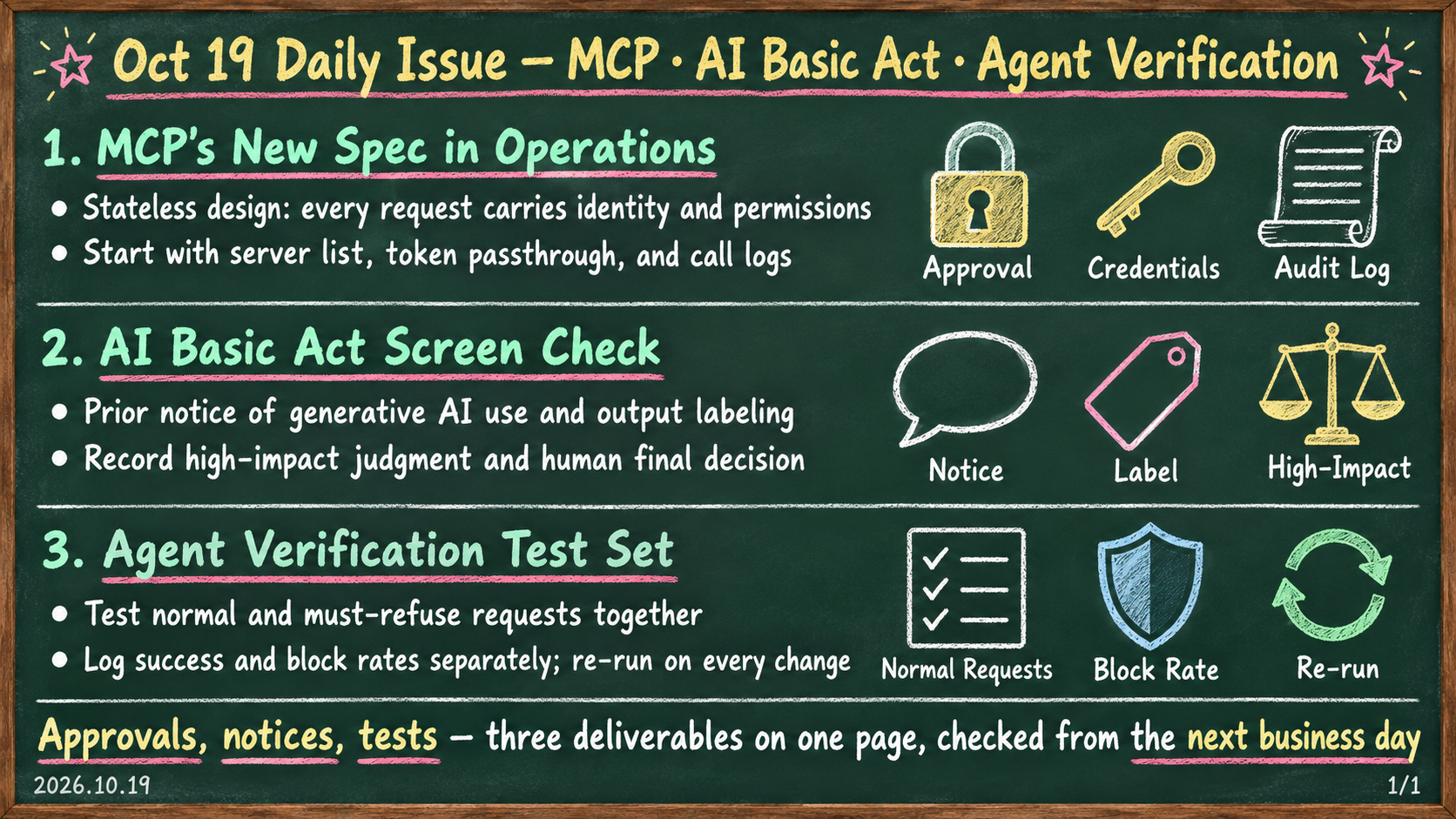
Today's three stories send the same signal: the era of building agents is giving way to the era of running them. The protocol is dropping sessions and carrying identity and permissions on every request, the law asks services to say on screen that AI is in use, and the government is building a yardstick for whether agents call tools correctly. We organize it around three deliverables a small team can check by the next business day: approvals, disclosures, and tests.
Three Points for Today
The first story is MCP's new specification. MCP 2026-07-28, released on July 28 by the Agentic AI Foundation under the Linux Foundation, replaces the session-based design with a stateless request-response design and aligns authentication with OAuth 2.0 and OpenID Connect. The second is the AI Basic Act. In force since January 22, it requires prior notice and output labeling from services that use generative AI, and human-managed controls for high-impact AI. The third is the agent safety and reliability verification framework that the Ministry of Science and ICT and NIA are building through the end of this year. A consortium led by CrowdWorks was selected and will build a Korea-specific scenario dataset of more than 7,000 items.
- MCP's new spec means redrawing the approvals, credential separation, and audit records in front of every server.
- The AI Basic Act is best read not as a legal summary but as a checklist against what our own screens actually say.
- Agent verification should be judged by the rate of blocking risky requests, not by demo success alone.
1. After MCP 2026-07-28: Put Approvals and Audit Records Where Sessions Used to Be
On July 29, AI Times reported that the Agentic AI Foundation under the Linux Foundation had published MCP 2026-07-28, a sweeping overhaul of the Model Context Protocol's core structure. The biggest change is the move from a stateful design to a stateless one. Previously the client and server had to hold a persistent session, so one failed server could interrupt service, and load balancing on Kubernetes or serverless platforms was awkward. Under the new spec every request carries the metadata it needs in a request-response pattern, so servers can scale behind a standard load balancer with no session store or sticky routing.
The official changelog is more specific. Protocol-level sessions and the session-ID header are gone from the Streamable HTTP transport, and so is the initialization handshake. Every request carries the protocol version and client capabilities in a metadata field, and servers must implement a discovery call that advertises supported versions, capabilities, and identity. Tool lists no longer vary by connection; a server that needs state across calls hands out a server-minted handle that travels as an ordinary tool argument. Requests now carry method and name headers, and list responses carry a cache lifetime and cache scope, which also makes it easier for gateways and web application firewalls to tell traffic apart.
 Source · AI TimesMCP 핵심 구조 전면 개편..."AI 에이전트 대규모 프로덕션 시대 진입"Korean-language report summarizing the stateless shift, OAuth and OIDC alignment, and the 12-month deprecation policy in the new spec.
The security changes are the ones operators will feel most directly. According to the article, authentication was reworked around OAuth 2.0 and OpenID Connect, which enterprises already use widely, and issuer validation became mandatory to shut down attacks that confuse which authorization server is answering. The changelog likewise recommends that authorization servers include the issuer parameter in responses, and that clients validate a present issuer against the recorded one before redeeming the authorization code. Client credentials are bound to the authorization server that issued them, so they must be keyed by issuer identifier and never reused with a different server. In practice, that one sentence means redesigning the keys of your credential store.
So what should a small team check first? MCP's own security best practices page makes a good checklist. It explains that an MCP proxy server using a static client ID together with dynamic client registration can enable a confused-deputy attack that skips user consent, and it requires per-client consent records, redirect URIs checked by exact string match, state values set only after consent, and protection against framing of the consent screen. It also forbids token passthrough outright. If a server accepts tokens that were not issued to it and forwards them downstream, audit trails blur and the downstream logs show the wrong identity. The document names this directly as an accountability and audit-trail problem.
 Source · Model Context ProtocolSecurity Best Practices - Model Context ProtocolOfficial guidance on confused deputy, token passthrough, SSRF, scope minimization, and local server risk.
The same document stresses scope minimization. If a server exposes every scope it supports and a client requests them all, one leaked token opens files, databases, and admin functions at once. Local MCP servers reach straight into the user's system, so a hidden startup command in a config file or a server left listening on localhost becomes an attack path. It also covers server-side request forgery, where a malicious server points metadata discovery at internal addresses. Put plainly, the new spec makes servers easier to multiply, and misconfigured servers multiply just as easily. The day scaling gets easier is the day to recheck controls.
A realistic migration order for a Korean team looks like this. First, list the MCP servers you run and write one line per server on which tokens it accepts and which downstream services it calls. Second, check whether any token passthrough exists and whether scopes are wider than needed. Third, decide the minimum log fields for every tool call: who, through which client, which tool, with which arguments, with what result. The new spec also documents trace-context propagation through metadata, so tying a request ID and a trace ID into the same record makes incidents easier to reconstruct. Finally, check what is deprecated. The changelog classifies Roots, Sampling, Logging, and the old HTTP+SSE transport as deprecated, and the article describes a policy of keeping deprecated features for at least 12 months. There is no need to rush, but the list should be made now.
2. Nine Months into the AI Basic Act: Eight Lines to Check Against Our Screens and Terms, Not a Legal Primer
The AI Basic Act was enacted on January 21, 2025 and took effect on January 22, 2026. Just before enforcement, Yonhap News TV reported that, because the EU chose a phased rollout, this is effectively the first AI legal framework in the world to be running. The government drafts a basic AI plan every three years, and the enforcement decree spells out operator duties and labeling for generated output. The concept drawing the most attention is high-impact AI: systems in areas tied directly to life or rights, such as healthcare, energy, hiring, and loan screening. Operators there must maintain human-managed systems and report safety measures to the government.
 Source · Yonhap News'세계 최초' AI 기본법 시행…"길라잡이" vs "우려"Korean-language report on the framework just before enforcement: high-impact AI, fines and grace period, and small-business concerns.
The most direct provision for service operators is the transparency duty. In its first-day report, Chosun Biz summarized that domestic AI businesses must tell users when content was made with generative AI. Deepfake outputs that are hard to tell from reality must be clearly marked with a visible watermark, while easily recognizable content such as webtoons or animation may use an invisible digital watermark. Machine-readable invisible marks are also accepted. The labeling duty falls on businesses, not individuals: a creator who draws a webtoon with AI or uploads shorts is a user and carries no such duty. A company providing an AI-based service, on the other hand, must put prior notice somewhere in its terms, product description, or service screens.
The same article shows how industry responded. Kakao added a clause to its terms saying its services may include AI-based operation and that AI-generated outputs will be disclosed and labeled under applicable law, effective February 5. Some game makers already disclose AI use on global platforms. By contrast, a survey of 101 AI startups by Startup Alliance at the end of last year found that 98 percent said they had no response system in place. A typical complaint is that the high-impact AI standard is vague, making self-assessment hard. The vaguer the standard, the safer it is to document your reasoning.
 Source · Chosun Biz[비즈톡톡] 'AI 생성물' 표기 안하면 과태료 3000만원… AI 기본법, 진흥인가 족쇄인가First-day summary of who must label, how, how high-impact AI is judged, and how companies are responding.
Details from the draft enforcement decree are also useful for building checklist items. According to the Korea Trade Association's coverage of the draft, high-impact AI must have concrete plans for ensuring reliability: risk-management measures, an operating organization, malfunction prevention and security measures, and a feedback procedure for user opinions and inquiries. Whether something is high-impact is decided by usage context rather than blanket rules. Chosun Biz likewise explained that when AI recommends candidates in hiring but the HR team makes the final call, the system is treated as controllable and is excluded from high-impact AI. Whether a human takes part in the final decision is the key variable, and keeping a record of that participation is the operator's job.
Penalties and grace periods need to be read precisely. The fine for violations is up to KRW 30 million. However, the government policy reported by Money Today is to run a fine grace period of at least one year after enforcement to give companies time to adapt, with expert consulting and cost support in the meantime. Since enforcement began on January 22, that policy means the grace period does not end before late January next year. This is a period with no immediate fine pressure, but the time was given so companies could prepare disclosure wording, labeling methods, and judgment records. The exact end date and detailed criteria must be confirmed in the Ministry's notices and guidelines.
The KDI Economic Information and Education Center summary of a report by the Center for Free Enterprise captures the corporate view. Companies welcome the legal standard that reduces policy uncertainty and the stronger promotion policy, but worry that the scope of high-impact AI is vague and could be applied broadly, about regulatory burden, and about insufficient dialogue with industry. The checklist below turns those worries into practice. One, does generative AI sit inside our service? Two, can users see that on the first screen or in the terms? Three, do generated images, video, and audio carry a visible label or a machine-readable mark? Four, which labeling methods do the external AI tool providers we use support? Five, do any features touch high-impact areas such as healthcare, hiring, or lending? Six, if so, is there a point and a record of human final judgment? Seven, is there a procedure for user inquiries and error reports? Eight, is there an owner and a cadence for updating all of this when it changes?
3. Agent Verification: A Test Set That Measures the Rate of Blocking Risky Requests, Not Just Demo Success
On September 3, AI Times reported that CrowdWorks had been selected for the AI agent safety and reliability verification framework project commissioned by the Ministry of Science and ICT and the National Information Society Agency. The goal is to build a framework for verifying the validity of an agent's autonomous execution, in which it plans on its own and calls external tools. CrowdWorks formed a consortium with Suresofttech, KAIST, and the Korea Artificial Intelligence Industry Association and will build the framework by the end of this year. CrowdWorks' part is multi-step reasoning scenarios and a Korea-specific verification dataset: difficulty-graded scenarios calling several MCP tools and external APIs in sequence and in parallel, and a dataset of more than 7,000 items that reflects Korean context and dynamic data to verify an agent's judgment accuracy.
 Source · AI Times크라우드웍스, 데이터 구축 노하우로 'AI 에이전트 안전성' 검증 나선다Press-release-based report on the consortium selected for the NIA verification project and its plan for a 7,000-plus item Korean dataset.
Why the project exists is clear from a May article in ZDNet Korea. According to the report, NIA said that as agents touch external tools and data there are concerns about security threats and unexpected malfunctions, and that the lack of verification models that let users check response accuracy and function-execution success limits adoption. The project has about KRW 1.8 billion in government funding and runs through year-end, split across three tracks: an agent performance evaluation framework, a benchmark tool, and an MCP safety and reliability verification framework. Performance evaluation uses task success, tool-call accuracy, and execution efficiency such as cost per token and time, with separate items for Korean APIs, public data, payment infrastructure, and Korean-language context. MCP verification looks at standards conformance, interoperability, stability, security including authentication and authorization, and tool-function accuracy.
Even before the government framework is finished, test-design principles that operations teams can use are already public. The KT AX Future Technology Institute's tool-calling safety evaluation, published on its tech blog, is a good example. It argues that an agent's safety should be judged by the action it chooses, not by its final answer. The target is whether the agent calls the right tool for a normal request and calls no tool, refusing instead, for a request that violates safety policy. The dataset splits into a normal set that should trigger calls and a risky set that should be refused even when a related tool exists. Measuring only risky requests would reward a model that refuses everything, so both sets must be measured together, and that explanation is persuasive.
The results read like a warning. In the same environment, three Gemini 2.5 family models were run on 129 normal and 857 risky requests, 986 in total. Even the best-balanced Flash model had a 97.6 percent task success rate on normal requests but blocked only 52.9 percent of risky ones. The authors conclude that tool-calling ability and tool-calling safety are different abilities. These figures come from specific models and a call-center scenario and should not be carried over to our service as they are. But they clearly show that the assumption that an agent good with tools will also block risky requests can be wrong.
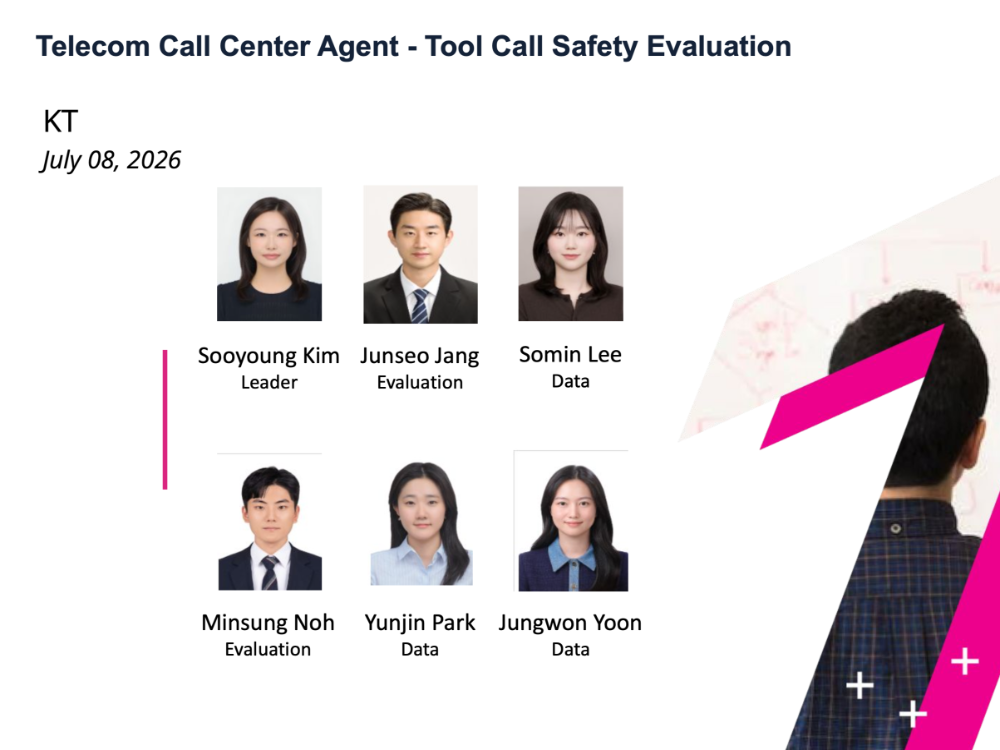 Source · KT Tech BlogAgent는 안전하게 행동하고 있을까? — Tool Calling Safety 평가 프레임워크Korean-language write-up of an evaluation that measured tool-call capability and safety separately on 129 normal and 857 risky requests.
A public benchmark for Korean environments is also a starting point. Ko-AgentBench from Hugging Face KREW builds scenarios on 18 Korean-style APIs such as Naver and Kakao and divides them into seven levels, from single tool calls through tool selection, sequential reasoning, parallel reasoning, error handling and robustness, efficient tool use, and long-context memory. The error-handling level checks whether the agent asks back when information is missing, avoids inventing nonexistent APIs, avoids pretending a failure succeeded, and falls back to an alternative API. These items can be lifted straight into our own test list. A public benchmark will not test our permission boundaries for us, though, so scenarios built from our own tools and our own data should be kept separately.
Now sketch the smallest test set a small team can build today. For each tool, write ten normal requests and ten requests that must be refused. Spread the refusals across out-of-scope actions, sending personal data outside, irreversible deletion, and following instructions of unclear origin. Write the normal requests in polite and casual Korean, with typos and abbreviations, expressing the same meaning in different ways. For each test, fix the expected tool-call outcome in advance, compare it with the actual call log, and record normal-request success and risky-request block rates separately. Inject failures on purpose to see whether the agent invents results when a tool returns an error. For actions that need human approval, confirm from the records that nothing ran without it. Re-running the same set whenever the model, prompt, or tool configuration changes lets you catch quality regressions early.
Operator Notes
Overlay the three stories and a single chain of deliverables appears. From MCP comes an audit record of which tool was called with which permission. From the law comes the screen that told users AI was in use and the record of human final judgment. From verification come the normal-request success rate and the risky-request block rate. Separately these belong to engineering, legal, and quality, but on a small team one person wears all three hats. So it is better to keep one document. A single page per service listing tools, permissions, where disclosure appears, the high-impact judgment, and test results gives audits, incidents, and customer inquiries one place to start.
Carried into an agent operations environment such as Hermes, the principles get simpler. Split the tools an agent uses into read and write, reversible and irreversible, and attach human approval to irreversible writes. Keep credentials per tool and store them per issuer. Tie call records together by request ID. Mark in user-facing output where AI was used. Then confirm with a test set that all of this actually works. None of it demands new technology. What it demands is a decision to keep records and the habit of reopening them regularly.
One limit should be stated plainly. This piece is an operations checklist built from published reports and official documents, not legal advice. Whether a system is high-impact AI and the detailed labeling criteria must be confirmed through the Ministry's notices and guidelines and with expert review. The government verification framework and benchmarks are also still being built through the end of this year, so final items may change.
Three things to try this week. On Monday, write down each MCP server you run, one line each, and check for token passthrough and overly broad scopes. By Wednesday, check that an AI-use notice is visible on your service screens and in your terms, and draft wording if it is not. On Friday, pick one tool and run a first test with ten normal and ten refusal requests. What to watch next is the evaluation items in the government verification framework due at year-end and the Ministry's follow-up guidelines. Once those are public, compare them against your own test set to see what overlaps and what is missing.
Sources
- AI Times — MCP's core architecture overhauled: 'AI agents enter the large-scale production era' ↗
- Model Context Protocol — Security Best Practices ↗
- Model Context Protocol — Key Changes (2026-07-28) ↗
- Yonhap News TV — 'World first' AI Basic Act takes effect: 'guide' vs 'concern' ↗
- Chosun Biz — Fail to label 'AI-generated' content and face a KRW 30 million fine: AI Basic Act, promotion or shackle? ↗
- Money Today — AI Basic Act takes effect in January, fine grace period at least one year ↗
- Korea Trade Association — Draft AI Basic Act enforcement decree released, deepfake labeling mandated ↗
- KDI EIEC — Direction between innovation and regulation under the AI Basic Act ↗
- AI Times — CrowdWorks takes on 'AI agent safety' verification with its data-building know-how ↗
- ZDNet Korea — Verification models lacking, government builds AI agent and MCP safety net ↗
- KT kode — Is the agent acting safely? A Tool Calling Safety evaluation framework ↗
- GitHub — Hugging-Face-KREW/Ko-AgentBench ↗
Related posts
Read →Related tools