October 26 Daily — Agent permissions, execution evidence, and Korea’s AI plan
AhnLab’s agentic security strategy raises practical questions about permissions and audit evidence. Korea’s AI action plan calls for separating policy commitments from verified implementation.
DAILY NEWSLETTER · 2026-10-26 · PERMISSIONS · AUDIT EVIDENCE · POLICY DELIVERY
October 26 Daily — Agent permissions, execution evidence, and Korea’s AI plan
As AI moves from analysis into security operations and external tool execution, the adoption question changes. Capability matters, but so do authorization and evidence of what actually happened. Today’s briefing starts with AhnLab’s recent security strategy, then examines audit trails and the implementation of Korea’s AI action plan. Technical documents supply operational principles; the policy plan is an existing commitment to examine, not a new announcement today.
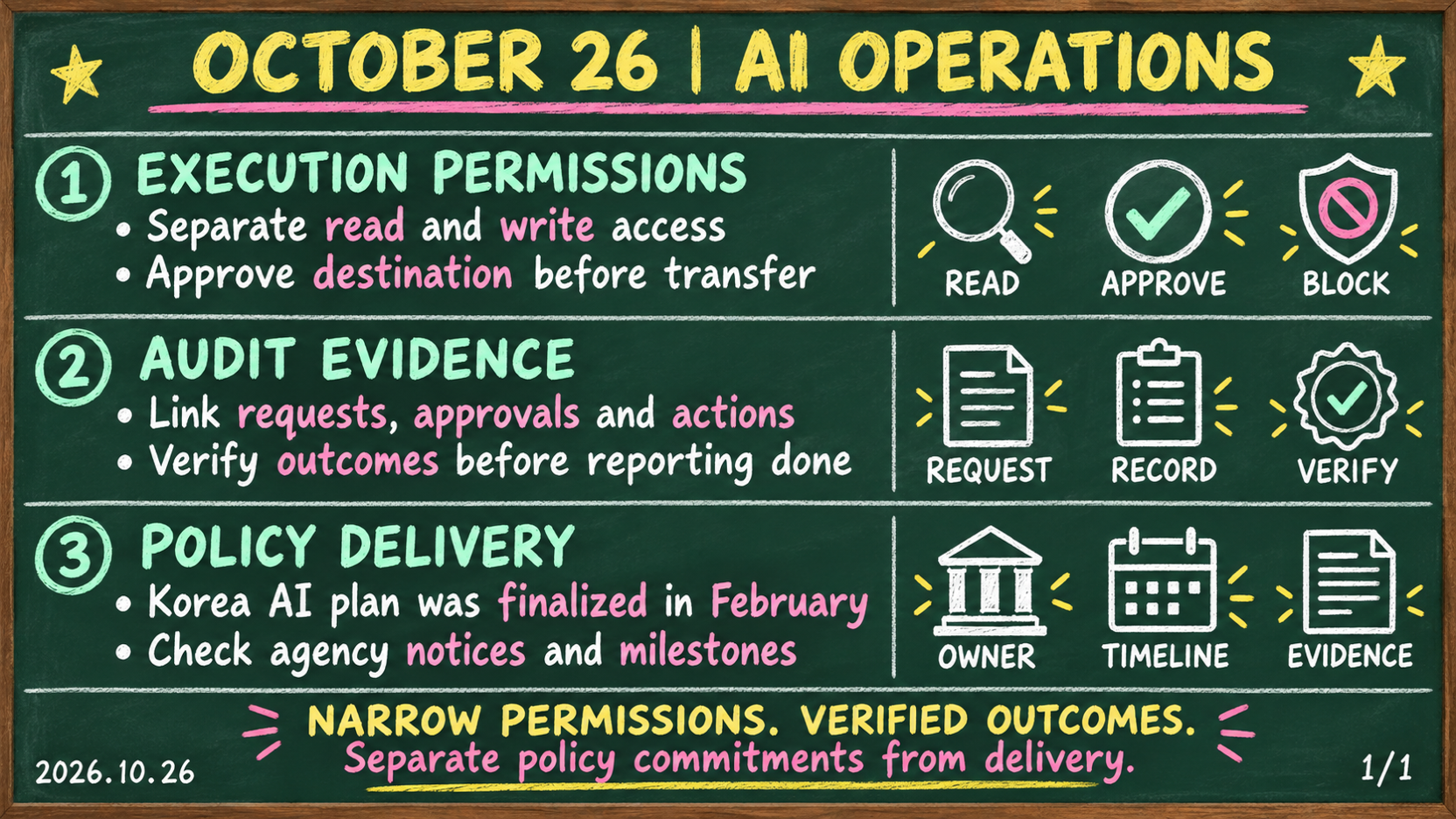
Three points for today
The three topics answer different questions: what an agent may do before execution, how its result can be established afterward, and how policy ambitions connect to changes on the ground. A product roadmap is not proof that every feature has shipped. A tool-call record is not proof of task completion. An approved government plan is not proof that its programs have been delivered. The examples below are editorial recommendations for testing these distinctions, not reported incidents or customer trials.
1. AhnLab’s agentic security direction makes execution boundaries a procurement question
Yonhap reported on October 23 that AhnLab presented its AI-centered security strategy and its 2027 product and service roadmap at the previous day’s Tech Summit. The direction is to integrate AI across the portfolio rather than add it only as isolated features. AhnLab AI Plus, described as a next-generation integrated security architecture, aims to connect distributed data and support collaboration among multiple agents. What the article establishes is a strategy and roadmap. It does not provide independently evaluated detection results or an unattended-response success rate. It should not be read as proof that human-free security operations have already been validated.
 REPORT · YONHAPAhnLab unveils a next-generation security strategy using AI agentsThe October 23 report establishes the platform direction and future roadmap.
For Korean operations teams, the first decision is where analysis ends and intervention begins. Reading alerts and summarizing them is not the same authority as suspending an account or blocking network traffic. Even a reasonable analysis can cause an outage if it is connected to the wrong target. A sensible design could combine suspicious-login summaries, supporting lookups, and a draft suspension request, while reserving actual suspension for separate approval and server-side checks. This is not a claim about AhnLab’s implementation. It is a control design that buyers can request when evaluating agentic security offerings.
The MCP security guidance explains why a connection alone is not a sufficient trust boundary. Its official documentation describes the risks of accepting tokens not issued for the MCP server and passing them unchanged to downstream services. Such arrangements can weaken both security controls and accountability. It also calls for showing the actual startup command and obtaining explicit consent in one-click local-server configuration flows. The page reviewed here is draft documentation, so operators must compare it with the protocol versions supported by their installed clients and servers. A documented requirement does not prove that every existing implementation satisfies it.
 DOCUMENTATION · MODEL CONTEXT PROTOCOLSecurity Best PracticesThe guidance covers token boundaries, consent, local execution, and scope minimization.
Classify permissions by their effects, not merely by tool names: reading, changing state, and transmitting data. A generic shell tool can both inspect and delete files. A customer-management integration may offer both search and bulk export. A tool allowlist alone obscures these differences. Enforce target boundaries, editable fields, permitted destinations, and approval expiry in the execution layer. A prompt saying “do not do anything dangerous” may help guide behavior, but it cannot replace credential restrictions or network controls. Instructions encountered in documents and web pages are material to evaluate, not a source of additional authority.
Approval reuse also needs a defined boundary. Permission to send a summary to one business partner must not silently expand to sending the entire customer list to a changed recipient. The approval view should identify purpose, target, proposed change, and reversibility. Immediately before execution, check that those conditions still hold. A changed pending request should not inherit the old approval. In multi-agent systems, the analysis agent should not be able to borrow the intervention agent’s stronger credentials. Small teams face the same tradeoff: an all-powerful shared service account increases convenience and the potential blast radius together.
This week’s useful test is denial before demonstration. In a test environment, request an unapproved account suspension, reuse expired consent, and attempt a transfer to an unapproved destination. Verify that prohibited requests are blocked, that the reason is visible to an operator, and that the agent cannot obtain the same effect through another tool. The procurement question is less “How many agents are there?” and more “Where is intervention authority enforced, and how can an incorrect intervention be stopped?” Detection automation and response automation deserve separate acceptance criteria.
2. Auditability means connecting authorization, execution, and the observed result
The more fluent an agent sounds, the easier it becomes to mistake “completed” for a verified system state. Anthropic’s agent-design essay recommends grounding progress in feedback from the environment, including tool outputs and code execution. It also discusses stopping conditions and checkpoints for human feedback. This is a design resource originally published in 2024, and the page itself notes that the tooling landscape has changed. It is not evidence of a newly released product feature. Today’s audit topic revisits operating principles as agents gain responsibilities; it is not a claim that a new audit product launched today.
 DESIGN RESOURCE · ANTHROPICBuilding effective AI agentsThe essay links environmental feedback, stopping conditions, and human review.
Separate the request, decision, approval, execution, and verification in the audit design. The request identifies who assigned the work. Approval specifies what was authorized and within which boundaries. Execution records which tool acted on which target. Verification records the result observed in the destination system afterward. A shared task identifier lets another operator reconstruct that path without reading an entire conversation. This is an operational proposal, not a field schema mandated for every organization by a particular standard. The question is whether records establish what happened and who authorized it, not whether the log looks extensive.
MCP’s guidance adds a second perspective: inappropriate token passthrough can obscure client identity and the audit trail. A username in a downstream system does not necessarily identify the original requester, proxy server, and executing agent separately. This matters for small Korean teams where many workflows share one service account. Keep the task identifier distinct from the execution principal, and connect downstream request identifiers where the service provides them. Logging the original token to improve traceability would move in the wrong direction. Identify credentials by reference and remove secret values from logs and error messages.
DOCUMENTATION · MODEL CONTEXT PROTOCOLSecurity Best Practices: token boundaries and accountabilityIts discussion of accountability explains why identity boundaries matter for audit design.
For an email workflow, distinguish generating a draft from completing a send. Acceptance by the send API, creation of a message in the sending system, and confirmed receipt are also different states. If only acceptance can be verified, report acceptance rather than delivery. After an error, check whether the message was already sent before retrying; use an idempotency key when the service supports one. Losing the network response does not establish that nothing happened. A useful failure record therefore includes both the error and how far the external state was checked, along with whether another attempt is safe.
Keeping every conversation and source document indefinitely is not a shortcut to good auditing. Support cases, HR records, and contracts can contain personal information unrelated to the operational question. Define necessary target references, change summaries, timestamps, and result states first, and assess raw-content retention separately. Decide who can read logs, how long they remain available, and which stores a deletion request affects. Without separate log-access and execution permissions, the audit system can become another data-exposure path. The need for evidence does not justify unlimited access to underlying data.
The final audit test is whether another operator can explain the event using the records alone. Did the approved target match the changed target? Did retrying create a duplicate action? Did the completion report match the observed result? Have someone other than the conversation’s author check. Practice cancellation for reversible operations and require stricter pre-execution approval for irreversible ones. Agree on the meaning of completion before calculating a success rate. Counting an agent’s success statements is not the same measurement as counting externally verified outcomes.
3. Korea’s AI action plan needs owners, milestones, and delivery evidence—not just task counts
Korea’s AI action plan was not announced today. The National AI Strategy Committee’s original release states that it was finalized as the national AI basic plan at its second plenary meeting on February 25, 2026. It contains 99 implementation tasks and 326 policy recommendations across three policy pillars and 12 strategic areas. Presenting those numbers as an October announcement would be misleading. The reason to revisit the plan here is that responsibility for secure, observable AI operations connects enterprise deployment with public-sector AI transformation.
PRIMARY RELEASE · NATIONAL AI STRATEGY COMMITTEENational AI Strategy Committee holds its second plenary meetingThe original release establishes the February 25 decision, plan structure, and related policy decisions.Hankook Ilbo’s reporting that day examined implementation constraints alongside the plan’s breadth. It raised concerns about limited budgets and staffing, the need for departmental execution plans and funding, and the importance of defining the problems to solve. These were risks identified when the plan was adopted, not a finding that the plan has failed or a verified list of overdue tasks as of October. The two reviewed materials cannot establish the latest status of every recommendation. Current program status requires follow-up notices and budget and delivery documents from the responsible agencies.
 REPORT · HANKOOK ILBO99 implementation tasks and 326 policy recommendations: is the AI action plan achievable?The February report provides context on staffing, funding, and problem-definition risks.
For a business operator, start with the path connecting the policy to an actual need. If the need is data access, check release conditions and usage rights. If it is a public project, find the responsible agency and live procurement notice. If it is training, check eligibility and application dates. Mention of an industry in a policy plan does not establish an available support program today. Separate policy language from verified notices in budget documents. Counting an unconfirmed benefit as committed income or cost savings can destabilize the entire implementation schedule.
Security and resilience are not peripheral. The February meeting also covered government AI infrastructure governance and a roadmap for vulnerability reporting, remediation, and disclosure. But a policy direction or roadmap should not be rewritten as a new legal requirement already binding on every private company. Check current law, effective dates, scope, and procurement conditions separately. Teams can use the policy emphasis on trust and recovery to improve their own permission controls, records, and incident procedures. That exercise is not a legal compliance determination.
A compact internal tracking sheet could contain the task, responsible agency, next document to check, review date, and internal owner. Its purpose is to reveal dependencies rather than display achievement. Which feature is delayed if a public dataset is late? Which contract needs review if cloud-transition conditions change? Translating a policy intention into a service acceptance criterion requires intermediate evidence: a notice, a contract, and an operational test. For the same reason, this briefing does not recommend a particular support program or supply an unverified implementation rate.
The practical conclusion is to separate the scale of the plan from the organization’s readiness. Anticipating public-sector demand is not a substitute for credential management, personal-data handling, approval for external actions, and recovery records. Equally, possessing security controls does not prove eligibility for a specific program. Policy documents and operating documents complement one another; neither replaces the other. At the next review, choose one relevant task and follow it from the original announcement to concrete follow-up evidence rather than repeating the total task count.
Operator’s note
A team using a tool-executing agent such as Hermes can combine the three themes in one bounded test. Choose a workflow that reads a public policy document, prepares an internal memo, and requests review. Give it read-only source access, limit the document’s save location, and require separate approval for external transmission. Then check whether the records connect the requester, approved scope, and actual saved result. This is a proposed operating exercise, not a claim that a particular product has already passed it.
The acceptance criterion is a maintained boundary, not an attractive summary. Does the agent ignore a web page’s request for an additional transmission? Does it stop when the approval target changes? Does the file actually exist after the save tool returns success? If the policy source is old, retain its date and say when current status has not been established. Separate failures safe to retry from those needing human judgment. Publication, messaging, and payments should not inherit the same retry rule as a failed lookup.
The resulting evidence can support vendor comparisons and internal deployment decisions. One test, however, cannot guarantee security or generalize to every workflow. Each expansion of authority needs denial tests and outcome checks appropriate to its effects. The rule is straightforward: narrow permissions before acting, verify results afterward, and describe policy and product commitments only as far as the evidence supports.
Watch intervention authority and recovery paths rather than agent counts; evidence connecting approval to results rather than log volume; and agency follow-up rather than policy task totals. This week, start with one recurring task and check that unauthorized changes are blocked and completion claims match the observed outcome.
Sources
Related posts
Read →Related tools