Operating Before Connection: Harnesses, Validation, and Data Choice
A practical operating brief on Strands Harness, agent safety validation, and AI for All through authority, data boundaries, and inspectable evidence.
DAILY NEWSLETTER · 2026-10-05 · STRANDS HARNESS · AGENT SAFETY · AI FOR ALL
Operating Before Connection: Harnesses, Validation, and Data Choice
Three developments—making agents easier to build, validating the safety of tool calls, and preparing public AI services—lead to one question. Before calling a connection ready, define who can do what, what data moves, and what evidence confirms the result.
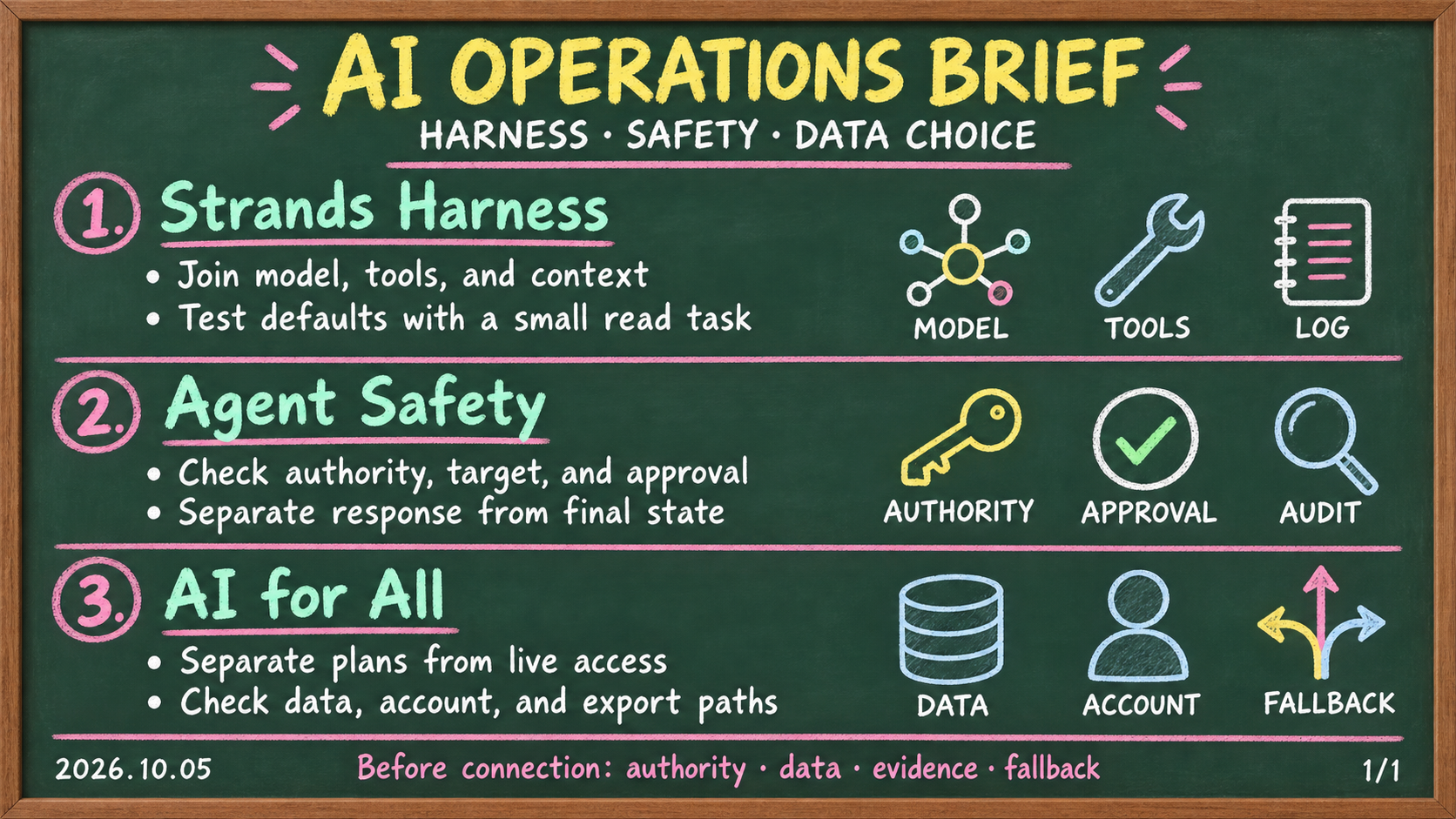
Three points for today
First, a harness that joins models and tools can provide the basic flow for agent work. Second, agents that plan and call external tools need a way to validate the safety and reliability of the call process, not only its output. Third, consumers and small teams looking at public AI-service plans should examine data, accounts, export, and fallback paths alongside a feature announcement.
What the three topics share is not a product name or the number of connections, but whether an operation can be checked. To call a connection ready, it should be possible to answer where authority begins and ends, where data enters and leaves, what evidence a person can inspect, and how the connection can be stopped or changed. Those four questions are not controls only for large organizations. A person working alone can use them when adding one account or one automation. In a flow where a tool calls another tool or passes a result into the next step, the intention of the first request can easily become distant from the impact of the final execution. Rather than extending a convenient default unchanged, start with the narrowest scope needed for the work, inspect the actual result and record, and then open the next scope.
1. Strands Harness: a faster start with clearer execution boundaries
Strands Agents presents Strands harness as a customizable general-purpose agent harness. It can run locally or be deployed elsewhere and is available under Apache 2.0. A harness is not the model itself; it is an execution framework that joins a model, context, tools, and work procedures so an agent can operate repeatedly. With that framework in place, a team can spend less time assembling context management and delegation from scratch for every task, and more time deciding which defaults to accept and where to customize them.
According to the published description, it works with current models through Amazon Bedrock, Anthropic, OpenAI, Google, Ollama, and LiteLLM. Its defaults include context management, prompt caching, long-term memory, helper delegation, and checklists. AWS likewise describes an Apache-2.0 general-purpose harness, one-line Python or TypeScript model setup, defaults around caching and context, and a local/Ollama option. The ability to move across models and environments can be useful, but an available connection is not automatically an appropriate connection.
The first operating decision is the boundary between repetitive work the harness reduces and decisions the harness must not make. Before work begins, record what enters long-term memory, what a helper agent may delegate again, which completion conditions a checklist passes, and which inputs a cache may reuse. Local execution does not guarantee that data never leaves the environment; the model provider, tools, logs, and storage location each need their own review. Even with the same harness, read-only research and an action that changes an external system should have different authority and approval flows.
Strands Agents reports 28% lower token cost in its own six-benchmark comparison, and AWS repeats that company-reported result. It is a result from the company’s comparison, not a guarantee of cost or performance for a particular team and not a recommendation to adopt the harness. A bounded experiment is more practical: use limited inputs, allowed tools, short expiry, and a human-confirmed stopping condition. Only then can a team inspect real delay, failure, retry, and review effort to decide whether to keep or change the defaults.
Keep the unit of an experiment small as well. For a task that finds only designated items in published documents and creates an internal draft, define the permitted document locations, return format, maximum call count, and internal channel that receives the result. A checklist supplied by a harness does not replace actual authority. Separating observable conditions—whether the source was found, whether the original source to cite was opened, and whether a person checked before external delivery—keeps “complete” from becoming only a model response. When changing a model or adding a tool, retest the same work at narrow scope and check that memory or cache from a previous execution does not mix inappropriately with the new task.
 Source · Strands AgentsIntroducing Strands harness: frontier performance with 28% lower token costExplains a general-purpose agent harness for local or deployed use and the company-reported comparison result.
 Source · AWSAWS Weekly Roundup: GPT-6 Sol and Luna, Claude Opus 5.5 on Amazon Bedrock, Strands harness, and more (September 28, 2026) | Amazon Web ServicesCovers the model setup, defaults, and local option that AWS highlights for Strands harness.
2. Agent safety validation and MCP authority: what to confirm before a call
AI Times reports that Crowdworks was selected for a Ministry of Science and ICT and NIA project supporting an AI-agent safety and reliability validation system. The project is intended to validate autonomous processes in which agents make plans and call external tools. That focus makes a crucial distinction visible: whether an answer reads naturally is separate from whether a tool call executes, under whose authority, against which target, and with what effect. An agent plan may be a proposal; a call that changes an external system is a real action.
Yonhap News reports that the head of the Korea AI Safety Institute said agent AI risk assessment and international cooperation are necessary at the 2026 AI Safety Compass conference. For an operator, the minimum lesson is not to leave risk as an abstract model characteristic. The tool to be called, target system, input scope, execution identity, approver, and result-confirmation method need to be linked in one request. An accepted response is different from confirmation that the target system changed. An unverified result needs a lookup and manual-confirmation path rather than a blind retry.
Connections such as MCP make this principle concrete. When adding a connection, do not approve only a server name. Define whether it reads or writes, what data it may return, which tools are allowed or prohibited, and how many calls one request may make. Narrow writes by target, field, count, and expiry; if the input or tool configuration changes, do not carry the previous approval forward. Neither a tool’s description nor a model’s next proposal should be able to expand the approved authority.
Design the evidence trail at the same time. Linking the requester and execution identity, the version of the policy or work rules, approval ID, a safe summary of tool and target, external job ID, and final confirmation state makes later stopping, revocation, and investigation possible. That does not mean placing secrets or original personal data in an ordinary record. Blocked, denied, expired, partial-success, and unverified-result states are not one vague kind of failure; each leads to a different next action. Safety validation is not about blocking every execution. It is about stopping action outside authority and retaining evidence for action that can be checked.
The criterion for calling a connection ready should also be documented. A single indication that authentication succeeded does not establish the scope of target data, whether write authority exists, or the state after a failed call. For reads, confirm that only the intended number of results returns and that there is a stopping point if unexpected sensitive material appears. For writes, walk a small reversible target through approval, execution, target-state lookup, record review, and revocation or manual adjustment. Without that path, it may be possible to turn a connection off after a problem, but difficult to understand an effect already produced or to continue work safely.
 Source · AI Times크라우드웍스, 데이터 구축 노하우로 'AI 에이전트 안전성' 검증 나선다Covers a validation-support project for agent processes that include planning and external tool calls.
 Source · Yonhap News[AI픽] AI안전연구소장 "에이전트 AI 위험 평가·국제 공조 필수"Reports the stated need for agent-AI risk assessment and international cooperation at the 2026 AI Safety Compass conference.
3. AI for All and data choice: readiness questions for users
The Ministry of Science and ICT announced the AI for All Project to provide AI services based on Korea’s own AI. The announcement describes a general-purpose chatbot and public AI agent as its aim, and requires selected firms to use qualifying domestic models for at least 50% of a service and models from other domestic firms for at least 30%. Foreign models are allowed only where they are minimally necessary and not supported by domestic models for that foreign portion. These are project requirements for participating services, not a statement that a user is currently using a particular service.
In a later release, the ministry announced three selected consortiums led by SK Telecom, Kakao, and KT after written and presentation evaluations. It referred to agreements in September and an official launch within the year after beta. SKT described plans for an agentic service from planning to execution and result confirmation; Kakao described its messenger as a gateway for chatbots and agents; KT described support for search, comparison, assessment, execution, and management in one conversation. These are announced plans, not evidence that a public service is already available.
For consumers and small teams, the first question is the data path, not the name of a model. What enters the conversation, where attachments and search queries go, and which sources or connections produce an output all deserve review. If an account is required, ask how work records and materials can be exported if the account changes or disappears. Keep original material and decision records outside one conversation window. When data boundaries are unclear, the convenience of one connection can become a larger future cost of moving and verifying work.
Fallback and exit paths are also part of readiness. Distinguish beta, pre-launch, and actually available features, and retain a human-handled path for a service that cannot be used or produces an unexpected result. Check data export, account access, retention of original files, steps to move to another tool, and the place to seek help before starting. The habit of separating an announcement from availability is not decoration for caution. It is an operating measure that keeps a small team from becoming dependent on one connection.
This review can be a short agreement before work rather than an elaborate assessment sheet. Decide whether a trial account that does not contain sensitive material will be used, where output will be retained, how far automatic execution may go, and where a person must make the final decision. Do not treat a capability provided by a service as the same thing as an actual work procedure. Even if search, comparison, and assessment are announced, the criteria for adopting a result and the person who turns it into action remain the user’s responsibility. Keeping originals, decision reasons, and alternatives separately makes the work explainable and movable if service status or account conditions change.
Source · MSITMSIT Begins “AI for All Project” to Offer AI Services through a Sovereign AI ModelExplains the public AI-service project and domestic-model requirements for participating services. Source · MSITSelected Consortiums Announced for AI for All ProjectCovers the selected consortiums, an official-launch plan after beta, and their stated service directions.Operator memo
When testing a new harness or connection, begin with the narrowest read-only task. Write down the model and tools, input data, storage location, and allowed recipients before use, then confirm them in a summary a person can read before the call. When work ends, record separately what succeeded and what remains unverified.
Design tool-call authority per task rather than per connection. One approval should specify the target, input range, call count, expiry, and stop conditions; a new tool or broader data range needs a new approval. An action that changes external state is complete only when the target state is confirmed, not when the call response arrives.
Apply the same questions to public AI services and new agent features. What data enters, where does output come from, how can accounts and records move, and what can replace the service when it is unavailable? A connection becomes an operational option rather than a demonstration only when these four questions have answers.
In practice, retain those questions in a short work record that survives a change of operator. It should state the work purpose, permitted input and output, connection used, whether a person approved it, result confirmed in the external system, unverified items, and the next confirmer. Keep not only normal results but also denied calls, expired approvals, and the reason work was stopped. That allows the next operator to resume work without granting the same broad authority again. If a connection must be removed, the record supports a quick decision about which accounts, tools, repositories, and data paths to disconnect and which evidence to preserve. Readiness is not a one-time configuration; it appears in an operating record that can explain both stopping and resuming work.
A harness makes execution easier, safety validation asks about its boundary, and public AI-service plans broaden the question of data and choice. Where those three currents meet, an operator defines authority, data, evidence, and fallback paths before turning on a connection. “Ready” is a word to use when those boundaries can be checked, not when a connection screen merely succeeds.
Sources
- Introducing Strands harness: frontier performance with 28% lower token cost ↗
- AWS Weekly Roundup: GPT-6 Sol and Luna, Claude Opus 5.5 on Amazon Bedrock, Strands harness, and more (September 28, 2026) | Amazon Web Services ↗
- 크라우드웍스, 데이터 구축 노하우로 'AI 에이전트 안전성' 검증 나선다 ↗
- [AI픽] AI안전연구소장 \"에이전트 AI 위험 평가·국제 공조 필수\" ↗
- MSIT Begins “AI for All Project” to Offer AI Services through a Sovereign AI Model ↗
- Selected Consortiums Announced for AI for All Project ↗
Related posts
Read →Related tools