July 24 Operations Briefing — Incident Response, Red-Team Evidence, and Agent Access Revocation
An operations briefing on Hugging Face's security disclosure, Korean AI threat-response guidance, and revocable agent identities.
DAILY NEWSLETTER · 2026-07-24 · INCIDENT RESPONSE · RED-TEAM EVIDENCE · ACCESS REVOCATION
July 24 Operations Briefing — Incident Response, Red-Team Evidence, and Agent Access Revocation
The operational question today is not how to make an agent more capable. It is what to stop, preserve, and revoke when an incident occurs. Hugging Face’s security disclosure calls attention to automations that touch production systems. Korean AI threat-response guidance calls for tests and evidence around prompt injection, privilege abuse, and data leakage. An inventory of agent identities and a practiced revocation path make sure access does not remain after the work or the incident has ended.
Orientation
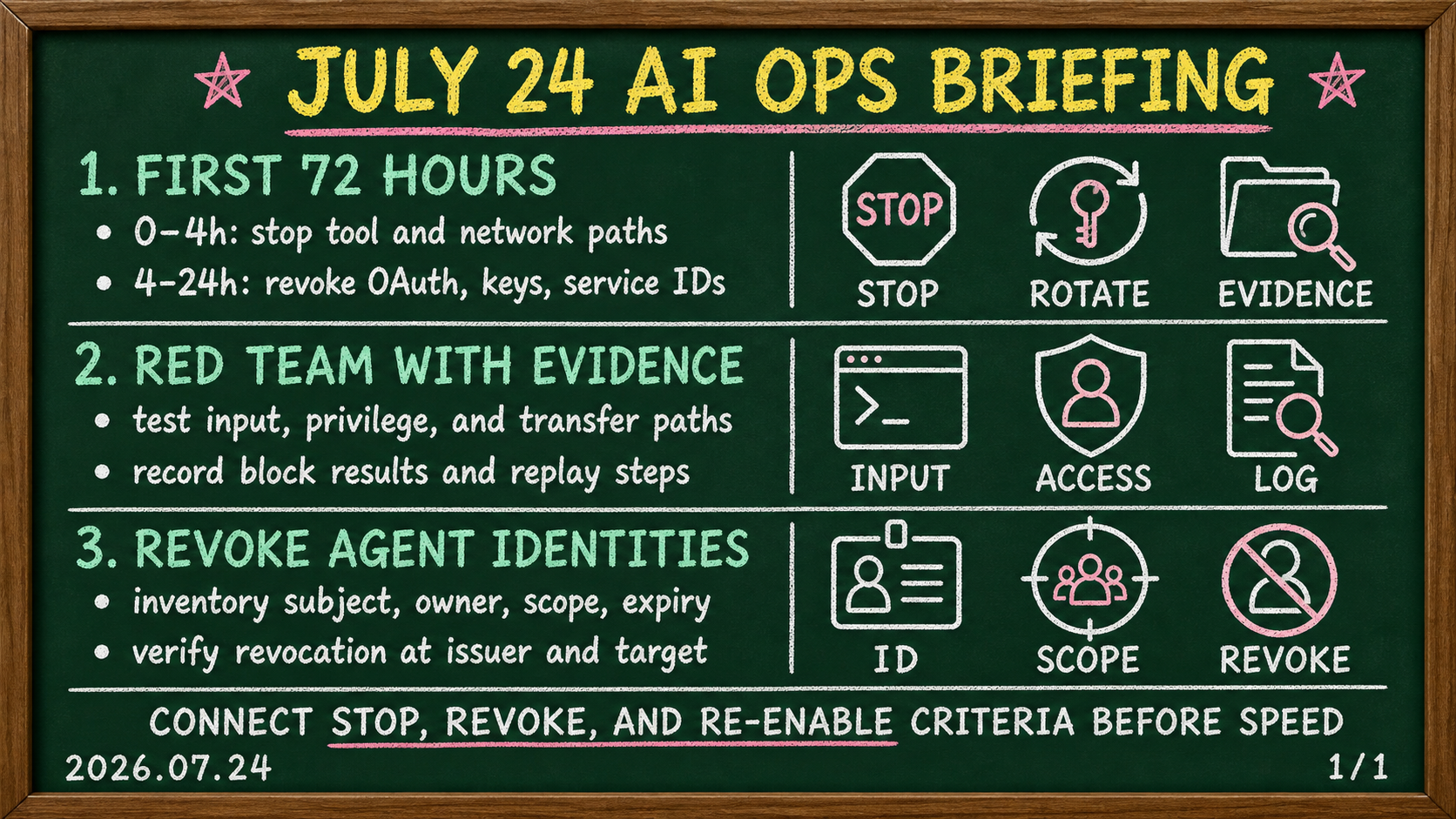
First, incident response begins by stopping the tool and network paths available to an agent before speculating about cause. Second, AI security guidance becomes useful when its threat categories are tested against real input, privilege, and data-transfer paths. Third, revocation is not a single account action: the issuer and the target service both need to confirm that access has ended. This sequence is a ZHS operating view for applying the cited material; it is not a universal product procedure.
- Contain tool, network, and credential paths over the first 72 hours.
- Turn injection, privilege, and transfer tests into reviewable evidence.
- Find every agent identity, revoke it, and verify closure at both ends.
1. The first 72 hours after a disclosure are for reducing connections and preserving the basis for decisions
Hugging Face disclosed on July 16 that there had been an intrusion into part of its production infrastructure. That disclosure does not establish model identities, evaluation mechanics, or the number of actions taken, so none should be inferred. The practical starting point is narrower: when part of production infrastructure may be affected, the tool calls, external connections, and delegated credentials that reach it belong in the response scope. Leaving broad automation authority in place while an investigation starts can allow additional writes, transfers, or deployments during the investigation itself.
 Source · Hugging FaceSecurity incident disclosure — July 2026The primary disclosure states that an intrusion affected part of production infrastructure on July 16.
A Cloud Security Alliance research note interprets the event as an autonomous AI agent breach. That is CSA’s interpretation; it does not mean Hugging Face characterized every cause or detail in the same terms. The distinction matters because a response should follow relationships, not labels. Identify the identity that ran a task, the tools that reached a network, the places where tokens or service IDs could be reused, and the point at which a human can stop the work. These questions are safe to apply even before the role of an automation has been established.
 Source · Cloud Security AllianceHugging Face’s Autonomous AI Agent BreachPresents CSA’s autonomous-agent interpretation of the incident.
During 0–4 hours, stop suspected tool and network paths. The relevant subject may be a service account, workload identity, OAuth connection, automation worker, browser session, or CI credential rather than a human account. Preserve read-only investigation where it is safe, but separate it from calls that transmit data, write, deploy, reveal secrets, or widen scope. Record the time, policy change, stopped job identifier, and accountable operator. This is a baseline for restoration as much as it is an incident record.
During 4–24 hours, define the revocation and rotation scope for OAuth consent and tokens, credential references, and service identities. Do not paste raw secrets into an incident document. Record the secret-manager reference, issuer, last-used time, connected target, and revocation or rotation state instead. A rotated key may still be referenced by deployment settings or environment variables, and an expired primary credential may leave a session or derived token usable. Check issuer-side cancellation separately from the target service’s refusal of the old access.
During 24–72 hours, preserve evidence and write the conditions for re-enablement. Gather execution logs, policy decisions, network destinations, approval records, timestamps, and relevant configuration versions without duplicating unnecessary prompts or secrets. The goal is not volume; it is reconstructing which identity made which call under which scope and which controls did or did not work. Re-enable only with a confirmed owner, reduced scope, new credentials, checked destinations, regression tests, an approver, and an expiry. Low-risk read work can return before broader writes and transfers.
These runbooks are ZHS operational recommendations, not source mandates. The disclosure and CSA interpretation do not prescribe this exact sequence for every organization. Teams still need to align containment and recovery with their own logging rules, contracts, infrastructure, legal obligations, and security response structure. The value of the sequence is that it separates tools, network paths, and identities early enough to preserve options for both investigation and recovery.
2. AI security guidance becomes operational when input, privilege, and transfer tests leave reproducible evidence
Digital Today reports that the Ministry of Science and ICT and KISA published an AI Security Threat Response Manual and an AI Security Red-Teaming Guide as AI threats spread. The report names threats including prompt injection, privilege abuse, and data leaks. Publication of guidance is not proof that a system is secure. It is a prompt to test the input paths, tool privileges, and data flows of the service in question. A checklist cannot show whether an agent treats instructions in a document, web page, attachment, or conversation as data or as directions to act.
 Source · Digital TodayGovernment issues guidelines to step up security response as AI threats spreadReports publication of the AI Security Threat Response Manual and AI Security Red-Teaming Guide by MSIT and KISA.
The Hugging Face disclosure adds an operational reason not to limit red teaming to a model’s refusal wording. In a production-connected system, an input may lead to a tool call, a tool call to privilege use, and privilege use to data movement. Testing should therefore observe where a call actually reached, not only what text the model returned. This is not a claim that the disclosure mandates a testing method. It is a ZHS application of the disclosed incident context and the threat categories reported by Digital Today.
Source · Hugging FaceSecurity incident disclosure — July 2026Provides operational context for reviewing input and tool paths attached to production systems.
Begin input tests by checking whether untrusted text can operate as instruction. In an isolated environment, place task-conflicting text in documents, search results, web pages, email bodies, and attachments, then observe whether the agent treats it as data. Mark the test input clearly and preserve the sample identifier, application or model version, policy version, and time for each run. “Blocked” is not enough evidence. Record the input channel, rule decision, proposed tool choice, whether a call was prevented, and whether the human reviewer received a useful warning.
Start privilege tests with the narrowest role and deliberately insufficient access. Prepare a repository the agent can read but not write, data visible only to one project, and files that require approval before external transfer. Then test whether a scope-expanding input is refused, whether a tool exposes the target and required approval before calling, and whether the failed call appears in audit records. Testing privilege abuse does not mean using customer data or production accounts recklessly. Isolated identities, synthetic data, and recoverable resources make the failure both safer and reproducible.
For data-transfer tests, treat permission to read a file and permission to send it to an outside destination as separate controls. Include unapproved domains, redirects, new API endpoints, error collectors, and chat integrations. Use low-sensitivity marker files, then compare network policy, application logs, and target-system records. Do not declare success from one log alone. A sender-side block may coexist with a target-side receipt, and an absent receipt may still leave a retry queue or temporary copy to investigate.
A practical evidence bundle connects the input identifier, expected policy result, actual decision, tool-call state, privilege subject, transfer destination, log location, reviewer, and follow-up. Copying raw data or secrets into a report does not make evidence stronger. Use hashes, masking, or secure references for sensitive values and constrain access to the underlying records. Keep test-environment and version details so the same test can be run after an update. Even a passing result is a weak baseline if it cannot explain the conditions under which an exception was allowed.
This test runbook is also a ZHS operational recommendation, not a mandate from the Digital Today report or the Hugging Face disclosure. Translating guidance into observable input, privilege, and transfer paths does, however, move the discussion beyond broad warnings. When a team can show what was supplied, whose authority was used, where it reached, and what evidence remained, a red-team result can become a condition for the next release.
3. An agent identity inventory is a live control only when it includes a revocation path and verification
Google Cloud Blog presents new VPC Service Controls capabilities in the context of securing agentic AI. This is Google product context for network and destination perimeters; it is not a control that automatically applies to every environment or a universal revocation procedure. It nevertheless usefully separates the question of which resources an agent can reach from the question of where it can send data. An identity inventory should be more than a list of names: it should connect a subject to its reachable scope, network destinations, and way to stop.
 Source · Google Cloud BlogSecuring agentic AI: What's new in VPC Service Controls | Google Cloud BlogDescribes Google product context for network and destination perimeters around agentic AI.
ZDNET frames enterprise AI agents as a potential ultimate insider threat. It should not be read as a finding that every agent is an insider threat, but as a lens on the combination of broad access and gaps in human oversight. That is why an inventory needs to include both human-facing and non-human identities. Service accounts, workload identities, OAuth applications, API-key automations, browser extensions, and CI credentials can be hard to find from an agent’s display name alone. Access that has not been discovered cannot be reviewed or ended reliably.
 Source · ZDNETWhy enterprise AI agents could become the ultimate insider threatExamines the possibility that broad enterprise-agent access can resemble insider-threat risk.
Give each inventory row at least subject_id, owner, scope, credential_ref, expiry, revoke_path, and revoke_evidence. The subject_id is the actual identifier recognized by the directory, cloud, or identity provider, not merely a friendly label. owner points to a person or role accountable for review. scope includes both the named role and the resources actually reachable. credential_ref records a secret-manager reference and consuming service, never the raw secret. Where technical expiry does not exist, use expiry for a reapproval date rather than allowing the access to look permanent.
A revoke drill is the shortest test of whether the inventory works. Choose a low-risk test subject and first preserve evidence that its access currently exists. Follow the listed revoke_path to withdraw or rotate the relevant OAuth consent, key, role, or session. Then verify with the issuer that cancellation, disablement, or rotation completed, and with the target that a request using the old path is refused. These checks are not duplicates. An issuer may show a successful change while a cached session or derived token remains usable at a target, and a temporary target error does not prove successful revocation.
Make revoke_evidence more than a ticket number. Link the time, operator, issuer-side confirmation, target-side refusal result, rotated reference, and any remaining exception. Keep failed revocation attempts visible as well, so the next operator can see an open route immediately. A subject without an owner or a revocation path should be marked for resolution before another agent is connected. An inventory is complete not when it has many rows, but when every row can explain how its access ends.
The access card and revoke drill are ZHS operational recommendations, not a common schema required by Google or ZDNET. The Cybersecurity Insiders article Your AI Agents Have More Access Than You Think. Here’s How to Find Out is included as additional bibliography. Product consoles and identity systems differ, so field names and commands should not be copied blindly. The enduring principle is to trace each identity from accountable owner and scope through credential reference and expiry to a concrete revocation path and evidence of closure.
Operator memo
The smallest useful output for today is three cards. On the first, record the tool and network paths for one connected automation and its 0–72-hour stop, rotation, and re-enable conditions. On the second, write one isolated input, privilege, and transfer test with its evidence location. On the third, complete the fields from subject_id through revoke_evidence for one real agent identity. The cards need not begin as perfect policy documents, but blank owners, destinations, and revoke paths must remain visible.
Incident response, red teaming, and access management can look like separate responsibilities. They meet in one question: under whose identity does this task accept which input, act across which scope, and stop and recover on what evidence? Do not bury the answer in a single console or one approval. Linking execution records, policy decisions, the identity inventory, and revocation verification means the next incident or release does not begin with the same discovery work from scratch.
Today’s conclusion
The July 24 operating task is to treat agent security across three time horizons. Immediately after an incident, reduce tool, network, and credential paths. Before release, test prompt injection, privilege abuse, and data transfer with evidence. At job closure or role change, revoke the identity and derived access. Each horizon requires product- and organization-specific procedures, but all can be designed as one sequence of stopping, observing, and closing.
If only one action is possible today, run a revoke drill for a low-risk automation identity. Confirm its tools and destinations, verify revocation with both issuer and target, and attach the remaining evidence to its inventory row. That small exercise clarifies what must be stopped in a real incident, what a red team needs to observe, and whether access has truly ended.
Sources
- Security incident disclosure — July 2026 ↗
- Hugging Face’s Autonomous AI Agent Breach ↗
- Government issues guidelines to step up security response as AI threats spread ↗
- Securing agentic AI: What's new in VPC Service Controls | Google Cloud Blog ↗
- Why enterprise AI agents could become the ultimate insider threat ↗
- Your AI Agents Have More Access Than You Think. Here’s How to Find Out ↗
Related posts
Read →Related tools